construction websites

Deconstructing Great Construction Websites: Projects Edition
Project portfolios are among the most important sections of a construction company’s website. They’re also among the most underutilized.

Many contractors showcase beautiful photographs alongside a project name, location, and square footage. While impressive projects can capture attention, those details rarely explain why a prospective client should trust the contractor with a similar assignment.

Your project pages should turn completed work into proof for the next opportunity.

Tell the Story Behind the Project

A strong project page explains more than what was built. It describes the challenges, decisions, and outcomes that made the project meaningful.

Consider a hospital renovation completed while the facility remained operational. The finished photographs may look impressive, but they don’t necessarily communicate the planning required to protect patients, coordinate shutdowns, manage infection-control requirements, and maintain hospital operations.

Those details help prospective healthcare clients understand the contractor’s relevant experience and judgment.

Our recommended structure is simple: explain the challenge, describe your approach, and demonstrate the outcome. This connects the work your team performed to the value delivered for the client.

Make Your Experience Easy to Evaluate

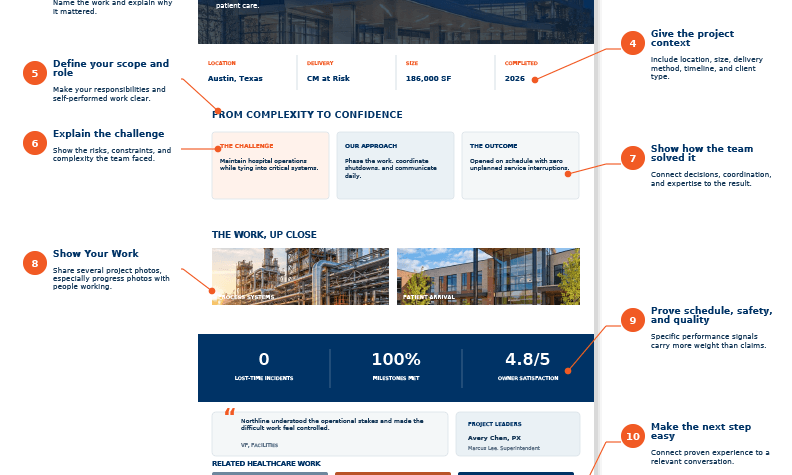
Prospective clients need practical information. Include the project location, size, delivery method, completion date, and your company’s specific scope and responsibilities.

Photographs should show the completed project, but progress images and employees performing the work can be equally valuable. They offer evidence of craftsmanship, coordination, specialized capabilities, and how your team operates.

Whenever possible, include measurable performance indicators. Schedule milestones, safety performance, owner satisfaction, and operational outcomes can provide stronger evidence than broad claims about quality or service.

Project testimonials and introductions to the people who led the work can further strengthen credibility.

Build a Portfolio That Helps Win Work

An effective project library should also help visitors find relevant experience. Organize projects by market sector, service, geography, or delivery method, and connect them to related work and capabilities.

Our Deconstructing Great Construction Websites: Projects Edition infographic highlights 10 elements that help transform project pages from photo galleries into meaningful business development resources.
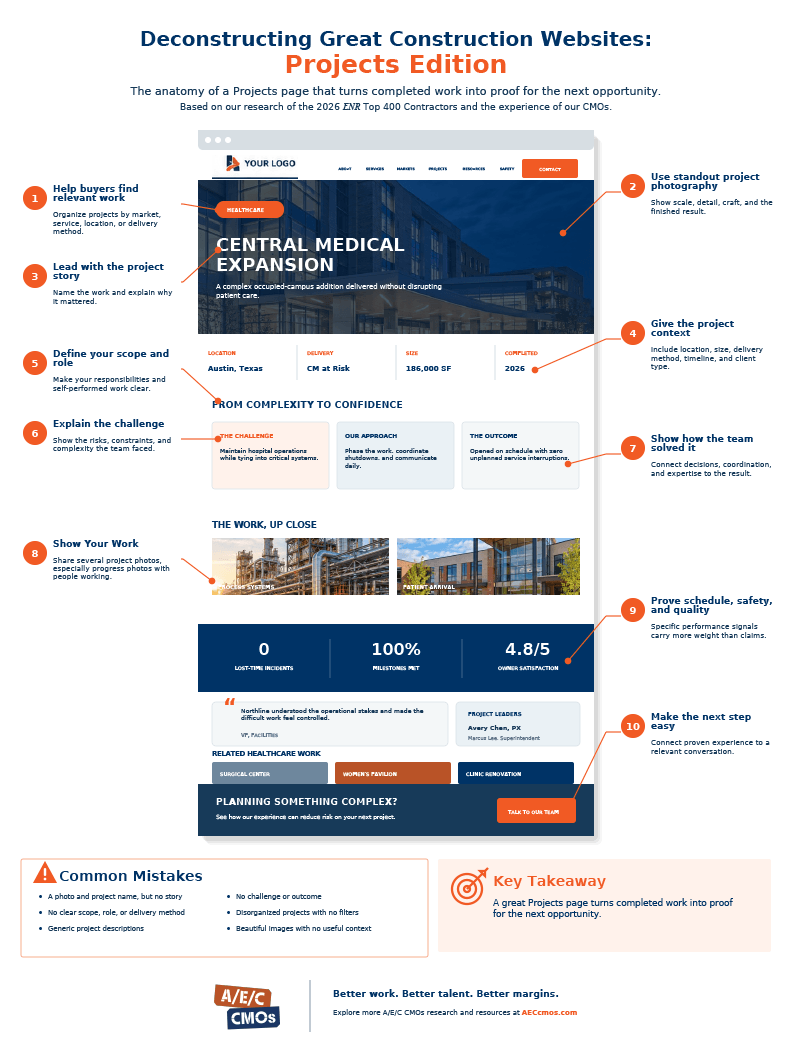
Click to download the Deconstructing Great Construction Websites: Projects Edition.

The goal isn’t to prove that you’ve completed impressive projects. It’s to demonstrate why your experience makes you a strong choice for the next one.

Explore more strategies for attracting and winning desirable clients in Find & Win Your Best Clients.

Deconstructing Great Construction Websites: Careers Edition

Construction companies invest considerable time and money trying to recruit qualified employees. Yet many of their Careers pages offer little more than a list of openings, a few generic statements about culture, and an application link.

That approach assumes candidates already want to work for the company. In reality, skilled craft professionals, superintendents, project managers, estimators, and emerging leaders have choices. Your Careers page should help them understand why your company deserves serious consideration.

Recruiting Is a Marketing Challenge, Too

A great Careers page begins with a clear employee value proposition. Why should someone build a career with your company instead of another contractor offering similar compensation?

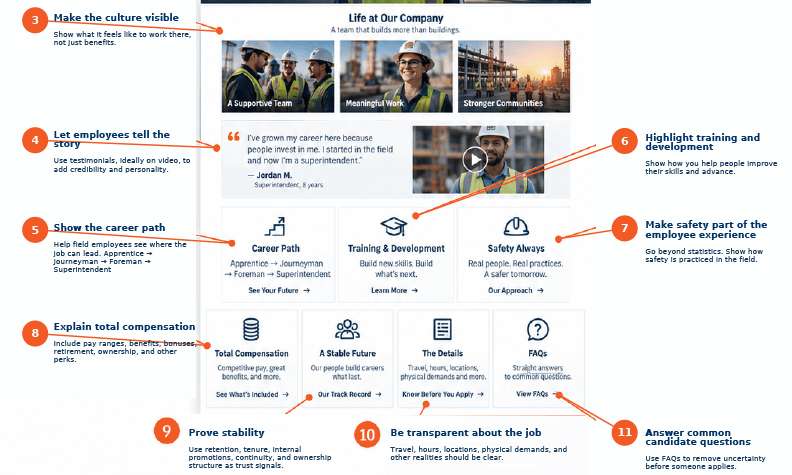
The answer should go beyond competitive pay and benefits. Show what daily work looks like, how employees treat one another, what the company expects, and what people find rewarding about working there.

Authentic jobsite photography, employee testimonials, and short videos can communicate much more than generic claims about having a great culture. Let employees explain their experiences in their own words, especially those working in the field.

Show the Career, Not Just the Job

Many construction professionals want to know where an opportunity could lead. A Careers page should explain training programs, mentorship, advancement opportunities, and the career paths available to employees who want to grow.

Safety deserves particular attention. Rather than simply declaring that safety is a core value, show how the company practices it through training, field leadership, planning, and employee involvement.

Transparency also matters. Compensation, benefits, travel expectations, work locations, physical requirements, and schedules all influence whether an opportunity is a good fit. Hiding those realities may generate more applications, but it won’t necessarily attract better candidates.

Finally, make the application process straightforward. Strong candidates shouldn’t have to navigate confusing forms or unnecessary steps just to express interest.

Turn Your Careers Page Into a Recruiting Asset

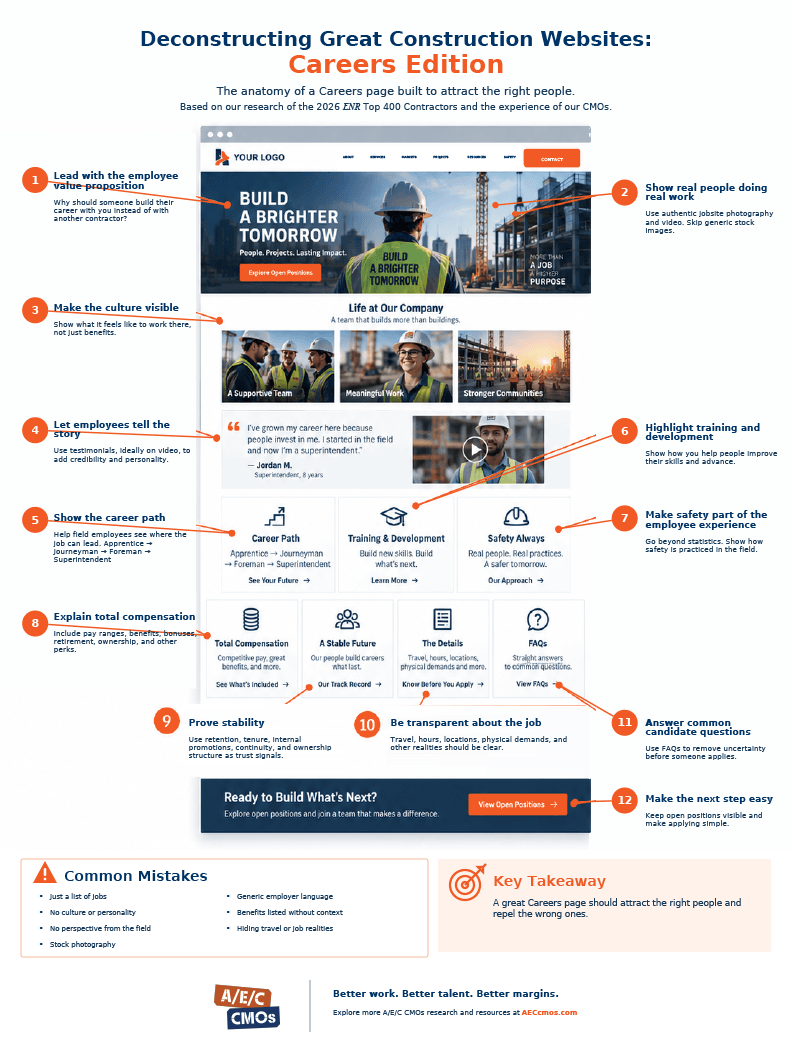
Our Deconstructing Great Construction Websites: Careers Edition infographic identifies 12 elements that help construction companies attract qualified candidates, communicate their employee experience, and improve recruiting effectiveness.

It also highlights mistakes such as relying on stock photography, hiding job realities, and describing benefits without explaining what they mean to employees.

A great Careers page should attract the right people and repel the wrong ones. That’s not a failure of recruiting. It’s the beginning of a better hiring process.

Explore additional strategies in our Talent Acquisition & Retention resources.

Deconstructing Great Construction Websites: Market Sectors Edition

Visit enough construction company websites and you’ll encounter plenty of pages stating that the company serves healthcare, education, industrial, commercial, and other markets.

Often, those pages use nearly identical copy with a few industry references changed. They describe the contractor’s capabilities but say relatively little about the challenges faced by the people buying construction services.

That’s a missed opportunity. A great market sector page should demonstrate that you understand the buyer, the work, and what’s at stake.

Speak to the Buyer’s World

Different markets have different priorities, risks, and purchasing considerations.

Healthcare executives may be concerned about continuity of patient care, infection control, and minimizing disruption to occupied facilities. Industrial clients may prioritize production uptime, shutdown schedules, safety, and maintaining operations. Educational institutions may need to coordinate construction around academic calendars, students, faculty, and campus activities.

A market sector page should demonstrate that your team understands these pressures before describing how your services address them.

Generic claims about expertise won’t accomplish that. Specific explanations of challenges, planning processes, and risk-reduction strategies provide much stronger evidence of sector knowledge.

Prove That Your Experience Is Relevant

Not every impressive project demonstrates relevant qualifications. A prospective healthcare client evaluating an occupied renovation may learn more from a smaller, technically demanding hospital project than from a much larger development in an unrelated market.

Choose project examples that reflect the buyer’s actual concerns. Explain the decisions your team made, the challenges you addressed, and the outcomes achieved.

Include meaningful sector-specific proof where available, such as repeat-client relationships, relevant project experience, schedule performance, or operational results. Introduce the people who understand the market and provide answers to questions prospective clients are likely to ask.

Finally, connect each sector page to relevant projects, services, technical insights, and people. Those relationships help visitors explore your capabilities without starting their research over.

Make Market Expertise Visible

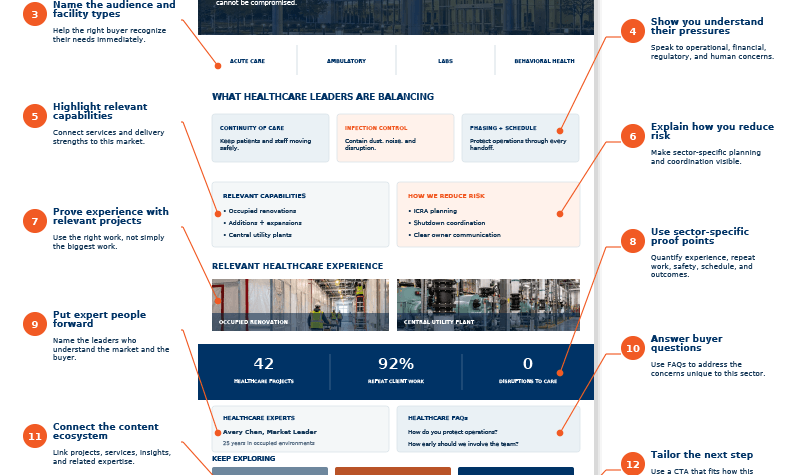
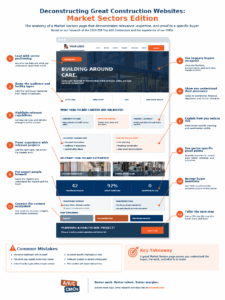
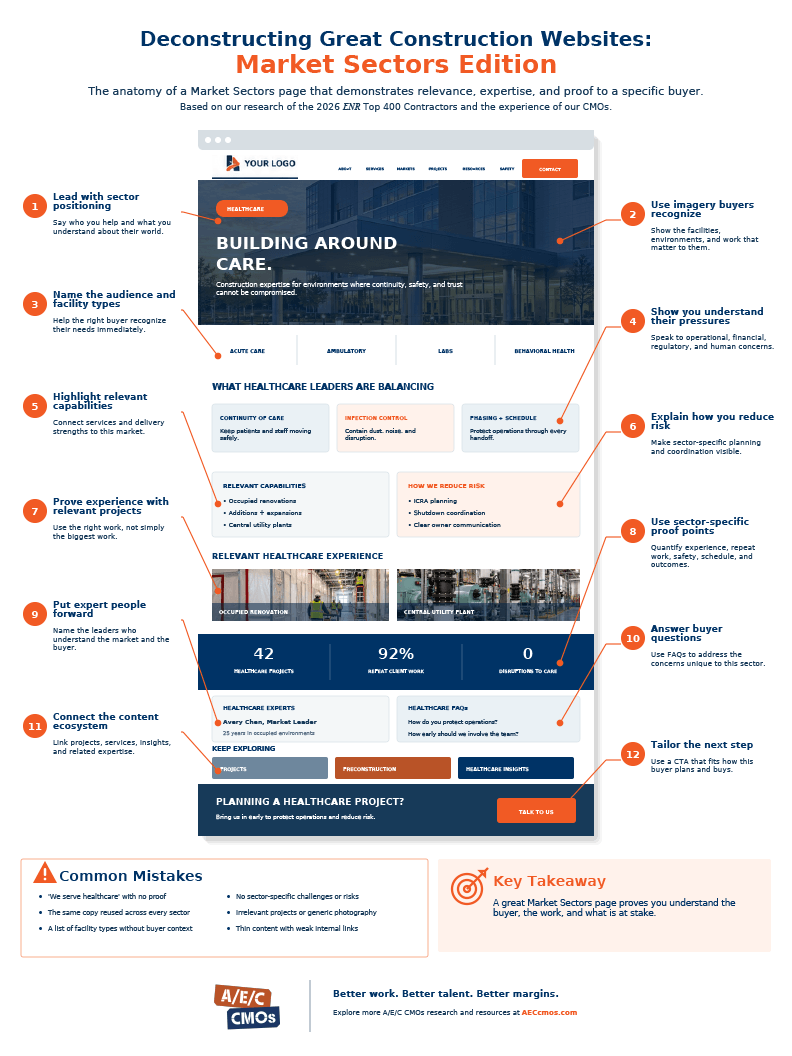
Our Deconstructing Great Construction Websites: Market Sectors Edition infographic identifies 12 elements that help construction companies demonstrate relevance, expertise, and credibility with specific buyers.

The illustration uses healthcare construction to show how a sector page can connect client pressures, relevant capabilities, measurable proof, and a meaningful next step.

A great sector page does more than announce that you work in a market. It demonstrates that you understand what matters to that market and have the experience to deliver.

Explore related insights in Find & Win Your Best Clients and Build Visibility & Authority.

Deconstructing Great Construction Websites: About Edition

Most construction companies have an About page. Unfortunately, too many use it to tell visitors when the company was founded, how many offices it has, and how committed everyone is to quality, safety, and integrity.

There’s nothing inherently wrong with that information. The problem is that it often doesn’t give prospective clients or employees a compelling reason to choose the company over another contractor. An effective About page needs to do more than explain who you are. It should communicate what makes your company different and why those differences matter.

Your Company Story Should Have a Purpose

Construction companies often have fascinating histories. Many started with a single crew, a small equipment fleet, or an entrepreneur who saw an opportunity to do things differently. Those stories can communicate resilience, entrepreneurial thinking, and the values that shaped the organization.

But history alone isn’t differentiation. The important question is how your company’s experiences, decisions, and evolution influence the business today.

The same principle applies to core values. Listing integrity, teamwork, and accountability tells visitors very little unless you demonstrate how those values influence decisions and behaviors. Specific examples, authentic employee stories, and measurable trust signals make those claims more credible.

Make Your People Part of the Story

Construction is a relationship-driven business, yet many About pages contain surprisingly little about the people responsible for those relationships.

Introduce leaders beyond the executive suite, including market leaders, operations executives, and others who interact with clients. Show real employees and actual jobsites rather than relying on stock photography. Explain the culture in terms that help prospective employees understand whether they would thrive there.

A strong About page also provides practical information about services, markets, geography, and ownership. Visitors shouldn’t have to search through multiple pages to understand the basics of your company.

Build an About Page That Attracts the Right People

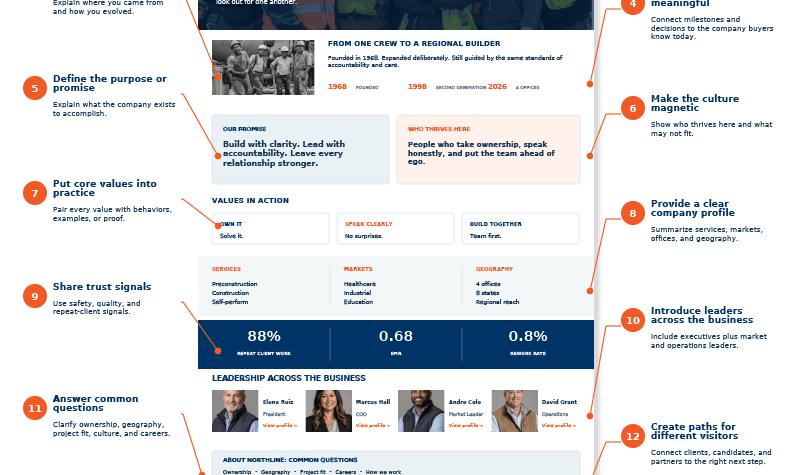
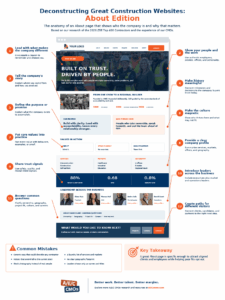
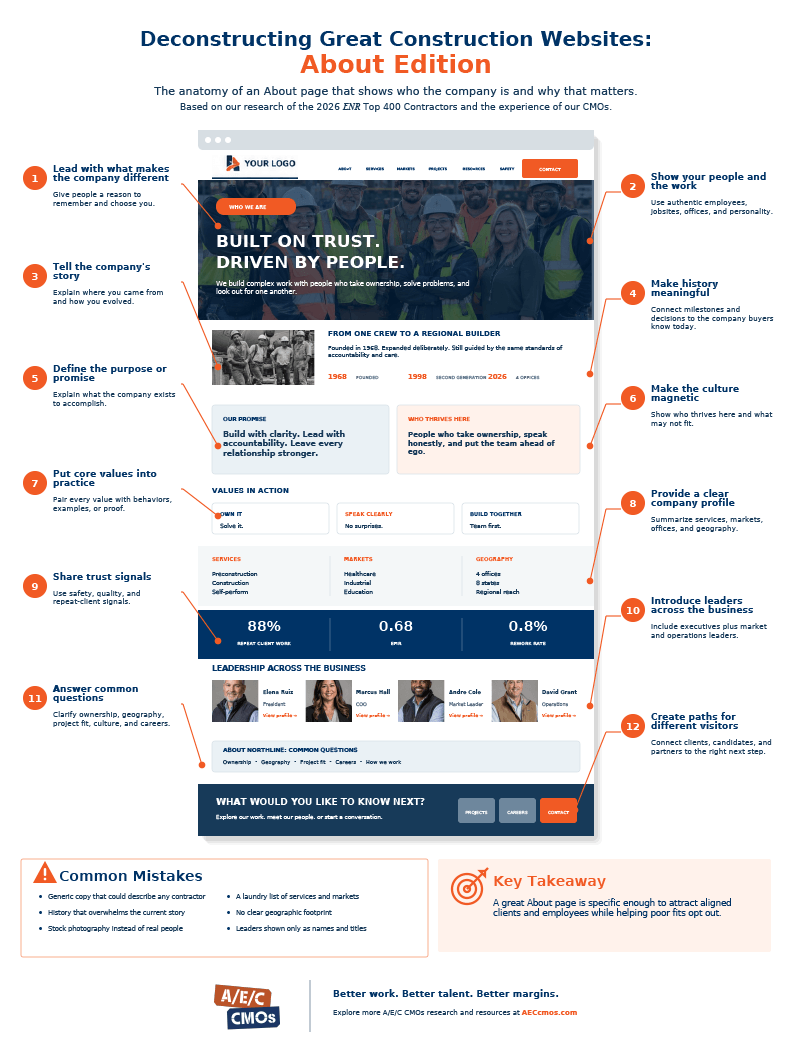
Our Deconstructing Great Construction Websites: About Edition infographic identifies 12 elements of an effective About page, along with common mistakes that weaken credibility and differentiation.

The takeaway is straightforward: a magnetic About page is specific enough to attract aligned clients and employees while helping poor fits recognize that the company may not be right for them.

Your About page isn’t simply your company’s biography. It’s an opportunity to demonstrate the experience, personality, and values that make your organization worth choosing.

Explore more insights about positioning and differentiation in our Build a Magnetic Brand resources.

Deconstructing Great Construction Websites: Resources Edition

Construction companies possess an enormous amount of knowledge. Their teams solve complicated problems, develop creative approaches, manage risk, and make decisions that affect clients every day.

Unfortunately, much of that expertise never reaches prospective buyers. It remains in project meetings, internal documents, conversations, and the experiences of individual employees.

A well-developed Resources section can help change that, but only when it provides something more valuable than a collection of occasional blog posts and company announcements.

Organize Around What Your Audience Needs

Too many Resources sections are organized exclusively by format: Blog, News, Videos, Downloads, and Podcasts.

Those formats are useful, but visitors don’t always arrive knowing what type of content they want. They may be trying to solve a staffing challenge, understand a delivery method, evaluate a new market, or reduce risk on an upcoming project.

Organizing resources by topic helps visitors find information relevant to their situation, regardless of whether it’s presented as an article, research report, webinar, podcast, or guide.

It also creates opportunities to connect related content and establish greater authority around the subjects where your company has meaningful expertise.

Show Where Your Expertise Comes From

Publishing content doesn’t automatically make a company an authority.

Strong resources demonstrate first-hand experience, identify knowledgeable contributors, explain the reasoning behind recommendations, and support claims with appropriate evidence. Original research, real project examples, clear methodologies, and expert perspectives can help establish credibility.

This is particularly important as prospective clients increasingly use search engines and AI-powered tools to research contractors, evaluate capabilities, and explore unfamiliar subjects.

Our research into the 2026 ENR Top 400 Contractors examines how effectively construction companies demonstrate public authority and differentiate their brands. That work, combined with our CMOs’ industry experience, informed the recommendations in this infographic series.

Make Good Ideas Easier to Find and Use

One valuable insight can support multiple resources. A project lesson might become an article, webinar, podcast discussion, and practical guide, allowing different audiences to engage with the material in ways that suit them.

Video and audio content should also include useful supporting information, such as summaries, transcripts, and related links. Whenever possible, keep educational resources accessible rather than requiring visitors to submit their information before learning anything meaningful.

Most importantly, give visitors a useful next step. That might be another resource, a newsletter subscription, a related project, or a conversation with an expert.

Turn Your Resources Section Into an Authority-Building Asset

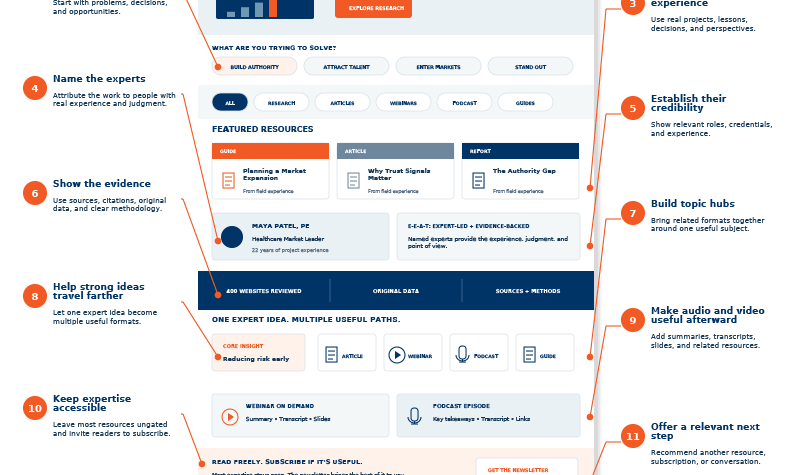
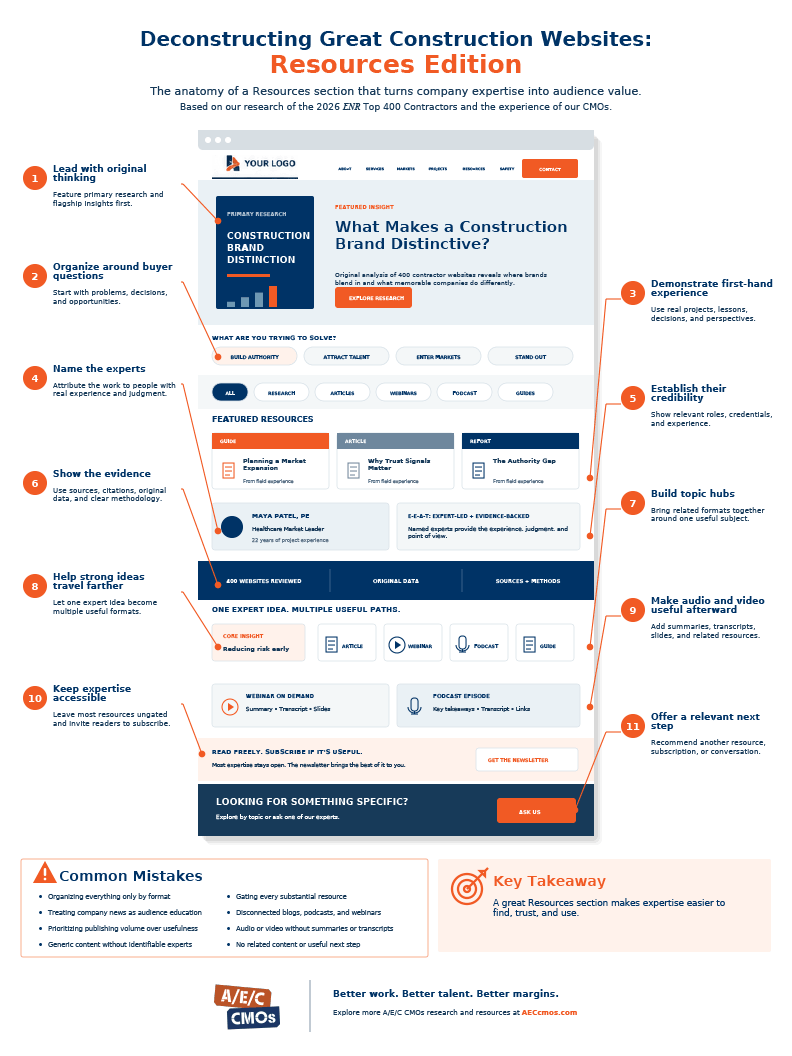
Our Deconstructing Great Construction Websites: Resources Edition infographic identifies 11 elements that help construction companies make their expertise easier to find, trust, and use.

A great Resources section isn’t measured solely by how much content you publish. It’s measured by how effectively that content helps your audience understand important issues, make decisions, and recognize your expertise.

Explore more strategies in Build Visibility & Authority.