
What Your Jobsite Says About Your Company
Construction companies spend a lot of time thinking about what their websites, proposals, presentations, and social media say about their brands. Meanwhile, the biggest brand experience they have may be sitting on a city block for 18 months.
Your jobsite is probably the most visible expression of your construction brand, and it may be the most impactful.
Thousands of people can drive or walk past it. Clients visit it. Architects and engineers attend meetings there. Prospective employees see it. Neighbors live beside it. Other contractors work inside it. Your client’s executives may bring their own leaders or customers through to show off the project.
All of those people are forming opinions about your company before they ever read your About page. A clean, organized, professional jobsite reinforces confidence, while a sloppy one can undermine millions of dollars spent trying to position the company as sophisticated, safe, innovative, or detail-oriented.
Your website tells people what kind of contractor you are. Your jobsite gives them evidence.
The Jobsite Is a Giant Brand Experience
Think about the physical footprint of a significant construction project. There may be fencing around an entire city block, a tower crane visible for miles, multiple trailers, dozens of workers entering every morning, delivery trucks moving throughout the day, equipment operating in public view, and hundreds or thousands of vehicles passing the site every week.
For many people, this is the only interaction they will ever have with your company. That makes the jobsite far more than an operations environment. It is a billboard, workplace, client experience, recruiting tool, community presence, and demonstration of how your company operates.
The best contractors recognize that. Brand standards should not stop when someone leaves the corporate office.
Start With the Obvious: Can Anyone Tell Whose Jobsite It Is?
I am still surprised by how many substantial construction projects have little or no contractor identification. There may be a small project sign tucked behind a fence, an old banner flapping in the wind, or a sun-faded logo that looked good when it was installed 14 months ago. Sometimes the only obvious branding belongs to the equipment rental company.
If you are going to occupy a highly visible piece of real estate for a year or two, use it. Depending on the project, branding opportunities might include:
- Project identification signs
- Fence banners and scrims
- Jobsite trailer graphics
- Entrance and directional signage
- Safety signage
- Branded gates
- Crane signage
- Tower wraps
- Equipment decals
- Temporary walls and barricades
- Project information boards
- QR codes linking to project information, careers, or the company website
- Recruiting messages
- Community information
- Client and project-team recognition
Not every site needs every one of these. A remote industrial project and a downtown high-rise clearly have different audiences and requirements. But no signage, damaged signage, crooked banners, dirty graphics, or six different versions of the company logo communicate something too, and usually it is not the message marketing intended.
Maintaining the signage matters just as much as installing it. If your banner is torn, replace it. If the project sign is covered in mud, clean it. If the temporary fencing has become a collection of sagging panels and zip ties, somebody should own fixing it. Details communicate standards.
Your People Are Wearing the Brand
PPE creates another interesting branding opportunity because construction sites are inherently multi-brand environments. The GC or CM might have its logo on hard hats and safety vests, but so do the electricians, plumbers, mechanical contractor, concrete subcontractor, steel erector, safety consultants, and dozens of other companies.
That is fine. A strong jobsite does not need everyone wearing the general contractor’s logo. Trade partners should maintain their own identities, and seeing a variety of respected companies on a project can reinforce the scale and complexity of the work.
What matters is whether the GC or CM’s team looks intentional and identifiable. Consistent hard hats, vests, shirts, jackets, and other field gear reinforce the company’s presence and help clients immediately recognize the project team.
They also build internal identity. Well-executed branded PPE can create team pride in the same way uniforms do in sports, because it communicates that there is a company behind the individual and a standard associated with being part of that company.
Heavy Equipment Can Become Brand Media
Few industries own more impressive physical assets than construction: excavators, dozers, cranes, loaders, trucks, lifts, and specialized equipment. Yet many contractors barely think of that equipment as part of the brand.
It does not need to become a rolling billboard, but recognizable equipment creates repeated impressions in the market. A clean logo on an excavator working beside a highway may be seen by tens of thousands of people, while a tower crane can dominate a skyline for months.
Some companies take this much further. Demo Diva is one of the most obvious examples. Its pink demolition equipment is inseparable from the brand, and you can recognize Demo Diva without reading the company name because the equipment itself has become a distinctive brand asset.
Most contractors should not paint their excavators hot pink. The lesson is not the color. The lesson is recognizing that your physical assets communicate your brand whether you manage them intentionally or not.
A Dirty Jobsite Is Still a Dirty Jobsite
This is where the brand conversation needs to get blunt. A filthy, chaotic, poorly organized jobsite makes your company look sloppy.
You can have an award-winning website, beautiful proposal templates, professional photography, and an expensive new brand identity. If the owner walks the site and sees trash everywhere, poorly organized materials, damaged signage, unclear pathways, and crews who appear to be operating without control, all that polish becomes less convincing.
Construction is messy, and nobody expects an active jobsite to look like an Apple Store. But there is an obvious difference between construction happening and a site being poorly managed.
Housekeeping, material organization, clean access points, clear pedestrian paths, orderly laydown areas, dumpsters that are actually being used, and good wayfinding communicate discipline. Clients may not understand every technical aspect of the work being performed, but they understand order.
If the jobsite appears under control, they are more likely to believe the project is under control. If it looks chaotic, they start wondering what else is chaotic.
Your Client Visits More Often Than You Think
It is easy for marketing teams to think of the jobsite as primarily an operations environment. The client sees something different.
Owners regularly come to the site for OAC meetings, progress walks, milestone events, inspections, tours, and executive visits. They may bring senior leadership, investors, board members, donors, tenants, customers, or other stakeholders with them, and sometimes the construction project itself is something they are proud to show off.
Imagine an owner bringing their CEO onto the project and immediately encountering confusing parking, poor wayfinding, trash near the entrance, and a trailer that looks like nobody has cleaned it in six months.
Now imagine the opposite. The site is easy to enter. Parking is clear. Visitors know where to go. The team greets them professionally. PPE is available. The trailer is organized. Plans, visuals, safety information, schedules, and project branding reinforce that this is an important project being run by professionals.
Those experiences affect confidence. They also affect whether that client wants to work with the team again.
People Judge How Your Employees Behave
Brand is not just visual. Your team’s behavior may be even more memorable than your signage.
How do workers park? Do they block neighboring businesses or residential driveways? Are radios blasting? How do employees interact with pedestrians? What happens when someone has a question? Are workers respectful around occupied facilities? Are crews leaving trash outside the project perimeter? How do they behave when they go to the convenience store or restaurant next door wearing your logo?
Those moments count.
Bad parking sounds trivial until 20 workers take every available space outside a neighboring business for three months. At that point, your project has created a group of people who may never hire your company but absolutely have an opinion about it.
Construction marketing does not control those behaviors, but the brand still gets credit or blame for them.
The Internet Means the Neighborhood Is Watching
A recent Instagram phenomenon illustrates this perfectly. The “Office Girlies” have been talking about the construction jobsite next door to their office. They are not construction executives reviewing the contractor’s formal marketing. They are simply neighbors observing what is happening outside their window, and the construction site has become part of their content and conversation.
That should be a reminder for every contractor. People notice jobsites. They notice the workers, progress, unusual activity, equipment, and anything that feels impressive, funny, disruptive, thoughtful, or frustrating.
And now they have cameras in their pockets and platforms where they can tell thousands of other people what they noticed. Your communications team is no longer the only one documenting your project.
Public-Facing Projects Create Even More Opportunity
The branding impact becomes especially important when construction happens in downtown areas, neighborhoods, hospitals, schools, universities, retail environments, or other occupied spaces.
Instead of treating the surrounding community as an inconvenience to manage, great contractors can involve them. Building next to an elementary school? Create a safe opportunity for students to learn about construction. Explain what the crane does. Let them decorate hard hats. Show them how the building is coming together.
Working at a children’s hospital? There may be opportunities to engage patients and families from a safe distance, decorate a crane, celebrate milestones, or make construction part of a positive experience rather than simply a disruption outside their window.
Working downtown? Think about what neighboring businesses and pedestrians experience every day.
These activities need to be coordinated with clients, safety teams, and site operations, but they can turn the unavoidable disruption of construction into community goodwill. They can also introduce children and young adults to careers they may never have considered, creating brand value and workforce development at the same time.
The GC Owns the Overall Experience
On a large project, there could be dozens of companies represented. That does not mean the GC gets to say, “That wasn’t our employee.”
From the client’s perspective, the general contractor or construction manager owns the jobsite experience. Trade partners should absolutely maintain their own brands, and there is no reason everyone needs matching logos.
But the GC sets expectations for housekeeping, safety, logistics, access, parking, signage, professionalism, and the overall condition of the site. The superintendent may therefore be one of the most important brand managers in the entire company, even if they do not think of themselves that way.
The superintendent influences what the client, architect, subcontractors, employees, neighbors, and visitors experience every day for the life of the project. Few people in the organization have more opportunities to prove what the company’s brand actually means.
A Jobsite Can Recruit Your Next A Player
There is also an enormous employer-brand opportunity here. Construction professionals notice other jobsites.
They see which companies appear organized. They see the equipment. They see how people are treated. They hear from friends working on the project. They notice whether the superintendent seems to have control of the job or whether everyone is constantly putting out fires.
Prospective employees are evaluating you long before they visit your Careers page.
A strong jobsite tells an A player that this looks like a place where good people can do good work. It can also repel the wrong people, which is equally valuable.
If your company expects clean jobsites, disciplined planning, professional behavior, strong safety practices, organized logistics, and high accountability, someone who dislikes those standards may decide your company is not for them.
Good. A strong employer brand should attract people who fit and discourage people who do not.
Your jobsites are one of the clearest demonstrations of what the organization actually expects.
Make Every Jobsite Camera Ready
Years ago, I worked with a contractor that used the phrase “camera ready” for every jobsite, a concept they had borrowed from Disney World.
The idea was simple: at any moment, someone could take a picture. It might be marketing, the client, an employee, a neighbor, or someone posting to social media.
So the site should be ready to represent the company.
I still think that is one of the best jobsite brand standards I have heard. It does not mean hiding the realities of construction or stopping work every time someone pulls out a phone. It means establishing a baseline level of organization and pride so that the company is comfortable with what people see.
That standard also makes marketing dramatically easier. If the site is consistently camera ready, project teams can send photos without marketing having to crop out piles of trash, damaged signs, inappropriate graphics, or someone wearing a competitor’s shirt front and center.
Field photography becomes more useful for recruiting, social media, project profiles, award submissions, proposals, case studies, and client communications. The operations standard creates marketing assets almost automatically.
I Have Seen the Difference Firsthand
A few years ago, I had the opportunity to tour a Rogers-O’Brien jobsite in Waco while demonstrating construction robotics.
What stuck with me was not a giant branding gimmick. The site was organized, the wayfinding was good, the team was professional, and the environment felt controlled.
That matters.
I have visited enough construction companies and jobsites throughout my career to know that you start forming opinions quickly. You notice whether people seem prepared. You notice the trailer. You notice how visitors are handled. You notice whether you know where to go. You notice whether the team appears proud of the place.
Those impressions reinforce everything the company claims elsewhere about its culture, quality, safety, and professionalism, or they contradict it.
Your Jobsite Is Also Content
A well-run site creates another advantage: proof.
Marketers spend a tremendous amount of time looking for ways to demonstrate expertise, experience, trust, and authority. The jobsite is full of all four.
It shows real people doing real work. It demonstrates the scale and complexity of your projects. It gives subject matter experts things to explain. It provides visible evidence of planning, technology, safety, coordination, craftsmanship, and problem-solving.
It also creates stories.
Instead of staging generic corporate content, marketing can document the expertise already happening in the field. A clean mechanical room can demonstrate coordination. A complicated logistics plan can become an educational post. A crane pick can become a video explaining planning and safety. A superintendent can explain why the team sequenced part of the job a particular way.
A student tour can become both community and recruiting content.
The brand becomes far more credible when people can see the company doing what it says it does.
Walk Your Own Jobsite Like a Stranger
Construction leaders should occasionally walk onto one of their projects and pretend they know nothing about the company. Do not start by evaluating production. Look at the experience.
Could you tell immediately who is building the project? Is the signage in good condition? Can a visitor figure out where to park and where to go? Does the site appear organized? Are entrances clean? Do your people look like a team?
How are neighboring properties being treated? What would a client’s CEO notice? What would an experienced superintendent working for a competitor notice? What would a parent walking a child past the fence notice?
And if someone pulled out their phone and started filming right now, would you be comfortable with the result?
Those are brand questions. They are also operations questions, recruiting questions, client-experience questions, and leadership questions.
That overlap is exactly why the jobsite matters so much.
Your Brand Is Already on Display
A construction company does not get to decide whether its jobsites are part of the brand. They already are.
The only decision is whether you manage them that way.
Put up good signage and maintain it. Make your people recognizable. Take pride in your equipment. Keep the site organized. Set expectations for behavior. Respect the neighborhood. Think about visitors. Create community engagement when appropriate. Give employees a workplace they are proud to show other people.
Most importantly, make sure the experience in the field supports the promises being made everywhere else.
Because your website may be the place where someone reads about your commitment to quality, professionalism, safety, innovation, or people. Your jobsite is where they decide whether they believe you.
 By perryn@aeccmos.com
Your Employees Are Brand Ambassadors, for Better or Worse
A friend recently texted me after reading one of the stories in my book, Choose Your Own Construction Marketing Journey. She wanted to know if it was really true. Unfortunately, it was.
A business developer I knew had spent more than three years pursuing what would have been the largest project in his company’s history, worth more than $100 million. His company was qualified, competitive, and, from what he later learned, the team managing the selection process was prepared to recommend them.
Then, on the day the client was making its final decision, one of the contractor’s employees got into a traffic altercation. The employee was driving a branded company truck, wearing company apparel, and gave another driver the “one-finger salute”.
That other driver happened to be the CEO of the prospective client.
The CEO walked into the selection meeting and said he would never hire that contractor. The client’s team, which had planned to recommend them, reportedly hid the contractor’s bid rather than even put it forward for consideration.
More than three years of business development disappeared because of a few seconds in traffic. The employee was disciplined, and the incident prompted company-wide education about how employee behavior affects the organization, but the $100 million-plus opportunity was gone.
Marketing did not lose that project. Business development did not lose it. Estimating did not lose it. An employee representing the company in public did.
That is why every employee is a brand ambassador, whether they volunteered for the role or not.
Your Brand Does Not Belong Only to Marketing
Construction companies tend to think about brand through things marketing can control: the logo, website, proposals, presentations, signage, social media, project photography, and advertising.
Those things matter, but the market experiences your company through people too. A superintendent talks with an owner. A project manager attends an OAC meeting. A driver pulls into a gas station wearing a company shirt. An estimator attends an association event. An executive comments on LinkedIn. A laborer answers a neighbor’s question outside a jobsite.
Every one of those interactions creates an impression.
The individual involved may think they are simply being themselves, while the person watching may see the company logo on their chest or truck and make a much broader judgment. That is especially true in construction because our brands are unusually visible in the physical world.
Employees wear branded PPE and apparel, drive branded vehicles, work on highly visible jobsites, and regularly interact with clients, trade partners, neighbors, and the public. You do not get to turn the brand off when someone leaves the marketing department.
Branded Vehicles Turn Driving Into a Public Brand Experience
Company vehicles may be one of the clearest examples. When someone drives a truck with your logo across the door, they are driving a billboard through the community.
If they are courteous, professional, and responsible, nobody may consciously think, “What excellent brand behavior,” and that is fine. Good behavior simply reinforces the expectation that a professional company employs professional people.
Bad behavior is much more noticeable. Aggressive driving, cutting people off, excessive speeding, blocking entrances, road rage, littering, or parking like nobody else matters creates a very different impression. The $100 million-plus story is an extreme example, but the mechanism is not unusual because you rarely know who is in the car beside you.
It could be a prospective client, the architect on an upcoming project, a job candidate considering your company, a supplier, or your client’s board member. It could also simply be someone who now has a reason to tell several other people that your employees are jerks.
The employee may experience the incident as a private moment of frustration. The branded truck makes it public.
The Logo on Your Shirt Changes the Context
Apparel works the same way. Construction companies invest heavily in branded shirts, jackets, hats, safety vests, and other gear because they want employees to look like a team and represent the company well. That visibility comes with a tradeoff.
If you are wearing the logo, people can associate your behavior with the organization. How you treat the server at lunch matters. How you talk to someone at a convenience store matters. How you behave at an association event matters. How loudly a group of employees acts at a restaurant after work can matter.
Nobody expects employees to behave like corporate spokespeople every hour of the day. They are people, and companies cannot control every moment of an employee’s life. But wearing the brand creates an obvious association.
Even without the logo, that association can still exist. In close-knit construction markets, people often know where other people work, and your reputation follows you beyond your uniform because clients, competitors, architects, engineers, and trade partners often move within the same relatively small professional network.
Your behavior becomes part of how they experience your employer.
The Positive Side Is Much More Powerful
This should not become a paranoid discussion about all the ways employees can embarrass the company. The upside is much bigger.
Good employees strengthen a construction brand every day without ever thinking of themselves as marketers. They volunteer in the community, participate in industry associations, answer questions patiently, treat trade partners with respect, help a young person understand what a career in construction could look like, stay positive when a project becomes difficult, and make clients feel heard.
Those interactions are often more credible than formal marketing because people are experiencing the company rather than hearing the company describe itself.
Marketing can claim that your company has great people. A client interacting with a great project manager proves it.
A careers page can say the company cares about the community. Twenty employees showing up to volunteer proves it.
A proposal can describe a collaborative culture. The way your superintendent treats a trade partner when something goes wrong proves it.
Brand is strongest when what marketing says and what people experience are the same thing.
Your Jobsite Is Full of Brand Ambassadors
This connects directly to the way companies manage their jobsites.
The jobsite is probably the most visible expression of a construction brand, and employees are a major part of that experience. Owners visit for OAC meetings and progress walks. Architects and engineers come through. Neighbors see the crews every day. Employees from other contractors see how your people operate, and clients bring executives and customers through to show off the project.
Those visitors notice behavior.
They notice whether people appear organized, whether someone offers to help when they look lost, whether the team seems proud of the project, and whether employees communicate professionally. They also notice bad parking, trash, disrespect toward neighboring businesses, inappropriate language, and people acting as though the public around the site is an inconvenience.
Marketing may never hear about most of those moments, but they still affect the brand.
Your Employees Are Also Recruiting
The same principle applies to your employer brand. Candidates do not only evaluate what recruiters tell them. They watch your employees.
Someone considering a move may know one of your project managers, work alongside your superintendent on a joint venture, see your people at an industry event, or have friends who interact with your teams. They pay attention to whether those employees seem engaged, professional, burned out, proud, miserable, ambitious, helpful, or cynical.
That information carries enormous weight because it feels less filtered than the Careers page. A recruiter can say the company has a great culture. A candidate who repeatedly meets employees with positive attitudes has evidence.
The reverse is true too. A construction company can spend heavily on an employer-brand campaign and still struggle if its employees consistently tell people not to work there.
This is one reason culture and brand cannot be separated neatly. What employees experience internally eventually becomes visible externally.
Brand Expectations Should Start Before Someone Is Hired
I would not turn this into a long list of etiquette rules. Most adults know they should not give someone the finger while driving a company truck. The larger issue is whether employees understand that their actions can affect the business in ways they may never see. That conversation can begin during the interview process.
If professionalism, respect, community involvement, teamwork, or accountability are truly part of the company culture, talk about those expectations with candidates. Ask questions that help you understand how they respond to difficult people, stressful situations, mistakes, or conflict.
Then reinforce those expectations during onboarding. Do not simply hand a new employee a branded shirt and explain the dress code. Help them understand what the company stands for and what it means to represent it.
The goal is not to make employees afraid to be themselves. It is to create awareness that the reputation everyone depends on is built collectively.
Core Values Matter Most When the SOP Does Not Exist
This is one reason I care about meaningful core values. Policies and procedures can address many recurring situations, but no company can write an SOP for every decision an employee will ever face. There will always be ambiguous moments.
A neighbor is angry about construction noise. A client makes an unreasonable request. Someone cuts you off in traffic. A subcontractor makes a mistake. A visitor shows up at the jobsite confused. An employee sees something that technically belongs to another person’s responsibility.
What guides behavior when there is no policy telling someone exactly what to do? That is where real core values should matter.
If values are only words painted on an office wall, they are not very useful. When they are genuinely understood, they give employees principles for making decisions when the correct response is not obvious.
Respect. Accountability. Service. Safety. Humility. Teamwork.
Whatever values a company chooses, employees need to understand what they mean behaviorally. If “respect” is a core value, it should apply to the client, the apprentice, the neighboring business owner, and the stranger in traffic.
Leaders Carry Even More Brand Weight
This conversation cannot focus only on field employees. Leaders are even more visible.
A CEO’s behavior at an industry event carries more weight than most employees’ behavior because people know who the CEO is. The same applies to presidents, executives, business developers, and other highly visible representatives.
Their LinkedIn comments matter. How they treat association staff matters. How they interact with people they do not perceive as important matters. How they handle conflict matters.
Their reputation can become inseparable from the company’s reputation, particularly in founder-led businesses.
Leadership therefore has to model the behavior it expects from everyone else. It is difficult to tell employees they are brand ambassadors if executives behave as though the rules do not apply to them.
Social Media Has Made the Line Even Blurrier
Employees also represent companies in digital spaces, although the connection can be less obvious than a wrapped truck. LinkedIn profiles usually identify employers directly. Other social platforms may not, but people who know the employee know where they work.
That does not mean employers should police every personal opinion or try to control employees’ private lives. It does mean employees should understand that the wall between personal and professional reputation is thinner than it used to be.
Screenshots travel. Comments are searchable. Videos can spread far outside the original audience.
The safest principle is not “never say anything.” It is simply to understand that public behavior can have professional consequences, particularly when the connection to an employer is obvious.
Give Employees Opportunities to Strengthen the Brand
If employees are already brand ambassadors, companies should make it easier for them to be good ones.
Encourage community involvement. Support participation in industry associations. Give subject matter experts opportunities to speak and share what they know. Recognize employees who represent the organization well. Provide good apparel employees are proud to wear, and create jobsites they are proud to show people.
Help younger leaders build visibility in the industry, and explain the company’s values in practical terms rather than assuming everyone interprets them the same way.
None of this requires turning employees into influencers or asking them to repost every company announcement. In fact, forced employee advocacy often feels exactly like what it is: forced.
The strongest advocacy happens when employees genuinely like the company, understand what it stands for, and are proud to be associated with it.
One Employee Can Reinforce Years of Brand Building or Undermine It
The employee who gave the prospective client’s CEO the finger probably had no idea what was at stake.
They almost certainly did not know the other driver was about to participate in a decision involving a project worth more than $100 million. They did not know their business development team had spent three years building that opportunity. That is exactly the point.
Employees rarely know who is watching, and the consequences are usually far less dramatic than losing the largest project in company history. But smaller interactions accumulate too.
Every positive interaction strengthens trust. Every professional jobsite visit reinforces the company’s reputation. Every employee who participates constructively in the industry expands the company’s relationships, and every person who treats the community well adds another small piece of goodwill.
The opposite accumulates too. Your employees are already brand ambassadors, along with your executives, project managers, superintendents, drivers, estimators, and business developers. For better or worse, the market experiences your brand through all of them.
The goal is not to control every interaction. It is to hire people who fit your values, make those values meaningful, help employees understand the impact they have, and create a culture they are proud to represent.
Because sometimes the most important impression your company makes has nothing to do with marketing. It may happen at a jobsite, at an association event, in a restaurant, or in the lane next to your future client’s CEO.
Build a Content Ecosystem, Not a Content Calendar
Most construction companies do not have a shortage of things to talk about. They have a system problem.
Marketing publishes a project announcement on Monday, a safety photo on Wednesday, and realizes on Friday that nobody has posted to LinkedIn recently. Someone writes a blog article because SEO is on the annual plan. An executive speaks at a conference, the presentation is uploaded to a folder, and almost nobody outside the room ever sees it again.
A month later, marketing starts over and asks the same question: What should we post next?
That approach creates activity, but it rarely builds authority.
A better approach is to build a content ecosystem, where the company’s strongest ideas, expertise, projects, and perspectives move through multiple channels and formats while reinforcing the same positioning.
The goal is not to publish more content. It is to make your best content work harder.
Most Contractors Are Sitting on More Content Than They Realize
Construction companies are full of subject matter expertise.
Project executives know why certain jobs go sideways. Superintendents solve problems every day that clients never see. Estimators recognize the decisions that create budget problems before construction begins. Safety professionals understand risks that rarely appear in a marketing brief, while recruiters know why good people accept one offer and reject another.
Executives have decades of perspective on clients, markets, labor, risk, growth, and leadership.
The problem is that most of this knowledge stays inside people’s heads, email inboxes, meetings, jobsite conversations, and project folders.
Marketing’s job should not be to manufacture expertise for these people. It should capture what they know, find the ideas that matter to clients and employees, and make those ideas easier to understand and share.
That distinction matters even more as generative AI makes generic content nearly free to produce. Anyone can create another article called “Five Tips for a Successful Construction Project.” Very few companies can publish a project executive’s firsthand explanation of the three preconstruction decisions that repeatedly cause occupied renovation schedules to fail.
One is information. The other is expertise.
Start With an Idea, Not a Platform
A content calendar often starts with empty boxes.
We need two LinkedIn posts this week. We need a blog on Thursday. We need something for Facebook. We have not sent an email this month.
That approach forces the team to constantly generate new material to satisfy the schedule.
A content ecosystem begins somewhere else.
What do we want to be known for? What problems do our clients care about? What buying situations are important to our growth strategy? What does our team know about those problems that would genuinely help someone?
Those questions produce the core idea. Only then should marketing decide how that idea should appear on different channels.
For example, imagine a project executive spends 30 minutes with marketing discussing this question:
What causes the most avoidable problems during occupied renovations?
That conversation can produce far more than one article. The important thing is not producing ten pieces of content from one interview for the sake of volume. It is identifying the useful ideas inside that conversation and presenting each one in the format where it works best.
One Strong Idea Can Become an Entire Content Series
The full conversation with that project executive might become a long-form website article explaining the major risks in occupied renovations.
A particularly strong opinion could become a LinkedIn post under the executive’s name. Three recurring mistakes could become a carousel. A real project example could become a case study. A short explanation could become a video, while common owner questions could become FAQs on the website.
A deeper version could become a webinar, association presentation, or client lunch-and-learn. The primary lessons could become a section in an email newsletter, while a business developer could send the article directly to a prospect planning an occupied renovation.
Months later, the company might combine this material with several related pieces and create a larger guide to planning construction in occupied facilities.
The company did not need ten unrelated ideas. It needed one valuable subject and a system for extending it.
That is the foundation of a content ecosystem.
Repurposing Does Not Mean Copying and Pasting
Repurposing gets a bad reputation because many companies do it poorly.
They publish an article on the website, copy the opening paragraph into LinkedIn, paste the same copy into Facebook, send the article in an email, and call it a multichannel campaign.
That is distribution.
Good repurposing recognizes that people behave differently on different platforms. The core expertise can remain consistent while the format, depth, opening, visuals, and call to action change.
Your Website Is the Permanent Library
The website should usually hold the deepest version of an important idea.
This is where the company can explain the issue thoroughly, answer related questions, incorporate project examples, show proof, introduce subject matter experts, and connect the topic to relevant services.
Long-form articles also create something permanent. A good social post might disappear from most people’s feeds within days, while a strong website resource can continue to be found through search, shared by business development, referenced in proposals, linked from future content, and discovered by AI search tools long after it was published.
Your website should gradually become a useful library of what your company knows.
LinkedIn Needs a Point of View
LinkedIn is not your blog.
Instead of copying the article introduction, identify an observation that can stand on its own.
The project executive might say, “The worst time to discover your renovation phasing plan does not work is after your client’s employees have already moved into temporary space.”
That idea can become a useful post without requiring the reader to leave LinkedIn. Another post might share a project lesson, a third might challenge a common assumption, and a fourth might use a photograph to demonstrate the logistical issue.
Each one reinforces the same expertise without simply repeating the article.
Instagram and Facebook Need More Visual Translation
Some ideas that work as detailed articles need to become simpler and more visual for Instagram or Facebook.
Three renovation mistakes might become a carousel. A project lesson could become before-and-after photography with a concise explanation. A superintendent might record a 45-second video explaining something customers frequently misunderstand.
A complex process could become a simple diagram. The message remains connected to the larger content theme, but the execution fits how people consume information on that platform.
Email Creates Continuity
A newsletter should not simply list everything the company published that month.
It should help the reader make sense of the best material. Explain why a topic matters now, share the most useful insight, connect it to another resource, and give the reader a reason to continue exploring if the issue applies to them.
Email is especially useful because it creates continuity between individual pieces of content. Someone may not need the information today, but six months later, when the relevant buying trigger occurs, they may remember the company that has been consistently helping them understand the issue.
Video Lets Buyers Experience the Expert
Some expertise becomes more credible when buyers can hear the person explaining it.
That does not require a studio or highly produced corporate video. A project executive who can clearly answer a real owner question on camera demonstrates expertise differently than a polished article does.
Video gives prospective clients a sense of how someone communicates, thinks, and approaches problems. Longer conversations can also create multiple shorter clips, but the clips should be selected because each contains a useful idea rather than because marketing needs six reels this month.
Presentations and Webinars Should Keep Working After the Event
Construction companies put significant effort into presentations.
An executive develops an AGC session. A technical leader prepares a webinar. A project team presents lessons learned. A CEO spends weeks developing a keynote.
Then the event ends and the content largely disappears.
That is wasted intellectual capital.
A strong presentation can become articles, videos, social posts, graphics, newsletter content, follow-up resources, FAQs, and future presentations. Questions from the audience can reveal additional topics buyers care about.
The event should be one expression of the idea, not the end of it.
Build the Ecosystem Around Content Pillars
An ecosystem still needs boundaries.
Without them, repurposing can simply create more random content.
Start with a small number of subjects your company needs to be known for. These content pillars should come from the business strategy, positioning, expertise, and growth priorities rather than whatever topics happen to be popular online.
A commercial contractor might use pillars such as:
- Client challenges and buying triggers
- Technical expertise and project execution
- People, culture, and career development
- Market perspective and company point of view
A specialty contractor might organize content around specific applications, common project risks, preconstruction decisions, field expertise, and workforce development.
The exact pillars matter less than the discipline behind them. If a topic does not help the company reinforce a useful area of expertise, position, relationship, or business objective, it probably does not deserve much marketing energy.
Marketing Teams Are Evolving Around the Content Ecosystem
Building this kind of system is also changing the people construction companies need inside their marketing departments.
Over the past few years, one of the roles I have recommended most often is some version of a content curator or content coordinator.
That title can mean different things depending on the size of the company, but the function is increasingly important. This person is not expected to be the technical expert on preconstruction, safety, roofing, healthcare construction, industrial shutdowns, or whatever markets the company serves.
Their job is to find the expertise that already exists.
They identify the people worth interviewing, listen for useful ideas in meetings, watch for strong project stories, capture frequently asked questions, coordinate with subject matter experts, organize photos and video, maintain the content pipeline, and make sure valuable knowledge does not disappear after a presentation or project meeting.
They also help connect the dots.
A content curator should be able to recognize that something a project executive said during an interview could become an article, three social posts, a short video, a newsletter section, and a discussion point for an upcoming webinar. They should know that a great project photograph becomes more valuable when it is accompanied by the lesson behind the work, not simply the square footage and completion date.
This is fundamentally different from hiring someone whose primary responsibility is to “post on social media.” The content curator coordinates expertise.
The Curator Is Not the SME
This distinction deserves to be explicit because it is where many content programs go wrong.
A 25-year-old content coordinator should not be expected to invent a veteran superintendent’s perspective on jobsite logistics. They should know how to get that perspective out of the superintendent.
The curator needs curiosity, interviewing ability, organization, enough understanding of the business to recognize a useful idea, and the communication skills to translate technical expertise without flattening it into generic marketing language.
The subject matter expert still owns the substance. That might be a project executive, estimator, engineer, superintendent, safety leader, recruiter, CEO, or client-facing specialist.
The curator creates the system around them.
This model is particularly effective in construction because the people with the deepest expertise are usually the people with the least time to create content themselves. Asking them to write a 1,500-word blog post is often unrealistic, while asking them thoughtful questions for 30 minutes can be much more productive.
Marketing can take it from there.
AI Makes the Curator More Powerful, Not Less Necessary
AI is accelerating this shift.
A good content coordinator can now take a recorded SME conversation, generate a transcript, identify themes, create an initial outline, organize supporting material, draft variations, and reformat approved content far faster than was possible a few years ago.
That does not eliminate the curator. It increases their leverage.
Someone still needs to recognize which SME is worth interviewing, ask the questions that uncover useful experience, distinguish a generic answer from an interesting one, challenge unclear statements, verify claims, protect the company’s voice, understand the audience, and decide what deserves to be published.
AI can help transform expertise. It cannot be allowed to manufacture expertise the company does not actually have.
That is why I expect content curation and coordination to become an increasingly important marketing capability. The companies that win will not necessarily employ the most writers; they will be better at capturing and distributing what their people genuinely know.
Connect the Ecosystem to Buying Triggers
Content becomes much more valuable when it reflects the reasons buyers enter the market.
Imagine a contractor wants to grow its manufacturing practice.
The marketing team could publish generic posts about manufacturing construction, or it could study what happens before a manufacturer begins looking for construction help.
A production line needs to be added. Capacity is constrained. A plant is being expanded. Equipment has been purchased. A company is reshoring production. An acquisition creates a facility need. A shutdown is scheduled. A capital plan receives approval.
Those situations should shape the content.
Instead of another “Why Choose Us for Manufacturing Construction” article, the contractor could publish guidance on planning a production-line expansion without disrupting operations. An executive could discuss the five questions manufacturers should answer before purchasing equipment that requires facility modifications, while a project team could explain how early contractor involvement affected the schedule of a recent plant expansion.
A webinar could address shutdown planning, and business development could share those materials with manufacturers before they have active projects.
Now the content ecosystem is building an association between the contractor and the situations that eventually create work.
Repetition Is Part of the Strategy
One reason companies publish random content is that marketers and executives become bored with their own themes.
They assume the audience must be bored too.
Usually, the audience barely saw the first post.
People are busy. Algorithms control what appears in their feeds. Emails go unread. Prospects are not studying your content strategy or noticing that the project executive discussed phasing six weeks ago.
Strong brands repeat important ideas.
If your company wants to become known for prefabrication, occupied healthcare construction, complex industrial work, higher education, preconstruction, safety innovation, or developing exceptional field leaders, those subjects should appear repeatedly.
The stories and formats should change, while the association should strengthen.
There is a difference between saying exactly the same thing every week and consistently reinforcing what you want to be known for. Random content avoids repetition; effective positioning requires it.
A Content Ecosystem Makes Thought Leadership More Sustainable
One of the biggest barriers to thought leadership in construction is subject matter expert time.
Your project executives have projects to run. Your superintendent is not waiting for marketing to schedule a content interview. Your estimator has bids due, and your CEO has a company to lead.
A good content system respects that reality.
Marketing should capture expertise efficiently, then do the work of multiplying its value. A focused 45-minute SME interview might support several weeks of content. One quarterly webinar could support an entire campaign, while a podcast conversation might create an article, several clips, executive social content, a newsletter feature, and new ideas for future interviews.
A piece of original research can fuel content for months.
The SME should provide the experience, expertise, examples, opinions, and judgment. Marketing should shape the material, organize it, challenge it when necessary, and determine how to make it useful for the audience.
The content curator or coordinator is often the person who keeps that entire process moving.
Not Every Piece Needs to Be Completely New
Marketers sometimes feel guilty repurposing material because they think every post should deliver a new idea.
That standard is unnecessary and inefficient.
A strong article might contain six ideas worth exploring separately. Research can produce dozens of useful observations, while a project can reveal several different lessons depending on whether the audience is an owner, architect, candidate, estimator, or operations professional.
An executive’s perspective can evolve over time.
Repurposing also allows the company to meet different people where they are. Someone who will never read a 2,000-word article might watch a one-minute video. Someone who ignores the video might save a carousel, while another person may encounter the idea during a webinar six months later.
The value is not how many unique thoughts marketing produces each week. The value is how effectively the company’s best expertise reaches and stays with the right people.
Build Paths Between Content
An ecosystem also means content connects.
A LinkedIn post can introduce an issue and point to a deeper article. The article can link to a related project, while the project can feature the people who solved the problem. Those subject matter experts can have other articles or videos.
A newsletter can bring the reader back to another part of the topic later. A webinar can take the discussion deeper. Business development can use the best resources during a pursuit.
Over time, someone interested in one subject can move naturally through a body of expertise instead of encountering an isolated blog post and leaving.
The website stops functioning like a brochure with a blog attached. It becomes a knowledge base for the problems your company is best equipped to solve.
The Return Compounds
This is where an ecosystem becomes more valuable than a content calendar.
Random content is consumed and replaced. An ecosystem accumulates.
After a year, the company does not simply have 50 articles and 150 social posts. It has a searchable body of expertise, answers to buyer questions, firsthand perspectives from employees, project proof, resources business development can use, content that supports recruiting, material executives can present, and stronger associations between the company and the problems it wants to own.
That body of work also improves the economics of future content creation.
Marketing does not start with a blank page each Monday. New ideas connect to existing ones. Old material can be updated. Research can be revisited, and an SME interview can expand an established pillar rather than creating a completely new direction.
The ecosystem gets deeper as it grows.
Stop Asking What You Should Post This Week
A content calendar is still useful.
Someone needs to know what is publishing, where it is going, who owns it, and when it needs to be completed. The problem is confusing the calendar with the strategy.
Instead of beginning with empty publishing slots, begin with better questions.
What do we want this company to be known for? What problems do our best clients face? What events cause those problems to become urgent? What expertise does our team have that the market would find useful?
What evidence can we provide? Which subject matter experts have earned a point of view? What major ideas are worth reinforcing for the next year, not merely the next week?
Then make sure somebody owns the system that captures those answers.
For a growing construction marketing department, that person may increasingly be a content curator or coordinator rather than another traditional marketing generalist.
Capture the ideas. Build substantial anchor content when the subject deserves it. Break the strongest ideas into useful pieces. Adapt them for each platform instead of copying and pasting, connect those pieces to one another, and keep reinforcing the areas of expertise your company wants the market to remember.
That is how you stop feeding a content calendar and start building an authority engine.
SEO for AEC Firms Has Changed: Expertise Is the New Search Advantage
For years, search engine optimization followed a fairly familiar formula. A company identified the terms its prospective clients were searching for, created pages and articles around those terms, optimized the website, built links, and tried to move higher in Google’s rankings.
That foundation has not disappeared, but the way people find and evaluate information is changing quickly. A construction executive researching a new technology, delivery method, contractor, engineering partner, or business challenge may still start with Google. Increasingly, though, that research may also include a Google AI Overview, ChatGPT, another AI assistant, YouTube, LinkedIn, industry publications, podcasts, and recommendations from peers. In many cases, the buyer may get a useful answer before ever clicking the first traditional search result.
That changes the strategic question for architecture, engineering, and construction firms. It is no longer enough to ask how a company can rank for a particular search. A better question is: How do we become one of the companies the market, search engines, and AI systems recognize as a credible authority on this subject?
That is a much bigger challenge, but it is also one that established A/E/C firms are unusually well positioned to solve. Most already possess the raw material: decades of projects, lessons learned, technical expertise, experienced people, customer relationships, field knowledge, proprietary processes, and informed opinions. The opportunity is to turn that institutional knowledge into visible authority.
What Has Changed About SEO for AEC Firms?
SEO is not disappearing. Google continues to say that traditional SEO fundamentals remain relevant to its generative AI search experiences, including AI Overviews and AI Mode. What has changed is the environment around those fundamentals and the way buyers interact with information before they ever reach a company website.
Traditional search primarily helped people find websites. Generative search can increasingly help people understand a subject, compare alternatives, explore questions, and evaluate possible decisions. Google describes AI Mode as especially useful for nuanced questions, comparisons, and topics that previously might have required several separate searches because its systems can break a complex question into related searches, gather information from multiple sources, and synthesize an answer.
Consider how that could apply to construction. A facility owner might once have searched for “industrial contractor Houston.” Today, that same person might ask, “What should I look for when selecting a contractor for an occupied industrial facility where shutdown time is expensive?”
That is not simply a keyword. It is a business problem, and the companies most capable of providing a meaningful answer are probably not SEO agencies or freelance writers. They are contractors and professionals who have actually managed shutdowns, coordinated work around operating facilities, planned complex phasing, dealt with unexpected field conditions, and learned what makes those projects succeed or fail.
That is where the next era of A/E/C search visibility starts.
Search Is Moving From Keywords Toward Questions, Problems, and Expertise
Construction buyers rarely wake up wanting marketing content. They have problems to solve, risks to reduce, decisions to make, and projects to move forward.
They may need to understand a delivery method, compare materials, improve a facility, meet a regulation, control costs, address a schedule problem, evaluate new technology, find qualified partners, or understand what could go wrong before signing a contract. Traditional SEO sometimes encouraged companies to turn these questions into keywords and then produce content designed primarily to capture search traffic.
The better opportunity now is to reverse that thinking and start with the knowledge inside the business. What does your company understand because of the work it has actually performed? What do your experienced people see that a generalist does not? What questions do sophisticated clients ask before making major decisions? What mistakes repeatedly cost owners time or money? Where does conventional wisdom differ from what your team sees in the field?
Those questions produce something much more valuable than keyword-driven content. They produce expertise.
Google’s own guidance increasingly emphasizes this distinction. Its current guidance for generative AI search encourages publishers to create unique, expert-led, non-commodity content that provides value beyond common knowledge.
That description should sound familiar to A/E/C leaders because it is essentially the difference between repeating what everybody already knows and explaining what your company has learned by doing the work.
E-E-A-T Matters More in an AI-Saturated World
Google uses the concept of E-E-A-T when discussing content quality: Experience, Expertise, Authoritativeness, and Trustworthiness. Google is careful to explain that E-E-A-T is not a single ranking factor or score. Instead, its systems use many signals intended to identify helpful and reliable information, with trust serving as the central idea supported by experience, expertise, and authority.
For construction leaders, the terminology matters less than the underlying question: Why should someone trust this source?
That is particularly relevant to A/E/C. If someone is searching for decorating ideas, being wrong may result in an ugly living room. If someone is researching structural systems, building envelopes, industrial shutdowns, safety practices, environmental remediation, utility construction, roofing systems, healthcare facilities, or major capital investments, poor information can carry far greater consequences.
Your company’s credibility matters.
Experience: Have You Actually Dealt With This?
A superintendent who has spent 25 years building hospitals understands issues that someone summarizing hospital construction articles does not. A roofing contractor that has inspected thousands of roofs after Midwestern storms sees patterns that generic internet content cannot easily replicate. An engineer who has worked through dozens of infrastructure projects understands where theoretical solutions collide with permitting, site conditions, budgets, and operations.
That firsthand experience has value precisely because it is difficult to manufacture. As AI makes it easier for anyone to summarize existing information, direct experience becomes a more meaningful distinction.
Expertise: Do You Understand the Subject Deeply Enough to Explain It?
A/E/C firms are full of expertise, although much of it has historically remained trapped inside the company. It lives inside estimators, engineers, architects, superintendents, project executives, safety professionals, operations leaders, technical specialists, and owners.
Those people do not need to become “content creators,” nor should they. Their job is to know the work. The company’s responsibility is to find effective ways to capture that knowledge, organize it, and make it useful to clients and the market without creating another burden for its best people.
Authoritativeness: Does the Broader Market Recognize You for This Expertise?
Authority develops when expertise becomes visible and is recognized beyond the company itself. That can happen when experts speak at conferences, appear on podcasts, contribute to industry discussions, participate in associations, conduct research, publish useful perspectives, appear in trade publications, educate clients, or are referenced by other credible sources.
Research from Ahrefs offers an important signal. In a study of 75,000 brands, branded mentions across the web had a substantially stronger correlation with brand visibility in Google AI Overviews than backlinks did. Ahrefs appropriately cautions that correlation does not prove causation, but the larger finding matters: companies that are widely discussed and recognized across the web tend to appear more frequently in AI-generated results.
A later Ahrefs analysis found branded web mentions remained highly correlated with visibility across ChatGPT, Google AI Mode, and AI Overviews, while simply having more website pages showed little relationship with AI visibility.
In plain construction language, publishing more pages does not automatically make a company an authority. Being recognized for something does.
Trustworthiness: Does the Evidence Support the Claim?
Trust ties the other elements together. People need confidence that your company knows what it is talking about, can support its claims, and is willing to provide useful information rather than simply manufacture sales copy.
For construction companies, trust is not an abstract branding concept. It influences whether an owner includes you on a shortlist, whether a recruit believes your culture claims, whether a journalist calls your executive, whether an industry organization asks your expert to speak, and whether someone believes the advice attached to your company’s name.
Increasingly, that visible reputation can also influence how digital systems interpret your company and its authority.
AI Has Made Content Easier to Produce. That Makes Expertise More Valuable.
Generative AI has dramatically reduced the effort required to produce average content. Almost any company can now generate an article about construction trends, the benefits of design-build, ways to improve safety, the importance of communication, technology adoption, or artificial intelligence in a matter of seconds.
Those topics are not inherently bad. The problem is that if your company’s article contains essentially the same information an AI model can already produce, there is little reason for a client to read yours, for Google to prioritize it, for an AI assistant to reference it, or for anyone to remember who produced it.
Google now explicitly distinguishes commodity information from content that brings original experience, expert analysis, or a perspective that goes beyond common knowledge. That creates a counterintuitive opportunity for A/E/C firms: AI does not make your experienced people less important. It makes them more important.
The internet does not need another generic explanation of preconstruction. It may need your preconstruction leader explaining why three recent projects uncovered budget problems earlier than expected. It does not need another generic article about safety, but it may need your safety director explaining what changed after investigating recurring near misses. It does not need another explanation of building envelopes, but it may need your specialist explaining why a detail commonly specified in one climate creates problems in another.
The value is not simply the subject. The value is what your people know about the subject that others do not.
Your Company’s Knowledge Is Becoming a Marketing Asset
Most established A/E/C firms possess an enormous library of intellectual property without recognizing it as such. It is rarely stored neatly in a database. Instead, it resides in hundreds or thousands of experiences accumulated across projects and careers.
A difficult project taught the team something. A design solution saved an owner money. A superintendent knows which early warning signs indicate a schedule problem. An estimator can spot unrealistic assumptions immediately. A project executive has watched procurement challenges evolve for twenty years. A specialist understands a regulation better than almost anyone in the market. An owner has seen three economic cycles and can explain how client behavior changes during each one.
Those insights have traditionally been exchanged through meetings, phone calls, proposals, conferences, and relationships. They still should be, but search and AI create another opportunity: allowing those ideas to become part of the company’s public body of knowledge.
That is bigger than blogging. It is the digital documentation of institutional expertise.
The Goal Is Not to Feed the Algorithm
The response to AI search should not be another generation of shortcuts designed to manipulate algorithms. Google explicitly warns against that thinking. Its current generative search guidance says there is no need to rewrite content specifically for AI systems, manufacture special AI content structures, or chase many of the so-called GEO or AEO hacks being promoted.
Instead, Google continues to recommend useful, original content created primarily for people. That is good news for construction leaders because they do not need to understand every new acronym.
SEO. AEO. GEO. LLMO. The labels will continue changing, but the business principle underneath them is more durable: become genuinely useful and genuinely credible in the areas where you want your firm to be known, then make that expertise visible.
SEO Is Becoming Part of Brand Strategy
This may be the largest strategic change of all.
Traditional SEO was often treated as a technical marketing function. Research keywords. Optimize pages. Acquire backlinks. Watch rankings. Those activities still have a place, but search visibility increasingly intersects with reputation and brand authority.
Consider the signals that show a company has become known for something. Someone searches for the company by name. An industry publication quotes one of its executives. A podcast invites its CEO. Another company references its research. A client shares something the company published. An association invites one of its specialists to speak. Those outcomes do not come from metadata alone. They come from becoming recognized.
Ahrefs’ research reinforces this relationship. Across its analysis of AI search visibility, off-site brand signals such as web mentions and branded searches correlated with AI visibility more strongly than many traditional link and website-volume metrics.
That suggests a broader definition of search strategy: your search presence is increasingly influenced by the reputation your company builds across the market, not simply the pages it publishes on its own website.
For an A/E/C leader, that means SEO should no longer live entirely in a marketing silo. It overlaps with brand, public relations, research, executive visibility, recruiting, business development, client education, speaking, associations, media, and thought leadership. The website remains important, but it is one piece of a larger authority system.
Small and Mid-Sized A/E/C Firms Have an Opportunity
It is easy to assume that this evolution favors the biggest firms with the largest marketing budgets. Size certainly creates advantages, but expertise is not distributed according to marketing spend.
A $75 million specialty contractor may know more about a narrow technical issue than a $10 billion general contractor. A regional engineering firm may understand local infrastructure challenges better than a global competitor. A second-generation contractor may have forty years of institutional knowledge about a market that a national consolidator entered three years ago.
Generative search creates more opportunities for people to ask increasingly specific questions, and specific questions reward specific knowledge. That creates room for companies willing to define what they know, capture their experts’ perspectives, and consistently build authority around the problems they understand best.
You do not have to become the internet’s leading authority on construction. You need to become a credible authority on the subjects that matter to your clients and your company’s strategy.
Your Subject Matter Experts Should Not Become Content Creators
This distinction matters for executives because the answer is not to give your best technical people another job.
Your superintendent does not need a weekly blogging quota. Your engineers do not need to become influencers, and your CEO does not need to spend half the day creating LinkedIn content. Subject matter experts should remain subject matter experts.
The marketing function should draw that knowledge out of them, organize it, strengthen it, and distribute it without turning knowledgeable professionals into part-time marketers. AI can help enormously with that process by organizing conversations, summarizing interviews, identifying themes, improving readability, and adapting ideas for different formats.
But AI should amplify expertise rather than replace it. The core message still needs to originate somewhere real: experience, expertise, research, evidence, or a defensible point of view. Otherwise, the company is simply using increasingly sophisticated technology to produce increasingly polished sameness.
What Construction Leaders Should Expect From SEO Now
Executives do not need to become search experts, but they do need to change the expectations they place on marketing.
The old conversation may have focused heavily on rankings, traffic, keywords, and how many articles were published. The better conversation is broader: Are we building authority in markets important to our growth? Are our experts visible? Does our company contribute something useful to the industry’s knowledge? Are we associated with the problems we are uniquely qualified to solve?
Construction leaders should also ask whether someone researching those problems would encounter their company’s thinking, whether the market has evidence supporting the claims the company makes about itself, and whether a sophisticated client would come away from the firm’s digital presence believing it understands their world.
Those questions connect search directly to business strategy, which is where it belongs.
From Ranking to Recognition
SEO for A/E/C firms is not dead. It is becoming more demanding.
Technical SEO still matters. Websites still need to be accessible, understandable, useful, and well organized. Search rankings still matter, and Google remains an important source of discovery. But ranking is no longer the entire objective.
The larger objective is recognition. You want the market to recognize your company as knowledgeable, prospective clients to recognize your experience, industry peers to recognize your authority, and search engines to find substantial evidence supporting that authority. As AI becomes a larger part of how people research companies, problems, products, technologies, and partners, you also want those systems to encounter the same pattern.
A company cannot manufacture that authority with a few optimized articles. It has to build it over time through real expertise, useful perspectives, visible proof, and consistent recognition.
Fortunately, many A/E/C firms already possess the hardest part. They have spent decades earning the experience. The next challenge is making that expertise easier for the market to see.
The New SEO Strategy for A/E/C Firms
The shift can be summarized simply.
Old SEO asked: How do we create content that ranks?
The next era asks: How do we become a source worth finding, trusting, citing, and remembering?
For architecture, engineering, and construction firms, the answer will not come from producing more generic content. It will come from the people who already know the work.
Their experience creates expertise. Consistently demonstrating that expertise creates authority. Authority, supported by evidence and recognized by others, builds trust.
That is E-E-A-T in practical terms, and increasingly, it is also the foundation of search visibility in an AI-driven world.

The Construction Authority Gap: What 400 Contractor Websites Reveal About E-E-A-T
Construction companies know how to solve difficult problems. Their websites often fail to show that knowledge.
A/E/C CMOs evaluated the websites of the 2026 ENR Top 400 Contractors [download ungated research report] to understand how effectively construction companies demonstrate experience, expertise, authority, and trust online. The average score was just 44.9 out of 100. Eighty-one percent of contractors scored below the Established Thought Leader threshold, while only 8% reached the two highest authority tiers.
The results reveal an authority gap, but not an expertise gap. Contractors have decades of knowledge inside their project teams, estimating departments, safety programs, executive meetings, and closeout reports. The problem is that buyers rarely get to see it.
What is E-E-A-T?
E-E-A-T stands for Experience, Expertise, Authoritativeness, and Trustworthiness. Google uses the framework in its search quality evaluation process to help distinguish reliable, helpful content from information that merely sounds credible.
- Experience demonstrates firsthand knowledge gained by doing the work.
- Expertise reflects technical depth, useful teaching, and command of a subject.
- Authoritativeness shows that a company or expert is recognized beyond its own website.
- Trustworthiness is supported by clear authorship, evidence, sources, dates, disclosures, and a reliable website experience.
Google does not assign websites a public E-E-A-T score, and E-E-A-T is not a direct ranking factor. A/E/C CMOs adapted the principles for a construction buyer’s perspective and added a fifth category: Content Ecosystem. A few strong articles do not constitute an authority system unless the expertise is current, organized, discoverable, and sustained.
Why E-E-A-T matters more in the age of AI slop
AI has made polished content inexpensive and abundant. It has also made average content remarkably easy to imitate.
Contractors can now publish articles that look professional, use the correct terminology, and repeat familiar industry advice without contributing anything original. When every company publishes the same broad explanations of design-build, preconstruction, safety, sustainability, and construction technology, the content does not differentiate the contractor. It creates more sameness and further commoditizes construction.
The durable advantage is not content volume. It is specific, attributable, evidence-backed knowledge that could only come from people who have done the work.
A superintendent explaining how the team resolved a sequencing constraint carries more weight than another generic article about project planning. An estimator publishing a transparent regional cost analysis creates more value than a list of predictable cost-saving tips. A market leader documenting the decisions behind a successful delivery method demonstrates more authority than a project announcement declaring the job a success.
AI can help contractors capture, organize, draft, and repurpose knowledge. It cannot replace the lived experience, original evidence, and technical judgment that make the knowledge worth reading.
How we evaluated the ENR Top 400 Contractors
A/E/C CMOs reviewed the supplied corporate websites and directly connected official content platforms of the 2026 ENR Top 400 Contractors. Each company could earn up to 100 points across five equally weighted categories:
| Category | Points | What we evaluated |
|---|---|---|
| Experience | 20 | Firsthand observations, original cases, practical lessons, and sustained depth |
| Expertise | 20 | Educational usefulness, technical depth, named experts, research, and frameworks |
| Authority | 20 | Independent publication, speaking, citations, recognition, and expert continuity |
| Trust | 20 | Authorship, evidence, methods, dates, disclosures, and technical reliability |
| Content Ecosystem | 20 | Format breadth, organization, recency, continuity, and sustained expert participation |
Only publicly available evidence received credit. We did not review private proposals, internal knowledge systems, unlinked social media content, presentations or webinars we could not access, or interviews with subject-matter experts.
We also did not attempt to judge each contractor’s operational competence. Buyers are rarely qualified to evaluate technical mastery from the outside. They judge the proof a company chooses to make visible, which is the same buyer-view perspective we applied to this research.
Awards, promotions, project announcements, groundbreakings, community involvement, contract wins, and recruiting updates did not count as meaningful thought leadership. Those materials may strengthen credibility and culture, but they do not independently educate a buyer or establish topic authority.
Most contractor websites stop at credibility
The center of the market was concentrated in the Minimal Authority Footprint and Credible Operator tiers. Together, those two categories accounted for 302 contractors, or 75.5% of the entire ENR Top 400 sample.
| Authority tier | Score | Contractors | Share |
|---|---|---|---|
| Industry Authority | 91–100 | 11 | 2.8% |
| Authority Engine | 76–90 | 21 | 5.3% |
| Established Thought Leader | 60–75 | 44 | 11.0% |
| Credible Operator | 40–59 | 146 | 36.5% |
| Minimal Authority Footprint | 20–39 | 156 | 39.0% |
| Limited Public Authority | 0–19 | 22 | 5.5% |
Most contractor websites successfully demonstrate that the company can perform the work. They show completed projects, markets served, safety commitments, awards, community involvement, and years in business. Those are valuable trust signals, but they do not show buyers how the company thinks.
Thought leadership answers different questions. How does the contractor identify risk? What has its team learned across similar projects? Which delivery decisions improve cost, schedule, safety, quality, or constructability? What should an owner understand before choosing a partner or committing to an approach?
A project portfolio proves that the contractor was there. Authority content demonstrates what its people learned and why that knowledge should matter to the next buyer.
Five findings construction marketers should understand
1. Operational proof is common; educational proof is not
Construction companies are generally comfortable talking about what they built. They are less consistent about explaining the decisions, tradeoffs, lessons, and methods behind the work.
That creates a significant opening for contractors willing to turn project experience into buyer education. A useful article does not need to reveal confidential information or proprietary processes. It needs to help a buyer recognize a problem, understand the available options, or make a better decision.
2. A busy newsroom is not necessarily thought leadership
Many contractors publish regularly, but much of that activity consists of awards, new hires, promotions, project milestones, charitable work, and company announcements.
Company news answers, “What happened at our company?” Thought leadership answers, “What should the buyer understand or do next?” Both belong in a healthy communications program, but they perform different jobs and should not be mistaken for one another.
3. Attribution is a major dividing line
Higher-scoring contractors connect useful content to named practitioners. Their experts have substantive biographies, recognizable specialties, and a visible body of work that may include articles, research, webinars, conference presentations, or media commentary.
Anonymous content may be accurate, but it does little to build the authority of the people behind the company. Naming the expert makes the knowledge more inspectable, credible, and memorable. It also allows authority to compound as the expert contributes across multiple formats.
4. Original research creates disproportionate value
Recurring cost indices, market outlooks, technical studies, benchmarks, and proprietary frameworks give buyers something they cannot obtain from a generic summary. They also give journalists, associations, clients, and other experts something worth citing.
Original research does not have to begin as a national study. A contractor might analyze regional escalation, procurement lead times, recurring safety observations, schedule performance, labor conditions, or lessons across a specific project type. The strongest research is narrow enough to be credible and useful enough to influence a decision.
5. Authority is a system, not a campaign
The highest-scoring contractors do not rely on one impressive report or a temporary burst of articles. They have systems for identifying useful knowledge, involving subject-matter experts, producing multiple content formats, organizing material by topic, and maintaining continuity over time.
A campaign creates activity. An authority system builds an asset that becomes more valuable with every useful contribution.
Only 11 contractors reached Industry Authority
The companies that earned the highest designation were:
- AECOM
- Skanska USA
- Black & Veatch
- DPR Construction
- Turner Construction
- Burns & McDonnell
- Haskell
- Mortenson
- Suffolk Construction
- VINCI Construction
- CDM Smith
Most are among the largest companies in the ENR Top 400 or ENR Top 500 Design Firms. That is not surprising. Research, editorial operations, expert development, and multi-format publishing require resources and organizational continuity.
Scale alone, however, does not create authority. These companies distinguish themselves by deliberately converting technical expertise into public knowledge. They publish recurring research, maintain visible expert networks, develop useful intellectual property, and create content systems that buyers and industry audiences can return to.
Smaller contractors should not try to imitate the publishing volume of a global enterprise. They can compete by being more focused. A regional or specialized contractor can become the most useful source of knowledge around a narrow market, delivery challenge, client type, or technical problem.
How contractors can move to the next authority tier
 Limited Public Authority: 0–19
These websites offer corporate information and project proof but almost no visible thought-leadership system. The first step is to publish three or four genuinely useful lessons tied to completed work, with a named practitioner attached to each piece.
A functioning insights section, visible publication dates, and substantive expert biographies can establish the foundation. The goal is not volume; it is proving that the company has knowledge worth sharing.
 Minimal Authority Footprint: 20–39
These contractors show isolated examples of expertise but lack consistency. They should identify two or three buyer problems where the company has deep experience and a defensible perspective.
Publishing at least quarterly can create continuity, provided every piece includes specific examples, expert attribution, evidence, and practical value. Over 12 months, those contributions can become a recognizable educational archive rather than a collection of disconnected posts.
 Credible Operator: 40–59
These companies already have a real content system, but its depth, organization, cadence, or attribution is inconsistent. Their best next move is to convert occasional insights into recurring properties.
A quarterly market update, annual benchmark, technical webinar series, or owner’s guide creates an expectation that the company will continue contributing useful knowledge. Stronger expert profiles, topic clusters, documented methods, and external speaking opportunities can help move the contractor from credible to recognizable.
 Established Thought Leader: 60–75
These contractors sustain public education and demonstrate recognizable topic authority. To advance, they need more original intellectual property and stronger connections between their experts, content, and external authority.
Proprietary research, recurring reports, named frameworks, association education, and multiple complementary formats can deepen their position. Their priority should be producing work that other people reference, apply, and share.
 Authority Engine: 76–90
These companies operate mature, expert-led, multi-format content systems. Their opportunity is to move from participating in industry conversations to shaping them.
Benchmark research, flagship intellectual property, prominent conference roles, greater citation activity, and intentional development of the next generation of experts can elevate the system. Authority also needs institutional ownership so it survives leadership transitions and does not depend on one visible individual.
 Industry Authority: 91–100
These contractors already produce knowledge the market recognizes and trusts. Their challenge is maintaining rigor as the system grows.
Research must remain current, editorial standards must remain high, and experienced experts must continue transferring knowledge to emerging leaders. The objective is not simply to defend a score; it is to keep producing information that clients, partners, journalists, and the wider industry rely on.
Build the authority system from the work outward
Contractors do not need a publishing factory. They need a repeatable way to capture and package knowledge that already exists.
Start with two or three buyer problems where the company has meaningful experience. Identify the people who can explain the decisions and tradeoffs involved, then incorporate knowledge capture into project reviews, pursuit debriefs, estimating updates, safety meetings, and closeouts. Record the numbers, constraints, alternatives, and outcomes while they are still accessible.
From there, create a manageable publishing rhythm. One strong idea might become a technical article, executive briefing, webinar, conference submission, and media pitch, but every format should add value rather than repeat the same summary.
Name the experts and reviewers. Date the material, cite outside sources, explain the method, disclose limitations, and connect claims to real examples. Once the content is strong enough, distribute it through associations, conferences, contributed articles, partner programs, and media relationships.
The goal is not to sound like a thought leader. It is to become a reliable source of knowledge for the markets your company wants to lead.
Most contractors already have the raw material
The ENR Top 400 results show an industry rich in operating experience but uneven in public authority. The knowledge exists inside project teams, pursuit interviews, conference decks, client conversations, technical reviews, and lessons learned. It simply has not been converted into a visible, sustained system.
That is the opportunity. Contractors that combine real experience with named experts, original evidence, useful teaching, and consistent publication will become easier to discover, easier to trust, and harder to compare solely on price.
Download the ungated research report.
Research note: This study reflects publicly available website content reviewed as of September 7, 2026. Scores evaluate visible thought-leadership authority, not overall company quality, operational performance, safety, financial strength, or technical competence.
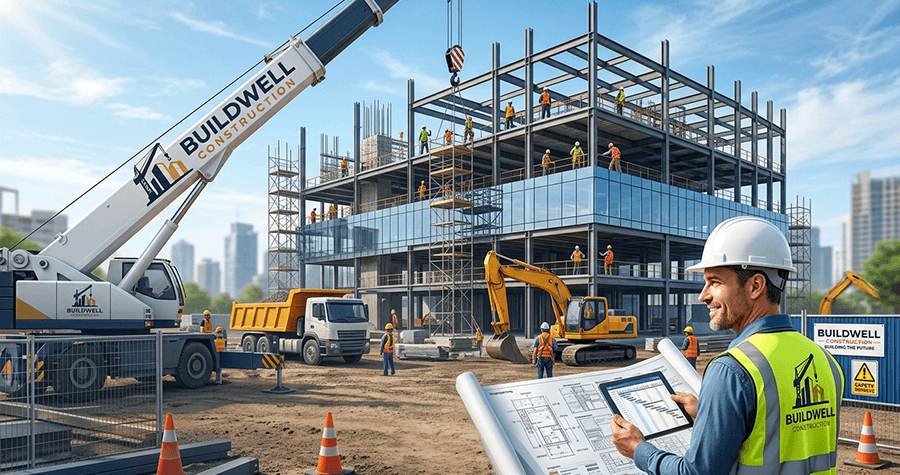
ROI of a Rebrand for Construction Companies: What the Research Really Shows
Construction leaders rarely question the ROI of a new crane, estimating platform, or project-management system. Those investments have visible costs and measurable outcomes. A rebrand can be harder to evaluate.
The investment is easy to calculate, but the return may appear in several places: stronger recruiting, better clients, higher pursuit hit rates, improved margins, greater awareness, shorter sales cycles, and increased enterprise value.
That complexity sometimes leads contractors to treat branding as a cosmetic expense. Change the logo. Build a new website. Wrap the trucks. Order new hard hats. Then hope people notice.
Research into design-led companies suggests that this view is far too narrow. A strong brand can create meaningful business value, but only when branding extends beyond appearance and becomes part of how the company competes.
What Is the ROI of a Rebrand for a Construction Company?
The ROI of a rebrand compares the financial value created by the new brand with the total cost of developing and implementing it.
The basic formula is:
Rebrand ROI = (Financial gain attributable to the rebrand − Total rebrand investment) ÷ Total rebrand investment × 100
The calculation looks simple. Attribution is not.
A construction company’s rebrand can influence:
- Which clients invite the firm to compete
- Whether buyers understand what makes the contractor different
- How often the company advances from shortlist to interview
- Whether it wins on value or competes primarily on price
- The types of employees it attracts and retains
- How successfully it enters a new geography or market sector
- How well acquired companies become part of one organization
- How confidently employees tell the same company story
- What the business may be worth to future investors or buyers
A new logo alone is unlikely to produce those results. A strategically grounded rebrand can.
The Design Value Index: Evidence That Design Creates Business Value
The Design Management Institute and Motiv Strategies created the Design Value Index to examine the financial performance of publicly traded companies considered “design-centric.”
The original portfolio included companies such as Apple, Coca-Cola, Ford, IBM, Nike, Starbucks, Target, Walt Disney, and Whirlpool. These organizations were not selected merely because they produced attractive advertising. They demonstrated that design:
- Operated across the enterprise
- Held a prominent position within the organization
- Had support from senior leadership
- Was managed by experienced executives
- Received sustained investment
- Influenced strategy, products, services, and customer experience
From 2003 through 2013, the portfolio of design-centric companies reportedly outperformed the S&P 500 by 228%.
A hypothetical $10,000 investment during that period would have grown to approximately:
- $39,923 in the design-centric portfolio
- $17,522 in the S&P 500
The Design Value Index subsequently reported outperformance of more than 200% across three successive ten-year studies. Its 2005–2015 portfolio, composed of 16 design-centric companies, outperformed the S&P 500 by 211%.
Sources: Design Management Institute’s original Design Value research and 2015 Design Value Index report.
Does That Mean a Rebrand Produces a 228% ROI?
No, and construction marketers should resist making that claim.
The Design Value Index did not divide each company’s branding expenses by the revenue or profit directly attributable to those expenses. It compared the stock performance of a selected portfolio of design-centric companies with the performance of the S&P 500.
The study demonstrates an association between design maturity and long-term shareholder value. It does not prove that spending $100,000 on a rebrand will produce $228,000 in profit.
Several factors also limit how broadly we should apply the headline number:
- The portfolio included only 15 or 16 companies.
- The companies were selected partly through expert evaluation.
- Exceptional performers could materially influence the result.
- Design-centric companies may also have stronger leadership, innovation, operations, marketing, and customer experiences.
- The study examined publicly traded corporations, not privately held contractors.
- “Design” included much more than visual identity or branding.
The correct lesson is not that every rebrand produces the same return. It is that companies treating design and brand as strategic business capabilities have historically created substantially more shareholder value than companies treating design as decoration.
Broader Research Supports the Business Case
McKinsey later conducted a larger study involving 300 publicly listed companies, more than two million pieces of financial data, and more than 100,000 documented design actions.
Over five years, companies in the top quartile of the McKinsey Design Index achieved:
- 32% more revenue growth than their industry counterparts
- 56% more total shareholder return growth
- Approximately twice the revenue growth and shareholder returns of industry peers
The results held across consumer goods, medical technology, and retail banking. McKinsey also found that the market disproportionately rewarded top-quartile companies. Being slightly better than average did not produce the same advantage.
The highest-performing companies treated design as a leadership priority, measured its performance, built around the complete customer experience, worked across departmental boundaries, and continuously tested and improved their ideas.
Source: McKinsey, The Business Value of Design.
What This Research Means for Construction Companies
Construction companies do not sell consumer products, and most contractors are not publicly traded. The industry also has long sales cycles, relationship-driven buying, complex pursuits, and years of backlog. However, those differences don’t make brand less important; they just make its effects harder to isolate.
A contractor’s brand shapes how clients, employees, recruits, partners, and prospective sellers interpret the company before they ever speak with its leadership. Buyers may use similar words to describe competing contractors:
- Safe
- Experienced
- Trusted
- Quality-driven
- Relationship-focused
- On time and on budget
Those claims may all be true. Unfortunately, they do little to help one company become more memorable or preferable than another. A magnetic construction brand makes the contractor’s value recognizable. It gives the market a clear reason to choose the company while helping wrong-fit buyers recognize that it may not be for them.
That distinction can create returns well beyond marketing.
Where a Construction Rebrand Can Generate ROI
1. Better-fit opportunities
A clear position helps owners, developers, general contractors, and partners understand what the company does best. This can produce fewer wrong-fit leads and more invitations aligned with the contractor’s experience, delivery model, geography, and margin goals.
The goal is not simply to generate more opportunities. It is to attract better work.
2. Higher pursuit hit rates
Contractors spend significant time and money pursuing work. Estimating labor, preconstruction support, proposal development, travel, interviews, and executive time all contribute to the true cost of a pursuit.
If a stronger brand improves recognition, differentiation, and buyer confidence, even a modest increase in hit rate can generate substantial value.
Suppose a contractor pursues 40 projects annually at an average internal pursuit cost of $10,000. That represents a $400,000 investment before the company wins any work.
Moving from a 20% hit rate to a 25% hit rate would mean two additional wins. The financial return from those projects could outweigh the entire rebrand investment.
The example is hypothetical, but it shows why contractors should connect brand performance to pursuit data, not merely impressions alone.
3. Stronger pricing power
When buyers cannot see a meaningful difference between contractors, price becomes the deciding factor.
A strong brand will not eliminate competitive bidding. It can, however, make expertise, specialization, processes, people, and client experience easier to recognize.
That creates a better foundation for value-based conversations and may reduce pressure to win every project by offering the lowest number.
4. Improved recruiting and retention
Construction companies are competing for many of the same project managers, superintendents, estimators, craft professionals, and emerging leaders.
An employer brand that accurately communicates the company’s culture, opportunities, expectations, and purpose can improve applicant quality. It may also reduce dependence on outside recruiters and help employees determine whether the organization fits them before accepting an offer. The return can appear through:
- More qualified applicants
- Higher offer-acceptance rates
- Lower recruiting costs
- Shorter time to fill priority positions
- Improved first-year retention
- More employee referrals
A magnetic employer brand should attract the right people and repel those unlikely to thrive in the organization.
5. Faster entry into new markets
A contractor entering a new geography or sector does not automatically carry its existing reputation into that market.
A well-developed rebrand can clarify which experience transfers, establish relevance with a new audience, and give business-development teams a more compelling story. That support matters most when a company expands beyond the relationships that fueled its earlier growth.
6. More successful mergers and acquisitions
An acquisition may add revenue, people, clients, and geography without creating a unified company.
A strategic rebrand can help leadership define what the combined organization stands for, decide which brand equity to preserve, and establish a shared story for employees and clients. Without that work, the company may continue operating as a collection of disconnected firms under one ownership structure.
7. Greater enterprise value
A recognizable position, consistent client experience, a healthy reputation, transferable marketing systems, and a strong employer brand can make a construction company less dependent on one founder or a handful of relationships.
That does not guarantee a higher valuation. It can, however, create a more durable business—and durability matters to investors, successors, and potential buyers.
A Rebrand Is More Than a New Identity
Many disappointing rebrands begin with visual decisions before leaders answer the strategic questions.
A construction rebrand should establish:
- The company’s ideal clients and projects
- The opportunities it should and should not pursue
- Its most defensible market position
- The problems it is uniquely equipped to solve
- The experience clients should expect
- The culture and talent it wants to attract
- The evidence supporting its claims
- The story employees and seller-doers can repeat
- The changes required across the organization
- The metrics leadership will use to evaluate progress
Only then should the work translate into names, messages, logos, websites, proposals, jobsite graphics, fleet graphics, recruiting materials, signage, and other brand expressions.
Changing the appearance without addressing the underlying business creates a fresher-looking version of the same problem.
How to Measure the ROI of a Construction Rebrand
Establish a baseline before launching the new brand. Otherwise, leadership will have nothing meaningful to compare future performance against. Track a combination of leading and lagging indicators.
Not every improvement can be credited exclusively to the rebrand. The objective is to build a reasonable chain of evidence connecting brand changes to behavior and business outcomes.
How Long Does It Take to See a Return?
Construction companies should not evaluate a rebrand like a 30-day lead-generation campaign.
Early indicators may appear within three to six months:
- Increased website engagement
- Better recruiting response
- More consistent messaging
- Stronger employee participation
- Improved reactions from clients
- Greater engagement from target accounts
Revenue and profitability effects may require 12 to 36 months because construction sales cycles and backlogs are long. The company may also need time to implement the brand across proposals, interviews, jobsites, recruiting, client experience, and operations.
The rebrand launch is not the finish line. It is the point at which the organization begins delivering the new promise.
When a Rebrand Is Most Likely to Produce a Return
A construction rebrand is more likely to create measurable value when the company is:
- Entering new markets or geographies
- Pursuing larger or more sophisticated clients
- Shifting from hard-bid to negotiated work
- Integrating an acquisition
- Preparing for a leadership transition
- Struggling to recruit the right talent
- Known for work it no longer wants
- Losing to competitors it believes are less qualified
- Growing beyond a founder-led reputation
- Carrying an identity that no longer reflects the business
- Unable to explain why clients should choose it
A rebrand is less likely to succeed when leadership wants a new appearance but won’t change the client experience, pursuit strategy, internal behavior, or investment behind it.
The Real ROI Comes From Becoming Easier to Choose
The Design Value Index offers compelling evidence that design-centric companies can create extraordinary long-term value. McKinsey’s broader research reinforces the relationship between design excellence, revenue growth, and shareholder returns.
Neither study promises that every construction company will receive a predetermined return from rebranding.
They point to a more useful conclusion: design and brand create the greatest value when leadership treats them as business capabilities—not marketing decorations.
For a construction company, a rebrand’s ROI doesn’t come from unveiling a new logo. It comes from building a clearer, more credible, and more consistent company—one that attracts the right clients and talent, repels the wrong ones, and gives people a compelling reason to choose it.
That is the difference between looking different and becoming a magnetic brand.
Is Your Construction Brand Creating—or Costing You—Opportunities?
A/E/C CMOs helps construction companies evaluate their existing brands, uncover gaps between their reputation and growth goals, and build magnetic brands that attract better work, better talent, and better margins.
Grade your construction brand or talk with a Construction Marketing Officer™ about whether your company is ready for a rebrand.

Introducing the Magnetic Brand Grader

0–24: Fragmented

25–39: Reactive

40–54: Building

55–64: Strategic

65–74: Integrated

75–89: Advanced
Why Doesn’t the Online Grader Go to 100?
Technically, it does. We just make the last points intentionally difficult.
The 10-question grader is designed to provide a useful snapshot, not certify a construction company as having world-class marketing.
Scores above 89 should require evidence.
That might include meaningful marketing attribution, bottom-up budgeting, marketing automation, relevant lead or account scoring, a significant marketing-generated pipeline, substantial digital authority, and thought leadership strong enough that the company is creating original information the rest of the industry cites.
For many small and midsized construction companies, a score in the 60s or 70s would already represent a very sophisticated marketing operation.
Nobody needs a 98 to have excellent marketing.
Your Score Is a Starting Point
The final number is useful because it creates a benchmark. The more important question is:
What should we improve next?
A company scoring 38 does not need to copy everything a company scoring 78 is doing. It needs to identify the few improvements that will create the biggest impact at its current stage.
That could mean sharpening the value proposition, defining the ICP, improving pursuit discipline, developing a content strategy, establishing better marketing leadership, strengthening the employer brand, improving client retention, or connecting marketing and business development more effectively.
Maturity comes from building the right capabilities in the right order.
The Goal Isn’t More Marketing
Construction companies do not need another reason to add activities to an already busy marketing department.
The objective of the Magnetic Brand Grader is exactly the opposite.
It should help leadership prioritize.
Where are we strong? Where are we reactive? What is holding us back? What should we stop doing? What capability would make sales easier? What would improve client retention? What would help recruiting? What could make us less dependent on individual relationships or economic conditions outside our control?
Those are more valuable questions than whether the company needs another social platform.
A higher Magnetic Brand Score should represent a stronger marketing system, not a longer marketing to-do list.
How Magnetic Is Your Construction Brand?
You probably already have a feeling about whether your marketing is working.
The Magnetic Brand Grader gives you a framework for evaluating it.
Answer 10 straightforward questions, get your Magnetic Brand Score, see your marketing maturity level, and identify where your company has the greatest opportunities to improve.
It takes about three minutes.
The objective is not to build a perfect marketing department.
It is to build a company that is more valuable, more differentiated, more profitable, and more resilient because marketing is doing the job it should be doing.

What’s Included in a Construction Company’s Brand?
Ask most people to describe a company’s brand, and they will start with the logo. That makes sense. The logo is the most obvious visual representation of a brand. It appears on the website, proposals, trucks, hard hats, equipment, signs, uniforms, and just about everything else carrying the company name.
But the logo is not the brand.
A construction company’s brand is the collection of experiences people have with the organization and the expectations those experiences create. It includes what clients experience during a project, how employees are treated, how quickly someone responds to an email, what a jobsite looks like, how a superintendent interacts with a neighbor, what prospective employees find online, and even how employees wearing company apparel behave while grabbing lunch.
Jeff Bezos famously said, “Your brand is what other people say about you when you’re not in the room.” That is especially true in construction, where your company’s brand is being experienced every day in offices, jobsites, client meetings, restaurants, traffic, proposals, interviews, and communities.
TL;DR
A construction company’s brand includes much more than its logo, colors, and website. It is the collection of experiences people have with the company across every interaction.
That includes your visual identity, positioning, messaging, culture, leadership, client experience, employee experience, proposals, interviews, website, social media, trucks, equipment, jobsite trailers, PPE, signage, and even how employees behave while representing the company in public.
A strong brand creates consistency between what the company promises and what people actually experience. When those experiences reinforce each other, the brand builds confidence, increases perceived value, helps attract better-fit clients and employees, and can make the company worth paying more for.
Your Logo Represents the Brand. It Is Not the Brand.
A logo matters because it gives people a visual symbol to associate with everything they know and feel about the company. Over time, all those experiences begin attaching themselves to that mark.
If clients consistently have smooth projects, employees are proud to work there, subcontractors enjoy doing business with the company, and the market views the contractor as highly capable, the logo eventually carries some of that confidence with it. The opposite happens too. A beautiful logo cannot rescue a company that communicates poorly, treats people badly, delivers inconsistent quality, or creates frustrating client experiences.
Think of the logo as the visual representation of the brand, not the brand itself. The brand is everything that gives that symbol meaning.
Positioning Is Part of the Brand
A strong brand should help people understand what the company is known for. Why should an owner hire you instead of another capable contractor? What markets do you understand particularly well? What problems are you especially good at solving? What kind of client relationship do you create? Why are you worth paying more for?
If the answer sounds like every other contractor — quality, safety, integrity, relationships, on time, on budget — then the company may have an identity, but it does not have much differentiation.
Positioning creates context for the rest of the brand. It helps prospective clients understand why your experience matters and where you fit in the market. It gives employees something meaningful to rally around and guides thought leadership, business development, pursuit strategy, website content, and even decisions about which opportunities should receive the company’s attention.
Without clear positioning, branding often becomes decoration.
Your Culture Is Part of Your Brand
A strong brand should reflect the company’s actual culture. That does not mean every company needs beanbag chairs, ping-pong tables, or a clever set of values painted on the office wall. It means the personality projected externally should feel recognizable to the people working inside the business.
Some contractors are disciplined and highly structured. Others are entrepreneurial and fast-moving. Some are deeply technical. Some feel like extended families. Others attract independent problem-solvers who thrive with a lot of responsibility. There is no universally correct culture.
The goal is alignment.
A good brand acts like a magnet. It attracts clients and employees who appreciate that culture and makes the company less appealing to people who probably would not fit anyway. Trying to create a brand everyone likes usually results in a brand nobody remembers.
Leadership Sets the Tone
Leaders have an outsized influence on the brand experience. What executives prioritize, tolerate, reward, and communicate eventually makes its way through the organization. Their behavior tells employees which parts of the stated brand are real and which parts are simply marketing language.
If leadership claims relationships matter but treats subcontractors poorly, the real brand wins. If the company claims to value employees but executives communicate only when something goes wrong, employees notice. If leadership talks about innovation but every new idea dies in committee, the market eventually sees that too.
Marketing can help define and communicate the brand, but leadership has to create the environment where that brand can actually exist.
Your Jobsite Is One of Your Biggest Brand Experiences
Construction companies have something most businesses would love to have: enormous physical environments where the public can see their work happening. Yet many contractors treat jobsites entirely as operational spaces and overlook them as brand experiences.
Take the logos away for a moment and ask a simple question: Does your jobsite look any different from your competitor’s jobsite?
Think about the fencing, entrance signage, trailers, equipment, cranes, dumpsters, wayfinding, safety signage, trucks, hard hats, vests, and even the cleanliness and organization of the site. A clean, organized, well-branded jobsite communicates something before anyone reads a marketing message. It suggests discipline, professionalism, pride, and attention to detail.
The jobsite trailer matters too. Clients, architects, subcontractors, inspectors, employees, and recruits may spend considerable time there. If the exterior looks temporary and neglected and the inside feels chaotic, that is a brand experience.
Your machinery and fleet are equally important. Excavators, cranes, service trucks, trailers, and other equipment can become enormous moving billboards. Companies invest millions of dollars in equipment and then sometimes put a six-inch logo on the door.
Construction is one of the few industries where companies can literally display their work, people, equipment, and brand throughout the communities they serve.
Employee Behavior Is Brand Behavior
Brand experiences do not end when employees leave the jobsite. Someone answers the company phone. Someone drives a branded truck through traffic. Someone wearing the company logo walks into a restaurant for lunch. Someone replies to a client email. Someone shows up ten minutes late to a meeting.
All of those interactions shape perception.
That does not mean marketing should police employees’ every move. It means leaders should recognize that people experience a company through its people. How quickly do employees return calls? Do they show up when promised? Are emails professional and responsive? How do crews interact with neighbors around a project? How does someone driving a branded vehicle behave on the highway?
People may never meet your CEO or visit your office. Their entire perception of the company could come from one superintendent, one truck driver, or one interaction with someone wearing the logo.
Your Client Experience Is Your Brand
Marketing does not hand the brand to Operations when the contract is signed. The project experience may be the most important brand experience the company creates.
What happens during preconstruction? How does the project begin? How are problems communicated? Does the client get surprised? How does accounting interact with them? What happens at closeout? Does the company disappear after substantial completion until somebody needs another project?
Every interaction either reinforces or contradicts the promise the company made during the pursuit.
A brand promising partnership should feel collaborative during difficult conversations. A contractor positioning itself around predictability should communicate early when conditions change. A company claiming to be easy to work with should probably have an invoicing and closeout process that is actually easy to work with.
The client does not separate Operations from Marketing. They experience one company.
Proposals and Interviews Are Brand Experiences Too
For many prospective clients, the proposal and interview are among the most concentrated experiences they have with your brand before deciding whether to hire you.
A generic proposal creates a generic impression. A proposal that understands the client’s challenges, clearly communicates value, and looks and sounds consistent with the rest of the company creates confidence.
Interviews reveal even more. Clients see how team members communicate, how well they know one another, whether executives dominate the conversation, how the proposed project team thinks, and whether the culture described in the proposal seems real when actual humans enter the room.
Good proposals and interviews should feel like the company. If they do not, either the pursuit is misrepresenting the culture or the brand has not been defined clearly enough.
Employer Brand Is Part of the Brand
Companies sometimes treat employer branding as a separate initiative owned entirely by HR. Candidates do not. They see one company.
The website, careers page, social media, employee reviews, job postings, recruiter communications, application process, interview experience, office, jobsite, and employees they meet all contribute to their perception.
The company cannot advertise its way around a bad culture. If the careers page promises opportunity and mentorship while employees experience stagnation and poor communication, the real employer brand eventually becomes obvious.
The reverse is also true. Companies with exceptional cultures sometimes struggle to recruit because nobody outside the company can see what employees already know. Marketing should help make the authentic culture visible.
Vendors and Subcontractors Experience Your Brand
Your brand extends beyond clients and employees. Subcontractors, suppliers, vendors, consultants, and partners have experiences with your company too.
How easy is prequalification? How fairly are partners treated? Do you communicate clearly? Do you pay reasonably? Are expectations predictable? Do you treat subcontractors as partners when things get difficult or immediately turn adversarial?
Those experiences travel through the industry. Construction is highly interconnected, and today’s subcontractor may become tomorrow’s referral source, joint-venture partner, client contact, employee, or competitor.
Reputation compounds quickly.
Your Community Experiences the Brand
Jobsites do not operate in isolation. Neighbors deal with noise, traffic, dust, deliveries, road closures, fencing, and workers moving through the area.
How those interactions are handled matters. A superintendent who communicates respectfully with a neighboring business creates a brand experience. So does a driver blocking access without explanation. A clean site creates an impression. So does trash blowing into the adjacent property.
This is especially important because community members may not understand the contractual boundaries of the project. They see the logo on the fence, and to them, that is who is responsible.
Digital Presence Shapes the Brand Before You Meet
Long before someone calls your office, they may have already experienced your brand online. They searched for your company, visited your website, looked through project pages, read employee profiles, checked LinkedIn, viewed photos, or asked an AI platform about contractors in your market.
What did they learn?
Does the digital presence accurately communicate the company that exists today, or does it look like the company from ten years ago? Does your website reinforce expertise or undermine it? Does your thought leadership demonstrate how your people think? Do search engines and AI platforms even understand what markets you serve and what you are known for?
The digital brand is often the first experience prospective clients and employees have with the company. It should earn enough confidence to create the next interaction.
Strong Brands Increase Perceived Value
A cohesive brand makes a company feel more credible, and that matters commercially.
A contractor with clear positioning, relevant proof, professional visuals, consistent communication, strong thought leadership, a well-managed jobsite, polished pursuit materials, and a good reputation creates confidence before price enters the conversation.
Confidence increases perceived value.
That does not mean a nice website allows you to arbitrarily charge more. It means the total brand experience gives the client more reasons to believe the company will deliver a better outcome with less risk.
When two contractors appear identical, price naturally becomes more important. When one feels clearly more capable, relevant, professional, and trustworthy, the comparison changes.
Your Brand Is the Sum of the Experiences
There is no single moment when someone experiences your construction brand. They experience pieces of it over time: a project sign, a Google search, a conversation with a superintendent, a proposal, a truck in traffic, an interview, an invoice, a LinkedIn post, a jobsite trailer, a conversation with one of your subcontractors, or an employee wearing the logo at lunch.
Eventually, all those interactions add up to an impression.
Your logo gives that impression a visual symbol. The experiences give the logo its meaning.
That is your brand.

AI Is Commoditizing Information. Construction Brands Need to Build What AI Can’t.
The internet spent the last 25 years rewarding companies that could publish useful information. Artificial intelligence is changing the value of that information.
In a recent Instagram Reel, Glove Jones made an observation that should get the attention of every marketer and business leader: as search becomes increasingly agentic, the things most likely to survive and thrive are trusted brands, personalities, communities, proprietary data, and real experiences. His argument goes beyond another prediction that “SEO is dead.” We’ve heard versions of that headline for years, usually followed by SEO continuing to work just fine.
This shift is more fundamental. AI is making ordinary information abundant. It can find information, summarize it, compare sources, answer increasingly complicated questions, and now take actions on someone’s behalf. As information becomes easier to produce and easier to consume without visiting the source that created it, simply having information becomes less valuable.
For construction companies, that should change how we think about content, thought leadership, expertise, and ultimately the brand itself.
Because if AI can reproduce most of what you publish, why should anyone care that you published it?
Google isn’t killing the search box. It’s turning it into something much bigger.
There’s an important clarification to Jones’s premise. Google has not announced that it is eliminating its search bar. In May 2026, Google called its new AI-powered Search box the “biggest upgrade in over 25 years.” The new experience accepts text, images, files, videos, and even Chrome tabs, then reasons across those inputs. Google is also combining AI Overviews and AI Mode into a more conversational search experience.
More importantly, Google is building agents directly into Search. Information agents can monitor the web in the background, synthesize developments, notify users when something changes, and help them take action. Google is also expanding agentic capabilities into activities such as booking services and shopping.
The search box isn’t disappearing. The old relationship between the searcher, the search engine, and your website is.
For years, the basic bargain was relatively simple. Someone searched for something. Google displayed a list of websites. The person clicked a result, visited a website, consumed the information, and perhaps took another action.
Now the AI can increasingly sit between the user and those websites. It can research multiple sources, synthesize the information, answer the question, continue the conversation, monitor the subject, and eventually perform parts of the task. That changes what information is worth.
AI is turning information into a commodity
Consider how much construction marketing content follows essentially the same formula:
- “What is preconstruction?”
- “Five Benefits of Design-Build Construction.”
- “How to Choose the Right General Contractor.”
- “Why Safety Matters in Construction.”
- “Five Trends Changing Healthcare Construction.”
Most of that content wasn’t particularly differentiated before AI. Now a sophisticated AI model can produce a competent version of it in seconds, and it can also summarize 20 versions written by your competitors.
That doesn’t mean educational content suddenly has no value. Buyers still have questions, search still matters, and Google is very clearly continuing to send people to websites from its AI experiences. Google says AI Mode has already surpassed one billion monthly users, while AI Overviews exceeds 2.5 billion monthly active users.
What is changing is the value of commodity information. Google itself is telling website owners to pay attention. Its updated guidance for generative AI Search specifically emphasizes providing unique, non-commodity content rather than creating more interchangeable information.
That’s a pretty significant choice of words.
If you’re publishing something that 50 competitors could publish, and AI could write without ever talking to your team, you haven’t created much of a competitive advantage. You created more information.
The next content advantage is something AI can’t manufacture
This is where Jones’s framework gets particularly interesting. He identifies trusted brands, personalities, communities, proprietary data, and real experiences as assets that become more valuable as AI commoditizes information.
I would add another layer: perspective.
Information tells me what happened. Perspective tells me what you think it means. Experience tells me why you believe it. Proprietary data gives me evidence I couldn’t get somewhere else. Personality gives me a reason to remember who said it, and trust determines whether I believe you.
AI is astonishingly useful for information retrieval and synthesis. But when everyone has access to increasingly similar artificial intelligence, access to the tool doesn’t create much differentiation.
Your inputs do.
Construction companies are sitting on mountains of information nobody else has
This is where I think construction companies have an enormous opportunity. Most contractors possess extraordinary amounts of knowledge that never becomes marketing content.
Your preconstruction team knows what is happening to costs before most people in your market do. Your estimators see changes in subcontractor participation, pricing, labor pressure, material availability, and escalation. Your project executives know which decisions consistently cause schedule problems, while your project managers know where owners get frustrated.
Your superintendents have seen hundreds of good ideas look terrific on paper and fail in the field. Your teams know which design decisions create constructability problems, which procurement approaches work, which project types are changing, and where clients repeatedly waste money.
Meanwhile, marketing publishes “Five Reasons to Hire a General Contractor Early.”
We can do better.
The knowledge inside your company is an asset. Marketing’s job should increasingly be to extract, organize, analyze, package, and distribute that knowledge—not merely generate another month of content for the editorial calendar.
Proprietary research becomes a moat
This is one reason I’m increasingly bullish on primary research for construction brands. AI can summarize a report, but it can’t retroactively conduct the research your company never did.
Imagine a healthcare contractor surveying 100 hospital facility executives about their capital-program priorities. A higher education contractor could analyze five years of campus construction trends across its region, while a multifamily contractor could publish original research about the causes of preconstruction delays.
A specialty contractor could analyze hundreds of completed projects to identify which design conditions correlate with change orders. A GC could use its estimating data—carefully anonymized and aggregated—to provide insights about escalation, subcontractor participation, procurement timing, or market-sector capacity.
Suddenly the content isn’t merely competing for search traffic. It becomes the source other people discuss.
That distinction becomes increasingly valuable in an AI-mediated internet because AI systems still need material to learn from, synthesize, reference, and cite. Google is even expanding features designed to make original reporting, influential sources, firsthand perspectives, creator insights, social discussions, and trusted sources more visible within its AI experiences.
Don’t just answer the existing question better.
Create information that didn’t exist before.
Real experience is becoming more valuable, too
Construction has another competitive advantage that many industries would love to have: you actually build things. You have real projects, clients, problems, decisions, mistakes, innovations, and lessons.
Unfortunately, contractors often sanitize those experiences until nothing interesting remains. A typical project profile says the project was challenging, collaboration was important, the team worked together, and everyone was proud of the finished building.
Great. So did everybody else’s.
Real experience gets much more interesting when you’re willing to explain what actually happened. What did the team discover during preconstruction? What assumption turned out to be wrong? What did you change? What almost caused the project to miss its deadline?
What did the superintendent see that nobody else did? What did you recommend that saved the owner money? What would you do differently next time?
Those answers have fingerprints on them. AI can imitate the structure of a case study, but it cannot have spent 18 months solving the problem your team solved.
Google appears to understand that distinction as well. Its May 2026 Search updates specifically expanded the visibility of firsthand perspectives from public discussions, social media, creators, and communities.
Experience isn’t an SEO trick. It’s evidence that you’ve actually done the work.
Founder-led and expert-led brands have another advantage
Jones also points toward the growing importance of personalities, creators, podcasts, YouTube, Instagram, and founder-led brands. Construction companies should pay attention.
For years, many contractors have intentionally removed personality from their marketing. Websites speak in a corporate collective voice. Executives rarely publish opinions. Subject-matter experts are hidden three clicks deep on the team page, and social media mostly consists of project photos, employee anniversaries, safety lunches, and golf tournaments.
The company may employ brilliant people, but you would never know it from the outside. That’s a missed opportunity in an internet increasingly filled with machine-generated sameness.
People follow people. They remember the estimator who explains why a common budgeting assumption is wrong, the healthcare construction executive who has a strong point of view about phasing occupied renovations, and the superintendent who teaches young project managers what drawings don’t tell them.
The goal isn’t to turn your CEO into an influencer. The goal is to let expertise have a face.
Your brand should make its experts more visible, and those experts should make the brand more credible.
A point of view is harder to commoditize than information
This may be the biggest opportunity of all. Too much construction thought leadership doesn’t actually contain much thought.
It explains, summarizes, and reports, but it rarely argues.
Real thought leadership should occasionally make someone say, I hadn’t thought about it that way.
Perhaps your company believes GMP contingency is routinely misunderstood. Perhaps your superintendent thinks architects should involve field leadership earlier. Perhaps your preconstruction leader believes an accepted industry practice is wasting owners’ money, or your CEO believes the industry’s approach to workforce development is fundamentally broken.
Those perspectives won’t appeal to everyone, and that’s part of what makes them valuable.
AI is exceptional at synthesizing the consensus. Brands have an opportunity to provide the informed perspective that moves the conversation beyond it.
That doesn’t mean manufacturing controversy for attention. A/E/C has enough chest-beating without adding another executive trying to become the construction industry’s newest LinkedIn provocateur. It means having informed opinions backed by experience.
Community may become more important than audience
There is another important distinction in Jones’s framework: community. An audience consumes what you publish. A community interacts with it, contributes to it, challenges it, discusses it, and eventually builds relationships around it.
For construction companies, community doesn’t have to mean building a giant Facebook group. It might be a quarterly roundtable of healthcare facility leaders, a breakfast series for architects and developers, or a research panel of higher education capital-program executives.
It could be an annual benchmarking study where participants receive deeper findings, a podcast that becomes a gathering place for people working in a specific market, or a newsletter that clients actually forward because it consistently teaches them something.
The technology will continue changing. Platforms will rise and fall. Algorithms will get rewritten.
Relationships between people are much harder to disrupt.
Stop asking AI to create your expertise
There is an irony in all of this. AI is one of the most powerful marketing tools construction companies have ever had. I use it. A/E/C CMOs will use it extensively. It can accelerate research, identify patterns, organize information, improve workflows, analyze data, repurpose content, and dramatically increase what a small marketing team can accomplish.
The mistake is using AI to manufacture expertise you don’t possess.
If your content strategy becomes asking ChatGPT for “20 blog topics for a commercial contractor” and publishing whatever comes back, you’ve simply found a faster way to become indistinguishable.
Use AI to amplify your expertise. Use it to interrogate your proprietary data, help subject-matter experts organize their thinking, turn a 45-minute interview with a superintendent into several useful pieces of content, analyze research responses, find patterns across years of project information, and challenge an executive’s argument before publishing it.
AI should make your company’s unique knowledge easier to extract and distribute. It shouldn’t become the source of the knowledge.
The future internet may be AI for utility and humans for meaning
Jones describes the emerging split particularly well: AI for utility, humans for meaning. I think he’s onto something.
When I want a quick comparison, calculation, definition, summary, itinerary, or synthesis, AI is remarkably useful. But humans still want to know who has actually been there, whose judgment they trust, who has a perspective worth hearing, who discovered something new, and who understands their world.
They also want to know who can tell the story and who they want to work with.
That’s why the rise of AI doesn’t make branding less important. It makes Magnetic Brands more important.
A magnetic construction brand isn’t merely visible. It possesses enough expertise, distinction, credibility, personality, and trust that people deliberately seek it out, remember it, recommend it, and want to hear what it has to say.
In a world drowning in perfectly competent information, competence alone won’t create much gravity.
What construction marketers should do now
Don’t respond to AI Search by producing twice as much content. Produce more content that could only come from your company.
Interview the experts hiding inside your organization. Conduct original research. Analyze your own data. Develop a point of view. Tell better project stories. Put knowledgeable people in front of cameras and microphones. Create communities around the markets you serve. Publish experiences rather than generic explanations, and invest in building a brand people recognize before an AI agent ever recommends a list of contractors.
SEO still matters. Your website still matters. Technical optimization still matters. Google itself is continuing to build ways for AI Search users to discover and visit original websites and trusted sources.
But optimizing commodity content isn’t a durable strategy when the machines themselves can manufacture commodity content.
The competitive question is changing from “Can Google find us?” to “Do we have something worth finding?”
That’s a much harder question, and it’s also a much better one.
Sources
Glove Jones. Instagram Reel discussing the shift toward agentic search and the increasing value of trusted brands, personalities, communities, proprietary data, and real experiences. Reel: DYm93z3NgGL.
Google. “A New Era for AI Search,” May 19, 2026. Google describes its new AI-powered Search box as its largest upgrade in more than 25 years and outlines information agents, agentic capabilities, and generative interfaces in Search.
Google. “New Opportunities, Control and Insights for Website Owners,” June 3, 2026. Google recommends unique, non-commodity content for visibility in generative AI Search and reports more than one billion AI Mode users and 2.5 billion AI Overviews users.
Google. “New Ways to Find Your Favorite Sources and Original Content in AI Search,” May 27, 2026. Google describes features emphasizing trusted sources, original content, creator insights, and firsthand perspectives.
Google. “5 New Ways to Explore the Web With Generative AI in Search,” May 6, 2026. Google discusses surfacing authentic voices, original content, social discussions, and firsthand sources within its AI Search experiences.

Why Do Construction Companies Need Marketing?
Many construction companies grow for years without what most industries would consider a formal marketing strategy. A founder builds relationships, estimators respond to invitations, business developers work their networks, and good projects lead to referrals. When the backlog is healthy, marketing can appear unnecessary.
Until it isn’t.
Relationships and referrals remain enormously valuable in construction, but they are not a complete growth strategy. They give a company limited control over which opportunities appear, when they appear, and whether they fit the company’s capabilities, capacity, and financial goals. A contractor can be busy while pursuing the wrong work, becoming too dependent on one market, or losing ground with the clients and employees it needs for the future.
Strategic marketing gives construction companies more control over growth. It helps leadership determine where the company should compete, what it should be known for, whom it needs to reach, and why those people should choose it.
Marketing Is More Than Promotion
Construction leaders often think of marketing as proposals, social media, project photography, events, sponsorships, and branded giveaways. Those activities may support the business, but they are tools—not the strategy itself.
Marketing begins with business decisions. Which markets offer the strongest opportunity? Which clients are profitable, compatible, and likely to become long-term partners? Where does the company have a credible advantage? Which service lines should it expand, and which opportunities distract it from its strengths?
A strong marketing function helps answer those questions and turns the answers into a coordinated plan. It aligns leadership, business development, operations, recruiting, and communications around the kind of company the organization is trying to become.
That work can influence revenue, profitability, hit rate, client retention, employee retention, market diversification, and the quality of opportunities entering the pipeline. Those outcomes matter considerably more than likes, impressions, or how many people picked up a koozie at the last golf tournament.
Buyers Research Construction Companies Differently
Construction remains a relationship-driven industry, but relationships no longer develop exclusively through lunches, conferences, associations, and personal introductions. Clients research companies before returning a call, accepting a meeting, or adding a contractor to a shortlist.
They visit the website. They search for relevant experience. They look at leadership profiles, project examples, reviews, news coverage, and employee activity. They ask colleagues for recommendations and then validate those recommendations online. Increasingly, they also consult AI-powered search and research tools that synthesize information from many of those sources.
A referral may introduce the company, but the brand helps the buyer decide whether the company belongs in the conversation.
If the website looks dated, the messaging sounds like every competitor, and the company cannot clearly demonstrate relevant expertise, the business developer begins at a disadvantage. Marketing does not replace the relationship. It gives that relationship credibility before, during, and after the first conversation.
Good Marketing Makes Business Development More Effective
Business developers are often expected to generate awareness, educate prospects, maintain hundreds of relationships, attend industry events, uncover future projects, monitor changing close dates, and keep every opportunity moving. That is an unreasonable burden for one department to carry alone.
Marketing provides reinforcements.
It can keep the company visible between personal conversations, give business developers useful insights to share, demonstrate expertise before the pursuit begins, and nurture potential clients who are not ready to buy. Account-based marketing can help leadership concentrate resources on the clients and markets that best fit the company instead of waiting for random opportunities to enter the pipeline.
When marketing and business development work together, BD spends less time explaining the basics and more time developing meaningful relationships. The company becomes better prepared before the RFP arrives, which is particularly important in an industry where the strongest pursuit advantage is often built months or years before the proposal is due.
Marketing Helps Contractors Compete on More Than Price
Most construction-company messaging is interchangeable. Firms promise quality, safety, integrity, relationships, experience, and on-time delivery. Those qualities matter, but they rarely explain why one qualified company is the better choice for a particular client.
Without a clear value proposition, buyers are left to compare familiar names, project lists, fees, and gut feelings. Price becomes more influential because the companies have not given the client enough meaningful distinction to evaluate.
Marketing helps uncover and communicate the differences that matter. Those differences may include specialized expertise, a better preconstruction process, greater cost certainty, a particular approach to complex renovations, stronger communication, unique self-perform capabilities, or a deeper understanding of a client’s operating environment.
The objective is not to manufacture a clever slogan. It is to identify a valuable truth about the company, prove it, and communicate it consistently enough that the market recognizes it.
Marketing Makes Growth More Resilient
Contractors become vulnerable when too much revenue depends on one market, geographic area, service line, client, or referral source. A strong backlog can conceal that exposure until economic conditions change, a major program ends, or a dependable client changes direction.
Strategic marketing helps leadership identify adjacent opportunities before the company is desperate for work. A hospitality contractor may have relevant experience for student housing. A light-industrial contractor may be able to move into distribution facilities or selected data-center work. A company with strong relationships in one geographic market may be able to build credibility in another.
Those decisions require research, client conversations, competitive intelligence, positioning, and disciplined market development. They should not begin when the backlog is already falling. Marketing allows a company to invest some of today’s success in reducing tomorrow’s risk.
The Brand Also Affects Recruiting and Retention
Construction companies do not compete only for projects. They compete for estimators, project managers, superintendents, craft professionals, marketers, and future leaders.
Candidates evaluate a company much like clients do. They want to understand its reputation, culture, leadership, opportunities, and direction. What they encounter during the applicant process either reinforces or contradicts the employer brand.
Marketing can help the company communicate what makes it a worthwhile place to build a career, but communication alone is not enough. A credible employer brand must reflect the actual employee experience. When leadership, operations, human resources, and marketing work together, the company can attract better-aligned applicants and give its best people more reasons to stay.
Construction Companies Need Marketing Leadership
The need for marketing does not mean every contractor needs a large internal department. The right structure depends on the company’s size, goals, markets, and existing team.
It does mean someone must connect marketing decisions to business strategy. Without that leadership, marketing becomes a collection of requests: update this proposal, post this photo, order this giveaway, sponsor this event, and redesign this brochure. The team stays busy, but the company may not become more competitive.
A Construction Marketing Officer™ works on the business more than in it. This leader helps the company choose markets, define its position, develop growth plans, strengthen the client and employee experience, guide must-win pursuits, support business development, and build a brand capable of carrying the company forward.
Construction companies need marketing because reputation alone does not create direction. Relationships alone do not provide diversification. A healthy backlog does not guarantee future demand. Strategic marketing connects what the company does well with the clients, employees, and opportunities it needs next.