The 12 Brand Archetypes: How to Build a Construction Brand People Actually Remember
AI has made it easier than ever to create competent marketing. A contractor can generate website copy, social posts, recruiting content, emails, proposal language, and ad concepts in minutes.
That convenience comes with a downside: it is also easier than ever to sound like everybody else.
Give an AI tool a generic prompt to write a construction company homepage, and you will probably get some combination of quality, safety, integrity, relationships, innovation, and building the future. Ask it to make the copy more professional, approachable, or confident, and you may get better sentences without getting a more recognizable brand.
That is the problem with a lot of what I call AI slop. It is not necessarily wrong or poorly written. Much of it is perfectly competent. It is just interchangeable.
For construction companies, that creates a bigger problem than it may appear. Many contractors already look and sound alike. They use similar project photography, talk about the same values, hire from the same labor pool, pursue the same owners, and make many of the same claims about their people and capabilities.
As generative AI becomes part of everyday marketing, companies need stronger inputs if they want stronger outputs. That includes real expertise, original opinions, distinctive language, and a clear brand personality.
Brand archetypes are one tool for defining that personality.
At their simplest, archetypes help answer a useful question:
If our company were a person, what kind of person would it be?
Not just how would that person talk, but how would they behave? What would they believe? What would they value? How would they react under pressure? What would they never say or do?
Those answers can shape a brand much more effectively than another list of adjectives like innovative, trustworthy, and customer-focused.
What is a brand archetype?
A brand archetype is a recognizable personality framework that helps define how a company behaves, communicates, and relates to its audience.
The concept of archetypes traces back to psychologist Carl Jung. Carol S. Pearson later developed the 12-archetype framework, and Pearson and Margaret Mark applied that framework specifically to branding in The Hero and the Outlaw: Building Extraordinary Brands Through the Power of Archetypes.
The reason archetypes work is that people already understand these characters intuitively. A Ruler behaves differently from an Everyman. A Sage approaches problems differently from a Jester. A Caregiver communicates differently from an Outlaw.
You do not need a 40-page brand standards manual to understand the basic difference.
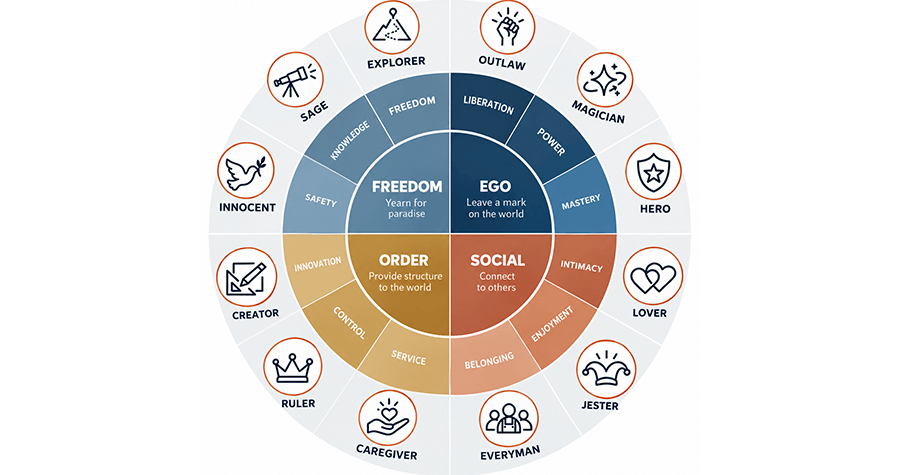
That makes archetypes especially useful with construction leadership teams. I’ve used them off and on for about 10 years and, more recently, with more than a dozen brands. One of the easiest ways to start the conversation is simply to put the archetype wheel in front of the team and ask what feels right, what feels wrong, and why.
The discussion usually gets useful quickly.
Leadership teams begin connecting the archetypes to how customers experience the company, what employees value, and how they want the organization to be perceived. For companies with multiple operating brands, the exercise can be even more valuable because those brands may compete with each other for projects, employees, and attention.
If every company in the portfolio looks, sounds, and behaves the same, there is not much reason for the brands to remain distinct.
Brand personality helps give each one territory it can own.

Brand archetypes are a framework, not gospel
This is probably the most important point in this article:
Brand archetypes are a framework, not gospel.
I do not recommend taking an online quiz, learning that your company is 72% Hero, and rebuilding your brand around the result. The value is not in perfectly classifying the organization.
The value is in creating clarity.
Archetypes give leadership, marketing, business development, and creative teams a shared language for discussing something that is otherwise difficult to define. They create boundaries around how the brand should feel and behave.
I usually prefer one dominant archetype because it forces clearer decisions. Sometimes a secondary archetype helps. In other situations, two subtypes within one archetype provide enough nuance to make the personality distinctive.
The subtype lists below are not a rigid academic taxonomy. They are practical variations that help companies move beyond simply saying, “We are a Hero,” or, “We are a Sage.”
The goal is not to put the company in a box. The goal is to give the brand enough personality that people recognize it.
The 12 Brand Archetypes and Their Subtypes
1. The Outlaw
 Core motivation: disruption, liberation, and challenging the status quo.
The Outlaw believes something about the existing system needs to change. An industry may be bloated, outdated, inefficient, dishonest, or unnecessarily complicated, and the Outlaw is willing to say so publicly.
That can be a powerful position in construction technology, where many companies promise transformation while using nearly identical SaaS language. It can also work for contractors, manufacturers, or service companies that have built their reputation by rejecting an accepted way of doing business.
Strong Outlaw brands do not rebel merely to attract attention. They have a point of view and something meaningful they are pushing against.
Common traits: Bold, independent, provocative, unconventional, uncompromising.
Common Outlaw subtypes
- The Disruptor challenges established methods and introduces a materially different approach.
- The Revolutionary wants more than incremental improvement. It believes the system itself needs to change.
- The Maverick operates on its own terms and is comfortable doing things differently from the market.
- The Activist organizes its identity around a cause, belief, or injustice it wants to address.
- The Reformer sees a broken system and wants to rebuild it better.
Watch out for: Mistaking edginess for differentiation. An Outlaw without a meaningful point of view is just loud.
Brand examples: Harley-Davidson, Virgin, Diesel, BrewDog, and selected Patagonia campaigns.
2. The Hero
 Core motivation: mastery, courage, achievement, and overcoming difficult challenges.
The Hero wants to prove what is possible through effort, discipline, and competence. Hero brands are often driven by performance and become especially compelling when the work itself is difficult, high stakes, or demanding.
Construction naturally creates Hero stories because projects involve risk, complexity, schedules, weather, safety, logistics, and problems that have to be solved under pressure. That does not mean every contractor should choose Hero. If every project story becomes, “We overcame the impossible,” the brand can quickly become self-congratulatory.
The strongest Hero brands make the customer, project team, or larger mission part of the victory.
Common traits: Strong, determined, courageous, disciplined, competitive.
Common Hero subtypes
- The Warrior confronts difficult situations directly.
- The Champion fights on behalf of someone else and helps them succeed.
- The Defender protects people, organizations, or important values.
- The Rescue Hero enters when something has gone wrong and decisive action is required.
- The Competitor continually raises the standard and measures itself against difficult challenges.
Watch out for: Making the company the hero of every story. Constant chest beating gets old quickly.
Brand examples: Nike, FedEx, Duracell, The Home Depot, and the U.S. Marines.
3. The Everyman
 Core motivation: belonging, connection, familiarity, and acceptance.
The Everyman does not want to stand above the audience. It wants to stand beside them.
These brands tend to be approachable, practical, straightforward, and easy to trust. Their personality often sounds like a good superintendent, estimator, or company owner who knows the work and does not need to impress anyone with corporate language.
Construction is full of genuinely Everyman companies, which is part of the challenge. Contractors regularly describe themselves as hardworking, honest, relationship-driven people who treat customers like family and do what they say they are going to do.
Those qualities may all be true. They are also common.
Common traits: Approachable, grounded, straightforward, relatable, dependable.
Common Everyman subtypes
- The Realist tells it like it is without unnecessary polish or exaggeration.
- The Neighbor builds familiarity through friendliness and community.
- The Citizen values responsibility, dependability, and contributing to the greater whole.
- The Good Guy earns trust through decency, loyalty, and consistency.
- The Supporter is the person you know you can call when something needs to get done.
Watch out for: Confusing relatable with generic. If every competitor is “your trusted partner,” that phrase does not distinguish anybody.
Brand examples: IKEA, Wrangler, Folgers, classic Chevrolet positioning, and Budweiser.
4. The Sage
 Core motivation: truth, knowledge, understanding, and better decisions.
The Sage wants to understand how something really works and then help other people understand it too.
Sage brands teach, investigate, research, analyze, and explain. In the built environment, this can be especially powerful for engineering firms, technical contractors, consultants, manufacturers, construction technology companies, and organizations whose expertise genuinely influences project outcomes.
The strongest Sage brands do not need to keep calling themselves experts. They repeatedly demonstrate expertise through useful ideas, data, education, and clear thinking.
Common traits: Analytical, educational, thoughtful, objective, curious.
Common Sage subtypes
- The Expert develops deep specialization and earns authority through demonstrated mastery.
- The Researcher gathers evidence, tests assumptions, and looks for patterns.
- The Strategist connects individual decisions to a larger business or project picture.
- The Mentor shares knowledge to make other people more capable.
- The Analyst breaks complicated subjects apart and makes them understandable.
Watch out for: Becoming academic, condescending, or so cautious that the company never expresses an actual point of view.
A/E/C CMOs is predominantly a Sage brand. Original research, education, frameworks, benchmarking, and challenging unsupported assumptions about construction marketing all support that personality.
That does not mean we need to sound like professors. Sage is the underlying motivation, not permission to be boring.
Brand examples: The Economist, TED, PBS, Google, and National Geographic.
5. The Explorer
 Core motivation: freedom, discovery, independence, and new possibilities.
The Explorer wants to know what is over the next hill.
The archetype is commonly associated with travel and outdoor brands, but literal exploration is only one interpretation. At its core, Explorer is about independence, movement, discovery, and refusing to be constrained by conventional boundaries.
In the built environment, that mindset may appear in firms entering new markets, solving problems in remote locations, pioneering construction methods, or giving customers a better view of something that was previously difficult to see.
Common traits: Curious, adventurous, independent, ambitious, pioneering.
Common Explorer subtypes
- The Seeker continually searches for new ideas, experiences, or possibilities.
- The Trailblazer deliberately enters territory others avoid.
- The Pioneer creates a path that others may eventually follow.
- The Adventurer becomes energized by difficult or uncertain environments.
- The Wanderer values independence and resists conventional boundaries.
Watch out for: Exploration without direction. Constantly chasing what is new can look more restless than pioneering.
Brand examples: Jeep, The North Face, REI, GoPro, and Patagonia.
6. The Creator
 Core motivation: originality, imagination, craftsmanship, and bringing ideas to life.
The Creator looks at what exists and sees what it could become.
Construction companies sometimes overlook this archetype because the word “creator” sounds artistic, but the mindset fits much of the industry. Architecture, fabrication, custom building, specialty construction, product design, engineering, modular construction, and even sophisticated self-perform work can all express the Creator.
The core idea is not simply creativity. It is the desire to make something original, useful, beautiful, or exceptionally well crafted.
Common traits: Inventive, expressive, meticulous, imaginative, original.
Common Creator subtypes
- The Architect turns ideas into thoughtful, coherent systems.
- The Inventor develops new tools, products, methods, or solutions.
- The Maker takes pride in the act of building and the craft behind the result.
- The Artist prioritizes expression, aesthetics, and originality.
- The Visionary imagines something that does not exist yet and helps other people see it.
Watch out for: Falling so deeply in love with the work that the company forgets what the customer actually values.
Brand examples: LEGO, Adobe, Pixar, Dyson, and Apple’s design positioning.
7. The Caregiver
 Core motivation: service, protection, compassion, and responsibility.
The Caregiver’s instinct is to help, protect, and make someone’s situation better.
That personality can work particularly well when the customer is dealing with stress, risk, uncertainty, or something important enough that they need to trust the people doing the work. Residential construction, restoration, safety services, traffic control, healthcare construction, and other protective services are obvious examples, although the archetype can work much more broadly.
Caregiver does not mean soft. Protection can be one of the strongest expressions of the archetype.
Common traits: Supportive, compassionate, responsible, reassuring, dependable.
Common Caregiver subtypes
- The Helper recognizes a need and steps in.
- The Protector shields people from immediate risk, harm, or uncertainty.
- The Guardian takes responsibility for protecting people, places, assets, or systems over time.
- The Nurturer supports people as they grow, recover, or make an important transition.
- The Steward cares for something that has been entrusted to the organization.
- The Provider makes sure people have what they need.
Watch out for: Becoming overly sentimental or portraying customers as helpless.
We use the Caregiver archetype with Nastase Contracting, where helping homeowners make good decisions is central to the brand. Sometimes the right answer is a new roof. Other times it is telling a homeowner the roof still has useful life and does not need to be replaced yet.
We also use Caregiver with Guardian Traffic, with a stronger emphasis on the Protector and Guardian subtypes. Traffic control is ultimately about keeping people safe and helping crews, drivers, pedestrians, and communities move through work zones without unnecessary risk. The name Guardian reinforces the personality naturally rather than requiring the company to manufacture one.
Brand examples: Johnson & Johnson, UNICEF, Campbell’s, and selected Dove positioning.
8. The Ruler
 Core motivation: leadership, order, control, stability, and high standards.
The Ruler communicates a simple message: you are in capable hands.
These brands tend to be confident, disciplined, established, and structured. They often emphasize leadership, accountability, standards, and the ability to create order in complicated environments.
Construction has plenty of companies that want to look like Rulers because the archetype communicates scale and authority. The important question is whether the organization has the experience, culture, and discipline to support that position.
Common traits: Confident, polished, disciplined, commanding, structured.
Common Ruler subtypes
- The Leader provides direction and earns confidence.
- The Administrator creates order through systems, discipline, and consistency.
- The Sovereign communicates status, prestige, and elevated standards.
- The Manager organizes people and resources to produce dependable outcomes.
- The Judge emphasizes standards, accountability, fairness, and governance.
- The Patriarch/Matriarch leads with a sense of responsibility for the larger organization, industry, or community. Authority is not just about control; it is about setting standards and taking responsibility for what comes next.
Watch out for: Allowing confidence to become arrogance or structure to become bureaucracy.
We use the Ruler archetype with Legacy Utility Group, the parent company of Guardian Traffic. Legacy’s mission is broader than simply operating successful companies. The organization wants to improve the hydrovac and construction industry itself, which is why the Patriarch/Matriarch subtype fits particularly well.
The brand is not trying to act superior to the industry. It is taking a leadership position within it, with an expectation that its companies can help raise standards and improve how the work gets done.
That is a materially different personality from Guardian Traffic’s Caregiver orientation, even though the companies share ownership.
That distinction is exactly why archetypes can be useful in a multi-brand organization.
Brand examples: Mercedes-Benz, Rolex, American Express, and Ritz-Carlton.
9. The Magician
 Core motivation: transformation, possibility, and making difficult things achievable.
The Magician changes what people believe is possible.
Technology companies naturally gravitate toward this archetype because the promise is often larger than a feature or product. The software, equipment, process, or technology changes the experience itself.
Prefabrication, robotics, automation, reality capture, AI, advanced materials, and construction software can all support Magician positioning when the transformation is real.
Common traits: Visionary, imaginative, transformative, insightful, inspiring.
Common Magician subtypes
- The Visionary recognizes possibilities before most people can see them.
- The Healer restores something that is not working properly.
- The Catalyst causes change to begin.
- The Alchemist turns ordinary inputs into an extraordinary result.
- The Enabler removes barriers and makes something difficult easier to accomplish.
Watch out for: Falling into vague technology language. Once everything becomes revolutionary, seamless, game-changing, and transformative, none of those words mean much.
Brand examples: Disney, selected Apple positioning, immersive technology brands, and historically some Tesla positioning.
10. The Lover
 Core motivation: connection, beauty, passion, and meaningful experiences.
The Lover creates attraction.
Luxury is the most obvious expression of the archetype, but it is not the only one. Lover brands may emphasize craftsmanship, close relationships, aesthetics, comfort, material quality, or genuine passion for the work.
That can translate naturally to custom residential construction, architecture, interiors, hospitality, premium building products, or specialty trades where customers care deeply about how something looks and feels.
Common traits: Elegant, expressive, passionate, intimate, sensory.
Common Lover subtypes
- The Aesthete cares deeply about beauty, materials, detail, and design.
- The Partner places close relationships and mutual commitment at the center of the experience.
- The Harmonizer creates comfort, balance, and connection.
- The Enthusiast communicates with visible passion and excitement.
- The Sensualist builds the experience around sight, touch, sound, taste, atmosphere, or other senses.
Watch out for: Allowing aesthetics to substitute for substance. A beautiful brand cannot make up for an average customer experience.
Brand examples: Chanel, Ferrari, Tiffany & Co., Häagen-Dazs, and Godiva.
11. The Jester
 Core motivation: joy, humor, entertainment, and irreverence.
The Jester understands something B2B companies often forget: construction people still like to have fun.
A good Jester brand does more than publish memes or tell jobsite jokes. The personality gives the company permission to behave differently from the category around it.
That contrast can be especially powerful in construction, where much of the marketing is serious, polished, and predictable. A company with a genuinely playful culture may have an opportunity to stand apart simply by sounding more like the people inside the business.
Common traits: Funny, playful, unpredictable, energetic, irreverent.
Common Jester subtypes
- The Entertainer makes enjoyment part of the brand experience.
- The Trickster plays with expectations and uses surprise effectively.
- The Pleasure-Seeker emphasizes fun and enjoying the moment.
- The Provocateur uses humor to expose absurdity or question accepted norms.
- The Playmate creates an informal, energetic personality people want to join.
Watch out for: Becoming known for the joke instead of the company. Humor should strengthen recognition, not replace the business strategy.
Brand examples: Old Spice, Skittles, M&M’s, Duolingo, and classic Southwest Airlines campaigns.
12. The Innocent
 Core motivation: simplicity, goodness, optimism, and doing things the right way.
The Innocent believes things do not have to be complicated.
These brands tend to build confidence through transparency, simplicity, optimism, or a return to something straightforward and understandable. In construction, that can be powerful for companies operating in categories where customers expect confusion, hidden costs, unnecessary complexity, or aggressive sales tactics.
The brand promise becomes less about sophistication and more about making the experience clear and trustworthy.
Common traits: Honest, optimistic, wholesome, transparent, uncomplicated.
Common Innocent subtypes
- The Idealist believes there is a better way.
- The Optimist naturally focuses attention on possibility rather than fear.
- The Traditionalist finds reassurance in proven principles and timeless values.
- The Moralist places right and wrong at the center of the brand’s beliefs.
- The Purist emphasizes authenticity, transparency, simplicity, or cleanliness.
Watch out for: Becoming naive, overly sweet, or making claims about purity and goodness that the company cannot actually substantiate.
Brand examples: Burt’s Bees, Aveeno, The Honest Company, and classic Coca-Cola positioning.
What archetypes look like in actual construction brand strategy
The value of archetypes becomes much clearer once they leave the workshop and start affecting actual decisions.
One of my favorite examples is Linarc, a construction technology company. We landed on the Outlaw archetype and began giving the company permission to call out some of the bullshit in the ConTech SaaS industry.
That single decision gave the team more direction than a long mission statement probably would have. They immediately understood the kind of company we were trying to build, which influenced the language, attitude, visual direction, campaign concepts, and ideas the team pursued.
It also helped us shape the feel of another brand before that company even had a name.
Nastase Contracting required a completely different personality. Its Caregiver archetype directs the brand toward education, protection, honesty, and helping homeowners make smart decisions rather than pressuring them into unnecessary work.
Guardian Traffic is also a Caregiver, but the Protector and Guardian subtypes make it feel different from Nastase. Its personality is rooted more heavily in keeping people safe and taking responsibility for what happens around a work zone.
Legacy Utility Group sits above Guardian as the parent company, yet its Ruler archetype gives it a separate role. With the Patriarch/Matriarch subtype, Legacy is positioned as an organization that wants to lead, raise standards, and improve the hydrovac and construction industry.
A/E/C CMOs is predominantly Sage, which means our brand should earn authority through research, education, frameworks, analysis, and useful guidance rather than simply claiming expertise.
These brands do not need to behave the same way simply because they all operate in or around construction.
That is the point.
The two archetype mistakes I see most often in construction
After using this framework with construction companies for years, two mistakes show up repeatedly.
Mistake #1: Branding the CEO
Leadership teams sometimes look at the wheel, point at an archetype, and say, “That is definitely Steve.”
Steve might indeed be an Explorer, Outlaw, or Hero. That does not automatically mean the company should be.
Founder personality absolutely influences culture, particularly in privately held construction companies. Many firms still carry the fingerprints of the founder decades after the company was started.
The purpose of the exercise, though, is not to conduct a personality assessment on the CEO. We are defining the character the brand should consistently express to customers, employees, recruits, partners, and the market.
Those two things often overlap, but they are not always identical.
Mistake #2: Picking whatever every competitor already uses
This is where Everyman becomes the obvious construction example.
The industry genuinely contains a lot of straightforward, hardworking, relationship-driven people. It makes perfect sense that contractors naturally gravitate toward Everyman characteristics.
The strategic problem appears when the entire competitive set says essentially the same thing.
Your trusted partner.
People you can count on.
Built on relationships.
Doing things the right way.
Treating every customer like family.
None of those ideas are inherently bad. Taken together across an industry, they create sameness.
Our Brand Distinction in the Built Environment research looked at all 400 contractors in the 2026 ENR Top 400 and evaluated how effectively those firms differentiate their public-facing brands across ten dimensions, including brand voice and personality.
One of the conclusions from that work is that the bar is moving. Larger contractors are increasingly investing in stronger brands, better storytelling, more deliberate creative direction, and clearer positioning.
Small and midsize contractors are not only competing against the beige construction websites of the past anymore.
How to choose your construction company’s archetype
I do not start by asking leadership teams which archetype they like best. That turns the exercise into a popularity contest.
A better starting point is:
What personality should this brand portray, and what is already authentically true about the company?
Put the wheel in front of the leadership team and talk through it. Which archetypes feel natural? Which obviously do not? Which one would customers recognize? Which fits the culture? Which gives the company useful separation from competitors? Most importantly, which personality could employees actually sustain after the rebrand launch is over?
Then go into the subtypes.
You may discover that saying the company is a Sage is not specific enough. It might really be a Researcher and Mentor. Your Creator may be predominantly a Maker and Architect. Your Ruler may be more Patriarch/Matriarch than Sovereign.
Those differences matter because they begin turning a broad archetype into a usable personality.
Sometimes the most valuable part of the exercise is agreeing on what the company isn’t. That makes future decisions easier because the team has clearer boundaries around what fits the brand.
Your archetype should affect more than website copy
If your archetype only appears in the brand voice section of a PDF, it is not doing enough work.
A strong personality should affect the entire brand experience. A Ruler and an Everyman probably should not use identical photography. An Outlaw and an Innocent should not write the same LinkedIn post. A Sage and a Jester should not open a presentation the same way.
A Caregiver and a Hero might both talk about safety, but the emotional framing will be different. The Caregiver emphasizes protecting people. The Hero emphasizes overcoming risk and performing at a high standard.
The archetype can influence brand voice, messaging, visual identity, photography, video, advertising, thought leadership, recruiting, proposals, presentations, social media, sales language, and even the kinds of campaigns the marketing team chooses to pursue.
That is why I consider brand personality a core component of a Magnetic Brand.
It is not decoration. It is one of the things that makes the company recognizable.
AI can scale your personality. It should not create it.
This becomes increasingly important as construction companies adopt generative AI.
AI is very good at execution once it understands the parameters. Give it examples, approved vocabulary, real opinions, subject-matter expertise, strong source material, and a clearly defined personality, and it can help a team maintain consistency across a large amount of content.
Start instead with, “Write this in a professional, confident, approachable voice,” and you are asking the machine to find the middle.
That is where most AI slop lives.
The better order of operations is:
Human strategy → distinct brand personality → real expertise and opinions → AI-assisted execution
The technology itself is not the differentiator. The thinking you put into it is.
Construction companies already know this principle in another context. The best piece of equipment on a jobsite does not make an average operator exceptional. Technology multiplies the capability of the people using it.
AI works the same way with marketing.
Could someone recognize your company without seeing the logo?
Here is a practical test.
Take the company name and logo off your website copy, LinkedIn posts, recruiting ads, emails, proposals, presentations, and advertisements. Then put the content beside five competitors.
Would someone who knows the industry be able to tell which one belongs to you?
Most construction brands are not there yet.
They may look professional and communicate clearly, but that is different from being recognizable.
Brand archetypes will not solve that problem by themselves. Again, they are a framework, not gospel. What they can do is give leadership teams a simple language for deciding who the company is supposed to be.
Once everyone understands the character, a lot of other decisions become easier.
Does this sound like us? Would we actually say this? Does this photography fit? Would one of our competitors be equally comfortable running this campaign? Does this sister company need its own personality? Does this AI-generated content reinforce our brand or flatten it?
Those are much better questions than asking AI to make the copy “more engaging.”
In a world where competent marketing content is becoming cheap and abundant, being recognizable is becoming more valuable.
 By perryn@aeccmos.com
The Construction Authority Gap: What 400 Contractor Websites Reveal About E-E-A-T
Construction companies know how to solve difficult problems. Their websites often fail to show that knowledge.
A/E/C CMOs evaluated the websites of the 2026 ENR Top 400 Contractors [download ungated research report] to understand how effectively construction companies demonstrate experience, expertise, authority, and trust online. The average score was just 44.9 out of 100. Eighty-one percent of contractors scored below the Established Thought Leader threshold, while only 8% reached the two highest authority tiers.
The results reveal an authority gap, but not an expertise gap. Contractors have decades of knowledge inside their project teams, estimating departments, safety programs, executive meetings, and closeout reports. The problem is that buyers rarely get to see it.
What is E-E-A-T?
E-E-A-T stands for Experience, Expertise, Authoritativeness, and Trustworthiness. Google uses the framework in its search quality evaluation process to help distinguish reliable, helpful content from information that merely sounds credible.
- Experience demonstrates firsthand knowledge gained by doing the work.
- Expertise reflects technical depth, useful teaching, and command of a subject.
- Authoritativeness shows that a company or expert is recognized beyond its own website.
- Trustworthiness is supported by clear authorship, evidence, sources, dates, disclosures, and a reliable website experience.
Google does not assign websites a public E-E-A-T score, and E-E-A-T is not a direct ranking factor. A/E/C CMOs adapted the principles for a construction buyer’s perspective and added a fifth category: Content Ecosystem. A few strong articles do not constitute an authority system unless the expertise is current, organized, discoverable, and sustained.
Why E-E-A-T matters more in the age of AI slop
AI has made polished content inexpensive and abundant. It has also made average content remarkably easy to imitate.
Contractors can now publish articles that look professional, use the correct terminology, and repeat familiar industry advice without contributing anything original. When every company publishes the same broad explanations of design-build, preconstruction, safety, sustainability, and construction technology, the content does not differentiate the contractor. It creates more sameness and further commoditizes construction.
The durable advantage is not content volume. It is specific, attributable, evidence-backed knowledge that could only come from people who have done the work.
A superintendent explaining how the team resolved a sequencing constraint carries more weight than another generic article about project planning. An estimator publishing a transparent regional cost analysis creates more value than a list of predictable cost-saving tips. A market leader documenting the decisions behind a successful delivery method demonstrates more authority than a project announcement declaring the job a success.
AI can help contractors capture, organize, draft, and repurpose knowledge. It cannot replace the lived experience, original evidence, and technical judgment that make the knowledge worth reading.
How we evaluated the ENR Top 400 Contractors
A/E/C CMOs reviewed the supplied corporate websites and directly connected official content platforms of the 2026 ENR Top 400 Contractors. Each company could earn up to 100 points across five equally weighted categories:
| Category | Points | What we evaluated |
|---|---|---|
| Experience | 20 | Firsthand observations, original cases, practical lessons, and sustained depth |
| Expertise | 20 | Educational usefulness, technical depth, named experts, research, and frameworks |
| Authority | 20 | Independent publication, speaking, citations, recognition, and expert continuity |
| Trust | 20 | Authorship, evidence, methods, dates, disclosures, and technical reliability |
| Content Ecosystem | 20 | Format breadth, organization, recency, continuity, and sustained expert participation |
Only publicly available evidence received credit. We did not review private proposals, internal knowledge systems, unlinked social media content, presentations or webinars we could not access, or interviews with subject-matter experts.
We also did not attempt to judge each contractor’s operational competence. Buyers are rarely qualified to evaluate technical mastery from the outside. They judge the proof a company chooses to make visible, which is the same buyer-view perspective we applied to this research.
Awards, promotions, project announcements, groundbreakings, community involvement, contract wins, and recruiting updates did not count as meaningful thought leadership. Those materials may strengthen credibility and culture, but they do not independently educate a buyer or establish topic authority.
Most contractor websites stop at credibility
The center of the market was concentrated in the Minimal Authority Footprint and Credible Operator tiers. Together, those two categories accounted for 302 contractors, or 75.5% of the entire ENR Top 400 sample.
| Authority tier | Score | Contractors | Share |
|---|---|---|---|
| Industry Authority | 91–100 | 11 | 2.8% |
| Authority Engine | 76–90 | 21 | 5.3% |
| Established Thought Leader | 60–75 | 44 | 11.0% |
| Credible Operator | 40–59 | 146 | 36.5% |
| Minimal Authority Footprint | 20–39 | 156 | 39.0% |
| Limited Public Authority | 0–19 | 22 | 5.5% |
Most contractor websites successfully demonstrate that the company can perform the work. They show completed projects, markets served, safety commitments, awards, community involvement, and years in business. Those are valuable trust signals, but they do not show buyers how the company thinks.
Thought leadership answers different questions. How does the contractor identify risk? What has its team learned across similar projects? Which delivery decisions improve cost, schedule, safety, quality, or constructability? What should an owner understand before choosing a partner or committing to an approach?
A project portfolio proves that the contractor was there. Authority content demonstrates what its people learned and why that knowledge should matter to the next buyer.
Five findings construction marketers should understand
1. Operational proof is common; educational proof is not
Construction companies are generally comfortable talking about what they built. They are less consistent about explaining the decisions, tradeoffs, lessons, and methods behind the work.
That creates a significant opening for contractors willing to turn project experience into buyer education. A useful article does not need to reveal confidential information or proprietary processes. It needs to help a buyer recognize a problem, understand the available options, or make a better decision.
2. A busy newsroom is not necessarily thought leadership
Many contractors publish regularly, but much of that activity consists of awards, new hires, promotions, project milestones, charitable work, and company announcements.
Company news answers, “What happened at our company?” Thought leadership answers, “What should the buyer understand or do next?” Both belong in a healthy communications program, but they perform different jobs and should not be mistaken for one another.
3. Attribution is a major dividing line
Higher-scoring contractors connect useful content to named practitioners. Their experts have substantive biographies, recognizable specialties, and a visible body of work that may include articles, research, webinars, conference presentations, or media commentary.
Anonymous content may be accurate, but it does little to build the authority of the people behind the company. Naming the expert makes the knowledge more inspectable, credible, and memorable. It also allows authority to compound as the expert contributes across multiple formats.
4. Original research creates disproportionate value
Recurring cost indices, market outlooks, technical studies, benchmarks, and proprietary frameworks give buyers something they cannot obtain from a generic summary. They also give journalists, associations, clients, and other experts something worth citing.
Original research does not have to begin as a national study. A contractor might analyze regional escalation, procurement lead times, recurring safety observations, schedule performance, labor conditions, or lessons across a specific project type. The strongest research is narrow enough to be credible and useful enough to influence a decision.
5. Authority is a system, not a campaign
The highest-scoring contractors do not rely on one impressive report or a temporary burst of articles. They have systems for identifying useful knowledge, involving subject-matter experts, producing multiple content formats, organizing material by topic, and maintaining continuity over time.
A campaign creates activity. An authority system builds an asset that becomes more valuable with every useful contribution.
Only 11 contractors reached Industry Authority
The companies that earned the highest designation were:
- AECOM
- Skanska USA
- Black & Veatch
- DPR Construction
- Turner Construction
- Burns & McDonnell
- Haskell
- Mortenson
- Suffolk Construction
- VINCI Construction
- CDM Smith
Most are among the largest companies in the ENR Top 400 or ENR Top 500 Design Firms. That is not surprising. Research, editorial operations, expert development, and multi-format publishing require resources and organizational continuity.
Scale alone, however, does not create authority. These companies distinguish themselves by deliberately converting technical expertise into public knowledge. They publish recurring research, maintain visible expert networks, develop useful intellectual property, and create content systems that buyers and industry audiences can return to.
Smaller contractors should not try to imitate the publishing volume of a global enterprise. They can compete by being more focused. A regional or specialized contractor can become the most useful source of knowledge around a narrow market, delivery challenge, client type, or technical problem.
How contractors can move to the next authority tier
 Limited Public Authority: 0–19
These websites offer corporate information and project proof but almost no visible thought-leadership system. The first step is to publish three or four genuinely useful lessons tied to completed work, with a named practitioner attached to each piece.
A functioning insights section, visible publication dates, and substantive expert biographies can establish the foundation. The goal is not volume; it is proving that the company has knowledge worth sharing.
 Minimal Authority Footprint: 20–39
These contractors show isolated examples of expertise but lack consistency. They should identify two or three buyer problems where the company has deep experience and a defensible perspective.
Publishing at least quarterly can create continuity, provided every piece includes specific examples, expert attribution, evidence, and practical value. Over 12 months, those contributions can become a recognizable educational archive rather than a collection of disconnected posts.
 Credible Operator: 40–59
These companies already have a real content system, but its depth, organization, cadence, or attribution is inconsistent. Their best next move is to convert occasional insights into recurring properties.
A quarterly market update, annual benchmark, technical webinar series, or owner’s guide creates an expectation that the company will continue contributing useful knowledge. Stronger expert profiles, topic clusters, documented methods, and external speaking opportunities can help move the contractor from credible to recognizable.
 Established Thought Leader: 60–75
These contractors sustain public education and demonstrate recognizable topic authority. To advance, they need more original intellectual property and stronger connections between their experts, content, and external authority.
Proprietary research, recurring reports, named frameworks, association education, and multiple complementary formats can deepen their position. Their priority should be producing work that other people reference, apply, and share.
 Authority Engine: 76–90
These companies operate mature, expert-led, multi-format content systems. Their opportunity is to move from participating in industry conversations to shaping them.
Benchmark research, flagship intellectual property, prominent conference roles, greater citation activity, and intentional development of the next generation of experts can elevate the system. Authority also needs institutional ownership so it survives leadership transitions and does not depend on one visible individual.
 Industry Authority: 91–100
These contractors already produce knowledge the market recognizes and trusts. Their challenge is maintaining rigor as the system grows.
Research must remain current, editorial standards must remain high, and experienced experts must continue transferring knowledge to emerging leaders. The objective is not simply to defend a score; it is to keep producing information that clients, partners, journalists, and the wider industry rely on.
Build the authority system from the work outward
Contractors do not need a publishing factory. They need a repeatable way to capture and package knowledge that already exists.
Start with two or three buyer problems where the company has meaningful experience. Identify the people who can explain the decisions and tradeoffs involved, then incorporate knowledge capture into project reviews, pursuit debriefs, estimating updates, safety meetings, and closeouts. Record the numbers, constraints, alternatives, and outcomes while they are still accessible.
From there, create a manageable publishing rhythm. One strong idea might become a technical article, executive briefing, webinar, conference submission, and media pitch, but every format should add value rather than repeat the same summary.
Name the experts and reviewers. Date the material, cite outside sources, explain the method, disclose limitations, and connect claims to real examples. Once the content is strong enough, distribute it through associations, conferences, contributed articles, partner programs, and media relationships.
The goal is not to sound like a thought leader. It is to become a reliable source of knowledge for the markets your company wants to lead.
Most contractors already have the raw material
The ENR Top 400 results show an industry rich in operating experience but uneven in public authority. The knowledge exists inside project teams, pursuit interviews, conference decks, client conversations, technical reviews, and lessons learned. It simply has not been converted into a visible, sustained system.
That is the opportunity. Contractors that combine real experience with named experts, original evidence, useful teaching, and consistent publication will become easier to discover, easier to trust, and harder to compare solely on price.
Download the ungated research report.
Research note: This study reflects publicly available website content reviewed as of September 7, 2026. Scores evaluate visible thought-leadership authority, not overall company quality, operational performance, safety, financial strength, or technical competence.

Introducing the Magnetic Brand Grader

0–24: Fragmented
25–39: Reactive

40–54: Building

55–64: Strategic

65–74: Integrated

75–89: Advanced
Why Doesn’t the Online Grader Go to 100?
Technically, it does. We just make the last points intentionally difficult.
The 10-question grader is designed to provide a useful snapshot, not certify a construction company as having world-class marketing.
Scores above 89 should require evidence.
That might include meaningful marketing attribution, bottom-up budgeting, marketing automation, relevant lead or account scoring, a significant marketing-generated pipeline, substantial digital authority, and thought leadership strong enough that the company is creating original information the rest of the industry cites.
For many small and midsized construction companies, a score in the 60s or 70s would already represent a very sophisticated marketing operation.
Nobody needs a 98 to have excellent marketing.
Your Score Is a Starting Point
The final number is useful because it creates a benchmark. The more important question is:
What should we improve next?
A company scoring 38 does not need to copy everything a company scoring 78 is doing. It needs to identify the few improvements that will create the biggest impact at its current stage.
That could mean sharpening the value proposition, defining the ICP, improving pursuit discipline, developing a content strategy, establishing better marketing leadership, strengthening the employer brand, improving client retention, or connecting marketing and business development more effectively.
Maturity comes from building the right capabilities in the right order.
The Goal Isn’t More Marketing
Construction companies do not need another reason to add activities to an already busy marketing department.
The objective of the Magnetic Brand Grader is exactly the opposite.
It should help leadership prioritize.
Where are we strong? Where are we reactive? What is holding us back? What should we stop doing? What capability would make sales easier? What would improve client retention? What would help recruiting? What could make us less dependent on individual relationships or economic conditions outside our control?
Those are more valuable questions than whether the company needs another social platform.
A higher Magnetic Brand Score should represent a stronger marketing system, not a longer marketing to-do list.
How Magnetic Is Your Construction Brand?
You probably already have a feeling about whether your marketing is working.
The Magnetic Brand Grader gives you a framework for evaluating it.
Answer 10 straightforward questions, get your Magnetic Brand Score, see your marketing maturity level, and identify where your company has the greatest opportunities to improve.
It takes about three minutes.
The objective is not to build a perfect marketing department.
It is to build a company that is more valuable, more differentiated, more profitable, and more resilient because marketing is doing the job it should be doing.
12 Warning Signs Your Construction Company Needs a Rebrand
Construction companies evolve. They grow from subcontractors into prime contractors. They enter new markets, add services, expand geographically, acquire competitors, transition between generations, hire new leadership, become more sophisticated operationally, and change culture.
Sometimes the brand evolves with the company. Sometimes it gets left behind.
A rebrand becomes worth considering when the company people experience today no longer matches the company the brand communicates, or when leadership intentionally wants to use the brand to help move the organization toward something new.
That does not necessarily mean changing the logo. It starts with understanding what is actually broken.
TL;DR
Your construction company may need a rebrand when the brand no longer reflects the company you have become or the company leadership is genuinely committed to becoming.
Warning signs include making excuses for your website or identity, constantly explaining what the company name or logo means, being embarrassed to show the brand, maintaining multiple competing identities, looking indistinguishable from competitors, attracting the wrong clients or employees, entering markets the existing brand does not support, or having a dated name or identity that misrepresents the business.
Before rebranding, determine whether you actually need a brand refresh, repositioning, full rebrand, or company rename. A new logo alone will not solve a positioning, culture, or reputation problem.
1. You Keep Making Excuses for Your Brand
Listen to what employees say immediately before showing someone the website.
“Our website isn’t really that good.”
“We’re actually much bigger than it looks.”
“This doesn’t really show everything we do.”
“We do better work than people think.”
Those statements are warning signs because people inside the company already know the brand does not accurately represent the business.
The same thing happens with logos, proposals, signage, and other materials. Employees begin explaining away weaknesses before anyone else has a chance to notice them.
When you routinely need to apologize for the brand, the market is probably experiencing the same disconnect without hearing your explanation.
2. You Have to Explain What the Name or Logo Means
A little story behind a company name can create personality. Requiring a five-minute explanation before anyone understands what the business does is different.
This becomes especially problematic when companies rename themselves using vague words or phrases that have little natural connection to construction, engineering, or the company’s existing reputation.
If someone hears your company name and responds, “What does that mean?” every time, you have created friction.
The same applies to logos. If everyone needs to hear the founder explain why the triangle represents three generations, the hidden negative space represents a bridge, and the seven lines represent the company’s original seven employees before the mark makes sense, the identity may be working too hard.
Good brands can have deeper meaning. They should not require instructions.
3. You Are Embarrassed by It
Executives should not hesitate before sending someone to the company website. Employees should not dislike wearing the apparel. Recruiters should not wish candidates could somehow skip the careers page, and business developers should not avoid using marketing materials because they think their own PowerPoint looks more professional.
Embarrassment is a useful diagnostic because it suggests the internal perception of the company has moved ahead of the external brand.
People know the business is better than it looks.
That gap eventually becomes a growth problem.
4. You Need Completely Different Logos for Different Situations
Every professional brand needs variations. Horizontal and vertical configurations are useful, as are monochrome versions, icon marks, and versions designed for embroidery or small digital applications.
That is not the problem.
The problem starts when a company has several completely different identities depending on the circumstance. One logo appears on trucks. Another appears on proposals. A different icon represents one business unit. Someone created an alternate mark for apparel. The old logo remains on equipment because employees like it better. Different offices gradually create their own versions.
Instead of flexibility, you now have competing brands.
A good identity system should adapt to different applications while still being instantly recognizable as the same company. Consistency builds memory. Confusion destroys it.
5. Your Brand Does Not Reflect the Current Culture
Companies change.
The contractor that was run like a small family business 20 years ago may now employ 1,000 people across five offices. A hierarchical company may have become much more entrepreneurial. New ownership may emphasize technology, professional development, collaboration, or a very different leadership philosophy.
If the brand still communicates the old organization, the company starts sending conflicting messages.
Clients experience one company while the website describes another. Employees live one culture while recruiting materials advertise something else.
A rebrand can help align the external expression with the culture that already exists, but culture has to be real. Marketing cannot invent it.
6. Leadership Needs to Plant a Flag in the Future
Sometimes the brand does not need to reflect current reality perfectly. It needs to help create the next reality.
An aspirational brand can signal where leadership intends to take the organization. Maybe the next generation is assuming leadership. The company is moving upmarket. Several divisions are becoming one organization. Leadership wants to professionalize the culture, enter more sophisticated markets, attract stronger talent, or stop being viewed as the regional contractor it was 20 years ago.
A rebrand can plant a flag in that future direction.
That only works when leadership genuinely intends to build the organization behind the promise. An aspirational brand should stretch the company, not fictionalize it.
7. Your Company Is Confusing
Sometimes the problem is not aesthetics. People simply cannot figure out what you do.
This frequently happens after years of adding services, creating divisions, making acquisitions, or entering new markets. The website navigation grows. Several logos appear. Business units overlap. Employees use different explanations depending on who is asking.
Confusion creates friction in both sales and recruiting. The market should not need an organizational chart to understand why it should hire you.
If clients, employees, or recruits regularly misunderstand what the company does, who it serves, or how the pieces fit together, the brand architecture may need significant work.
8. You Look and Sound Like Every Competitor
Pull up the websites for ten competitors and hide the logos.
Can you tell who is who?
Construction has a serious sameness problem. Websites use similar photography, similar colors, similar language, and the same claims about quality, safety, relationships, integrity, and people.
Even many modern construction brands still look interchangeable.
That is a missed opportunity.
A rebrand should not simply replace one generic construction identity with a more fashionable generic construction identity. If the new brand could easily belong to any contractor in America, the project has failed strategically even if the logo looks better.
A good rebrand should make the company more recognizable, not merely more attractive.
9. Your Brand Is Attracting the Wrong Clients or Employees
Brands act as filters.
The way your company positions itself influences who calls, who applies, which clients feel comfortable approaching you, and what kinds of projects people associate with the business.
If the company is trying to move toward larger, more sophisticated projects but the brand still looks small and transactional, the wrong prospects may continue showing up.
The same happens in recruiting. A company trying to attract ambitious future leaders may struggle if its employer brand communicates a stagnant, traditional workplace. Conversely, a highly structured company should not pretend to have an entrepreneurial free-for-all culture just because that sounds appealing in recruiting ads.
The goal is not to attract everyone. It is to attract the right people.
10. The Company Has Outgrown the Name
Sometimes the brand problem begins with the company name itself.
Maybe the name describes a service the company barely provides anymore. A geography in the name became limiting after expansion. An acronym has become meaningless. A founder’s name creates confusion after ownership changes.
Technology can age names too. A company named around a once-modern technology can eventually sound like it has “fax” in the name.
The business moved forward. The name stayed behind.
A rename is a much bigger decision than changing the logo because names can carry significant recognition, search equity, history, and relationships. But when the name actively misrepresents what the company does or where it is headed, maintaining it simply because it is familiar can create its own cost.
11. The Brand No Longer Matches the Business After Growth or Acquisition
Growth frequently creates brand debt.
A company acquires another contractor but never develops a clear architecture. It launches three service lines without updating its positioning. Regional offices operate independently until they barely look related. The website gets patched every time something changes.
Eventually, the business strategy and brand strategy stop matching.
This is especially common in construction M&A. The transaction closes, operations begin integrating, and branding gets pushed until later. Later arrives with multiple websites, overlapping services, inconsistent names, confused employees, and clients who are not sure how the companies relate.
A rebrand can create clarity, but only if it begins with the business strategy rather than the logo.
12. The Company You Are Today Does Not Match the Company People See
This is the simplest test.
Compare the company leadership knows internally with the company an outsider sees.
Does the brand accurately reflect your capabilities, culture, size, sophistication, markets, people, reputation, and ambitions?
If the answer is materially different, something needs to change.
Sometimes that is a communications problem. Sometimes it is positioning. Sometimes the visual identity simply needs modernization. And sometimes the company needs a true rebrand.
Refresh, Reposition, Rebrand, or Rename?
Not every brand problem requires starting over.
A brand refresh modernizes how the existing brand is expressed without fundamentally changing what the company stands for. That may include typography, colors, photography, graphics, website design, or refinements to the existing logo.
Repositioning changes how the market should understand the company and its value. Messaging, differentiation, target audiences, and value propositions may change substantially even if the company keeps much of its existing visual identity.
A rebrand goes deeper. It typically revisits positioning, messaging, personality, visual identity, and the broader experience to align the brand with a significant strategic change.
A rename changes the company’s name because the existing one creates confusion, limits growth, misrepresents the offering, carries an unwanted reputation, or no longer fits the business.
Sometimes a company needs one of these. Sometimes it needs several.
The diagnosis should come before the design.
Bad Reasons to Rebrand
You can also rebrand too soon.
Leadership got bored. A competitor launched a new website. Someone wants to follow a design trend. A new executive wants to put their stamp on the company. The current identity suddenly feels less exciting than whatever everyone is doing this year.
Those are weak reasons to spend the time, money, and organizational energy required for a meaningful rebrand.
Brands gain value through consistency. Changing them unnecessarily can destroy recognition you spent years building.
Do not rebrand because you are bored. Do it because something meaningful about the business, market, culture, reputation, audience, or future direction requires change.
A New Logo Will Not Fix a Weak Brand
Perhaps the biggest mistake construction companies make during a rebrand is completing the process and still looking like everybody else.
A new logo is unveiled. The website changes. The colors become more contemporary. Then every page still talks about quality, safety, integrity, relationships, and being on time and on budget.
The company looks newer but remains interchangeable.
That is a design project, not much of a rebrand.
A successful rebrand should create greater clarity about who the company is, who it is for, what it values, why it is different, and where it is going. The visual identity then gives those ideas something recognizable to attach themselves to.
If the company you are today is materially different from the company your brand communicates, or leadership is genuinely committed to becoming something the current brand cannot support, it is worth investigating a rebrand.
Just make sure you are fixing the right problem.

What’s Included in a Construction Company’s Brand?
Ask most people to describe a company’s brand, and they will start with the logo. That makes sense. The logo is the most obvious visual representation of a brand. It appears on the website, proposals, trucks, hard hats, equipment, signs, uniforms, and just about everything else carrying the company name.
But the logo is not the brand.
A construction company’s brand is the collection of experiences people have with the organization and the expectations those experiences create. It includes what clients experience during a project, how employees are treated, how quickly someone responds to an email, what a jobsite looks like, how a superintendent interacts with a neighbor, what prospective employees find online, and even how employees wearing company apparel behave while grabbing lunch.
Jeff Bezos famously said, “Your brand is what other people say about you when you’re not in the room.” That is especially true in construction, where your company’s brand is being experienced every day in offices, jobsites, client meetings, restaurants, traffic, proposals, interviews, and communities.
TL;DR
A construction company’s brand includes much more than its logo, colors, and website. It is the collection of experiences people have with the company across every interaction.
That includes your visual identity, positioning, messaging, culture, leadership, client experience, employee experience, proposals, interviews, website, social media, trucks, equipment, jobsite trailers, PPE, signage, and even how employees behave while representing the company in public.
A strong brand creates consistency between what the company promises and what people actually experience. When those experiences reinforce each other, the brand builds confidence, increases perceived value, helps attract better-fit clients and employees, and can make the company worth paying more for.
Your Logo Represents the Brand. It Is Not the Brand.
A logo matters because it gives people a visual symbol to associate with everything they know and feel about the company. Over time, all those experiences begin attaching themselves to that mark.
If clients consistently have smooth projects, employees are proud to work there, subcontractors enjoy doing business with the company, and the market views the contractor as highly capable, the logo eventually carries some of that confidence with it. The opposite happens too. A beautiful logo cannot rescue a company that communicates poorly, treats people badly, delivers inconsistent quality, or creates frustrating client experiences.
Think of the logo as the visual representation of the brand, not the brand itself. The brand is everything that gives that symbol meaning.
Positioning Is Part of the Brand
A strong brand should help people understand what the company is known for. Why should an owner hire you instead of another capable contractor? What markets do you understand particularly well? What problems are you especially good at solving? What kind of client relationship do you create? Why are you worth paying more for?
If the answer sounds like every other contractor — quality, safety, integrity, relationships, on time, on budget — then the company may have an identity, but it does not have much differentiation.
Positioning creates context for the rest of the brand. It helps prospective clients understand why your experience matters and where you fit in the market. It gives employees something meaningful to rally around and guides thought leadership, business development, pursuit strategy, website content, and even decisions about which opportunities should receive the company’s attention.
Without clear positioning, branding often becomes decoration.
Your Culture Is Part of Your Brand
A strong brand should reflect the company’s actual culture. That does not mean every company needs beanbag chairs, ping-pong tables, or a clever set of values painted on the office wall. It means the personality projected externally should feel recognizable to the people working inside the business.
Some contractors are disciplined and highly structured. Others are entrepreneurial and fast-moving. Some are deeply technical. Some feel like extended families. Others attract independent problem-solvers who thrive with a lot of responsibility. There is no universally correct culture.
The goal is alignment.
A good brand acts like a magnet. It attracts clients and employees who appreciate that culture and makes the company less appealing to people who probably would not fit anyway. Trying to create a brand everyone likes usually results in a brand nobody remembers.
Leadership Sets the Tone
Leaders have an outsized influence on the brand experience. What executives prioritize, tolerate, reward, and communicate eventually makes its way through the organization. Their behavior tells employees which parts of the stated brand are real and which parts are simply marketing language.
If leadership claims relationships matter but treats subcontractors poorly, the real brand wins. If the company claims to value employees but executives communicate only when something goes wrong, employees notice. If leadership talks about innovation but every new idea dies in committee, the market eventually sees that too.
Marketing can help define and communicate the brand, but leadership has to create the environment where that brand can actually exist.
Your Jobsite Is One of Your Biggest Brand Experiences
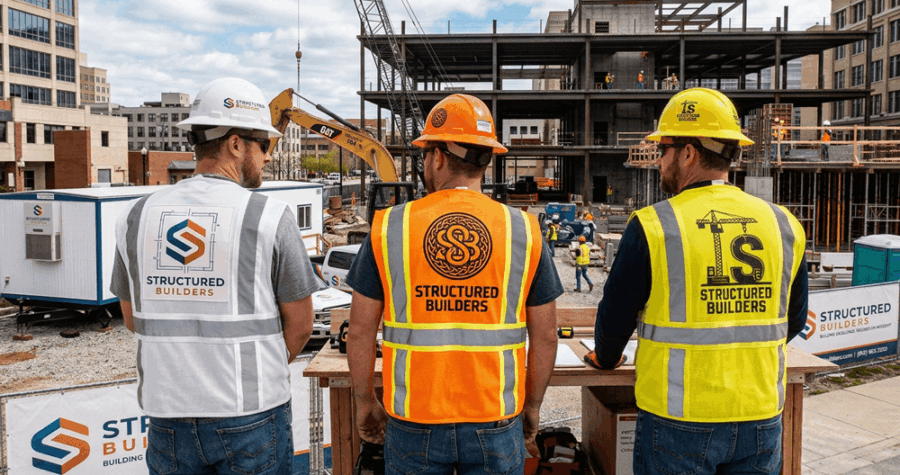
Construction companies have something most businesses would love to have: enormous physical environments where the public can see their work happening. Yet many contractors treat jobsites entirely as operational spaces and overlook them as brand experiences.
Take the logos away for a moment and ask a simple question: Does your jobsite look any different from your competitor’s jobsite?
Think about the fencing, entrance signage, trailers, equipment, cranes, dumpsters, wayfinding, safety signage, trucks, hard hats, vests, and even the cleanliness and organization of the site. A clean, organized, well-branded jobsite communicates something before anyone reads a marketing message. It suggests discipline, professionalism, pride, and attention to detail.
The jobsite trailer matters too. Clients, architects, subcontractors, inspectors, employees, and recruits may spend considerable time there. If the exterior looks temporary and neglected and the inside feels chaotic, that is a brand experience.
Your machinery and fleet are equally important. Excavators, cranes, service trucks, trailers, and other equipment can become enormous moving billboards. Companies invest millions of dollars in equipment and then sometimes put a six-inch logo on the door.
Construction is one of the few industries where companies can literally display their work, people, equipment, and brand throughout the communities they serve.
Employee Behavior Is Brand Behavior
Brand experiences do not end when employees leave the jobsite. Someone answers the company phone. Someone drives a branded truck through traffic. Someone wearing the company logo walks into a restaurant for lunch. Someone replies to a client email. Someone shows up ten minutes late to a meeting.
All of those interactions shape perception.
That does not mean marketing should police employees’ every move. It means leaders should recognize that people experience a company through its people. How quickly do employees return calls? Do they show up when promised? Are emails professional and responsive? How do crews interact with neighbors around a project? How does someone driving a branded vehicle behave on the highway?
People may never meet your CEO or visit your office. Their entire perception of the company could come from one superintendent, one truck driver, or one interaction with someone wearing the logo.
Your Client Experience Is Your Brand
Marketing does not hand the brand to Operations when the contract is signed. The project experience may be the most important brand experience the company creates.
What happens during preconstruction? How does the project begin? How are problems communicated? Does the client get surprised? How does accounting interact with them? What happens at closeout? Does the company disappear after substantial completion until somebody needs another project?
Every interaction either reinforces or contradicts the promise the company made during the pursuit.
A brand promising partnership should feel collaborative during difficult conversations. A contractor positioning itself around predictability should communicate early when conditions change. A company claiming to be easy to work with should probably have an invoicing and closeout process that is actually easy to work with.
The client does not separate Operations from Marketing. They experience one company.
Proposals and Interviews Are Brand Experiences Too
For many prospective clients, the proposal and interview are among the most concentrated experiences they have with your brand before deciding whether to hire you.
A generic proposal creates a generic impression. A proposal that understands the client’s challenges, clearly communicates value, and looks and sounds consistent with the rest of the company creates confidence.
Interviews reveal even more. Clients see how team members communicate, how well they know one another, whether executives dominate the conversation, how the proposed project team thinks, and whether the culture described in the proposal seems real when actual humans enter the room.
Good proposals and interviews should feel like the company. If they do not, either the pursuit is misrepresenting the culture or the brand has not been defined clearly enough.
Employer Brand Is Part of the Brand
Companies sometimes treat employer branding as a separate initiative owned entirely by HR. Candidates do not. They see one company.
The website, careers page, social media, employee reviews, job postings, recruiter communications, application process, interview experience, office, jobsite, and employees they meet all contribute to their perception.
The company cannot advertise its way around a bad culture. If the careers page promises opportunity and mentorship while employees experience stagnation and poor communication, the real employer brand eventually becomes obvious.
The reverse is also true. Companies with exceptional cultures sometimes struggle to recruit because nobody outside the company can see what employees already know. Marketing should help make the authentic culture visible.
Vendors and Subcontractors Experience Your Brand
Your brand extends beyond clients and employees. Subcontractors, suppliers, vendors, consultants, and partners have experiences with your company too.
How easy is prequalification? How fairly are partners treated? Do you communicate clearly? Do you pay reasonably? Are expectations predictable? Do you treat subcontractors as partners when things get difficult or immediately turn adversarial?
Those experiences travel through the industry. Construction is highly interconnected, and today’s subcontractor may become tomorrow’s referral source, joint-venture partner, client contact, employee, or competitor.
Reputation compounds quickly.
Your Community Experiences the Brand
Jobsites do not operate in isolation. Neighbors deal with noise, traffic, dust, deliveries, road closures, fencing, and workers moving through the area.
How those interactions are handled matters. A superintendent who communicates respectfully with a neighboring business creates a brand experience. So does a driver blocking access without explanation. A clean site creates an impression. So does trash blowing into the adjacent property.
This is especially important because community members may not understand the contractual boundaries of the project. They see the logo on the fence, and to them, that is who is responsible.
Digital Presence Shapes the Brand Before You Meet
Long before someone calls your office, they may have already experienced your brand online. They searched for your company, visited your website, looked through project pages, read employee profiles, checked LinkedIn, viewed photos, or asked an AI platform about contractors in your market.
What did they learn?
Does the digital presence accurately communicate the company that exists today, or does it look like the company from ten years ago? Does your website reinforce expertise or undermine it? Does your thought leadership demonstrate how your people think? Do search engines and AI platforms even understand what markets you serve and what you are known for?
The digital brand is often the first experience prospective clients and employees have with the company. It should earn enough confidence to create the next interaction.
Strong Brands Increase Perceived Value
A cohesive brand makes a company feel more credible, and that matters commercially.
A contractor with clear positioning, relevant proof, professional visuals, consistent communication, strong thought leadership, a well-managed jobsite, polished pursuit materials, and a good reputation creates confidence before price enters the conversation.
Confidence increases perceived value.
That does not mean a nice website allows you to arbitrarily charge more. It means the total brand experience gives the client more reasons to believe the company will deliver a better outcome with less risk.
When two contractors appear identical, price naturally becomes more important. When one feels clearly more capable, relevant, professional, and trustworthy, the comparison changes.
Your Brand Is the Sum of the Experiences
There is no single moment when someone experiences your construction brand. They experience pieces of it over time: a project sign, a Google search, a conversation with a superintendent, a proposal, a truck in traffic, an interview, an invoice, a LinkedIn post, a jobsite trailer, a conversation with one of your subcontractors, or an employee wearing the logo at lunch.
Eventually, all those interactions add up to an impression.
Your logo gives that impression a visual symbol. The experiences give the logo its meaning.
That is your brand.
Introducing the Magnetic Brand
Construction companies often describe a strong brand as one that is well known. Recognition certainly helps, but familiarity alone does not make a company magnetic.
A magnetic brand attracts the right clients, the right employees, and meaningful attention within the markets it wants to serve. It gives people a clear reason to notice the company, understand its value, and want to become part of what it is building.
That kind of brand does all three together. A company that attracts clients but cannot recruit the people needed to perform the work has a growth problem. A company that attracts applicants but is overlooked by its best prospects has a revenue problem. A company that receives attention without turning it into trust, relationships, and opportunities has a visibility problem.
A magnetic brand aligns those forces around the company’s business strategy.
A Brand Is Not a Logo
Construction companies frequently reduce branding to visual identity. They update a logo, adjust the colors, redesign the website, and describe the result as a rebrand.
Those elements matter. An outdated or inconsistent identity can make a sophisticated contractor appear smaller, less capable, or less disciplined than it is. Visual improvements can help a company communicate its evolution and present itself more credibly.
But a brand is not the logo. It is the collection of expectations, impressions, experiences, and stories associated with the company. It exists in the client’s perception of the preconstruction team, the subcontractor’s experience getting paid, the candidate’s interaction with a recruiter, and the employee’s confidence in leadership. It lives in what people say about the company when its representatives are not in the room.
A new logo can signal change. It cannot create a magnetic brand by itself.
Magnetic Brands Know What They Want to Attract
Magnets do not attract everything, and neither should a construction brand.
The strongest construction companies are not trying to appeal equally to every buyer, market, employee, and project type. They understand where they provide the most value and focus their energy accordingly.
That requires leadership to make choices. Which clients fit the company’s culture and capabilities? Which projects generate healthy returns? Which markets offer sustainable opportunities? Which employees are most likely to thrive? What reputation will help the company reach its next stage?
Without those decisions, the brand becomes broad and beige. The company promises quality, safety, integrity, experience, and relationships because those statements feel safe and familiar. Unfortunately, nearly every qualified competitor is making the same claims.
A magnetic brand is specific enough to attract the right people and distinct enough to help them understand why the company deserves consideration.
Magnetic Brands Are Known for Something
Ask ten leaders what their company is known for, and they may provide ten different answers. Ask clients, employees, and subcontractors, and the picture may become even less consistent.
That inconsistency is not merely a messaging problem. It may indicate that the company has not made the strategic choices necessary to build a clear market position.
Being known for something does not require trapping the company in a tiny niche. A contractor can serve multiple markets, regions, and client types while maintaining a recognizable point of view and a consistent standard of value. The company might be known for bringing clarity to complicated preconstruction decisions, protecting ongoing operations during occupied renovations, or understanding the regulatory and operational demands of a specific market.
The important question is not whether the company can write a memorable tagline. It is whether the market can connect the company’s name with a meaningful strength.
Attraction Must Be Supported by Experience
Marketing can generate interest, but the experience determines whether the attraction lasts.
A polished website may bring a prospect into the conversation, but an unfocused interview can push the prospect away. Strong recruiting content may increase applications, but a disorganized hiring process can undermine the employer brand. A compelling proposal may help win the project, but inconsistent communication during construction will shape whether the client returns.
This is why brand building cannot belong exclusively to the marketing department. Marketing can help define the promise, communicate it, and measure how it is perceived. Leadership and operations must ensure that the company consistently delivers it.
The strongest brands create alignment between what they say and what people experience. Over time, that consistency builds trust.
Magnetic Brands Create More Than Awareness
Awareness is useful, but it is not the final objective. A company can sponsor every event in town and still struggle to explain its value. It can have thousands of social-media followers and remain absent from the right pursuit lists.
A magnetic brand turns recognition into preference.
Clients invite the company into conversations earlier because they value its perspective. Business developers encounter prospects who already understand the company’s strengths. Employees recommend the organization to people in their networks. Candidates arrive with a clearer picture of the culture. Journalists, associations, and industry partners look to the company for informed opinions.
None of those outcomes happens because the brand is louder. They happen because it is relevant, credible, distinct, and consistently reinforced.
Smaller Companies Can Be More Magnetic Than Goliaths
A magnetic brand is not reserved for the largest companies with the largest marketing budgets. Smaller contractors can outperform much larger competitors when they possess a clearer position, stronger relationships, and a better understanding of their ideal clients.
Large companies often have more awareness, but their messaging can become diluted across offices, markets, and service lines. A focused company can communicate with greater specificity and demonstrate a depth of understanding that a generalist struggles to match.
The objective is not to appear bigger than the company is. It is to make the company’s actual strengths more visible, valuable, and credible.
Building a Magnetic Brand Takes Discipline
Magnetic brands are built through repeated choices. Leadership chooses where the company will compete. Marketing develops research, positioning, messaging, and campaigns around those decisions. Business development reinforces the position through relationships. Operations delivers the promised experience. Human resources connects it to recruiting and retention.
Measurement matters too. Revenue growth, profitability, hit rate, client retention, employee retention, inbound opportunities, qualified applicants, and market recognition can all provide evidence of whether the brand is becoming stronger.
Some of those indicators take time to change. That is why brand building requires more discipline than launching a new campaign or redesigning a website. It is an ongoing business practice.
A magnetic construction brand does not chase every opportunity or try to be everything to everyone. It creates a clear and credible pull toward the clients, employees, and attention the company needs to grow.
That is the standard A/E/C CMOs believes construction companies should pursue—and the conventional industry thinking we intend to challenge.

What is A/E/C CMOs?
A/E/C CMOs is a construction marketing firm primarily offering fractional Chief Marketing Officer services to growth-minded construction companies.
But the bigger idea is not simply giving contractors access to a part-time marketing executive.
A/E/C CMOs exists to help construction companies build stronger businesses through better marketing: attracting the right clients, pursuing more profitable work, creating brands people remember, improving client retention, recruiting better-fit employees, and building the systems needed to support sustainable growth.
Construction marketing has spent too long being defined by proposals, events, social media, and promotional materials. Those things have a place, but they are outputs. They are not the strategy.
Marketing should help drive the business.
TL;DR
A/E/C CMOs provides executive-level construction marketing leadership without requiring a company to hire a full-time CMO.
We help construction companies determine where they should grow, which clients and employees they want to attract, how they should position themselves, and what marketing systems and strategies are needed to get there. Fractional CMO engagements include strategic leadership and access to delivery support, so clients are not left with a strategy deck and a list of agencies to manage.
A/E/C CMOs is also building a broader platform around construction marketing research, education, proprietary frameworks, publishing, and thought leadership designed to help elevate marketing across the industry.
Construction Companies Need More Than Marketing Activity
A construction company can have a busy marketing department and still have a weak marketing strategy.
Proposals are going out. Social media is active. The company sponsors events, attends conferences, orders branded gear, updates the website, and keeps producing new collateral.
Everyone is busy.
But ask a few bigger questions.
Which clients are the most profitable?
Which market sectors should the company grow?
What is the company known for?
Why should an ideal client choose it instead of five capable competitors?
Which service lines deserve more investment?
Which prospects should business development prioritize?
What type of employee thrives inside the organization?
How does marketing support the CEO’s vision for the next five years?
Those are the questions a CMO should help answer.
A/E/C CMOs was built around the belief that marketing should have a seat at that table.
Fractional CMO Leadership for Construction Companies
For many construction companies, hiring a full-time Chief Marketing Officer does not make sense yet.
They may have a Marketing Director, Manager, Coordinator, proposal team, or outside agencies doing excellent execution work. What is missing is an experienced executive marketer who can connect those activities to the company’s business strategy.
That is where a fractional CMO fits.
A fractional CMO works as part of the leadership team without requiring the company to hire another full-time executive. The role is especially valuable for companies in growth mode, companies whose marketing function has outgrown its current structure, and companies facing major changes such as geographic expansion, new service lines, acquisitions, rebranding, or generational ownership transitions.
The work starts with understanding the business.
What does leadership want to achieve? Where is the company most profitable? Where does it have capacity? Which clients are worth pursuing? Where does business development struggle? What is preventing the company from becoming the obvious choice for the clients and employees it wants most?
Then marketing gets built around those answers.
Start With the Right Clients
One of the first things we establish is the Ideal Client Profile, or ICP.
Construction companies often define growth too broadly. They want more revenue, more opportunities, more leads, and more projects.
But more is not always better.
Some clients create stronger margins, healthier relationships, more repeat work, and better opportunities for employees. Others create tremendous volume while consuming resources and producing very little profit.
Marketing should help the company attract more of the first group.
Once the ICP is clear, marketing and business development can create a prioritized target-account strategy. The most important prospects receive deeper research and highly personalized attention. Other qualified prospects receive appropriate levels of customization and ongoing visibility.
Instead of chasing everyone, the company becomes more deliberate about who deserves its time.
That same discipline carries into project pursuits. A great client can still have a bad project, which is why the ICP and Go/No-Go process have different jobs. One identifies the organizations the company wants relationships with. The other determines whether an individual opportunity is worth pursuing.
Marketing and Business Development Should Reinforce Each Other
Construction is still a relationship-driven industry.
That does not make marketing less important. It makes coordination between marketing and business development more important.
Marketing builds awareness, creates positioning, develops thought leadership, provides account intelligence, supports targeted outreach, and gives business developers useful reasons to stay in front of prospects. Business development strengthens relationships, uncovers opportunities, gathers market intelligence, and brings direct client feedback into the organization.
When the two functions work well together, the company becomes easier to find, easier to understand, and easier to trust.
For must-win opportunities, marketing should also help guide pursuit strategy. That does not mean the CMO spends the week formatting proposals. It means helping the pursuit team determine what matters to the client, where the company is genuinely differentiated, which experience is most relevant, and how to communicate value rather than merely list qualifications.
We Care More About Profitable Growth Than Marketing Vanity Metrics
A/E/C CMOs is not built around generating more activity for the sake of activity.
More website traffic is not particularly useful if it comes from people who will never hire you. More leads do not help if they are for work you should not pursue. More revenue is not a victory if the projects reduce margins and burn out your best employees.
Marketing should contribute to a stronger bottom line.
That requires understanding backlog, capacity, market sectors, service lines, client retention, pursuit performance, and where the company actually makes money.
The goal is not simply to make construction companies bigger.
It is to help make them stronger, more profitable, more differentiated, and more resilient.
Strategy Without Execution Is Just a Nice Presentation
One frustration with the traditional fractional CMO model is that many engagements stop at strategy.
The CMO develops the plan, then the client is left managing a collection of agencies, freelancers, web developers, SEO firms, designers, and other vendors to actually get the work done.
That can become expensive and cumbersome very quickly.
A/E/C CMOs is being built differently.
Fractional CMO engagements include strategic leadership along with access to delivery capabilities for the marketing work required to execute that strategy. The goal is to reduce the number of disconnected vendors clients have to manage while keeping marketing aligned under one strategic direction.
The client should not need to spend another six figures with multiple agencies every time the strategy identifies a website, brand, content, SEO, or campaign problem that needs to be fixed.
Strategy and execution should work together.
Build Marketing Systems That Can Scale
Good marketing should not depend on one employee remembering where everything lives.
A/E/C CMOs helps companies develop the infrastructure behind marketing: CRM systems, brand standards, project and proposal libraries, content processes, analytics, website tracking, contact intelligence, playbooks, templates, dashboards, communication frameworks, and documented procedures.
Construction companies frequently grow faster than their marketing systems.
What worked when the company had one office and 100 employees becomes much harder to manage after acquisitions, geographic expansion, additional service lines, and a larger marketing team.
Building the foundation makes future growth easier.
It also reduces dependence on tribal knowledge.
Brand Is a Business Tool
A/E/C CMOs believes strong brands do much more than make a company look professional.
A strong construction brand helps attract the right clients, employees, partners, and opportunities. It makes the company easier to recognize, understand, remember, and recommend.
That requires more than a good logo.
Brand includes positioning, differentiation, personality, messaging, reputation, client experience, employee experience, digital presence, jobsite visibility, and what people say about the company when its employees are not in the room.
Our goal is to help construction companies build magnetic brands: brands that attract the right people instead of constantly chasing them.
That idea will continue to develop through A/E/C CMOs’ research, tools, and proprietary frameworks.
Construction Marketing Should Help Recruit, Too
Growth does not happen without people.
Construction companies cannot take on more work if they cannot recruit and retain the people needed to deliver it. That makes employer brand, applicant experience, careers content, internal communications, and culture part of the marketing conversation.
Marketing should work closely with HR while owning how the company communicates its employer brand externally.
The same principle used to identify ideal clients applies to employees. Start by looking at the people already succeeding inside the company and ask what characteristics leadership would want to clone.
Then build recruiting communication around attracting more people who fit that profile.
More applicants are not automatically better.
Better-fit applicants are.
Marketing Is Also an Internal Leadership Function
Marketing touches almost every department in a construction company.
Business development, estimating, operations, safety, HR, finance, field leadership, and executives all interact with marketing in different ways. That gives the marketing leader an unusually broad view of the organization.
A strong CMO can help communicate the CEO’s vision, build internal communication frameworks, support cultural initiatives, and identify disconnects between departments before they become larger problems.
Sometimes marketing is the thermometer, detecting what is happening inside the organization.
Sometimes it needs to become the thermostat and help change the environment.
That role becomes particularly important during acquisitions, leadership transitions, rebrands, major growth initiatives, and other moments when employees need clear, consistent communication.
Research Should Elevate the Industry
A/E/C CMOs is not intended to be only a consulting company.
Research is an important part of the vision.
Construction marketing needs more industry-specific benchmarks, original data, and rigorous thinking. Too much marketing advice is borrowed from other industries and applied to AEC companies without considering how differently construction actually works.
A/E/C CMOs will continue developing and publishing original research around construction marketing, branding, digital visibility, differentiation, and other issues affecting the industry.
The objective is not to produce research merely to generate leads.
Good research gives construction executives better information for making decisions, gives marketers stronger benchmarks for evaluating their work, and helps advance the profession.
If it also makes conventional industry thinking a little uncomfortable occasionally, that is probably healthy.
Building a Better Career Path for Construction Marketers
There is another reason A/E/C CMOs exists.
Construction has some extraordinarily talented marketers, but the traditional career path often creates a ceiling.
Many professionals build careers around proposals, events, and marketing execution, then discover there are limited opportunities to move into true executive marketing leadership or ownership.
A/E/C CMOs is designed to become larger than one person selling his time.
That is one reason I intentionally did not name the company after myself or build the brand around my personal life. The long-term vision includes creating opportunities for experienced construction marketers to become fractional CMOs, develop broader business acumen, build ownership opportunities, and help raise the level of marketing leadership throughout the industry.
I want A/E/C CMOs to create better marketing for construction companies and better opportunities for the people capable of leading it.
Construction First, but Not Construction Only
Construction is the starting point because it is where our experience, relationships, and deepest expertise live.
Over time, A/E/C CMOs can expand farther across the build industry, serving companies whose businesses intersect with the planning, design, construction, operation, and support of the built environment.
That expansion will not come from trying to be everything to everyone.
It will come from applying the same principle we recommend to clients: understand where you create the most value, earn credibility there, and expand deliberately.
What A/E/C CMOs Is Building
A/E/C CMOs is building a different model for construction marketing leadership.
Fractional CMO services are at the center of it, but the larger platform includes execution support, original research, proprietary frameworks, publishing, education, speaking, and tools that help construction leaders make better growth decisions.
The common thread is simple.
Construction marketing should not be confined to proposals, events, and promotional activity. It should help leadership decide where the company is going, who it wants to grow with, why those people should choose it, and what needs to change inside the business to make that growth possible.
That is what A/E/C CMOs is here to do: help construction companies build stronger brands, attract better-fit clients and employees, and grow more profitably.