
What Your Jobsite Says About Your Company
Construction companies spend a lot of time thinking about what their websites, proposals, presentations, and social media say about their brands. Meanwhile, the biggest brand experience they have may be sitting on a city block for 18 months.
Your jobsite is probably the most visible expression of your construction brand, and it may be the most impactful.
Thousands of people can drive or walk past it. Clients visit it. Architects and engineers attend meetings there. Prospective employees see it. Neighbors live beside it. Other contractors work inside it. Your client’s executives may bring their own leaders or customers through to show off the project.
All of those people are forming opinions about your company before they ever read your About page. A clean, organized, professional jobsite reinforces confidence, while a sloppy one can undermine millions of dollars spent trying to position the company as sophisticated, safe, innovative, or detail-oriented.
Your website tells people what kind of contractor you are. Your jobsite gives them evidence.
The Jobsite Is a Giant Brand Experience
Think about the physical footprint of a significant construction project. There may be fencing around an entire city block, a tower crane visible for miles, multiple trailers, dozens of workers entering every morning, delivery trucks moving throughout the day, equipment operating in public view, and hundreds or thousands of vehicles passing the site every week.
For many people, this is the only interaction they will ever have with your company. That makes the jobsite far more than an operations environment. It is a billboard, workplace, client experience, recruiting tool, community presence, and demonstration of how your company operates.
The best contractors recognize that. Brand standards should not stop when someone leaves the corporate office.
Start With the Obvious: Can Anyone Tell Whose Jobsite It Is?
I am still surprised by how many substantial construction projects have little or no contractor identification. There may be a small project sign tucked behind a fence, an old banner flapping in the wind, or a sun-faded logo that looked good when it was installed 14 months ago. Sometimes the only obvious branding belongs to the equipment rental company.
If you are going to occupy a highly visible piece of real estate for a year or two, use it. Depending on the project, branding opportunities might include:
- Project identification signs
- Fence banners and scrims
- Jobsite trailer graphics
- Entrance and directional signage
- Safety signage
- Branded gates
- Crane signage
- Tower wraps
- Equipment decals
- Temporary walls and barricades
- Project information boards
- QR codes linking to project information, careers, or the company website
- Recruiting messages
- Community information
- Client and project-team recognition
Not every site needs every one of these. A remote industrial project and a downtown high-rise clearly have different audiences and requirements. But no signage, damaged signage, crooked banners, dirty graphics, or six different versions of the company logo communicate something too, and usually it is not the message marketing intended.
Maintaining the signage matters just as much as installing it. If your banner is torn, replace it. If the project sign is covered in mud, clean it. If the temporary fencing has become a collection of sagging panels and zip ties, somebody should own fixing it. Details communicate standards.
Your People Are Wearing the Brand
PPE creates another interesting branding opportunity because construction sites are inherently multi-brand environments. The GC or CM might have its logo on hard hats and safety vests, but so do the electricians, plumbers, mechanical contractor, concrete subcontractor, steel erector, safety consultants, and dozens of other companies.
That is fine. A strong jobsite does not need everyone wearing the general contractor’s logo. Trade partners should maintain their own identities, and seeing a variety of respected companies on a project can reinforce the scale and complexity of the work.
What matters is whether the GC or CM’s team looks intentional and identifiable. Consistent hard hats, vests, shirts, jackets, and other field gear reinforce the company’s presence and help clients immediately recognize the project team.
They also build internal identity. Well-executed branded PPE can create team pride in the same way uniforms do in sports, because it communicates that there is a company behind the individual and a standard associated with being part of that company.
Heavy Equipment Can Become Brand Media
Few industries own more impressive physical assets than construction: excavators, dozers, cranes, loaders, trucks, lifts, and specialized equipment. Yet many contractors barely think of that equipment as part of the brand.
It does not need to become a rolling billboard, but recognizable equipment creates repeated impressions in the market. A clean logo on an excavator working beside a highway may be seen by tens of thousands of people, while a tower crane can dominate a skyline for months.
Some companies take this much further. Demo Diva is one of the most obvious examples. Its pink demolition equipment is inseparable from the brand, and you can recognize Demo Diva without reading the company name because the equipment itself has become a distinctive brand asset.
Most contractors should not paint their excavators hot pink. The lesson is not the color. The lesson is recognizing that your physical assets communicate your brand whether you manage them intentionally or not.
A Dirty Jobsite Is Still a Dirty Jobsite
This is where the brand conversation needs to get blunt. A filthy, chaotic, poorly organized jobsite makes your company look sloppy.
You can have an award-winning website, beautiful proposal templates, professional photography, and an expensive new brand identity. If the owner walks the site and sees trash everywhere, poorly organized materials, damaged signage, unclear pathways, and crews who appear to be operating without control, all that polish becomes less convincing.
Construction is messy, and nobody expects an active jobsite to look like an Apple Store. But there is an obvious difference between construction happening and a site being poorly managed.
Housekeeping, material organization, clean access points, clear pedestrian paths, orderly laydown areas, dumpsters that are actually being used, and good wayfinding communicate discipline. Clients may not understand every technical aspect of the work being performed, but they understand order.
If the jobsite appears under control, they are more likely to believe the project is under control. If it looks chaotic, they start wondering what else is chaotic.
Your Client Visits More Often Than You Think
It is easy for marketing teams to think of the jobsite as primarily an operations environment. The client sees something different.
Owners regularly come to the site for OAC meetings, progress walks, milestone events, inspections, tours, and executive visits. They may bring senior leadership, investors, board members, donors, tenants, customers, or other stakeholders with them, and sometimes the construction project itself is something they are proud to show off.
Imagine an owner bringing their CEO onto the project and immediately encountering confusing parking, poor wayfinding, trash near the entrance, and a trailer that looks like nobody has cleaned it in six months.
Now imagine the opposite. The site is easy to enter. Parking is clear. Visitors know where to go. The team greets them professionally. PPE is available. The trailer is organized. Plans, visuals, safety information, schedules, and project branding reinforce that this is an important project being run by professionals.
Those experiences affect confidence. They also affect whether that client wants to work with the team again.
People Judge How Your Employees Behave
Brand is not just visual. Your team’s behavior may be even more memorable than your signage.
How do workers park? Do they block neighboring businesses or residential driveways? Are radios blasting? How do employees interact with pedestrians? What happens when someone has a question? Are workers respectful around occupied facilities? Are crews leaving trash outside the project perimeter? How do they behave when they go to the convenience store or restaurant next door wearing your logo?
Those moments count.
Bad parking sounds trivial until 20 workers take every available space outside a neighboring business for three months. At that point, your project has created a group of people who may never hire your company but absolutely have an opinion about it.
Construction marketing does not control those behaviors, but the brand still gets credit or blame for them.
The Internet Means the Neighborhood Is Watching
A recent Instagram phenomenon illustrates this perfectly. The “Office Girlies” have been talking about the construction jobsite next door to their office. They are not construction executives reviewing the contractor’s formal marketing. They are simply neighbors observing what is happening outside their window, and the construction site has become part of their content and conversation.
That should be a reminder for every contractor. People notice jobsites. They notice the workers, progress, unusual activity, equipment, and anything that feels impressive, funny, disruptive, thoughtful, or frustrating.
And now they have cameras in their pockets and platforms where they can tell thousands of other people what they noticed. Your communications team is no longer the only one documenting your project.
Public-Facing Projects Create Even More Opportunity
The branding impact becomes especially important when construction happens in downtown areas, neighborhoods, hospitals, schools, universities, retail environments, or other occupied spaces.
Instead of treating the surrounding community as an inconvenience to manage, great contractors can involve them. Building next to an elementary school? Create a safe opportunity for students to learn about construction. Explain what the crane does. Let them decorate hard hats. Show them how the building is coming together.
Working at a children’s hospital? There may be opportunities to engage patients and families from a safe distance, decorate a crane, celebrate milestones, or make construction part of a positive experience rather than simply a disruption outside their window.
Working downtown? Think about what neighboring businesses and pedestrians experience every day.
These activities need to be coordinated with clients, safety teams, and site operations, but they can turn the unavoidable disruption of construction into community goodwill. They can also introduce children and young adults to careers they may never have considered, creating brand value and workforce development at the same time.
The GC Owns the Overall Experience
On a large project, there could be dozens of companies represented. That does not mean the GC gets to say, “That wasn’t our employee.”
From the client’s perspective, the general contractor or construction manager owns the jobsite experience. Trade partners should absolutely maintain their own brands, and there is no reason everyone needs matching logos.
But the GC sets expectations for housekeeping, safety, logistics, access, parking, signage, professionalism, and the overall condition of the site. The superintendent may therefore be one of the most important brand managers in the entire company, even if they do not think of themselves that way.
The superintendent influences what the client, architect, subcontractors, employees, neighbors, and visitors experience every day for the life of the project. Few people in the organization have more opportunities to prove what the company’s brand actually means.
A Jobsite Can Recruit Your Next A Player
There is also an enormous employer-brand opportunity here. Construction professionals notice other jobsites.
They see which companies appear organized. They see the equipment. They see how people are treated. They hear from friends working on the project. They notice whether the superintendent seems to have control of the job or whether everyone is constantly putting out fires.
Prospective employees are evaluating you long before they visit your Careers page.
A strong jobsite tells an A player that this looks like a place where good people can do good work. It can also repel the wrong people, which is equally valuable.
If your company expects clean jobsites, disciplined planning, professional behavior, strong safety practices, organized logistics, and high accountability, someone who dislikes those standards may decide your company is not for them.
Good. A strong employer brand should attract people who fit and discourage people who do not.
Your jobsites are one of the clearest demonstrations of what the organization actually expects.
Make Every Jobsite Camera Ready
Years ago, I worked with a contractor that used the phrase “camera ready” for every jobsite, a concept they had borrowed from Disney World.
The idea was simple: at any moment, someone could take a picture. It might be marketing, the client, an employee, a neighbor, or someone posting to social media.
So the site should be ready to represent the company.
I still think that is one of the best jobsite brand standards I have heard. It does not mean hiding the realities of construction or stopping work every time someone pulls out a phone. It means establishing a baseline level of organization and pride so that the company is comfortable with what people see.
That standard also makes marketing dramatically easier. If the site is consistently camera ready, project teams can send photos without marketing having to crop out piles of trash, damaged signs, inappropriate graphics, or someone wearing a competitor’s shirt front and center.
Field photography becomes more useful for recruiting, social media, project profiles, award submissions, proposals, case studies, and client communications. The operations standard creates marketing assets almost automatically.
I Have Seen the Difference Firsthand
A few years ago, I had the opportunity to tour a Rogers-O’Brien jobsite in Waco while demonstrating construction robotics.
What stuck with me was not a giant branding gimmick. The site was organized, the wayfinding was good, the team was professional, and the environment felt controlled.
That matters.
I have visited enough construction companies and jobsites throughout my career to know that you start forming opinions quickly. You notice whether people seem prepared. You notice the trailer. You notice how visitors are handled. You notice whether you know where to go. You notice whether the team appears proud of the place.
Those impressions reinforce everything the company claims elsewhere about its culture, quality, safety, and professionalism, or they contradict it.
Your Jobsite Is Also Content
A well-run site creates another advantage: proof.
Marketers spend a tremendous amount of time looking for ways to demonstrate expertise, experience, trust, and authority. The jobsite is full of all four.
It shows real people doing real work. It demonstrates the scale and complexity of your projects. It gives subject matter experts things to explain. It provides visible evidence of planning, technology, safety, coordination, craftsmanship, and problem-solving.
It also creates stories.
Instead of staging generic corporate content, marketing can document the expertise already happening in the field. A clean mechanical room can demonstrate coordination. A complicated logistics plan can become an educational post. A crane pick can become a video explaining planning and safety. A superintendent can explain why the team sequenced part of the job a particular way.
A student tour can become both community and recruiting content.
The brand becomes far more credible when people can see the company doing what it says it does.
Walk Your Own Jobsite Like a Stranger
Construction leaders should occasionally walk onto one of their projects and pretend they know nothing about the company. Do not start by evaluating production. Look at the experience.
Could you tell immediately who is building the project? Is the signage in good condition? Can a visitor figure out where to park and where to go? Does the site appear organized? Are entrances clean? Do your people look like a team?
How are neighboring properties being treated? What would a client’s CEO notice? What would an experienced superintendent working for a competitor notice? What would a parent walking a child past the fence notice?
And if someone pulled out their phone and started filming right now, would you be comfortable with the result?
Those are brand questions. They are also operations questions, recruiting questions, client-experience questions, and leadership questions.
That overlap is exactly why the jobsite matters so much.
Your Brand Is Already on Display
A construction company does not get to decide whether its jobsites are part of the brand. They already are.
The only decision is whether you manage them that way.
Put up good signage and maintain it. Make your people recognizable. Take pride in your equipment. Keep the site organized. Set expectations for behavior. Respect the neighborhood. Think about visitors. Create community engagement when appropriate. Give employees a workplace they are proud to show other people.
Most importantly, make sure the experience in the field supports the promises being made everywhere else.
Because your website may be the place where someone reads about your commitment to quality, professionalism, safety, innovation, or people. Your jobsite is where they decide whether they believe you.
 By perryn@aeccmos.com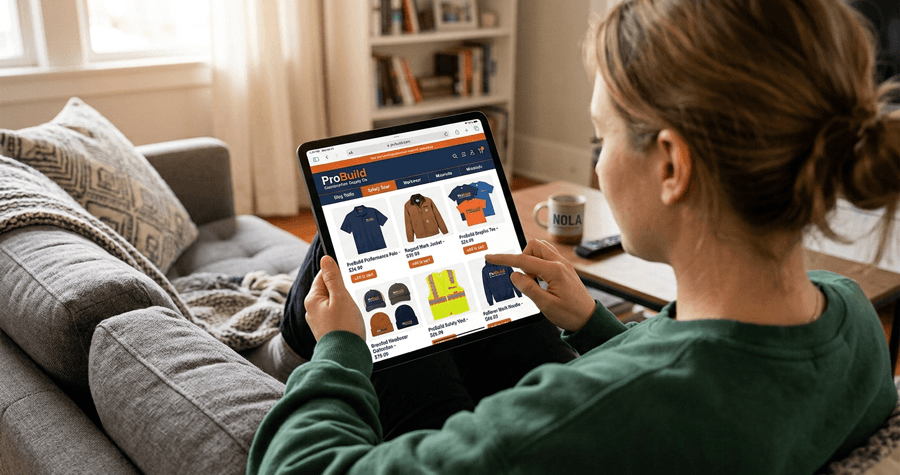
Why Construction Companies Need a Company Store

The Problem Usually Starts Small
A company with 10 employees can probably manage apparel with a spreadsheet and a few emails. Someone asks everyone for their shirt size, marketing orders 20 polos, and a box arrives at the office. It is not elegant, but it works.
Then the company grows. There are 50 employees instead of 10, some work remotely, others are assigned to projects hours away from headquarters, and maybe a second office opens. Field employees need different gear than office employees, leadership wants higher-end apparel for client-facing staff, and new hires arrive throughout the year.
Those are all good problems for a growing company to have, but now marketing has an Excel sheet containing everybody’s sizes, except three people never responded and somebody has lost 30 pounds since the last order, and a new hire starts next week. The process starts consuming time that nobody planned to spend on clothing.
A company store removes much of that friction because employees select their own items, choose their own sizes, provide the correct shipping information, and place their orders themselves from a catalog that marketing has already approved. It shifts marketers from processing individual orders to managing the overall system.
Employees Already Know How to Use an Online Store
One of the biggest advantages is also the simplest: nobody has to teach an employee how to order a jacket online.
Employees select the item, pick their size, choose any approved options, enter or confirm their shipping information, and complete the order. The experience is essentially the same as buying something from any other e-commerce site.
That eliminates one of the most annoying recurring jobs for marketing and administrative teams: collecting sizes. Instead of emailing 75 people asking for polo, jacket, vest, and T-shirt sizes and then trying to reconcile the responses, employees are responsible for selecting what actually fits them.
The same applies to delivery. Most companies I work with consolidate orders to their respective offices, while remote employees can have items shipped directly to them. Marketing no longer needs to receive six boxes at headquarters and spend an afternoon figuring out how to get one jacket to a superintendent working three states away.
More importantly, marketing’s purpose is to help the company grow. Moving repetitive, time-consuming, non-revenue-generating fulfillment tasks to a trusted outside partner gives marketers more time to focus on positioning, business development support, recruiting, content, campaigns, and the other work that actually drives the business forward.
Give Employees Freedom to Choose Without Giving Up Brand Control
A company store solves another common tension. Employees generally appreciate branded apparel more when they have some choice, while marketing and leadership still need to control how the company’s brand and image are represented in public.
A store gives you both.
Many construction companies provide each employee with an annual apparel stipend or credit. Instead of giving everyone the exact same shirt, employees can choose from an approved collection of polos, button-downs, T-shirts, jackets, vests, hats, and other items.
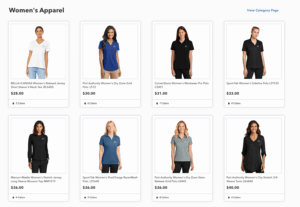 One employee may want a quarter-zip while another would rather have a jacket. Someone who always wears long sleeves can choose accordingly, while another employee may prefer polos. Let’s not forget female employees can pick out options that actually fit their bodies instead of being forced to wear the same polo shirt as everyone else. Employees can often purchase additional approved items for themselves or their families after using their company allowance.
This also works well for recognition and bonuses. Instead of giving everyone the same piece of swag, a company can award store credit and let the employee choose something they will actually use.
Marketing controls the catalog, products, and designs, while leadership determines the budget. That is a much better division of responsibility than asking the marketing coordinator to become everyone’s personal shopper.
A Store Protects Your Brand Identity
Construction companies accumulate old branded material surprisingly quickly. There is the current logo, the previous logo, the version somebody stretched horizontally, the old safety vest that uses the wrong shade of blue, the polo embroidered by a local vendor who recreated the mark instead of asking for the artwork, and the project sign using a logo that was retired four years ago.
It happens because physical brand assets are often decentralized. A superintendent needs something quickly and orders it locally. An office manager has a vendor they have used forever. A project manager finds an inexpensive website. Someone sends the wrong artwork because it is the first logo file they find.
A company store dramatically reduces that problem because employees are selecting from products and designs that have already been approved. Marketing can control the logo, colors, placement, product quality, decoration method, artwork, and available options before anything is ordered.
When the brand changes, marketing updates the store rather than chasing old artwork throughout the company. I have also seen contractors use apparel buy-back programs during a rebrand, where employees turn in old company apparel and receive credit toward new apparel. That helps remove obsolete logos from circulation much faster without making the transition feel punitive.
It Also Controls Your Vendors
Vendor sprawl is another hidden headache. One office uses a local embroiderer. Another orders promotional products online. Operations has a favorite sign company. HR orders new-hire items somewhere else, and somebody has an account with a national promotional-products website.
Individually, each decision may be reasonable. Collectively, they create inconsistent quality, inconsistent pricing, duplicate vendors, multiple invoices, and almost no control over the company’s physical brand.
A company store lets you consolidate much of that spending through a smaller number of trusted vendors. That does not mean one vendor has to manufacture everything, because a good store provider can manage the supplier relationships behind the scenes while employees experience one ordering system.
For a multi-office or multi-brand company, that single pane of glass becomes particularly valuable. Marketing can see what is available, employees know where to order, leadership knows where the money is going, accounting deals with fewer purchasing processes, and individual offices have less reason to create their own solutions.
A well-designed store can also collect variable information during checkout, such as office, department, project number, job cost code, or other accounting data. That makes cost allocation and invoicing considerably easier for accounts payable instead of requiring someone to decipher every order after the fact.
Apparel Is the Best Place to Start
I would not try to move every physical branded item into a store on day one. Start with the biggest pain point, which for many contractors is apparel because it creates the most sizing issues, employee requests, and administrative work.
Get that working first, then add other categories as the need becomes clear. Over the next year, that might include PPE, jobsite signage, promotional products, new-hire kits, awards, event materials, stationery, or temporary campaigns.
This approach is easier for employees too. They become accustomed to using the store for apparel before additional categories and workflows are introduced.
PPE Belongs in the System Too, but It May Need Its Own Rules
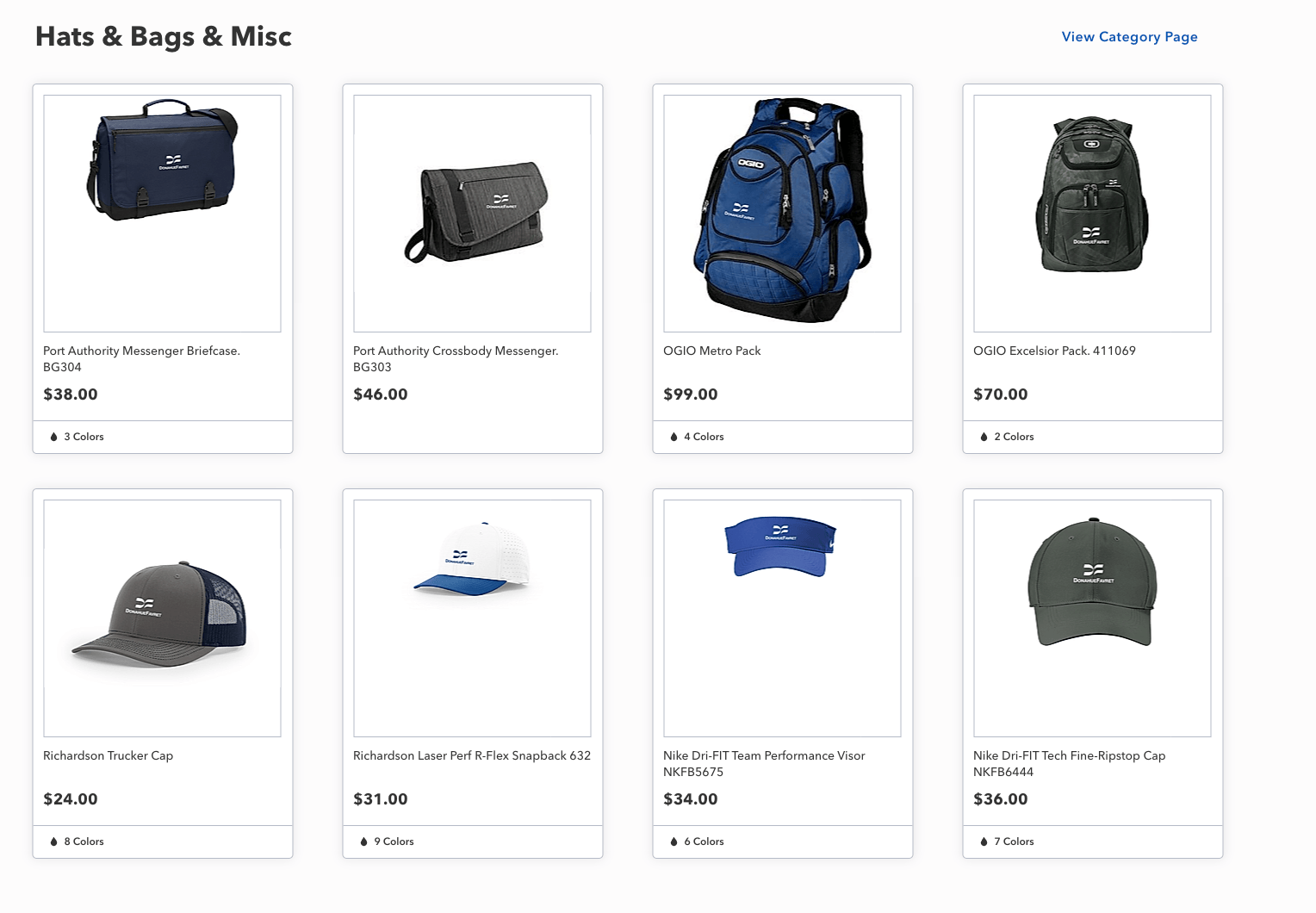
PPE is a natural extension, particularly for contractors with a large field workforce, but it operates differently from optional employee apparel. Required safety equipment is company-funded and may need different controls, approvals, and fulfillment rules.
Depending on the organization, PPE can live in a standalone store or in a protected section of the main store that employees access through an approved code or allowance. This keeps company-paid safety purchases separate from an employee’s apparel stipend while maintaining one familiar ordering experience.
The company can maintain approved branded hard hats, safety vests, gloves, field shirts, and other gear alongside non-branded safety items employees routinely need. This can be particularly helpful during onboarding because essential PPE and new-hire gear can be kept in inventory and ready when the employee starts.
A hybrid inventory model usually makes the most sense. Keep stock of the PPE and essential gear needed continually, place bulk apparel orders a few times per year for better pricing, and use print-on-demand where the added flexibility is worth a slightly higher unit cost.
The store remains the interface even though the purchasing rules and fulfillment methods behind different products may vary.
Jobsite Signage Is a Great Next Step
This is one of the applications construction companies often overlook. If every jobsite needs signage, why should every project team reinvent the ordering process?
A centralized signage store can standardize items such as:
 Fence mesh and banners
- Wayfinding
- Project identification
- Safety requirements
- Visitor check-in
- Surveillance notices
- Restricted-access areas
- Recruiting signage
- Project-team signs
- Community information
- Other frequently used site graphics
Using one trusted signage partner that can ship nationally means the sign installed in Texas can look like the one installed in Florida, Minnesota, or Louisiana. Marketing gets involved in developing and approving the design system once instead of recreating or correcting signs project by project.
The project team selects what it needs, enters the project-specific information, and has the signage delivered directly to the jobsite. The project pays for it, while marketing maintains control over the design and approved artwork.
When I CMO at REX Construction, REI Promos developed a store specifically around jobsite signage and it saved my marketing team 5-10 hours per project. It is a good reminder that a “company store” should not be thought of only as a place to buy polo shirts, it can solve a real construction operations problem.
Multi-Brand Companies Benefit Even More
The administrative case gets stronger when one organization owns multiple brands. I worked with a national ESOP with five different brands using a store structure to help manage apparel across the organization. Without a centralized system, imagine the potential complexity: five logos, different colors, multiple employee groups, separate budgets, numerous apparel choices, and employees spread around the country.
A company store gives marketing and leadership one place to manage the system while preserving the distinct identity of each brand. That becomes increasingly useful as construction companies grow through acquisitions.
Also, an acquirer does not necessarily want every acquired company to adopt the same name immediately. A store allows the parent organization to centralize purchasing and administration without forcing every business into the same visual identity.
One backend can support multiple brands without creating five separate administrative headaches.
Stores Are Useful for Temporary Campaigns Too
Not every store needs to live forever. A heavy civil contractor client developed a special USA 250 store around America’s 250th anniversary. A temporary collection gives employees access to campaign-specific apparel and merchandise without cluttering the permanent company catalog.
The same model could support company anniversaries, rebrands, ESOP celebrations, safety campaigns, major project milestones, recruiting campaigns, conferences, community initiatives, acquisitions, holiday programs, or employee recognition.
This gives marketing room to do something interesting without creating another manual ordering process. When the campaign ends, the collection can simply be removed.
The Same Model Works Beyond Contractors
Although contractors have particularly strong use cases, the concept works throughout A/E/C.
A friend who leads marketing for a large architecture firm uses the same type of system for stationery and other printed material. Approved business cards, letterhead, envelopes, presentation folders, notepads, and related items can all be standardized and ordered without marketing individually processing every request.
The underlying problem is the same whether someone is ordering a hard hat or a business card. You want the right item, with the right brand, going to the right person or location without creating unnecessary administrative work.
With the right store partner, much of that administrative burden moves away from marketing so marketers can spend more time marketing the business.
A Company Store Can Make Onboarding Easier
New hires expose how fragmented these systems can become.
HR tells marketing someone is starting. Marketing asks for their size. Someone checks whether there are enough shirts. Operations needs a hard hat. Business cards have to be ordered, and a jacket gets forgotten. The employee arrives, and half the materials are ready.
With a well-managed store and a small inventory of essential products, much of that can become standardized. New employees can receive their required company-paid PPE immediately and then use an apparel allowance to select approved items that fit their role, climate, and preferences.
For employees, the experience feels more professional. For marketing and HR, it removes another series of small manual tasks. Those tasks do not look expensive individually, but multiply them across every employee hired over several years and the administrative cost becomes substantial.
When Does a Company Store Make Sense?
You do not need to be a billion-dollar contractor.
I would start evaluating a company store when you have 25 or more employees, especially if you have multiple offices, remote employees, several brands, different needs for field and office employees, numerous vendors, frequent signage orders, or recurring new-hire fulfillment.
It is also worth considering when marketing is maintaining employee sizing spreadsheets, employees regularly request additional apparel, different offices are making independent branded purchases, or the company is preparing for a rebrand.
The trigger is not really employee count by itself. It is complexity. Once the system requires one person to remember who orders what, from whom, using which logo, delivered where, and charged to which budget, you have probably outgrown the spreadsheet.
Who Should Own the Store?
Marketing should own the brand side of the system. That means determining what products are appropriate, approving artwork and designs, establishing logo and decoration standards, and working with leadership to decide what should be offered.
Leadership should establish budgets and spending policies, while operations, safety, HR, and project teams provide input where their needs are involved. The key is that marketing governs the system without manually processing every transaction.
That is what makes the store valuable: marketing maintains control without becoming the fulfillment department.
A Vendor I Have Trusted for More Than 15 Years
 I have worked with REI Promos and Matt Lundy for more than 15 years, and they are the vendor I recommend when construction companies want to build this type of system.
I do not receive a referral fee or financial incentive for recommending them. I recommend them because I have seen them solve these problems repeatedly for companies in my client base and professional network.
Those solutions have included the REX Construction jobsite signage store, a special USA 250 store for a heavy civil contractor, apparel for a national ESOP managing five brands, PPE for a New Orleans general contractor, and stationery for a large architecture firm.
The applications are different, but the objective is consistent: make the purchase of branded materials, whatever they may be, easier without sacrificing control.
If your marketing team is still collecting shirt sizes in a spreadsheet, forwarding individual sign requests, tracking down logo files, and coordinating deliveries by email, I would talk with Matt Lundy at REI Promos about what a company store could look like for your organization.
The goal is not another online store to manage. It is a system that keeps marketing in control of the brand while allowing somebody else to handle much of the administrative burden.
The ROI of a Distinctive Construction Brand
Construction leaders rarely question the ROI of a new estimator, project management platform, piece of equipment, or business development hire. Brand investment tends to face a different standard.
What will we actually get from it?
It is a fair question. A new logo does not guarantee new revenue. A prettier website does not improve margins by itself. And no amount of marketing can compensate for poor project execution, bad client relationships, or a weak reputation.
But that is also an incomplete way to think about brand.
A distinctive construction brand affects how quickly people recognize your company, what they remember about you, whether you get considered for an opportunity, how much explanation your business development team has to do, whether prospects see meaningful differences between you and another qualified contractor, and whether talented people want to work for you.
Those effects compound.
And our recent research suggests the largest contractors in the country already understand that.
We Expected to Find a Lot More Beige Builders
When A/E/C CMOs began evaluating all 400 companies in the 2026 ENR Top 400 Contractors, our internal project code name was the Beige Builder Index.
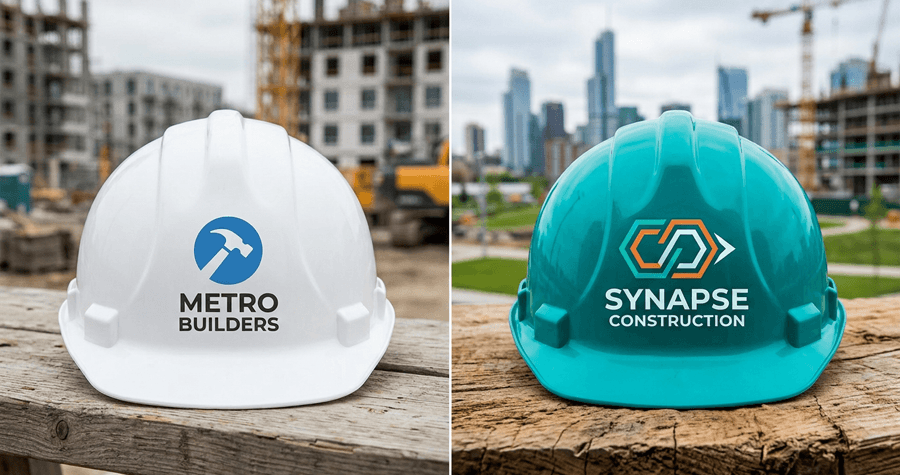
Construction has earned a reputation for sameness. Blue and gray logos. Jobsite photography. Hard hats at sunset. Claims about quality, safety, integrity, relationships, and people.
We expected plenty of competent companies whose brands were almost interchangeable.
We were wrong.
The average Brand Distinction Score among the ENR Top 400 was 37.9 out of 50. Nearly 90% of the companies we evaluated landed in our top two levels of brand distinction.
The final distribution was:
- 34.0% Ownable as Hell
- 55.8% Memorable Market Player
- 9.3% Recognizable Contractor
- 1.0% Beige Builder
- 0% Hard Hat Wallpaper
That surprised me.
The largest contractors have become much better at building professional, recognizable brands than the construction industry gets credit for. Looking credible online is no longer a differentiator at the top of the market. It is increasingly the price of admission.
Our research evaluated visible brand expression across ten dimensions, with particular attention to four high-signal experiences: the homepage, About section, Careers section, and Projects.
The study measured distinction, not construction quality. Revenue, ENR ranking, project size, safety performance, financial strength, and reputation did not earn additional points.
Companies such as Dome, ENTACT, Executive, Fortis, Primus, RailWorks, Quandel, Fontaine Bros., and Embree stood out for different reasons. They did not all use the same formula, which is exactly the point.
Read the full Brand Distinction Study and methodology.
The research raises an important question for every contractor outside the ENR Top 400:
If the companies you aspire to compete with already look this good, what happens when your brand does not?
The Bar Has Moved
A $100 million regional contractor may rarely compete directly against a $5 billion national contractor.
Your brand still competes against theirs.
Your prospective employees have seen sophisticated national construction brands. Your clients interact every day with technology companies, professional services firms, equipment manufacturers, consumer brands, and other companies that have invested heavily in creating clear, intuitive experiences.
Those experiences shape expectations.
Being locally known, doing excellent work, and having good relationships still matter tremendously. But a prospect who reaches your website does not automatically know any of that.
A professional-looking website used to signal sophistication. Today, a professional website mostly signals that the company is legitimate.
The next level is distinction.
Can someone recognize your company without seeing the logo?
Can a prospect explain why you are different?
Does your brand give a qualified employee a reason to choose you over five other good contractors?
Does your marketing communicate why a client should call you before the project hits the street?
Those questions are where brand begins creating economic value.
Distinctive Does Not Mean Loud
Construction leaders sometimes hear “distinctive brand” and picture a marketing team trying to make the company edgy, trendy, or clever.
That is not what we mean.
Distinctiveness is the collection of things that make a company easier to recognize, understand, remember, and choose.
That could come from a strong market position, an unmistakable visual identity, a clearly articulated specialty, a recognizable personality, a unique customer experience, subject matter expertise, an employer story, a memorable point of view, or some combination of them.
Demo Diva is an obvious example.
You do not need to see the logo to recognize a hot-pink excavator or dumpster in New Orleans. The name, equipment, personality, origin story, customer experience, and public presence reinforce each other.
That distinction gets attention.
More importantly, people remember who Demo Diva is and what the company does.
Most construction companies should not paint their equipment pink. Copying the tactic would miss the lesson entirely.
The lesson is to build something your competitors cannot easily copy without looking like they are copying you.
That is brand distinction.
So Where Is the ROI?
The ROI of brand is difficult to isolate because strong brands influence many parts of the business simultaneously.
That does not make the return imaginary.
Construction companies routinely invest in initiatives whose value appears across multiple financial lines. Training can improve safety, productivity, retention, and quality. Technology can improve efficiency, decision-making, client experience, and risk management.
Brand works similarly.
Its economic value appears in the business outcomes it improves.
1. A Strong Brand Helps You Win More Negotiated Work
Let’s connect this bluntly. If five qualified contractors appear basically interchangeable, the buyer has to make the decision using something else.
Price.
Previous relationships.
Familiarity.
Convenience.
Perceived risk.
Who called first.
Who the architect prefers.
Who somebody played golf with.
Those factors will always exist in construction, but a distinctive brand gives the buyer another reason to choose you.
It helps establish an idea about your company before the interview, proposal, or first business development conversation.
Maybe you are the contractor known for executing complex occupied renovations without disrupting operations. Maybe you dominate a specific technical niche. Maybe your preconstruction process is unusually strong. Maybe you are known for developing superintendents better than anyone else in your market.
Whatever the position is, the market has to know it.
A strong brand does not guarantee negotiated work. It makes you easier to remember when the right opportunity appears and gives buyers a reason to bring you into the conversation earlier.
That is especially valuable because being invited before the project becomes a commodity is worth considerably more than being really good at responding to an RFP.
2. Distinction Creates More Pricing Power
Contractors understandably dislike the phrase “pricing power.” Construction does not operate like luxury consumer goods, and owners are not going to pay an unlimited premium because they like your website.
But differentiation still affects price sensitivity.
When buyers see no meaningful difference between qualified options, price becomes more important.
When buyers believe one contractor offers a better fit, specialized expertise, lower perceived risk, better experience, stronger team, or more confidence, price becomes one factor among several.
That distinction can protect margin.
It can also help a contractor walk away from opportunities where the only competitive advantage available is being cheaper.
A magnetic brand should attract better-fit opportunities while making some poor-fit opportunities less attractive.
That is not lost revenue. It is focus.
3. Brand Makes Business Development More Efficient
Many construction companies have built their growth model around talented rainmakers.
Those relationships are valuable, but relationships do not scale particularly well.
A strong brand makes reputation more transferable.
Instead of every business developer beginning at zero, marketing helps the prospect understand the company before the first serious conversation.
The prospect may have seen your people speak at an industry conference, read an article from one of your subject matter experts, noticed your projects repeatedly, followed your leadership on LinkedIn, encountered employees talking positively about the company, or simply seen a consistent market presence over several years.
By the time business development reaches them, the company is no longer an unknown contractor asking for a meeting.
Marketing has already done some of the credibility-building.
That makes good business developers more productive. It does not replace them.
4. A Strong Brand Travels Better Than Relationships
This becomes particularly important when a contractor enters a new geography.
Imagine a successful regional contractor that has operated in the same market for 30 years. Its leadership team has deep relationships. Its project list is respected. Everybody knows the founders.
Then the company opens an office 500 miles away.
Most of that relationship equity stays home.
The new market does not automatically know the contractor’s history, reputation, people, or capabilities.
A strong brand helps carry that reputation into places where personal familiarity does not yet exist.
The same principle applies when entering a new sector, adding a service line, making an acquisition, transitioning leadership, or expanding beyond a founder’s personal network.
The more ambitious the growth strategy becomes, the more valuable a transferable reputation becomes.
Brand is one of the mechanisms that makes reputation transferable.
5. The Brand Competes for Employees Too
Construction companies do not operate in only one market.
They compete for projects and for people.
The same website being evaluated by a prospective client may also be evaluated that evening by a project manager considering a job change.
A generic Careers page filled with stock language about “our greatest asset” is unlikely to answer the questions that employee actually has.
What is it like to work here?
What does this company believe?
What kind of projects will I work on?
Who succeeds here?
Will I have opportunities to grow?
What makes this contractor different from the three others trying to recruit me?
Distinctive employer brands help answer those questions.
That can improve recruiting efficiency, increase employee referrals, attract people who fit the organization better, and reduce the amount of selling recruiters have to do.
For an industry where talent can constrain growth as much as backlog does, that is not a secondary branding benefit.
It is part of the ROI.
6. Distinction Makes Every Marketing Dollar Work Harder
Consider two contractors spending the same amount on marketing.
The first runs campaigns, sponsors events, posts project photography, updates its website, attends conferences, creates recruiting materials, and publishes occasional content. Each activity looks slightly different and says something slightly different about the company.
The second has a clear position, recognizable visual system, consistent voice, strong point of view, defined audiences, repeatable messages, and recognizable proof.
Every marketing activity reinforces the others.
Over time, the second contractor builds memory.
That is why brand is not simply another marketing expense. It is infrastructure for the rest of the marketing program.
A stronger brand can make advertising more recognizable, proposals more consistent, recruiting campaigns more credible, social content more memorable, business development presentations easier to understand, and thought leadership more closely associated with the company producing it.
Instead of repeatedly buying attention and starting over, the company begins accumulating recognition.
7. Brand Can Reduce Dependence on Individual Rainmakers
This may be one of the least discussed financial benefits.
Many construction companies have enormous relationship equity concentrated in a handful of people.
The founder knows everyone.
The president brings in the work.
One business developer owns the key relationships.
One operations leader is the reason certain clients keep calling.
That works until somebody retires, leaves, gets promoted, sells the company, or simply cannot maintain the same number of relationships as the business grows.
A strong institutional brand does not eliminate personal relationships. It captures more of that reputation at the company level.
Clients know the company rather than only knowing Charlie.
Employees want to work for the organization rather than only for Susan.
The market understands what the business stands for even when leadership changes.
That makes the company’s reputation more durable.
8. That Durability Can Contribute to Enterprise Value
This is where the brand conversation moves beyond the marketing budget.
A brand is not valuable simply because management spent money creating it.
Its value comes from what the brand helps the business produce.
A company that generates consistent demand, attracts talent, maintains pricing discipline, transfers relationships beyond individual leaders, enters markets more efficiently, earns repeat and negotiated work, and possesses a reputation that survives leadership transition has built something economically meaningful.
Those characteristics also make a business less dependent on any single person.
For an owner thinking about succession, private equity, ESOP conversion, acquisition, or generational transition, that should matter.
A buyer is not purchasing a logo.
They are purchasing the future cash-generating ability of the company.
A brand that contributes to that ability is an asset.
Do Not Confuse Brand ROI With Rebrand ROI
This distinction matters.
Paying an agency to create a new logo and website does not automatically produce any of the outcomes above.
You can spend a lot of money becoming a prettier Beige Builder.
The return comes from building a brand that more clearly communicates something meaningful about the company and then consistently delivering on it.
That usually involves more than visual identity.
Positioning matters.
Messaging matters.
Customer experience matters.
Leadership behavior matters.
Employee experience matters.
Project proof matters.
Subject matter expertise matters.
Photography matters.
Business development matters.
Marketing consistency matters.
The brand is the cumulative result.
The rebrand is merely one possible intervention.
How Should a Contractor Measure Brand ROI?
You probably will not find one clean line in the income statement labeled “brand return.”
That does not mean you should settle for impressions and followers.
Start with business outcomes.
Depending on the company’s strategy, useful measures might include:
- Percentage of revenue coming from negotiated versus competitively bid work
- Shortlist and interview invitations
- Win rate with ideal clients
- Inbound opportunities
- Repeat and referral revenue
- Average project margin by opportunity source
- Branded search activity and direct website traffic
- Business development conversion rates
- Expansion performance in new markets
- Qualified applicants per opening
- Employee referral rates
- Time required to fill critical positions
- Recruiting cost
- Employee retention in priority roles
- Engagement with subject matter experts and thought leadership
Not all of those changes will be caused exclusively by brand.
That is okay.
The goal is not to force a perfect attribution model onto something that affects the entire organization. The goal is to establish a baseline, invest intentionally, and determine whether the business outcomes the brand is supposed to influence are improving.
Construction companies already make decisions this way.
Marketing should be held accountable, but it should be held accountable to the right outcomes.
The Business Case A/E/C Marketers Should Be Making
If you are trying to convince a principal, CEO, or ownership group to invest in brand, I would not lead with colors, fonts, website design, social media, or awards.
Start with the business.
We want more negotiated work.
Then we need clients to know why we are different before the pursuit begins.
We want to enter a new market.
Then we need a reputation that can travel farther than our existing relationships.
We want better margins.
Then we need reasons to be chosen other than price.
We cannot hire enough people to support our backlog.
Then we need to compete for talent as intentionally as we compete for projects.
Our founder plans to retire.
Then we need more of the company’s reputation attached to the company rather than the founder.
Our business developers are stretched thin.
Then marketing needs to create familiarity and credibility before they enter the conversation.
That is the ROI conversation.
Brand should not be disconnected from business strategy. It should help accomplish it.
Strong Brands Do Not Replace Great Contractors
None of this changes the fundamentals.
You still have to estimate accurately.
Build safely.
Meet schedules.
Solve problems.
Develop people.
Communicate with clients.
Honor commitments.
A distinctive brand cannot sustainably manufacture a reputation the company has not earned.
But the opposite problem is incredibly common in construction.
Excellent contractors often have far more differentiation inside their businesses than anyone outside those businesses can see.
They have strong cultures, unusual expertise, better processes, remarkable people, deep market knowledge, and compelling stories.
Then their website says:
Quality. Integrity. Safety. Relationships.
That is a wasted asset.
Our Brand Distinction research showed us something encouraging. The top of the construction industry is already raising the standard.
Nearly 90% of the ENR Top 400 contractors we reviewed qualified as Memorable Market Players or Ownable as Hell.
The question for growing contractors is no longer whether a professional brand matters.
The market has already answered that.
The better question is:
What is it costing you when the market cannot see what makes your company worth choosing?
How Distinctive Is Your Construction Brand?
A/E/C CMOs’ Magnetic Brand Grader evaluates how clearly your company is positioned, differentiated, trusted, and understood by the people you want to attract.
The 12 Brand Archetypes: How to Build a Construction Brand People Actually Remember
AI has made it easier than ever to create competent marketing. A contractor can generate website copy, social posts, recruiting content, emails, proposal language, and ad concepts in minutes.
That convenience comes with a downside: it is also easier than ever to sound like everybody else.
Give an AI tool a generic prompt to write a construction company homepage, and you will probably get some combination of quality, safety, integrity, relationships, innovation, and building the future. Ask it to make the copy more professional, approachable, or confident, and you may get better sentences without getting a more recognizable brand.
That is the problem with a lot of what I call AI slop. It is not necessarily wrong or poorly written. Much of it is perfectly competent. It is just interchangeable.
For construction companies, that creates a bigger problem than it may appear. Many contractors already look and sound alike. They use similar project photography, talk about the same values, hire from the same labor pool, pursue the same owners, and make many of the same claims about their people and capabilities.
As generative AI becomes part of everyday marketing, companies need stronger inputs if they want stronger outputs. That includes real expertise, original opinions, distinctive language, and a clear brand personality.
Brand archetypes are one tool for defining that personality.
At their simplest, archetypes help answer a useful question:
If our company were a person, what kind of person would it be?
Not just how would that person talk, but how would they behave? What would they believe? What would they value? How would they react under pressure? What would they never say or do?
Those answers can shape a brand much more effectively than another list of adjectives like innovative, trustworthy, and customer-focused.
What is a brand archetype?
A brand archetype is a recognizable personality framework that helps define how a company behaves, communicates, and relates to its audience.
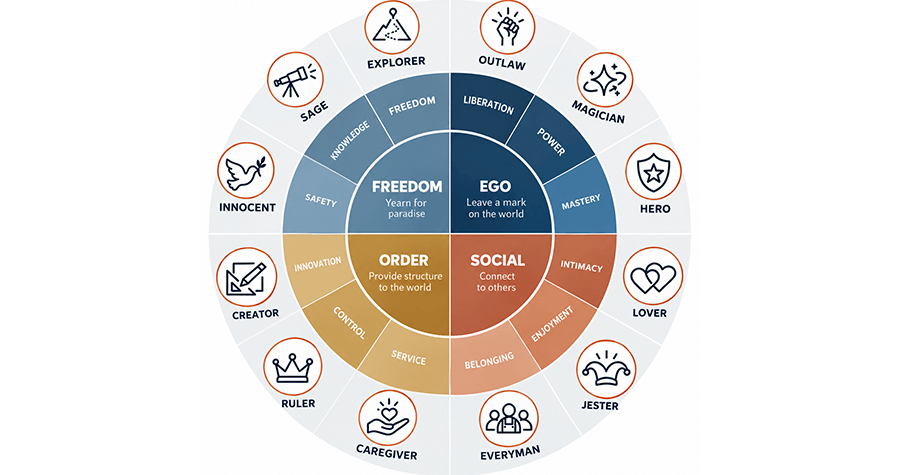
The concept of archetypes traces back to psychologist Carl Jung. Carol S. Pearson later developed the 12-archetype framework, and Pearson and Margaret Mark applied that framework specifically to branding in The Hero and the Outlaw: Building Extraordinary Brands Through the Power of Archetypes.
The reason archetypes work is that people already understand these characters intuitively. A Ruler behaves differently from an Everyman. A Sage approaches problems differently from a Jester. A Caregiver communicates differently from an Outlaw.
You do not need a 40-page brand standards manual to understand the basic difference.
That makes archetypes especially useful with construction leadership teams. I’ve used them off and on for about 10 years and, more recently, with more than a dozen brands. One of the easiest ways to start the conversation is simply to put the archetype wheel in front of the team and ask what feels right, what feels wrong, and why.
The discussion usually gets useful quickly.
Leadership teams begin connecting the archetypes to how customers experience the company, what employees value, and how they want the organization to be perceived. For companies with multiple operating brands, the exercise can be even more valuable because those brands may compete with each other for projects, employees, and attention.
If every company in the portfolio looks, sounds, and behaves the same, there is not much reason for the brands to remain distinct.
Brand personality helps give each one territory it can own.

Brand archetypes are a framework, not gospel
This is probably the most important point in this article:
Brand archetypes are a framework, not gospel.
I do not recommend taking an online quiz, learning that your company is 72% Hero, and rebuilding your brand around the result. The value is not in perfectly classifying the organization.
The value is in creating clarity.
Archetypes give leadership, marketing, business development, and creative teams a shared language for discussing something that is otherwise difficult to define. They create boundaries around how the brand should feel and behave.
I usually prefer one dominant archetype because it forces clearer decisions. Sometimes a secondary archetype helps. In other situations, two subtypes within one archetype provide enough nuance to make the personality distinctive.
The subtype lists below are not a rigid academic taxonomy. They are practical variations that help companies move beyond simply saying, “We are a Hero,” or, “We are a Sage.”
The goal is not to put the company in a box. The goal is to give the brand enough personality that people recognize it.
The 12 Brand Archetypes and Their Subtypes
1. The Outlaw
 Core motivation: disruption, liberation, and challenging the status quo.
The Outlaw believes something about the existing system needs to change. An industry may be bloated, outdated, inefficient, dishonest, or unnecessarily complicated, and the Outlaw is willing to say so publicly.
That can be a powerful position in construction technology, where many companies promise transformation while using nearly identical SaaS language. It can also work for contractors, manufacturers, or service companies that have built their reputation by rejecting an accepted way of doing business.
Strong Outlaw brands do not rebel merely to attract attention. They have a point of view and something meaningful they are pushing against.
Common traits: Bold, independent, provocative, unconventional, uncompromising.
Common Outlaw subtypes
- The Disruptor challenges established methods and introduces a materially different approach.
- The Revolutionary wants more than incremental improvement. It believes the system itself needs to change.
- The Maverick operates on its own terms and is comfortable doing things differently from the market.
- The Activist organizes its identity around a cause, belief, or injustice it wants to address.
- The Reformer sees a broken system and wants to rebuild it better.
Watch out for: Mistaking edginess for differentiation. An Outlaw without a meaningful point of view is just loud.
Brand examples: Harley-Davidson, Virgin, Diesel, BrewDog, and selected Patagonia campaigns.
2. The Hero
 Core motivation: mastery, courage, achievement, and overcoming difficult challenges.
The Hero wants to prove what is possible through effort, discipline, and competence. Hero brands are often driven by performance and become especially compelling when the work itself is difficult, high stakes, or demanding.
Construction naturally creates Hero stories because projects involve risk, complexity, schedules, weather, safety, logistics, and problems that have to be solved under pressure. That does not mean every contractor should choose Hero. If every project story becomes, “We overcame the impossible,” the brand can quickly become self-congratulatory.
The strongest Hero brands make the customer, project team, or larger mission part of the victory.
Common traits: Strong, determined, courageous, disciplined, competitive.
Common Hero subtypes
- The Warrior confronts difficult situations directly.
- The Champion fights on behalf of someone else and helps them succeed.
- The Defender protects people, organizations, or important values.
- The Rescue Hero enters when something has gone wrong and decisive action is required.
- The Competitor continually raises the standard and measures itself against difficult challenges.
Watch out for: Making the company the hero of every story. Constant chest beating gets old quickly.
Brand examples: Nike, FedEx, Duracell, The Home Depot, and the U.S. Marines.
3. The Everyman
 Core motivation: belonging, connection, familiarity, and acceptance.
The Everyman does not want to stand above the audience. It wants to stand beside them.
These brands tend to be approachable, practical, straightforward, and easy to trust. Their personality often sounds like a good superintendent, estimator, or company owner who knows the work and does not need to impress anyone with corporate language.
Construction is full of genuinely Everyman companies, which is part of the challenge. Contractors regularly describe themselves as hardworking, honest, relationship-driven people who treat customers like family and do what they say they are going to do.
Those qualities may all be true. They are also common.
Common traits: Approachable, grounded, straightforward, relatable, dependable.
Common Everyman subtypes
- The Realist tells it like it is without unnecessary polish or exaggeration.
- The Neighbor builds familiarity through friendliness and community.
- The Citizen values responsibility, dependability, and contributing to the greater whole.
- The Good Guy earns trust through decency, loyalty, and consistency.
- The Supporter is the person you know you can call when something needs to get done.
Watch out for: Confusing relatable with generic. If every competitor is “your trusted partner,” that phrase does not distinguish anybody.
Brand examples: IKEA, Wrangler, Folgers, classic Chevrolet positioning, and Budweiser.
4. The Sage
 Core motivation: truth, knowledge, understanding, and better decisions.
The Sage wants to understand how something really works and then help other people understand it too.
Sage brands teach, investigate, research, analyze, and explain. In the built environment, this can be especially powerful for engineering firms, technical contractors, consultants, manufacturers, construction technology companies, and organizations whose expertise genuinely influences project outcomes.
The strongest Sage brands do not need to keep calling themselves experts. They repeatedly demonstrate expertise through useful ideas, data, education, and clear thinking.
Common traits: Analytical, educational, thoughtful, objective, curious.
Common Sage subtypes
- The Expert develops deep specialization and earns authority through demonstrated mastery.
- The Researcher gathers evidence, tests assumptions, and looks for patterns.
- The Strategist connects individual decisions to a larger business or project picture.
- The Mentor shares knowledge to make other people more capable.
- The Analyst breaks complicated subjects apart and makes them understandable.
Watch out for: Becoming academic, condescending, or so cautious that the company never expresses an actual point of view.
A/E/C CMOs is predominantly a Sage brand. Original research, education, frameworks, benchmarking, and challenging unsupported assumptions about construction marketing all support that personality.
That does not mean we need to sound like professors. Sage is the underlying motivation, not permission to be boring.
Brand examples: The Economist, TED, PBS, Google, and National Geographic.
5. The Explorer
 Core motivation: freedom, discovery, independence, and new possibilities.
The Explorer wants to know what is over the next hill.
The archetype is commonly associated with travel and outdoor brands, but literal exploration is only one interpretation. At its core, Explorer is about independence, movement, discovery, and refusing to be constrained by conventional boundaries.
In the built environment, that mindset may appear in firms entering new markets, solving problems in remote locations, pioneering construction methods, or giving customers a better view of something that was previously difficult to see.
Common traits: Curious, adventurous, independent, ambitious, pioneering.
Common Explorer subtypes
- The Seeker continually searches for new ideas, experiences, or possibilities.
- The Trailblazer deliberately enters territory others avoid.
- The Pioneer creates a path that others may eventually follow.
- The Adventurer becomes energized by difficult or uncertain environments.
- The Wanderer values independence and resists conventional boundaries.
Watch out for: Exploration without direction. Constantly chasing what is new can look more restless than pioneering.
Brand examples: Jeep, The North Face, REI, GoPro, and Patagonia.
6. The Creator
 Core motivation: originality, imagination, craftsmanship, and bringing ideas to life.
The Creator looks at what exists and sees what it could become.
Construction companies sometimes overlook this archetype because the word “creator” sounds artistic, but the mindset fits much of the industry. Architecture, fabrication, custom building, specialty construction, product design, engineering, modular construction, and even sophisticated self-perform work can all express the Creator.
The core idea is not simply creativity. It is the desire to make something original, useful, beautiful, or exceptionally well crafted.
Common traits: Inventive, expressive, meticulous, imaginative, original.
Common Creator subtypes
- The Architect turns ideas into thoughtful, coherent systems.
- The Inventor develops new tools, products, methods, or solutions.
- The Maker takes pride in the act of building and the craft behind the result.
- The Artist prioritizes expression, aesthetics, and originality.
- The Visionary imagines something that does not exist yet and helps other people see it.
Watch out for: Falling so deeply in love with the work that the company forgets what the customer actually values.
Brand examples: LEGO, Adobe, Pixar, Dyson, and Apple’s design positioning.
7. The Caregiver
 Core motivation: service, protection, compassion, and responsibility.
The Caregiver’s instinct is to help, protect, and make someone’s situation better.
That personality can work particularly well when the customer is dealing with stress, risk, uncertainty, or something important enough that they need to trust the people doing the work. Residential construction, restoration, safety services, traffic control, healthcare construction, and other protective services are obvious examples, although the archetype can work much more broadly.
Caregiver does not mean soft. Protection can be one of the strongest expressions of the archetype.
Common traits: Supportive, compassionate, responsible, reassuring, dependable.
Common Caregiver subtypes
- The Helper recognizes a need and steps in.
- The Protector shields people from immediate risk, harm, or uncertainty.
- The Guardian takes responsibility for protecting people, places, assets, or systems over time.
- The Nurturer supports people as they grow, recover, or make an important transition.
- The Steward cares for something that has been entrusted to the organization.
- The Provider makes sure people have what they need.
Watch out for: Becoming overly sentimental or portraying customers as helpless.
We use the Caregiver archetype with Nastase Contracting, where helping homeowners make good decisions is central to the brand. Sometimes the right answer is a new roof. Other times it is telling a homeowner the roof still has useful life and does not need to be replaced yet.
We also use Caregiver with Guardian Traffic, with a stronger emphasis on the Protector and Guardian subtypes. Traffic control is ultimately about keeping people safe and helping crews, drivers, pedestrians, and communities move through work zones without unnecessary risk. The name Guardian reinforces the personality naturally rather than requiring the company to manufacture one.
Brand examples: Johnson & Johnson, UNICEF, Campbell’s, and selected Dove positioning.
8. The Ruler
 Core motivation: leadership, order, control, stability, and high standards.
The Ruler communicates a simple message: you are in capable hands.
These brands tend to be confident, disciplined, established, and structured. They often emphasize leadership, accountability, standards, and the ability to create order in complicated environments.
Construction has plenty of companies that want to look like Rulers because the archetype communicates scale and authority. The important question is whether the organization has the experience, culture, and discipline to support that position.
Common traits: Confident, polished, disciplined, commanding, structured.
Common Ruler subtypes
- The Leader provides direction and earns confidence.
- The Administrator creates order through systems, discipline, and consistency.
- The Sovereign communicates status, prestige, and elevated standards.
- The Manager organizes people and resources to produce dependable outcomes.
- The Judge emphasizes standards, accountability, fairness, and governance.
- The Patriarch/Matriarch leads with a sense of responsibility for the larger organization, industry, or community. Authority is not just about control; it is about setting standards and taking responsibility for what comes next.
Watch out for: Allowing confidence to become arrogance or structure to become bureaucracy.
We use the Ruler archetype with Legacy Utility Group, the parent company of Guardian Traffic. Legacy’s mission is broader than simply operating successful companies. The organization wants to improve the hydrovac and construction industry itself, which is why the Patriarch/Matriarch subtype fits particularly well.
The brand is not trying to act superior to the industry. It is taking a leadership position within it, with an expectation that its companies can help raise standards and improve how the work gets done.
That is a materially different personality from Guardian Traffic’s Caregiver orientation, even though the companies share ownership.
That distinction is exactly why archetypes can be useful in a multi-brand organization.
Brand examples: Mercedes-Benz, Rolex, American Express, and Ritz-Carlton.
9. The Magician
 Core motivation: transformation, possibility, and making difficult things achievable.
The Magician changes what people believe is possible.
Technology companies naturally gravitate toward this archetype because the promise is often larger than a feature or product. The software, equipment, process, or technology changes the experience itself.
Prefabrication, robotics, automation, reality capture, AI, advanced materials, and construction software can all support Magician positioning when the transformation is real.
Common traits: Visionary, imaginative, transformative, insightful, inspiring.
Common Magician subtypes
- The Visionary recognizes possibilities before most people can see them.
- The Healer restores something that is not working properly.
- The Catalyst causes change to begin.
- The Alchemist turns ordinary inputs into an extraordinary result.
- The Enabler removes barriers and makes something difficult easier to accomplish.
Watch out for: Falling into vague technology language. Once everything becomes revolutionary, seamless, game-changing, and transformative, none of those words mean much.
Brand examples: Disney, selected Apple positioning, immersive technology brands, and historically some Tesla positioning.
10. The Lover
 Core motivation: connection, beauty, passion, and meaningful experiences.
The Lover creates attraction.
Luxury is the most obvious expression of the archetype, but it is not the only one. Lover brands may emphasize craftsmanship, close relationships, aesthetics, comfort, material quality, or genuine passion for the work.
That can translate naturally to custom residential construction, architecture, interiors, hospitality, premium building products, or specialty trades where customers care deeply about how something looks and feels.
Common traits: Elegant, expressive, passionate, intimate, sensory.
Common Lover subtypes
- The Aesthete cares deeply about beauty, materials, detail, and design.
- The Partner places close relationships and mutual commitment at the center of the experience.
- The Harmonizer creates comfort, balance, and connection.
- The Enthusiast communicates with visible passion and excitement.
- The Sensualist builds the experience around sight, touch, sound, taste, atmosphere, or other senses.
Watch out for: Allowing aesthetics to substitute for substance. A beautiful brand cannot make up for an average customer experience.
Brand examples: Chanel, Ferrari, Tiffany & Co., Häagen-Dazs, and Godiva.
11. The Jester
 Core motivation: joy, humor, entertainment, and irreverence.
The Jester understands something B2B companies often forget: construction people still like to have fun.
A good Jester brand does more than publish memes or tell jobsite jokes. The personality gives the company permission to behave differently from the category around it.
That contrast can be especially powerful in construction, where much of the marketing is serious, polished, and predictable. A company with a genuinely playful culture may have an opportunity to stand apart simply by sounding more like the people inside the business.
Common traits: Funny, playful, unpredictable, energetic, irreverent.
Common Jester subtypes
- The Entertainer makes enjoyment part of the brand experience.
- The Trickster plays with expectations and uses surprise effectively.
- The Pleasure-Seeker emphasizes fun and enjoying the moment.
- The Provocateur uses humor to expose absurdity or question accepted norms.
- The Playmate creates an informal, energetic personality people want to join.
Watch out for: Becoming known for the joke instead of the company. Humor should strengthen recognition, not replace the business strategy.
Brand examples: Old Spice, Skittles, M&M’s, Duolingo, and classic Southwest Airlines campaigns.
12. The Innocent
 Core motivation: simplicity, goodness, optimism, and doing things the right way.
The Innocent believes things do not have to be complicated.
These brands tend to build confidence through transparency, simplicity, optimism, or a return to something straightforward and understandable. In construction, that can be powerful for companies operating in categories where customers expect confusion, hidden costs, unnecessary complexity, or aggressive sales tactics.
The brand promise becomes less about sophistication and more about making the experience clear and trustworthy.
Common traits: Honest, optimistic, wholesome, transparent, uncomplicated.
Common Innocent subtypes
- The Idealist believes there is a better way.
- The Optimist naturally focuses attention on possibility rather than fear.
- The Traditionalist finds reassurance in proven principles and timeless values.
- The Moralist places right and wrong at the center of the brand’s beliefs.
- The Purist emphasizes authenticity, transparency, simplicity, or cleanliness.
Watch out for: Becoming naive, overly sweet, or making claims about purity and goodness that the company cannot actually substantiate.
Brand examples: Burt’s Bees, Aveeno, The Honest Company, and classic Coca-Cola positioning.
What archetypes look like in actual construction brand strategy
The value of archetypes becomes much clearer once they leave the workshop and start affecting actual decisions.
One of my favorite examples is Linarc, a construction technology company. We landed on the Outlaw archetype and began giving the company permission to call out some of the bullshit in the ConTech SaaS industry.
That single decision gave the team more direction than a long mission statement probably would have. They immediately understood the kind of company we were trying to build, which influenced the language, attitude, visual direction, campaign concepts, and ideas the team pursued.
It also helped us shape the feel of another brand before that company even had a name.
Nastase Contracting required a completely different personality. Its Caregiver archetype directs the brand toward education, protection, honesty, and helping homeowners make smart decisions rather than pressuring them into unnecessary work.
Guardian Traffic is also a Caregiver, but the Protector and Guardian subtypes make it feel different from Nastase. Its personality is rooted more heavily in keeping people safe and taking responsibility for what happens around a work zone.
Legacy Utility Group sits above Guardian as the parent company, yet its Ruler archetype gives it a separate role. With the Patriarch/Matriarch subtype, Legacy is positioned as an organization that wants to lead, raise standards, and improve the hydrovac and construction industry.
A/E/C CMOs is predominantly Sage, which means our brand should earn authority through research, education, frameworks, analysis, and useful guidance rather than simply claiming expertise.
These brands do not need to behave the same way simply because they all operate in or around construction.
That is the point.
The two archetype mistakes I see most often in construction
After using this framework with construction companies for years, two mistakes show up repeatedly.
Mistake #1: Branding the CEO
Leadership teams sometimes look at the wheel, point at an archetype, and say, “That is definitely Steve.”
Steve might indeed be an Explorer, Outlaw, or Hero. That does not automatically mean the company should be.
Founder personality absolutely influences culture, particularly in privately held construction companies. Many firms still carry the fingerprints of the founder decades after the company was started.
The purpose of the exercise, though, is not to conduct a personality assessment on the CEO. We are defining the character the brand should consistently express to customers, employees, recruits, partners, and the market.
Those two things often overlap, but they are not always identical.
Mistake #2: Picking whatever every competitor already uses
This is where Everyman becomes the obvious construction example.
The industry genuinely contains a lot of straightforward, hardworking, relationship-driven people. It makes perfect sense that contractors naturally gravitate toward Everyman characteristics.
The strategic problem appears when the entire competitive set says essentially the same thing.
Your trusted partner.
People you can count on.
Built on relationships.
Doing things the right way.
Treating every customer like family.
None of those ideas are inherently bad. Taken together across an industry, they create sameness.
Our Brand Distinction in the Built Environment research looked at all 400 contractors in the 2026 ENR Top 400 and evaluated how effectively those firms differentiate their public-facing brands across ten dimensions, including brand voice and personality.
One of the conclusions from that work is that the bar is moving. Larger contractors are increasingly investing in stronger brands, better storytelling, more deliberate creative direction, and clearer positioning.
Small and midsize contractors are not only competing against the beige construction websites of the past anymore.
How to choose your construction company’s archetype
I do not start by asking leadership teams which archetype they like best. That turns the exercise into a popularity contest.
A better starting point is:
What personality should this brand portray, and what is already authentically true about the company?
Put the wheel in front of the leadership team and talk through it. Which archetypes feel natural? Which obviously do not? Which one would customers recognize? Which fits the culture? Which gives the company useful separation from competitors? Most importantly, which personality could employees actually sustain after the rebrand launch is over?
Then go into the subtypes.
You may discover that saying the company is a Sage is not specific enough. It might really be a Researcher and Mentor. Your Creator may be predominantly a Maker and Architect. Your Ruler may be more Patriarch/Matriarch than Sovereign.
Those differences matter because they begin turning a broad archetype into a usable personality.
Sometimes the most valuable part of the exercise is agreeing on what the company isn’t. That makes future decisions easier because the team has clearer boundaries around what fits the brand.
Your archetype should affect more than website copy
If your archetype only appears in the brand voice section of a PDF, it is not doing enough work.
A strong personality should affect the entire brand experience. A Ruler and an Everyman probably should not use identical photography. An Outlaw and an Innocent should not write the same LinkedIn post. A Sage and a Jester should not open a presentation the same way.
A Caregiver and a Hero might both talk about safety, but the emotional framing will be different. The Caregiver emphasizes protecting people. The Hero emphasizes overcoming risk and performing at a high standard.
The archetype can influence brand voice, messaging, visual identity, photography, video, advertising, thought leadership, recruiting, proposals, presentations, social media, sales language, and even the kinds of campaigns the marketing team chooses to pursue.
That is why I consider brand personality a core component of a Magnetic Brand.
It is not decoration. It is one of the things that makes the company recognizable.
AI can scale your personality. It should not create it.
This becomes increasingly important as construction companies adopt generative AI.
AI is very good at execution once it understands the parameters. Give it examples, approved vocabulary, real opinions, subject-matter expertise, strong source material, and a clearly defined personality, and it can help a team maintain consistency across a large amount of content.
Start instead with, “Write this in a professional, confident, approachable voice,” and you are asking the machine to find the middle.
That is where most AI slop lives.
The better order of operations is:
Human strategy → distinct brand personality → real expertise and opinions → AI-assisted execution
The technology itself is not the differentiator. The thinking you put into it is.
Construction companies already know this principle in another context. The best piece of equipment on a jobsite does not make an average operator exceptional. Technology multiplies the capability of the people using it.
AI works the same way with marketing.
Could someone recognize your company without seeing the logo?
Here is a practical test.
Take the company name and logo off your website copy, LinkedIn posts, recruiting ads, emails, proposals, presentations, and advertisements. Then put the content beside five competitors.
Would someone who knows the industry be able to tell which one belongs to you?
Most construction brands are not there yet.
They may look professional and communicate clearly, but that is different from being recognizable.
Brand archetypes will not solve that problem by themselves. Again, they are a framework, not gospel. What they can do is give leadership teams a simple language for deciding who the company is supposed to be.
Once everyone understands the character, a lot of other decisions become easier.
Does this sound like us? Would we actually say this? Does this photography fit? Would one of our competitors be equally comfortable running this campaign? Does this sister company need its own personality? Does this AI-generated content reinforce our brand or flatten it?
Those are much better questions than asking AI to make the copy “more engaging.”
In a world where competent marketing content is becoming cheap and abundant, being recognizable is becoming more valuable.

The Construction Authority Gap: What 400 Contractor Websites Reveal About E-E-A-T
Construction companies know how to solve difficult problems. Their websites often fail to show that knowledge.
A/E/C CMOs evaluated the websites of the 2026 ENR Top 400 Contractors [download ungated research report] to understand how effectively construction companies demonstrate experience, expertise, authority, and trust online. The average score was just 44.9 out of 100. Eighty-one percent of contractors scored below the Established Thought Leader threshold, while only 8% reached the two highest authority tiers.
The results reveal an authority gap, but not an expertise gap. Contractors have decades of knowledge inside their project teams, estimating departments, safety programs, executive meetings, and closeout reports. The problem is that buyers rarely get to see it.
What is E-E-A-T?
E-E-A-T stands for Experience, Expertise, Authoritativeness, and Trustworthiness. Google uses the framework in its search quality evaluation process to help distinguish reliable, helpful content from information that merely sounds credible.
- Experience demonstrates firsthand knowledge gained by doing the work.
- Expertise reflects technical depth, useful teaching, and command of a subject.
- Authoritativeness shows that a company or expert is recognized beyond its own website.
- Trustworthiness is supported by clear authorship, evidence, sources, dates, disclosures, and a reliable website experience.
Google does not assign websites a public E-E-A-T score, and E-E-A-T is not a direct ranking factor. A/E/C CMOs adapted the principles for a construction buyer’s perspective and added a fifth category: Content Ecosystem. A few strong articles do not constitute an authority system unless the expertise is current, organized, discoverable, and sustained.
Why E-E-A-T matters more in the age of AI slop
AI has made polished content inexpensive and abundant. It has also made average content remarkably easy to imitate.
Contractors can now publish articles that look professional, use the correct terminology, and repeat familiar industry advice without contributing anything original. When every company publishes the same broad explanations of design-build, preconstruction, safety, sustainability, and construction technology, the content does not differentiate the contractor. It creates more sameness and further commoditizes construction.
The durable advantage is not content volume. It is specific, attributable, evidence-backed knowledge that could only come from people who have done the work.
A superintendent explaining how the team resolved a sequencing constraint carries more weight than another generic article about project planning. An estimator publishing a transparent regional cost analysis creates more value than a list of predictable cost-saving tips. A market leader documenting the decisions behind a successful delivery method demonstrates more authority than a project announcement declaring the job a success.
AI can help contractors capture, organize, draft, and repurpose knowledge. It cannot replace the lived experience, original evidence, and technical judgment that make the knowledge worth reading.
How we evaluated the ENR Top 400 Contractors
A/E/C CMOs reviewed the supplied corporate websites and directly connected official content platforms of the 2026 ENR Top 400 Contractors. Each company could earn up to 100 points across five equally weighted categories:
| Category | Points | What we evaluated |
|---|---|---|
| Experience | 20 | Firsthand observations, original cases, practical lessons, and sustained depth |
| Expertise | 20 | Educational usefulness, technical depth, named experts, research, and frameworks |
| Authority | 20 | Independent publication, speaking, citations, recognition, and expert continuity |
| Trust | 20 | Authorship, evidence, methods, dates, disclosures, and technical reliability |
| Content Ecosystem | 20 | Format breadth, organization, recency, continuity, and sustained expert participation |
Only publicly available evidence received credit. We did not review private proposals, internal knowledge systems, unlinked social media content, presentations or webinars we could not access, or interviews with subject-matter experts.
We also did not attempt to judge each contractor’s operational competence. Buyers are rarely qualified to evaluate technical mastery from the outside. They judge the proof a company chooses to make visible, which is the same buyer-view perspective we applied to this research.
Awards, promotions, project announcements, groundbreakings, community involvement, contract wins, and recruiting updates did not count as meaningful thought leadership. Those materials may strengthen credibility and culture, but they do not independently educate a buyer or establish topic authority.
Most contractor websites stop at credibility
The center of the market was concentrated in the Minimal Authority Footprint and Credible Operator tiers. Together, those two categories accounted for 302 contractors, or 75.5% of the entire ENR Top 400 sample.
| Authority tier | Score | Contractors | Share |
|---|---|---|---|
| Industry Authority | 91–100 | 11 | 2.8% |
| Authority Engine | 76–90 | 21 | 5.3% |
| Established Thought Leader | 60–75 | 44 | 11.0% |
| Credible Operator | 40–59 | 146 | 36.5% |
| Minimal Authority Footprint | 20–39 | 156 | 39.0% |
| Limited Public Authority | 0–19 | 22 | 5.5% |
Most contractor websites successfully demonstrate that the company can perform the work. They show completed projects, markets served, safety commitments, awards, community involvement, and years in business. Those are valuable trust signals, but they do not show buyers how the company thinks.
Thought leadership answers different questions. How does the contractor identify risk? What has its team learned across similar projects? Which delivery decisions improve cost, schedule, safety, quality, or constructability? What should an owner understand before choosing a partner or committing to an approach?
A project portfolio proves that the contractor was there. Authority content demonstrates what its people learned and why that knowledge should matter to the next buyer.
Five findings construction marketers should understand
1. Operational proof is common; educational proof is not
Construction companies are generally comfortable talking about what they built. They are less consistent about explaining the decisions, tradeoffs, lessons, and methods behind the work.
That creates a significant opening for contractors willing to turn project experience into buyer education. A useful article does not need to reveal confidential information or proprietary processes. It needs to help a buyer recognize a problem, understand the available options, or make a better decision.
2. A busy newsroom is not necessarily thought leadership
Many contractors publish regularly, but much of that activity consists of awards, new hires, promotions, project milestones, charitable work, and company announcements.
Company news answers, “What happened at our company?” Thought leadership answers, “What should the buyer understand or do next?” Both belong in a healthy communications program, but they perform different jobs and should not be mistaken for one another.
3. Attribution is a major dividing line
Higher-scoring contractors connect useful content to named practitioners. Their experts have substantive biographies, recognizable specialties, and a visible body of work that may include articles, research, webinars, conference presentations, or media commentary.
Anonymous content may be accurate, but it does little to build the authority of the people behind the company. Naming the expert makes the knowledge more inspectable, credible, and memorable. It also allows authority to compound as the expert contributes across multiple formats.
4. Original research creates disproportionate value
Recurring cost indices, market outlooks, technical studies, benchmarks, and proprietary frameworks give buyers something they cannot obtain from a generic summary. They also give journalists, associations, clients, and other experts something worth citing.
Original research does not have to begin as a national study. A contractor might analyze regional escalation, procurement lead times, recurring safety observations, schedule performance, labor conditions, or lessons across a specific project type. The strongest research is narrow enough to be credible and useful enough to influence a decision.
5. Authority is a system, not a campaign
The highest-scoring contractors do not rely on one impressive report or a temporary burst of articles. They have systems for identifying useful knowledge, involving subject-matter experts, producing multiple content formats, organizing material by topic, and maintaining continuity over time.
A campaign creates activity. An authority system builds an asset that becomes more valuable with every useful contribution.
Only 11 contractors reached Industry Authority
The companies that earned the highest designation were:
- AECOM
- Skanska USA
- Black & Veatch
- DPR Construction
- Turner Construction
- Burns & McDonnell
- Haskell
- Mortenson
- Suffolk Construction
- VINCI Construction
- CDM Smith
Most are among the largest companies in the ENR Top 400 or ENR Top 500 Design Firms. That is not surprising. Research, editorial operations, expert development, and multi-format publishing require resources and organizational continuity.
Scale alone, however, does not create authority. These companies distinguish themselves by deliberately converting technical expertise into public knowledge. They publish recurring research, maintain visible expert networks, develop useful intellectual property, and create content systems that buyers and industry audiences can return to.
Smaller contractors should not try to imitate the publishing volume of a global enterprise. They can compete by being more focused. A regional or specialized contractor can become the most useful source of knowledge around a narrow market, delivery challenge, client type, or technical problem.
How contractors can move to the next authority tier
 Limited Public Authority: 0–19
These websites offer corporate information and project proof but almost no visible thought-leadership system. The first step is to publish three or four genuinely useful lessons tied to completed work, with a named practitioner attached to each piece.
A functioning insights section, visible publication dates, and substantive expert biographies can establish the foundation. The goal is not volume; it is proving that the company has knowledge worth sharing.
 Minimal Authority Footprint: 20–39
These contractors show isolated examples of expertise but lack consistency. They should identify two or three buyer problems where the company has deep experience and a defensible perspective.
Publishing at least quarterly can create continuity, provided every piece includes specific examples, expert attribution, evidence, and practical value. Over 12 months, those contributions can become a recognizable educational archive rather than a collection of disconnected posts.
 Credible Operator: 40–59
These companies already have a real content system, but its depth, organization, cadence, or attribution is inconsistent. Their best next move is to convert occasional insights into recurring properties.
A quarterly market update, annual benchmark, technical webinar series, or owner’s guide creates an expectation that the company will continue contributing useful knowledge. Stronger expert profiles, topic clusters, documented methods, and external speaking opportunities can help move the contractor from credible to recognizable.
 Established Thought Leader: 60–75
These contractors sustain public education and demonstrate recognizable topic authority. To advance, they need more original intellectual property and stronger connections between their experts, content, and external authority.
Proprietary research, recurring reports, named frameworks, association education, and multiple complementary formats can deepen their position. Their priority should be producing work that other people reference, apply, and share.
 Authority Engine: 76–90
These companies operate mature, expert-led, multi-format content systems. Their opportunity is to move from participating in industry conversations to shaping them.
Benchmark research, flagship intellectual property, prominent conference roles, greater citation activity, and intentional development of the next generation of experts can elevate the system. Authority also needs institutional ownership so it survives leadership transitions and does not depend on one visible individual.
 Industry Authority: 91–100
These contractors already produce knowledge the market recognizes and trusts. Their challenge is maintaining rigor as the system grows.
Research must remain current, editorial standards must remain high, and experienced experts must continue transferring knowledge to emerging leaders. The objective is not simply to defend a score; it is to keep producing information that clients, partners, journalists, and the wider industry rely on.
Build the authority system from the work outward
Contractors do not need a publishing factory. They need a repeatable way to capture and package knowledge that already exists.
Start with two or three buyer problems where the company has meaningful experience. Identify the people who can explain the decisions and tradeoffs involved, then incorporate knowledge capture into project reviews, pursuit debriefs, estimating updates, safety meetings, and closeouts. Record the numbers, constraints, alternatives, and outcomes while they are still accessible.
From there, create a manageable publishing rhythm. One strong idea might become a technical article, executive briefing, webinar, conference submission, and media pitch, but every format should add value rather than repeat the same summary.
Name the experts and reviewers. Date the material, cite outside sources, explain the method, disclose limitations, and connect claims to real examples. Once the content is strong enough, distribute it through associations, conferences, contributed articles, partner programs, and media relationships.
The goal is not to sound like a thought leader. It is to become a reliable source of knowledge for the markets your company wants to lead.
Most contractors already have the raw material
The ENR Top 400 results show an industry rich in operating experience but uneven in public authority. The knowledge exists inside project teams, pursuit interviews, conference decks, client conversations, technical reviews, and lessons learned. It simply has not been converted into a visible, sustained system.
That is the opportunity. Contractors that combine real experience with named experts, original evidence, useful teaching, and consistent publication will become easier to discover, easier to trust, and harder to compare solely on price.
Download the ungated research report.
Research note: This study reflects publicly available website content reviewed as of September 7, 2026. Scores evaluate visible thought-leadership authority, not overall company quality, operational performance, safety, financial strength, or technical competence.
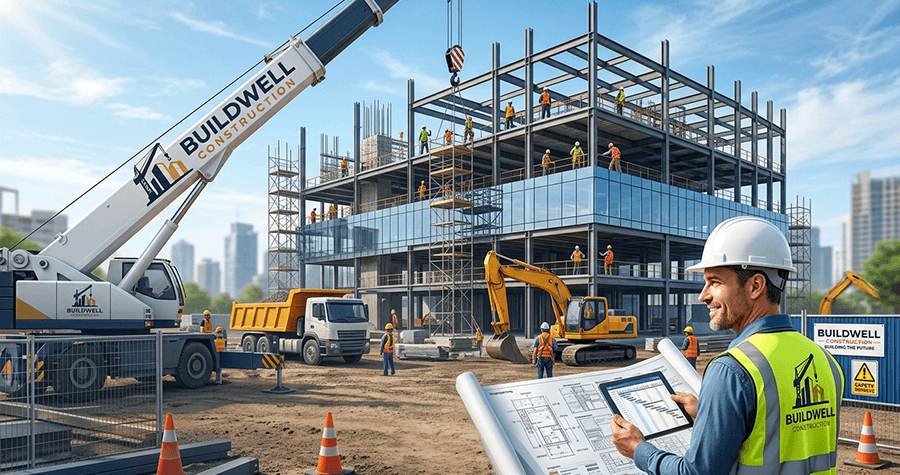
ROI of a Rebrand for Construction Companies: What the Research Really Shows
Construction leaders rarely question the ROI of a new crane, estimating platform, or project-management system. Those investments have visible costs and measurable outcomes. A rebrand can be harder to evaluate.
The investment is easy to calculate, but the return may appear in several places: stronger recruiting, better clients, higher pursuit hit rates, improved margins, greater awareness, shorter sales cycles, and increased enterprise value.
That complexity sometimes leads contractors to treat branding as a cosmetic expense. Change the logo. Build a new website. Wrap the trucks. Order new hard hats. Then hope people notice.
Research into design-led companies suggests that this view is far too narrow. A strong brand can create meaningful business value, but only when branding extends beyond appearance and becomes part of how the company competes.
What Is the ROI of a Rebrand for a Construction Company?
The ROI of a rebrand compares the financial value created by the new brand with the total cost of developing and implementing it.
The basic formula is:
Rebrand ROI = (Financial gain attributable to the rebrand − Total rebrand investment) ÷ Total rebrand investment × 100
The calculation looks simple. Attribution is not.
A construction company’s rebrand can influence:
- Which clients invite the firm to compete
- Whether buyers understand what makes the contractor different
- How often the company advances from shortlist to interview
- Whether it wins on value or competes primarily on price
- The types of employees it attracts and retains
- How successfully it enters a new geography or market sector
- How well acquired companies become part of one organization
- How confidently employees tell the same company story
- What the business may be worth to future investors or buyers
A new logo alone is unlikely to produce those results. A strategically grounded rebrand can.
The Design Value Index: Evidence That Design Creates Business Value
The Design Management Institute and Motiv Strategies created the Design Value Index to examine the financial performance of publicly traded companies considered “design-centric.”
The original portfolio included companies such as Apple, Coca-Cola, Ford, IBM, Nike, Starbucks, Target, Walt Disney, and Whirlpool. These organizations were not selected merely because they produced attractive advertising. They demonstrated that design:
- Operated across the enterprise
- Held a prominent position within the organization
- Had support from senior leadership
- Was managed by experienced executives
- Received sustained investment
- Influenced strategy, products, services, and customer experience
From 2003 through 2013, the portfolio of design-centric companies reportedly outperformed the S&P 500 by 228%.
A hypothetical $10,000 investment during that period would have grown to approximately:
- $39,923 in the design-centric portfolio
- $17,522 in the S&P 500
The Design Value Index subsequently reported outperformance of more than 200% across three successive ten-year studies. Its 2005–2015 portfolio, composed of 16 design-centric companies, outperformed the S&P 500 by 211%.
Sources: Design Management Institute’s original Design Value research and 2015 Design Value Index report.
Does That Mean a Rebrand Produces a 228% ROI?
No, and construction marketers should resist making that claim.
The Design Value Index did not divide each company’s branding expenses by the revenue or profit directly attributable to those expenses. It compared the stock performance of a selected portfolio of design-centric companies with the performance of the S&P 500.
The study demonstrates an association between design maturity and long-term shareholder value. It does not prove that spending $100,000 on a rebrand will produce $228,000 in profit.
Several factors also limit how broadly we should apply the headline number:
- The portfolio included only 15 or 16 companies.
- The companies were selected partly through expert evaluation.
- Exceptional performers could materially influence the result.
- Design-centric companies may also have stronger leadership, innovation, operations, marketing, and customer experiences.
- The study examined publicly traded corporations, not privately held contractors.
- “Design” included much more than visual identity or branding.
The correct lesson is not that every rebrand produces the same return. It is that companies treating design and brand as strategic business capabilities have historically created substantially more shareholder value than companies treating design as decoration.
Broader Research Supports the Business Case
McKinsey later conducted a larger study involving 300 publicly listed companies, more than two million pieces of financial data, and more than 100,000 documented design actions.
Over five years, companies in the top quartile of the McKinsey Design Index achieved:
- 32% more revenue growth than their industry counterparts
- 56% more total shareholder return growth
- Approximately twice the revenue growth and shareholder returns of industry peers
The results held across consumer goods, medical technology, and retail banking. McKinsey also found that the market disproportionately rewarded top-quartile companies. Being slightly better than average did not produce the same advantage.
The highest-performing companies treated design as a leadership priority, measured its performance, built around the complete customer experience, worked across departmental boundaries, and continuously tested and improved their ideas.
Source: McKinsey, The Business Value of Design.
What This Research Means for Construction Companies
Construction companies do not sell consumer products, and most contractors are not publicly traded. The industry also has long sales cycles, relationship-driven buying, complex pursuits, and years of backlog. However, those differences don’t make brand less important; they just make its effects harder to isolate.
A contractor’s brand shapes how clients, employees, recruits, partners, and prospective sellers interpret the company before they ever speak with its leadership. Buyers may use similar words to describe competing contractors:
- Safe
- Experienced
- Trusted
- Quality-driven
- Relationship-focused
- On time and on budget
Those claims may all be true. Unfortunately, they do little to help one company become more memorable or preferable than another. A magnetic construction brand makes the contractor’s value recognizable. It gives the market a clear reason to choose the company while helping wrong-fit buyers recognize that it may not be for them.
That distinction can create returns well beyond marketing.
Where a Construction Rebrand Can Generate ROI
1. Better-fit opportunities
A clear position helps owners, developers, general contractors, and partners understand what the company does best. This can produce fewer wrong-fit leads and more invitations aligned with the contractor’s experience, delivery model, geography, and margin goals.
The goal is not simply to generate more opportunities. It is to attract better work.
2. Higher pursuit hit rates
Contractors spend significant time and money pursuing work. Estimating labor, preconstruction support, proposal development, travel, interviews, and executive time all contribute to the true cost of a pursuit.
If a stronger brand improves recognition, differentiation, and buyer confidence, even a modest increase in hit rate can generate substantial value.
Suppose a contractor pursues 40 projects annually at an average internal pursuit cost of $10,000. That represents a $400,000 investment before the company wins any work.
Moving from a 20% hit rate to a 25% hit rate would mean two additional wins. The financial return from those projects could outweigh the entire rebrand investment.
The example is hypothetical, but it shows why contractors should connect brand performance to pursuit data, not merely impressions alone.
3. Stronger pricing power
When buyers cannot see a meaningful difference between contractors, price becomes the deciding factor.
A strong brand will not eliminate competitive bidding. It can, however, make expertise, specialization, processes, people, and client experience easier to recognize.
That creates a better foundation for value-based conversations and may reduce pressure to win every project by offering the lowest number.
4. Improved recruiting and retention
Construction companies are competing for many of the same project managers, superintendents, estimators, craft professionals, and emerging leaders.
An employer brand that accurately communicates the company’s culture, opportunities, expectations, and purpose can improve applicant quality. It may also reduce dependence on outside recruiters and help employees determine whether the organization fits them before accepting an offer. The return can appear through:
- More qualified applicants
- Higher offer-acceptance rates
- Lower recruiting costs
- Shorter time to fill priority positions
- Improved first-year retention
- More employee referrals
A magnetic employer brand should attract the right people and repel those unlikely to thrive in the organization.
5. Faster entry into new markets
A contractor entering a new geography or sector does not automatically carry its existing reputation into that market.
A well-developed rebrand can clarify which experience transfers, establish relevance with a new audience, and give business-development teams a more compelling story. That support matters most when a company expands beyond the relationships that fueled its earlier growth.
6. More successful mergers and acquisitions
An acquisition may add revenue, people, clients, and geography without creating a unified company.
A strategic rebrand can help leadership define what the combined organization stands for, decide which brand equity to preserve, and establish a shared story for employees and clients. Without that work, the company may continue operating as a collection of disconnected firms under one ownership structure.
7. Greater enterprise value
A recognizable position, consistent client experience, a healthy reputation, transferable marketing systems, and a strong employer brand can make a construction company less dependent on one founder or a handful of relationships.
That does not guarantee a higher valuation. It can, however, create a more durable business—and durability matters to investors, successors, and potential buyers.
A Rebrand Is More Than a New Identity
Many disappointing rebrands begin with visual decisions before leaders answer the strategic questions.
A construction rebrand should establish:
- The company’s ideal clients and projects
- The opportunities it should and should not pursue
- Its most defensible market position
- The problems it is uniquely equipped to solve
- The experience clients should expect
- The culture and talent it wants to attract
- The evidence supporting its claims
- The story employees and seller-doers can repeat
- The changes required across the organization
- The metrics leadership will use to evaluate progress
Only then should the work translate into names, messages, logos, websites, proposals, jobsite graphics, fleet graphics, recruiting materials, signage, and other brand expressions.
Changing the appearance without addressing the underlying business creates a fresher-looking version of the same problem.
How to Measure the ROI of a Construction Rebrand
Establish a baseline before launching the new brand. Otherwise, leadership will have nothing meaningful to compare future performance against. Track a combination of leading and lagging indicators.
Not every improvement can be credited exclusively to the rebrand. The objective is to build a reasonable chain of evidence connecting brand changes to behavior and business outcomes.
How Long Does It Take to See a Return?
Construction companies should not evaluate a rebrand like a 30-day lead-generation campaign.
Early indicators may appear within three to six months:
- Increased website engagement
- Better recruiting response
- More consistent messaging
- Stronger employee participation
- Improved reactions from clients
- Greater engagement from target accounts
Revenue and profitability effects may require 12 to 36 months because construction sales cycles and backlogs are long. The company may also need time to implement the brand across proposals, interviews, jobsites, recruiting, client experience, and operations.
The rebrand launch is not the finish line. It is the point at which the organization begins delivering the new promise.
When a Rebrand Is Most Likely to Produce a Return
A construction rebrand is more likely to create measurable value when the company is:
- Entering new markets or geographies
- Pursuing larger or more sophisticated clients
- Shifting from hard-bid to negotiated work
- Integrating an acquisition
- Preparing for a leadership transition
- Struggling to recruit the right talent
- Known for work it no longer wants
- Losing to competitors it believes are less qualified
- Growing beyond a founder-led reputation
- Carrying an identity that no longer reflects the business
- Unable to explain why clients should choose it
A rebrand is less likely to succeed when leadership wants a new appearance but won’t change the client experience, pursuit strategy, internal behavior, or investment behind it.
The Real ROI Comes From Becoming Easier to Choose
The Design Value Index offers compelling evidence that design-centric companies can create extraordinary long-term value. McKinsey’s broader research reinforces the relationship between design excellence, revenue growth, and shareholder returns.
Neither study promises that every construction company will receive a predetermined return from rebranding.
They point to a more useful conclusion: design and brand create the greatest value when leadership treats them as business capabilities—not marketing decorations.
For a construction company, a rebrand’s ROI doesn’t come from unveiling a new logo. It comes from building a clearer, more credible, and more consistent company—one that attracts the right clients and talent, repels the wrong ones, and gives people a compelling reason to choose it.
That is the difference between looking different and becoming a magnetic brand.
Is Your Construction Brand Creating—or Costing You—Opportunities?
A/E/C CMOs helps construction companies evaluate their existing brands, uncover gaps between their reputation and growth goals, and build magnetic brands that attract better work, better talent, and better margins.
Grade your construction brand or talk with a Construction Marketing Officer™ about whether your company is ready for a rebrand.

Introducing the Magnetic Brand Grader

0–24: Fragmented

25–39: Reactive

40–54: Building

55–64: Strategic

65–74: Integrated

75–89: Advanced
Why Doesn’t the Online Grader Go to 100?
Technically, it does. We just make the last points intentionally difficult.
The 10-question grader is designed to provide a useful snapshot, not certify a construction company as having world-class marketing.
Scores above 89 should require evidence.
That might include meaningful marketing attribution, bottom-up budgeting, marketing automation, relevant lead or account scoring, a significant marketing-generated pipeline, substantial digital authority, and thought leadership strong enough that the company is creating original information the rest of the industry cites.
For many small and midsized construction companies, a score in the 60s or 70s would already represent a very sophisticated marketing operation.
Nobody needs a 98 to have excellent marketing.
Your Score Is a Starting Point
The final number is useful because it creates a benchmark. The more important question is:
What should we improve next?
A company scoring 38 does not need to copy everything a company scoring 78 is doing. It needs to identify the few improvements that will create the biggest impact at its current stage.
That could mean sharpening the value proposition, defining the ICP, improving pursuit discipline, developing a content strategy, establishing better marketing leadership, strengthening the employer brand, improving client retention, or connecting marketing and business development more effectively.
Maturity comes from building the right capabilities in the right order.
The Goal Isn’t More Marketing
Construction companies do not need another reason to add activities to an already busy marketing department.
The objective of the Magnetic Brand Grader is exactly the opposite.
It should help leadership prioritize.
Where are we strong? Where are we reactive? What is holding us back? What should we stop doing? What capability would make sales easier? What would improve client retention? What would help recruiting? What could make us less dependent on individual relationships or economic conditions outside our control?
Those are more valuable questions than whether the company needs another social platform.
A higher Magnetic Brand Score should represent a stronger marketing system, not a longer marketing to-do list.
How Magnetic Is Your Construction Brand?
You probably already have a feeling about whether your marketing is working.
The Magnetic Brand Grader gives you a framework for evaluating it.
Answer 10 straightforward questions, get your Magnetic Brand Score, see your marketing maturity level, and identify where your company has the greatest opportunities to improve.
It takes about three minutes.
The objective is not to build a perfect marketing department.
It is to build a company that is more valuable, more differentiated, more profitable, and more resilient because marketing is doing the job it should be doing.
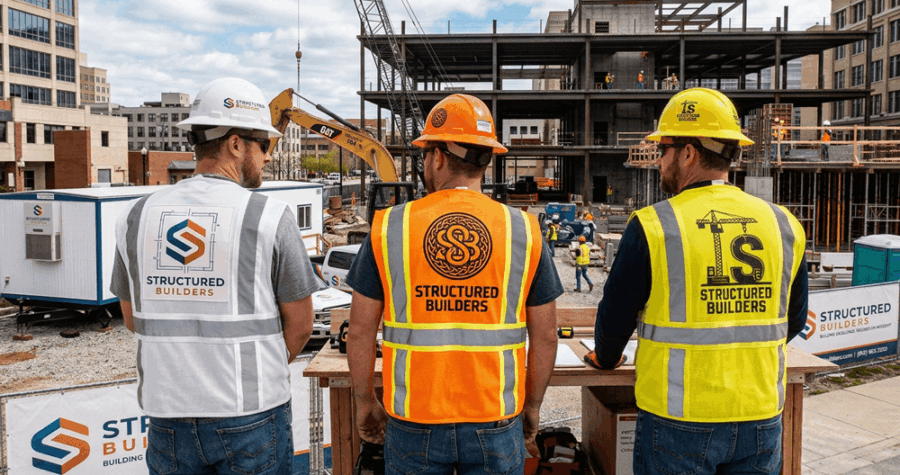
12 Warning Signs Your Construction Company Needs a Rebrand
Construction companies evolve. They grow from subcontractors into prime contractors. They enter new markets, add services, expand geographically, acquire competitors, transition between generations, hire new leadership, become more sophisticated operationally, and change culture.
Sometimes the brand evolves with the company. Sometimes it gets left behind.
A rebrand becomes worth considering when the company people experience today no longer matches the company the brand communicates, or when leadership intentionally wants to use the brand to help move the organization toward something new.
That does not necessarily mean changing the logo. It starts with understanding what is actually broken.
TL;DR
Your construction company may need a rebrand when the brand no longer reflects the company you have become or the company leadership is genuinely committed to becoming.
Warning signs include making excuses for your website or identity, constantly explaining what the company name or logo means, being embarrassed to show the brand, maintaining multiple competing identities, looking indistinguishable from competitors, attracting the wrong clients or employees, entering markets the existing brand does not support, or having a dated name or identity that misrepresents the business.
Before rebranding, determine whether you actually need a brand refresh, repositioning, full rebrand, or company rename. A new logo alone will not solve a positioning, culture, or reputation problem.
1. You Keep Making Excuses for Your Brand
Listen to what employees say immediately before showing someone the website.
“Our website isn’t really that good.”
“We’re actually much bigger than it looks.”
“This doesn’t really show everything we do.”
“We do better work than people think.”
Those statements are warning signs because people inside the company already know the brand does not accurately represent the business.
The same thing happens with logos, proposals, signage, and other materials. Employees begin explaining away weaknesses before anyone else has a chance to notice them.
When you routinely need to apologize for the brand, the market is probably experiencing the same disconnect without hearing your explanation.
2. You Have to Explain What the Name or Logo Means
A little story behind a company name can create personality. Requiring a five-minute explanation before anyone understands what the business does is different.
This becomes especially problematic when companies rename themselves using vague words or phrases that have little natural connection to construction, engineering, or the company’s existing reputation.
If someone hears your company name and responds, “What does that mean?” every time, you have created friction.
The same applies to logos. If everyone needs to hear the founder explain why the triangle represents three generations, the hidden negative space represents a bridge, and the seven lines represent the company’s original seven employees before the mark makes sense, the identity may be working too hard.
Good brands can have deeper meaning. They should not require instructions.
3. You Are Embarrassed by It
Executives should not hesitate before sending someone to the company website. Employees should not dislike wearing the apparel. Recruiters should not wish candidates could somehow skip the careers page, and business developers should not avoid using marketing materials because they think their own PowerPoint looks more professional.
Embarrassment is a useful diagnostic because it suggests the internal perception of the company has moved ahead of the external brand.
People know the business is better than it looks.
That gap eventually becomes a growth problem.
4. You Need Completely Different Logos for Different Situations
Every professional brand needs variations. Horizontal and vertical configurations are useful, as are monochrome versions, icon marks, and versions designed for embroidery or small digital applications.
That is not the problem.
The problem starts when a company has several completely different identities depending on the circumstance. One logo appears on trucks. Another appears on proposals. A different icon represents one business unit. Someone created an alternate mark for apparel. The old logo remains on equipment because employees like it better. Different offices gradually create their own versions.
Instead of flexibility, you now have competing brands.
A good identity system should adapt to different applications while still being instantly recognizable as the same company. Consistency builds memory. Confusion destroys it.
5. Your Brand Does Not Reflect the Current Culture
Companies change.
The contractor that was run like a small family business 20 years ago may now employ 1,000 people across five offices. A hierarchical company may have become much more entrepreneurial. New ownership may emphasize technology, professional development, collaboration, or a very different leadership philosophy.
If the brand still communicates the old organization, the company starts sending conflicting messages.
Clients experience one company while the website describes another. Employees live one culture while recruiting materials advertise something else.
A rebrand can help align the external expression with the culture that already exists, but culture has to be real. Marketing cannot invent it.
6. Leadership Needs to Plant a Flag in the Future
Sometimes the brand does not need to reflect current reality perfectly. It needs to help create the next reality.
An aspirational brand can signal where leadership intends to take the organization. Maybe the next generation is assuming leadership. The company is moving upmarket. Several divisions are becoming one organization. Leadership wants to professionalize the culture, enter more sophisticated markets, attract stronger talent, or stop being viewed as the regional contractor it was 20 years ago.
A rebrand can plant a flag in that future direction.
That only works when leadership genuinely intends to build the organization behind the promise. An aspirational brand should stretch the company, not fictionalize it.
7. Your Company Is Confusing
Sometimes the problem is not aesthetics. People simply cannot figure out what you do.
This frequently happens after years of adding services, creating divisions, making acquisitions, or entering new markets. The website navigation grows. Several logos appear. Business units overlap. Employees use different explanations depending on who is asking.
Confusion creates friction in both sales and recruiting. The market should not need an organizational chart to understand why it should hire you.
If clients, employees, or recruits regularly misunderstand what the company does, who it serves, or how the pieces fit together, the brand architecture may need significant work.
8. You Look and Sound Like Every Competitor
Pull up the websites for ten competitors and hide the logos.
Can you tell who is who?
Construction has a serious sameness problem. Websites use similar photography, similar colors, similar language, and the same claims about quality, safety, relationships, integrity, and people.
Even many modern construction brands still look interchangeable.
That is a missed opportunity.
A rebrand should not simply replace one generic construction identity with a more fashionable generic construction identity. If the new brand could easily belong to any contractor in America, the project has failed strategically even if the logo looks better.
A good rebrand should make the company more recognizable, not merely more attractive.
9. Your Brand Is Attracting the Wrong Clients or Employees
Brands act as filters.
The way your company positions itself influences who calls, who applies, which clients feel comfortable approaching you, and what kinds of projects people associate with the business.
If the company is trying to move toward larger, more sophisticated projects but the brand still looks small and transactional, the wrong prospects may continue showing up.
The same happens in recruiting. A company trying to attract ambitious future leaders may struggle if its employer brand communicates a stagnant, traditional workplace. Conversely, a highly structured company should not pretend to have an entrepreneurial free-for-all culture just because that sounds appealing in recruiting ads.
The goal is not to attract everyone. It is to attract the right people.
10. The Company Has Outgrown the Name
Sometimes the brand problem begins with the company name itself.
Maybe the name describes a service the company barely provides anymore. A geography in the name became limiting after expansion. An acronym has become meaningless. A founder’s name creates confusion after ownership changes.
Technology can age names too. A company named around a once-modern technology can eventually sound like it has “fax” in the name.
The business moved forward. The name stayed behind.
A rename is a much bigger decision than changing the logo because names can carry significant recognition, search equity, history, and relationships. But when the name actively misrepresents what the company does or where it is headed, maintaining it simply because it is familiar can create its own cost.
11. The Brand No Longer Matches the Business After Growth or Acquisition
Growth frequently creates brand debt.
A company acquires another contractor but never develops a clear architecture. It launches three service lines without updating its positioning. Regional offices operate independently until they barely look related. The website gets patched every time something changes.
Eventually, the business strategy and brand strategy stop matching.
This is especially common in construction M&A. The transaction closes, operations begin integrating, and branding gets pushed until later. Later arrives with multiple websites, overlapping services, inconsistent names, confused employees, and clients who are not sure how the companies relate.
A rebrand can create clarity, but only if it begins with the business strategy rather than the logo.
12. The Company You Are Today Does Not Match the Company People See
This is the simplest test.
Compare the company leadership knows internally with the company an outsider sees.
Does the brand accurately reflect your capabilities, culture, size, sophistication, markets, people, reputation, and ambitions?
If the answer is materially different, something needs to change.
Sometimes that is a communications problem. Sometimes it is positioning. Sometimes the visual identity simply needs modernization. And sometimes the company needs a true rebrand.
Refresh, Reposition, Rebrand, or Rename?
Not every brand problem requires starting over.
A brand refresh modernizes how the existing brand is expressed without fundamentally changing what the company stands for. That may include typography, colors, photography, graphics, website design, or refinements to the existing logo.
Repositioning changes how the market should understand the company and its value. Messaging, differentiation, target audiences, and value propositions may change substantially even if the company keeps much of its existing visual identity.
A rebrand goes deeper. It typically revisits positioning, messaging, personality, visual identity, and the broader experience to align the brand with a significant strategic change.
A rename changes the company’s name because the existing one creates confusion, limits growth, misrepresents the offering, carries an unwanted reputation, or no longer fits the business.
Sometimes a company needs one of these. Sometimes it needs several.
The diagnosis should come before the design.
Bad Reasons to Rebrand
You can also rebrand too soon.
Leadership got bored. A competitor launched a new website. Someone wants to follow a design trend. A new executive wants to put their stamp on the company. The current identity suddenly feels less exciting than whatever everyone is doing this year.
Those are weak reasons to spend the time, money, and organizational energy required for a meaningful rebrand.
Brands gain value through consistency. Changing them unnecessarily can destroy recognition you spent years building.
Do not rebrand because you are bored. Do it because something meaningful about the business, market, culture, reputation, audience, or future direction requires change.
A New Logo Will Not Fix a Weak Brand
Perhaps the biggest mistake construction companies make during a rebrand is completing the process and still looking like everybody else.
A new logo is unveiled. The website changes. The colors become more contemporary. Then every page still talks about quality, safety, integrity, relationships, and being on time and on budget.
The company looks newer but remains interchangeable.
That is a design project, not much of a rebrand.
A successful rebrand should create greater clarity about who the company is, who it is for, what it values, why it is different, and where it is going. The visual identity then gives those ideas something recognizable to attach themselves to.
If the company you are today is materially different from the company your brand communicates, or leadership is genuinely committed to becoming something the current brand cannot support, it is worth investigating a rebrand.
Just make sure you are fixing the right problem.

What’s Included in a Construction Company’s Brand?
Ask most people to describe a company’s brand, and they will start with the logo. That makes sense. The logo is the most obvious visual representation of a brand. It appears on the website, proposals, trucks, hard hats, equipment, signs, uniforms, and just about everything else carrying the company name.
But the logo is not the brand.
A construction company’s brand is the collection of experiences people have with the organization and the expectations those experiences create. It includes what clients experience during a project, how employees are treated, how quickly someone responds to an email, what a jobsite looks like, how a superintendent interacts with a neighbor, what prospective employees find online, and even how employees wearing company apparel behave while grabbing lunch.
Jeff Bezos famously said, “Your brand is what other people say about you when you’re not in the room.” That is especially true in construction, where your company’s brand is being experienced every day in offices, jobsites, client meetings, restaurants, traffic, proposals, interviews, and communities.
TL;DR
A construction company’s brand includes much more than its logo, colors, and website. It is the collection of experiences people have with the company across every interaction.
That includes your visual identity, positioning, messaging, culture, leadership, client experience, employee experience, proposals, interviews, website, social media, trucks, equipment, jobsite trailers, PPE, signage, and even how employees behave while representing the company in public.
A strong brand creates consistency between what the company promises and what people actually experience. When those experiences reinforce each other, the brand builds confidence, increases perceived value, helps attract better-fit clients and employees, and can make the company worth paying more for.
Your Logo Represents the Brand. It Is Not the Brand.
A logo matters because it gives people a visual symbol to associate with everything they know and feel about the company. Over time, all those experiences begin attaching themselves to that mark.
If clients consistently have smooth projects, employees are proud to work there, subcontractors enjoy doing business with the company, and the market views the contractor as highly capable, the logo eventually carries some of that confidence with it. The opposite happens too. A beautiful logo cannot rescue a company that communicates poorly, treats people badly, delivers inconsistent quality, or creates frustrating client experiences.
Think of the logo as the visual representation of the brand, not the brand itself. The brand is everything that gives that symbol meaning.
Positioning Is Part of the Brand
A strong brand should help people understand what the company is known for. Why should an owner hire you instead of another capable contractor? What markets do you understand particularly well? What problems are you especially good at solving? What kind of client relationship do you create? Why are you worth paying more for?
If the answer sounds like every other contractor — quality, safety, integrity, relationships, on time, on budget — then the company may have an identity, but it does not have much differentiation.
Positioning creates context for the rest of the brand. It helps prospective clients understand why your experience matters and where you fit in the market. It gives employees something meaningful to rally around and guides thought leadership, business development, pursuit strategy, website content, and even decisions about which opportunities should receive the company’s attention.
Without clear positioning, branding often becomes decoration.
Your Culture Is Part of Your Brand
A strong brand should reflect the company’s actual culture. That does not mean every company needs beanbag chairs, ping-pong tables, or a clever set of values painted on the office wall. It means the personality projected externally should feel recognizable to the people working inside the business.
Some contractors are disciplined and highly structured. Others are entrepreneurial and fast-moving. Some are deeply technical. Some feel like extended families. Others attract independent problem-solvers who thrive with a lot of responsibility. There is no universally correct culture.
The goal is alignment.
A good brand acts like a magnet. It attracts clients and employees who appreciate that culture and makes the company less appealing to people who probably would not fit anyway. Trying to create a brand everyone likes usually results in a brand nobody remembers.
Leadership Sets the Tone
Leaders have an outsized influence on the brand experience. What executives prioritize, tolerate, reward, and communicate eventually makes its way through the organization. Their behavior tells employees which parts of the stated brand are real and which parts are simply marketing language.
If leadership claims relationships matter but treats subcontractors poorly, the real brand wins. If the company claims to value employees but executives communicate only when something goes wrong, employees notice. If leadership talks about innovation but every new idea dies in committee, the market eventually sees that too.
Marketing can help define and communicate the brand, but leadership has to create the environment where that brand can actually exist.
Your Jobsite Is One of Your Biggest Brand Experiences
Construction companies have something most businesses would love to have: enormous physical environments where the public can see their work happening. Yet many contractors treat jobsites entirely as operational spaces and overlook them as brand experiences.
Take the logos away for a moment and ask a simple question: Does your jobsite look any different from your competitor’s jobsite?
Think about the fencing, entrance signage, trailers, equipment, cranes, dumpsters, wayfinding, safety signage, trucks, hard hats, vests, and even the cleanliness and organization of the site. A clean, organized, well-branded jobsite communicates something before anyone reads a marketing message. It suggests discipline, professionalism, pride, and attention to detail.
The jobsite trailer matters too. Clients, architects, subcontractors, inspectors, employees, and recruits may spend considerable time there. If the exterior looks temporary and neglected and the inside feels chaotic, that is a brand experience.
Your machinery and fleet are equally important. Excavators, cranes, service trucks, trailers, and other equipment can become enormous moving billboards. Companies invest millions of dollars in equipment and then sometimes put a six-inch logo on the door.
Construction is one of the few industries where companies can literally display their work, people, equipment, and brand throughout the communities they serve.
Employee Behavior Is Brand Behavior
Brand experiences do not end when employees leave the jobsite. Someone answers the company phone. Someone drives a branded truck through traffic. Someone wearing the company logo walks into a restaurant for lunch. Someone replies to a client email. Someone shows up ten minutes late to a meeting.
All of those interactions shape perception.
That does not mean marketing should police employees’ every move. It means leaders should recognize that people experience a company through its people. How quickly do employees return calls? Do they show up when promised? Are emails professional and responsive? How do crews interact with neighbors around a project? How does someone driving a branded vehicle behave on the highway?
People may never meet your CEO or visit your office. Their entire perception of the company could come from one superintendent, one truck driver, or one interaction with someone wearing the logo.
Your Client Experience Is Your Brand
Marketing does not hand the brand to Operations when the contract is signed. The project experience may be the most important brand experience the company creates.
What happens during preconstruction? How does the project begin? How are problems communicated? Does the client get surprised? How does accounting interact with them? What happens at closeout? Does the company disappear after substantial completion until somebody needs another project?
Every interaction either reinforces or contradicts the promise the company made during the pursuit.
A brand promising partnership should feel collaborative during difficult conversations. A contractor positioning itself around predictability should communicate early when conditions change. A company claiming to be easy to work with should probably have an invoicing and closeout process that is actually easy to work with.
The client does not separate Operations from Marketing. They experience one company.
Proposals and Interviews Are Brand Experiences Too
For many prospective clients, the proposal and interview are among the most concentrated experiences they have with your brand before deciding whether to hire you.
A generic proposal creates a generic impression. A proposal that understands the client’s challenges, clearly communicates value, and looks and sounds consistent with the rest of the company creates confidence.
Interviews reveal even more. Clients see how team members communicate, how well they know one another, whether executives dominate the conversation, how the proposed project team thinks, and whether the culture described in the proposal seems real when actual humans enter the room.
Good proposals and interviews should feel like the company. If they do not, either the pursuit is misrepresenting the culture or the brand has not been defined clearly enough.
Employer Brand Is Part of the Brand
Companies sometimes treat employer branding as a separate initiative owned entirely by HR. Candidates do not. They see one company.
The website, careers page, social media, employee reviews, job postings, recruiter communications, application process, interview experience, office, jobsite, and employees they meet all contribute to their perception.
The company cannot advertise its way around a bad culture. If the careers page promises opportunity and mentorship while employees experience stagnation and poor communication, the real employer brand eventually becomes obvious.
The reverse is also true. Companies with exceptional cultures sometimes struggle to recruit because nobody outside the company can see what employees already know. Marketing should help make the authentic culture visible.
Vendors and Subcontractors Experience Your Brand
Your brand extends beyond clients and employees. Subcontractors, suppliers, vendors, consultants, and partners have experiences with your company too.
How easy is prequalification? How fairly are partners treated? Do you communicate clearly? Do you pay reasonably? Are expectations predictable? Do you treat subcontractors as partners when things get difficult or immediately turn adversarial?
Those experiences travel through the industry. Construction is highly interconnected, and today’s subcontractor may become tomorrow’s referral source, joint-venture partner, client contact, employee, or competitor.
Reputation compounds quickly.
Your Community Experiences the Brand
Jobsites do not operate in isolation. Neighbors deal with noise, traffic, dust, deliveries, road closures, fencing, and workers moving through the area.
How those interactions are handled matters. A superintendent who communicates respectfully with a neighboring business creates a brand experience. So does a driver blocking access without explanation. A clean site creates an impression. So does trash blowing into the adjacent property.
This is especially important because community members may not understand the contractual boundaries of the project. They see the logo on the fence, and to them, that is who is responsible.
Digital Presence Shapes the Brand Before You Meet
Long before someone calls your office, they may have already experienced your brand online. They searched for your company, visited your website, looked through project pages, read employee profiles, checked LinkedIn, viewed photos, or asked an AI platform about contractors in your market.
What did they learn?
Does the digital presence accurately communicate the company that exists today, or does it look like the company from ten years ago? Does your website reinforce expertise or undermine it? Does your thought leadership demonstrate how your people think? Do search engines and AI platforms even understand what markets you serve and what you are known for?
The digital brand is often the first experience prospective clients and employees have with the company. It should earn enough confidence to create the next interaction.
Strong Brands Increase Perceived Value
A cohesive brand makes a company feel more credible, and that matters commercially.
A contractor with clear positioning, relevant proof, professional visuals, consistent communication, strong thought leadership, a well-managed jobsite, polished pursuit materials, and a good reputation creates confidence before price enters the conversation.
Confidence increases perceived value.
That does not mean a nice website allows you to arbitrarily charge more. It means the total brand experience gives the client more reasons to believe the company will deliver a better outcome with less risk.
When two contractors appear identical, price naturally becomes more important. When one feels clearly more capable, relevant, professional, and trustworthy, the comparison changes.
Your Brand Is the Sum of the Experiences
There is no single moment when someone experiences your construction brand. They experience pieces of it over time: a project sign, a Google search, a conversation with a superintendent, a proposal, a truck in traffic, an interview, an invoice, a LinkedIn post, a jobsite trailer, a conversation with one of your subcontractors, or an employee wearing the logo at lunch.
Eventually, all those interactions add up to an impression.
Your logo gives that impression a visual symbol. The experiences give the logo its meaning.
That is your brand.

AI Is Commoditizing Information. Construction Brands Need to Build What AI Can’t.
The internet spent the last 25 years rewarding companies that could publish useful information. Artificial intelligence is changing the value of that information.
In a recent Instagram Reel, Glove Jones made an observation that should get the attention of every marketer and business leader: as search becomes increasingly agentic, the things most likely to survive and thrive are trusted brands, personalities, communities, proprietary data, and real experiences. His argument goes beyond another prediction that “SEO is dead.” We’ve heard versions of that headline for years, usually followed by SEO continuing to work just fine.
This shift is more fundamental. AI is making ordinary information abundant. It can find information, summarize it, compare sources, answer increasingly complicated questions, and now take actions on someone’s behalf. As information becomes easier to produce and easier to consume without visiting the source that created it, simply having information becomes less valuable.
For construction companies, that should change how we think about content, thought leadership, expertise, and ultimately the brand itself.
Because if AI can reproduce most of what you publish, why should anyone care that you published it?
Google isn’t killing the search box. It’s turning it into something much bigger.
There’s an important clarification to Jones’s premise. Google has not announced that it is eliminating its search bar. In May 2026, Google called its new AI-powered Search box the “biggest upgrade in over 25 years.” The new experience accepts text, images, files, videos, and even Chrome tabs, then reasons across those inputs. Google is also combining AI Overviews and AI Mode into a more conversational search experience.
More importantly, Google is building agents directly into Search. Information agents can monitor the web in the background, synthesize developments, notify users when something changes, and help them take action. Google is also expanding agentic capabilities into activities such as booking services and shopping.
The search box isn’t disappearing. The old relationship between the searcher, the search engine, and your website is.
For years, the basic bargain was relatively simple. Someone searched for something. Google displayed a list of websites. The person clicked a result, visited a website, consumed the information, and perhaps took another action.
Now the AI can increasingly sit between the user and those websites. It can research multiple sources, synthesize the information, answer the question, continue the conversation, monitor the subject, and eventually perform parts of the task. That changes what information is worth.
AI is turning information into a commodity
Consider how much construction marketing content follows essentially the same formula:
- “What is preconstruction?”
- “Five Benefits of Design-Build Construction.”
- “How to Choose the Right General Contractor.”
- “Why Safety Matters in Construction.”
- “Five Trends Changing Healthcare Construction.”
Most of that content wasn’t particularly differentiated before AI. Now a sophisticated AI model can produce a competent version of it in seconds, and it can also summarize 20 versions written by your competitors.
That doesn’t mean educational content suddenly has no value. Buyers still have questions, search still matters, and Google is very clearly continuing to send people to websites from its AI experiences. Google says AI Mode has already surpassed one billion monthly users, while AI Overviews exceeds 2.5 billion monthly active users.
What is changing is the value of commodity information. Google itself is telling website owners to pay attention. Its updated guidance for generative AI Search specifically emphasizes providing unique, non-commodity content rather than creating more interchangeable information.
That’s a pretty significant choice of words.
If you’re publishing something that 50 competitors could publish, and AI could write without ever talking to your team, you haven’t created much of a competitive advantage. You created more information.
The next content advantage is something AI can’t manufacture
This is where Jones’s framework gets particularly interesting. He identifies trusted brands, personalities, communities, proprietary data, and real experiences as assets that become more valuable as AI commoditizes information.
I would add another layer: perspective.
Information tells me what happened. Perspective tells me what you think it means. Experience tells me why you believe it. Proprietary data gives me evidence I couldn’t get somewhere else. Personality gives me a reason to remember who said it, and trust determines whether I believe you.
AI is astonishingly useful for information retrieval and synthesis. But when everyone has access to increasingly similar artificial intelligence, access to the tool doesn’t create much differentiation.
Your inputs do.
Construction companies are sitting on mountains of information nobody else has
This is where I think construction companies have an enormous opportunity. Most contractors possess extraordinary amounts of knowledge that never becomes marketing content.
Your preconstruction team knows what is happening to costs before most people in your market do. Your estimators see changes in subcontractor participation, pricing, labor pressure, material availability, and escalation. Your project executives know which decisions consistently cause schedule problems, while your project managers know where owners get frustrated.
Your superintendents have seen hundreds of good ideas look terrific on paper and fail in the field. Your teams know which design decisions create constructability problems, which procurement approaches work, which project types are changing, and where clients repeatedly waste money.
Meanwhile, marketing publishes “Five Reasons to Hire a General Contractor Early.”
We can do better.
The knowledge inside your company is an asset. Marketing’s job should increasingly be to extract, organize, analyze, package, and distribute that knowledge—not merely generate another month of content for the editorial calendar.
Proprietary research becomes a moat
This is one reason I’m increasingly bullish on primary research for construction brands. AI can summarize a report, but it can’t retroactively conduct the research your company never did.
Imagine a healthcare contractor surveying 100 hospital facility executives about their capital-program priorities. A higher education contractor could analyze five years of campus construction trends across its region, while a multifamily contractor could publish original research about the causes of preconstruction delays.
A specialty contractor could analyze hundreds of completed projects to identify which design conditions correlate with change orders. A GC could use its estimating data—carefully anonymized and aggregated—to provide insights about escalation, subcontractor participation, procurement timing, or market-sector capacity.
Suddenly the content isn’t merely competing for search traffic. It becomes the source other people discuss.
That distinction becomes increasingly valuable in an AI-mediated internet because AI systems still need material to learn from, synthesize, reference, and cite. Google is even expanding features designed to make original reporting, influential sources, firsthand perspectives, creator insights, social discussions, and trusted sources more visible within its AI experiences.
Don’t just answer the existing question better.
Create information that didn’t exist before.
Real experience is becoming more valuable, too
Construction has another competitive advantage that many industries would love to have: you actually build things. You have real projects, clients, problems, decisions, mistakes, innovations, and lessons.
Unfortunately, contractors often sanitize those experiences until nothing interesting remains. A typical project profile says the project was challenging, collaboration was important, the team worked together, and everyone was proud of the finished building.
Great. So did everybody else’s.
Real experience gets much more interesting when you’re willing to explain what actually happened. What did the team discover during preconstruction? What assumption turned out to be wrong? What did you change? What almost caused the project to miss its deadline?
What did the superintendent see that nobody else did? What did you recommend that saved the owner money? What would you do differently next time?
Those answers have fingerprints on them. AI can imitate the structure of a case study, but it cannot have spent 18 months solving the problem your team solved.
Google appears to understand that distinction as well. Its May 2026 Search updates specifically expanded the visibility of firsthand perspectives from public discussions, social media, creators, and communities.
Experience isn’t an SEO trick. It’s evidence that you’ve actually done the work.
Founder-led and expert-led brands have another advantage
Jones also points toward the growing importance of personalities, creators, podcasts, YouTube, Instagram, and founder-led brands. Construction companies should pay attention.
For years, many contractors have intentionally removed personality from their marketing. Websites speak in a corporate collective voice. Executives rarely publish opinions. Subject-matter experts are hidden three clicks deep on the team page, and social media mostly consists of project photos, employee anniversaries, safety lunches, and golf tournaments.
The company may employ brilliant people, but you would never know it from the outside. That’s a missed opportunity in an internet increasingly filled with machine-generated sameness.
People follow people. They remember the estimator who explains why a common budgeting assumption is wrong, the healthcare construction executive who has a strong point of view about phasing occupied renovations, and the superintendent who teaches young project managers what drawings don’t tell them.
The goal isn’t to turn your CEO into an influencer. The goal is to let expertise have a face.
Your brand should make its experts more visible, and those experts should make the brand more credible.
A point of view is harder to commoditize than information
This may be the biggest opportunity of all. Too much construction thought leadership doesn’t actually contain much thought.
It explains, summarizes, and reports, but it rarely argues.
Real thought leadership should occasionally make someone say, I hadn’t thought about it that way.
Perhaps your company believes GMP contingency is routinely misunderstood. Perhaps your superintendent thinks architects should involve field leadership earlier. Perhaps your preconstruction leader believes an accepted industry practice is wasting owners’ money, or your CEO believes the industry’s approach to workforce development is fundamentally broken.
Those perspectives won’t appeal to everyone, and that’s part of what makes them valuable.
AI is exceptional at synthesizing the consensus. Brands have an opportunity to provide the informed perspective that moves the conversation beyond it.
That doesn’t mean manufacturing controversy for attention. A/E/C has enough chest-beating without adding another executive trying to become the construction industry’s newest LinkedIn provocateur. It means having informed opinions backed by experience.
Community may become more important than audience
There is another important distinction in Jones’s framework: community. An audience consumes what you publish. A community interacts with it, contributes to it, challenges it, discusses it, and eventually builds relationships around it.
For construction companies, community doesn’t have to mean building a giant Facebook group. It might be a quarterly roundtable of healthcare facility leaders, a breakfast series for architects and developers, or a research panel of higher education capital-program executives.
It could be an annual benchmarking study where participants receive deeper findings, a podcast that becomes a gathering place for people working in a specific market, or a newsletter that clients actually forward because it consistently teaches them something.
The technology will continue changing. Platforms will rise and fall. Algorithms will get rewritten.
Relationships between people are much harder to disrupt.
Stop asking AI to create your expertise
There is an irony in all of this. AI is one of the most powerful marketing tools construction companies have ever had. I use it. A/E/C CMOs will use it extensively. It can accelerate research, identify patterns, organize information, improve workflows, analyze data, repurpose content, and dramatically increase what a small marketing team can accomplish.
The mistake is using AI to manufacture expertise you don’t possess.
If your content strategy becomes asking ChatGPT for “20 blog topics for a commercial contractor” and publishing whatever comes back, you’ve simply found a faster way to become indistinguishable.
Use AI to amplify your expertise. Use it to interrogate your proprietary data, help subject-matter experts organize their thinking, turn a 45-minute interview with a superintendent into several useful pieces of content, analyze research responses, find patterns across years of project information, and challenge an executive’s argument before publishing it.
AI should make your company’s unique knowledge easier to extract and distribute. It shouldn’t become the source of the knowledge.
The future internet may be AI for utility and humans for meaning
Jones describes the emerging split particularly well: AI for utility, humans for meaning. I think he’s onto something.
When I want a quick comparison, calculation, definition, summary, itinerary, or synthesis, AI is remarkably useful. But humans still want to know who has actually been there, whose judgment they trust, who has a perspective worth hearing, who discovered something new, and who understands their world.
They also want to know who can tell the story and who they want to work with.
That’s why the rise of AI doesn’t make branding less important. It makes Magnetic Brands more important.
A magnetic construction brand isn’t merely visible. It possesses enough expertise, distinction, credibility, personality, and trust that people deliberately seek it out, remember it, recommend it, and want to hear what it has to say.
In a world drowning in perfectly competent information, competence alone won’t create much gravity.
What construction marketers should do now
Don’t respond to AI Search by producing twice as much content. Produce more content that could only come from your company.
Interview the experts hiding inside your organization. Conduct original research. Analyze your own data. Develop a point of view. Tell better project stories. Put knowledgeable people in front of cameras and microphones. Create communities around the markets you serve. Publish experiences rather than generic explanations, and invest in building a brand people recognize before an AI agent ever recommends a list of contractors.
SEO still matters. Your website still matters. Technical optimization still matters. Google itself is continuing to build ways for AI Search users to discover and visit original websites and trusted sources.
But optimizing commodity content isn’t a durable strategy when the machines themselves can manufacture commodity content.
The competitive question is changing from “Can Google find us?” to “Do we have something worth finding?”
That’s a much harder question, and it’s also a much better one.
Sources
Glove Jones. Instagram Reel discussing the shift toward agentic search and the increasing value of trusted brands, personalities, communities, proprietary data, and real experiences. Reel: DYm93z3NgGL.
Google. “A New Era for AI Search,” May 19, 2026. Google describes its new AI-powered Search box as its largest upgrade in more than 25 years and outlines information agents, agentic capabilities, and generative interfaces in Search.
Google. “New Opportunities, Control and Insights for Website Owners,” June 3, 2026. Google recommends unique, non-commodity content for visibility in generative AI Search and reports more than one billion AI Mode users and 2.5 billion AI Overviews users.
Google. “New Ways to Find Your Favorite Sources and Original Content in AI Search,” May 27, 2026. Google describes features emphasizing trusted sources, original content, creator insights, and firsthand perspectives.
Google. “5 New Ways to Explore the Web With Generative AI in Search,” May 6, 2026. Google discusses surfacing authentic voices, original content, social discussions, and firsthand sources within its AI Search experiences.