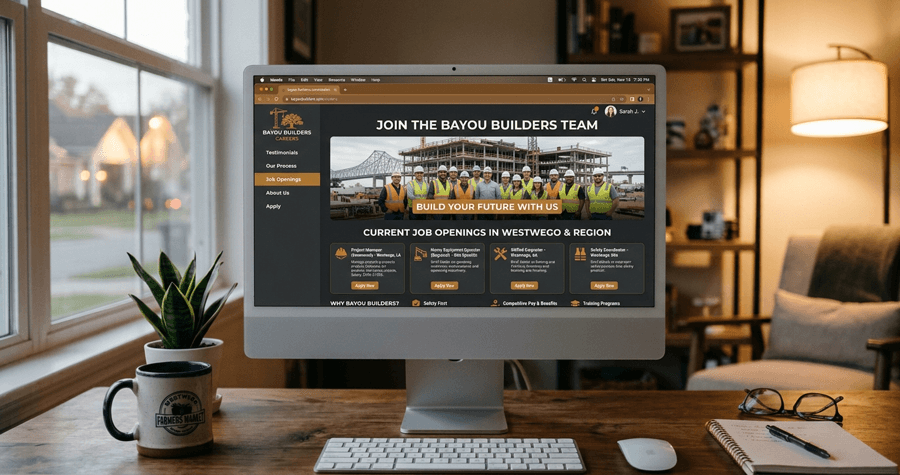
Month: November 2026

Your Careers Page Is Costing You Qualified Applicants

Your construction company might have an impressive website. Beautiful project photography, detailed market expertise, award-winning projects, and hundreds of millions of dollars in completed work. Everything is designed to convince prospective clients that you’re the right contractor for their next project.

But what does that same website tell someone who’s considering working for you?

If your Careers page is buried in the footer and consists of a generic paragraph about competitive benefits followed by a list of job openings, you’re sending prospective employees a message. And probably not the one you intended.

After more than 20 years working in construction marketing, I’ve reviewed hundreds of contractor websites. Too many smaller and midsized companies treat their Careers pages as an administrative necessity rather than a recruiting asset. Even among larger contractors, the quality of the employee experience can vary considerably. Our research on how leading contractors present their brands and careers provides a larger-industry comparison.

The worst offenders don’t have a Careers page at all. That sends an unfortunate message to prospective employees: attracting future team members isn’t important enough to deserve space on the website.

This isn’t simply a website design issue. It’s a business problem that can cost contractors qualified candidates, increase recruiting expenses, and make an already difficult labor market even more challenging. A careers page is just one stage of the full recruitment marketing funnel.

According to the 2026 AGC and NCCER Workforce Survey, 88% of contractors with craft openings reported those positions were as hard or harder to fill than the previous year. Among contractors with salaried openings, 87% reported the same challenge.

When finding qualified employees is this difficult, contractors can’t afford to lose interested candidates because their websites fail to answer basic questions or make applying unnecessarily difficult.

Your Website Sells to Clients but Ignores Future Employees

Construction companies understand the importance of knowing their ideal clients. They research target markets, identify decision-makers, understand buying motivations, and develop marketing messages that speak to those audiences.

Yet when it comes to prospective employees, many contractors abandon that discipline entirely.

Their Careers pages are company-focused rather than candidate-focused. They talk about the organization’s history, accomplishments, values, and growth without explaining what any of those things mean to someone considering a career there.

Imagine visiting a contractor’s website as an experienced superintendent. You want to know what projects the company builds, how its operations teams function, whether leadership supports its field employees, and what opportunities exist for your career. Instead, you find a paragraph about being a family-oriented company and a button to view open positions.

Why would that convince you to leave a good job?

The same principle applies to project managers, estimators, accountants, and marketing professionals. These candidates aren’t simply evaluating job openings. They’re comparing potential employers, and many office professionals are considering opportunities outside construction altogether.

Your Careers page needs to speak directly to their interests, ambitions, and concerns.

That starts with defining your ideal employees and understanding what makes your company attractive to them. Showcase the people they’ll work alongside, the projects they’ll help build, the opportunities they’ll have to develop professionally, and the culture they’ll experience every day.

Don’t just tell candidates you’re a great company. Give them reasons to believe they’d enjoy working there.

Mediocre Careers Pages Make You Look Like Every Other Contractor

There’s nothing inherently wrong with listing benefits and available positions. Candidates need that information. The problem is when that’s practically everything your Careers page offers.

I’ve encountered this repeatedly throughout my career. The same generic claims about competitive compensation, comprehensive benefits, a family atmosphere, and opportunities for advancement appear on one contractor’s website after another.

It’s the employer-branding equivalent of claiming your construction company delivers quality projects on time and within budget.

Those things are expected. They don’t explain why someone should choose you.

A more compelling Careers page demonstrates your culture through real employees, authentic photographs, and stories about what makes working for your company different.

Show a project manager explaining how leadership supported their career advancement. Feature a superintendent discussing the company’s approach to safety and project execution. Include photographs of crews collaborating, solving problems, and celebrating accomplishments rather than relying exclusively on pictures of completed buildings.

Employee testimonials are particularly useful when they represent the positions you frequently hire. Video testimonials can be even more effective because prospective employees get to see and hear the people they might eventually work with.

Your project portfolio can also become an important recruiting tool. Don’t simply showcase a completed hospital, bridge, or manufacturing facility. Explain what made the project challenging and highlight the employees who helped deliver it.

Great employees often want to work on great projects with people they respect. Your website should give them a glimpse of both.

And please, show some personality. Your company’s culture should be recognizable in its recruiting materials rather than disappearing behind generic corporate language.

Tell Candidates What Working There Actually Means

One of the biggest mistakes contractors make is failing to provide an honest picture of the employee experience, particularly for field positions.

Construction work is less predictable than many office jobs. Project locations change, schedules fluctuate, weather creates challenges, and some positions require considerable travel.

These aren’t necessarily negatives. Some employees enjoy traveling, working in different locations, and taking on challenging assignments. Others want to be home with their families every evening.

Neither candidate is wrong, but only one might be the right fit for a position involving extensive travel.

Contractors need to be transparent about these expectations rather than hiding inconvenient details until the interview process. Misrepresenting the position might generate additional applicants, but it can also waste everyone’s time and contribute to higher turnover.

For field positions, explain where your projects are located, whether overnight travel is required, what typical schedules look like, and how compensation accounts for travel. Clarify who provides tools, equipment, and vehicles, whether per diem or travel stipends are available, and what other expenses employees are expected to cover.

Candidates should also understand their professional development opportunities. Is there a formal apprenticeship or training program? Can a skilled tradesperson advance without moving into management? Are there opportunities to become a technical specialist, trainer, or subject matter expert?

Not everyone wants to supervise people. A strong employer recognizes that technical expertise and craftsmanship can be valuable career paths in their own right.

Safety deserves particular attention. A well-developed Safety page is an excellent companion to a Careers page because it provides evidence of how the company protects its employees.

And remember, prospective employees aren’t always the only people researching your organization. Spouses and family members often influence employment decisions, particularly when travel, physical risk, and unpredictable schedules are involved.

A spouse evaluating your contractor may pay as much attention to its safety practices and travel expectations as the candidate does to compensation.

Give both audiences the information they need to make an informed decision.

Stop Making Candidates Jump Through Hoops

Even when a contractor does a good job attracting candidates, the application process can create unnecessary barriers.

Someone finds an appealing opportunity on your website, clicks Apply, and gets redirected to a third-party hiring system. They’re required to create an account, upload a résumé, and then manually enter information that’s already in the document.

For experienced professionals, that’s frustrating. For field employees who may be applying from a smartphone and don’t have a formal résumé, it can be enough to abandon the process.

Your application should be appropriate for the position and easy to complete on a mobile device.

A project manager may be comfortable providing a résumé and detailed employment history. An experienced equipment operator or foreman may be better served by a shorter initial application that captures contact information, relevant experience, certifications, and geographic preferences.

HR can gather additional information during screening and subsequent stages of hiring. The objective isn’t to eliminate necessary qualifications or compliance requirements. It’s to avoid asking candidates for information that isn’t needed at that point in the process.

Contractors should also pay attention to the experience after an application is submitted.

At a minimum, candidates should immediately receive confirmation that their application was received, along with an explanation of the hiring process and what happens next.

If interviews are ongoing or decisions are delayed, communicate that. Even a brief update explaining that the company is still evaluating candidates demonstrates respect for their time.

And when you hire someone else, close the loop with the remaining applicants.

I’ve seen too many companies send an initial acknowledgment and then disappear. That damages the candidate experience and potentially the company’s employer reputation, especially in an industry where professional networks are closely connected.

Stop Throwing Away Qualified Candidates

Here’s a recruiting expense that construction executives rarely consider: the value of candidates who applied but weren’t hired.

Imagine your company advertises a project manager position, screens numerous applicants, interviews several qualified candidates, and ultimately hires one person.

What happens to the other finalists?

If your recruiting process consists primarily of emails and spreadsheets, those candidates often disappear into old inboxes and files. Six months later, when another project manager position opens, the company starts the entire recruiting process over again.

That’s an expensive way to operate.

I worked with a contractor that maintained a separate CRM specifically for applicants. We developed an automated workflow to check in quarterly with qualified candidates, keeping the company connected to people who might be a good fit for future opportunities.

An applicant tracking system (ATS) can accomplish the same thing. The important part is having a process for organizing prospective employees, tracking their qualifications, and maintaining appropriate contact after the initial hiring decision.

Your Careers page should support that process by allowing interested professionals to join your talent network even when a suitable position isn’t currently available.

This approach can create significant financial opportunities.

Construction companies can spend thousands of dollars monthly advertising openings on job boards, while external recruiter placement fees for experienced management positions can run into the tens of thousands of dollars.

Consider a contractor that avoids two external recruiter placements at $30,000 each and four months of job-board advertising at $10,000 per month by successfully hiring through its existing candidate pipeline.

That’s $100,000 in potential gross recruiting expenditures avoided.

This is an illustrative scenario, not a guaranteed savings estimate. Results depend on hiring volume, positions, actual recruiting costs, and how effectively the company maintains its candidate database. Managing the pipeline also requires resources.

Still, it demonstrates why developing relationships with prospective employees deserves attention. Over a year or two, a contractor that consistently builds its talent pipeline may become less dependent on expensive outside recruiting channels.

Treat qualified candidates the way your business development team treats qualified prospective clients. Stay connected, provide relevant information, and make it easy to restart the conversation when the timing is right.

Find Out Where Your Website Is Losing Applicants

Most construction companies can tell you approximately how many people applied for an open position. Far fewer can explain how many prospective employees visited the Careers page or what happened before those applications were submitted.

That makes it difficult to diagnose recruiting performance.

Marketing and HR should begin with a few basic website measurements: Careers page visits, average engagement time, bounce rate, and completed applications.

Visits show how much traffic the Careers page receives. Engagement time can help indicate whether candidates are exploring the content. Bounce rate may reveal sessions with limited interaction, although it should be interpreted in context rather than treated as a direct measure of candidate interest.

Most importantly, completed applications show whether visitors are taking action.

If possible, also track clicks to job listings, application starts, and application completions. If your ATS sends candidates to another website, coordinate tracking between the systems so you don’t lose visibility when they leave your company website.

A contractor attracting substantial Careers page traffic but relatively few applicants may have a messaging, relevance, or application-friction problem. A contractor receiving very little traffic may need to improve how it promotes employment opportunities through social media, referrals, job boards, and other channels.

Website metrics won’t explain everything, and more applications don’t necessarily mean better recruiting. HR should also evaluate whether the applications are coming from qualified candidates.

But without basic measurement, contractors are making recruiting decisions with incomplete information.

Take the Five-Minute Careers Page Test

Here’s a simple exercise for your next leadership meeting.

Ask someone who isn’t familiar with your company’s hiring process to visit your website on their smartphone and pretend they’re considering an available position.

Can they quickly understand why your company would be a good place to work? Can they find relevant opportunities, learn what the work involves, and get answers to their most important questions? Can they begin applying without unnecessary frustration?

Better yet, ask recent hires what they thought about your website and application experience. Find out what information they wanted but couldn’t find, what almost prevented them from applying, and what ultimately convinced them to pursue the opportunity.

Then use that feedback to make improvements.

Contractors spend considerable time and money making sure their websites appeal to prospective clients. It’s time to give prospective employees the same level of attention.

Your next great superintendent, project manager, estimator, or foreman might already be visiting your website.

The question is whether you’re giving them a reason to apply or a reason to leave.


Is Your Construction Careers Page Doing Its Job?

We’ve developed a visual guide covering the 12 essential elements of an effective construction Careers page, from employee value propositions and testimonials to career advancement, safety, and application experience.

Download Deconstructing Great Construction Websites: Careers Edition and use it with your marketing, HR, and leadership teams to identify opportunities to attract better employees.

Download the Free Careers Page Infographic

How to Measure the ROI of Recruitment Marketing

Imagine your construction company’s marketing team launches a recruiting campaign that generates 200 job applications. Everyone celebrates the response, and Marketing presents the results as a success.

Then HR reviews the applicants and discovers that only five meet the qualifications for an interview.

Meanwhile, another campaign produces just 20 applications, but eight candidates qualify for interviews, four receive job offers, and three accept.

Which campaign performed better?

Too many contractors measure recruiting success by how many applications they receive rather than how effectively they attract and hire qualified employees. Those measures make more sense when viewed across the recruiting funnel from awareness to retention.

It’s similar to measuring business development success by the number of proposals submitted instead of projects won and their profitability. Activity matters, but outcomes determine whether the investment was worthwhile.

After more than 20 years in construction marketing, I’ve worked with contractors to measure applications, qualified candidates, employee referrals, retention, and tenure. These measurements reveal much more about recruiting performance than application volume alone.

And when Marketing and HR share that information, they can connect recruiting efforts to hiring costs, employee retention, and the company’s employer brand. For related guidance on connecting marketing and recruiting, see our talent acquisition and retention resources.

Measure Qualified Applicants, Not Just Applications

Construction’s workforce shortage isn’t simply about finding people who want jobs. It’s about finding people with the right experience, qualifications, and expectations.

According to the 2026 AGC and NCCER Workforce Survey, half of responding contractors reported that available candidates lacked the necessary skills, certifications, or licenses.

That’s why qualified applicants should be your first measurement.

Before advertising a position, HR and the hiring manager should agree on what makes someone qualified for an interview. A project manager might need experience with specific project types, contract values, and delivery methods. A skilled tradesperson might need relevant certifications, field experience, and geographic availability.

Marketing can then develop recruiting messages that attract those candidates rather than trying to appeal to everyone.

Calculate your qualified applicant rate by dividing qualified applicants by completed applications. If 100 people apply and 25 qualify for interviews, your rate is 25%.

Track this by position and recruiting source. A campaign producing fewer applications but significantly more qualified candidates may be substantially more valuable.

Understand What Recruiting Actually Costs

Most construction executives know recruiting is expensive. What they often don’t know is how those costs compare across recruiting channels.

I’ve seen contractors spend $3,000 to $10,000 monthly advertising positions on job boards. External recruiter fees for experienced professionals can reach $20,000 to $50,000 per placement, depending on the position and agreement.

HR often already knows the company’s typical advertising expenses and recruiter fees. Some contractors even establish an average recruiting budget for each position.

Start with those numbers and calculate two measurements.

Cost per qualified applicant divides recruiting expenditures by the number of candidates qualified for interviews. If a contractor spends $5,000 advertising a superintendent position and attracts ten qualified candidates, the cost per qualified applicant is $500.

Cost per hire divides recruiting expenditures by the number of employees hired. If that same campaign produces two hires, the direct recruiting cost per hire is $2,500.

Track advertising, recruiter fees, referral bonuses, and other direct expenses. For a more comprehensive analysis, include allocated recruiting staff time, hiring manager time, and technology expenses.

The objective isn’t necessarily to minimize spending. It’s to understand which investments consistently produce qualified employees at a reasonable cost.

Measure Organic Recruiting and Employee Referrals

One of the strongest indicators of a magnetic employer brand is the company’s ability to attract qualified candidates without continually paying to reach them.

These candidates might discover your company through organic search, social media, thought leadership, employee stories, or its reputation in the construction community. Others visit your Careers page directly because they already want to work for you.

Marketing can influence this interest by shifting recruiting messages from company-focused to applicant-focused. Even small changes, such as referring to employees as team members or using a distinctive branded name for the workforce, can make the company feel more personal and approachable.

Promoting employee tenure, advancement opportunities, and multigenerational employment also reinforces the message that people choose to build careers there.

Track the number and percentage of qualified applicants and new hires coming from organic channels. Separate employee referrals into their own category so you can evaluate their effectiveness.

Employee referrals can be particularly valuable in construction, where professionals frequently know one another through projects and industry relationships.

I like using a three-stage referral incentive program:

  • $50 gift card or company store credit when a referred candidate applies and qualifies for an interview.
  • $2,000 bonus when the referred candidate is hired.
  • $5,000 additional bonus after the employee completes one year.

That’s a potential $7,050 investment in an employee who joins and stays for a year. Compared with a $30,000 external recruiter fee, it can be an attractive alternative.

The amounts should reflect the position, labor market, and recruiting economics. HR should also establish clear eligibility and payment rules to prevent abuse.

Measure qualified referrals, referral hires, cost per referral hire, and one-year retention. You may discover that your best recruiters are already on your payroll.

Track Hiring Speed and Offer Acceptance

Two additional measurements help reveal whether your company is becoming an employer candidates genuinely want to join.

Time-to-fill measures the number of days between opening a position and a candidate accepting the offer. Track it by role because recruiting a project executive is different from filling an entry-level position.

I’ve seen contractors improve their employer branding and Careers pages, then fill positions faster because candidates were more interested in joining the organization.

Offer acceptance rate measures the percentage of job offers candidates accept. If you extend ten offers and six candidates accept, your acceptance rate is 60%.

I’ve worked with contractors that tracked this metric as they improved their brands and recruiting experiences. More candidates wanted to work there, resulting in higher offer acceptance and faster hiring.

Of course, Marketing can’t take all the credit. Compensation, interview experiences, management, and competing offers influence these outcomes.

But improving both measurements can signal that your company is becoming a more desirable employer rather than simply generating more applications.

One-Year Retention Is the Ultimate Test

Hiring someone isn’t the end of recruiting. A contractor that fills 20 positions but loses half those employees within a year hasn’t necessarily solved its workforce problem.

That’s why I recommend one-year retention as the primary long-term measurement of recruiting success.

Track the percentage of new hires who remain employed after 12 months, and compare results by recruiting source, role, and department. Evaluate completed hiring cohorts so recent hires don’t distort the measurement.

You may discover that referrals stay longer than employees recruited through job boards, or that certain recruiting channels produce stronger results for specific positions.

However, don’t confuse recruitment problems with leadership problems.

If employees leave because of an abusive manager, unreasonable schedules, or inadequate operational support, Marketing may have attracted excellent people whom the company failed to retain.

HR, Marketing, and Operations need to review retention together to distinguish poor hiring matches from problems with the employee experience.

Reducing turnover can do more to improve recruiting economics than simply increasing the number of applicants.

Build a Shared Recruitment Marketing Scorecard

One of the most common problems I’ve encountered is the disconnect between Marketing and HR data.

Marketing sees website traffic, advertising performance, and applications. HR sees interviews, hiring decisions, recruiting costs, and retention. Neither department necessarily understands the complete recruiting funnel.

Where possible, integrate your applicant tracking system (ATS) with your CRM or reporting dashboards. A smaller contractor can start with a shared spreadsheet rather than investing in additional technology.

I recommend seven core measurements:

Measurement What It Reveals
Qualified applicants Are we attracting people worth interviewing?
Cost per qualified applicant How efficiently are we attracting them?
Cost per hire What does filling a position cost?
Organic and referral hires How much is our reputation helping?
Time-to-fill How quickly can we staff positions?
Offer acceptance rate Do candidates want to join?
One-year retention Are we hiring people who stay?

Review the results monthly, with deeper quarterly and annual evaluations. Compare performance by position and recruiting source wherever practical.

Marketing shouldn’t celebrate applications HR can’t use, and HR shouldn’t evaluate recruiting performance without considering how candidates are attracted and treated.

Both departments should be working toward the same business outcomes.

What Does Recruitment Marketing ROI Look Like?

Consider a midsized commercial contractor that frequently uses external recruiters to fill project management and field leadership positions.

Marketing proposes investing $20,000 in improving the Careers page, developing employee stories, and building a pipeline of prospective candidates.

Over the following year, the contractor hires two qualified employees through its referral program instead of external recruiters.

Assume each recruiter placement would have cost $30,000.

Investment or Savings Amount
Two recruiter fees avoided $60,000
Recruitment marketing investment ($20,000)
Two referral incentive packages ($14,100)
Net potential savings $25,900

That’s approximately a 76% return on the $34,100 invested in marketing and referral incentives.

This is an illustrative scenario, not a documented client result or guaranteed return. It assumes both positions would otherwise have required paid recruiter placements, excludes additional internal costs, and includes referral bonuses payable after one year.

Other contractors might realize savings through reduced job-board spending, faster hiring, or fewer repeated vacancies. Those benefits should be measured separately and included only when reasonably documented.

The example demonstrates how a relatively modest recruiting marketing investment can potentially produce a meaningful financial return.

Better Recruiting Starts with Better Measurement

Construction executives have become increasingly sophisticated about measuring business development. They track pursuits, hit rates, awarded contracts, backlog, and profitability because those numbers guide business decisions.

Recruiting deserves similar attention.

Marketing should understand which messages and channels attract qualified candidates. HR should measure hiring outcomes and recruiting costs. Operations should help evaluate employee performance and retention.

Start with the information you already have, connect the data, and identify which investments consistently produce employees who succeed and stay.

The real return on recruitment marketing isn’t how many people apply. It’s how many of the right people join your team, what it costs to attract them, and how long they choose to stay.

Holiday Marketing for Contractors: Are You Being Thoughtful or Just Checking the Box?

Somewhere this Christmas, a construction company’s marketing coordinator will spend an hour creating a graphic that says, “Merry Christmas from Our Team!”

It will feature a stock photo of a Christmas tree, perhaps with a hard hat or company logo awkwardly added. They’ll publish it on LinkedIn, collect a handful of likes from coworkers, and check another item off the marketing calendar.

Meanwhile, I recently ran into a former client who told me she still has a terrarium I gave her for Earth Day more than 12 years ago. It’s sitting on her office bookcase.

That’s the difference between acknowledging a holiday and creating a memorable brand experience.

I’ve spent more than 20 years marketing architecture, engineering, and construction companies, and I’ve experimented with everything from custom Christmas cards to construction-themed gifts and elaborate holiday campaigns. Some were surprisingly successful. Others received less attention than I hoped, despite the creative effort involved.

But they reinforced an important lesson: Holiday marketing shouldn’t be about checking boxes. It should create experiences that help people remember your company and strengthen their relationships with it. Sometimes the best holiday for your contractor isn’t Christmas at all.

Should Contractors Post Happy Thanksgiving and Merry Christmas on Social Media?

I’m not a fan of generic holiday social media posts, especially for construction companies. Think about your audience: On Christmas morning, are construction executives, developers, architects, and project managers really waiting to see whether their favorite contractor wishes them Merry Christmas on LinkedIn?

Probably not. You’re not Disney or Hallmark, and people aren’t following your company for holiday entertainment. That doesn’t mean you should never post about Thanksgiving, Christmas, or other holidays, but there’s a difference between sharing something meaningful and publishing something because the calendar says you’re supposed to.

If your company has a beloved holiday tradition, shares a community initiative, or wants to recognize employees who contributed throughout the year, that can be worthwhile content. A photograph of your actual team celebrating together communicates more personality than a generic stock image. A thoughtful Thanksgiving message from the president can reinforce relationships, and a simple Christmas message can be meaningful when it reflects the company’s culture.

But if you’re going to publish something, make it worth seeing.

What About Getting Creative?

Several years ago, I worked on a series called The 12 Days of Construction for REX Construction and REX Engineering. Rather than another generic greeting, we created construction-themed content inspired by the familiar holiday song.

We also developed a version for SuperDroid Robots. I even recruited an opera singer friend to perform it for a YouTube video. The campaigns were well received by the people who saw them, although they didn’t generate as much visibility as I’d hoped.

That’s an important distinction. A clever campaign isn’t automatically an effective campaign. You can develop an engaging concept and produce excellent content but still struggle to reach the intended audience.

If you’re going to invest in an elaborate holiday campaign, consider distribution. Can employees and leadership share it through their professional networks? Could it be featured in a newsletter, sent to clients, or supported by industry partners? And is the effort justified compared with other marketing priorities?

Creativity makes content memorable. Distribution gives people the opportunity to remember it. Sometimes a thoughtful photograph and a short message accomplish more than a complex production that consumes weeks of time.

The Best Holiday Might Be One Your Competitors Ignore

Most construction companies concentrate holiday marketing around Thanksgiving, Christmas, and New Year’s. These holidays are familiar and associated with appreciation, but they’re also crowded. Clients may receive dozens or hundreds of greetings, gifts, and seasonal messages in December.

If you want to stand out, consider an occasion more closely connected to your company’s expertise, values, or audience.

World Trenchless Day: An Opportunity to Build Authority

Consider a contractor specializing in horizontal directional drilling, underground utilities, or trenchless rehabilitation. World Trenchless Day celebrates the technologies and people behind underground infrastructure installation and rehabilitation with less surface disruption.

That’s a natural opportunity to demonstrate expertise, but posting “Happy World Trenchless Day!” isn’t enough. Instead, use the occasion to publish a project case study, feature a superintendent explaining a specialized method, invite municipal officials or engineers to visit a jobsite, or educate clients about the practical trade-offs in trenchless construction.

The holiday then becomes a platform for thought leadership. Rather than simply participating, the company contributes something valuable to the conversation and reinforces why it belongs in that market.

Earth Day: Making the Holiday Part of Your Brand

When I worked at Design the Planet, Earth Day was one of our most important annual celebrations. It fit the firm’s personality and values, so we embraced it and gave client gifts around Earth Day instead of competing with every other company in December.

That choice helped make the occasion part of our brand identity and allowed us to show appreciation when clients weren’t expecting another corporate gift. The strategy wasn’t about choosing an obscure holiday just to be different. Earth Day genuinely fit the company.

That’s the test I’d recommend for contractors: Does the occasion have a meaningful connection to your brand, employees, clients, or the communities you serve?

Labor Day can celebrate craftspeople who build our communities. Women in Construction Week can feature employees and career opportunities. Construction Safety Week can demonstrate real safety programs, people, and results.

There’s no magic number of holidays to observe. Choose the ones that fit your brand and audience, and make sure you have the capacity to promote them thoroughly. I’d rather see one meaningful campaign than 20 forgettable holiday graphics.

The Christmas Card That Took 20 Years to Get Noticed

One of my favorite holiday marketing stories involves a roofing and siding contractor. For nearly 20 years, the company mailed Christmas cards to its clients. Then we replaced the traditional design with something distinctive.

We created a custom illustration of a gingerbread house built and decorated with candy materials, a playful interpretation of the company’s roofing and siding services. Team members signed the cards before mailing them.

The response was remarkable. Several clients commented that it was nice the company had started sending Christmas cards. Except it hadn’t just started. It had been sending cards for nearly two decades; clients simply hadn’t noticed them before.

The next year, we developed another gingerbread illustration featuring gingerbread workers wearing company-branded hard hats and safety vests while decorating the house. The cards connected the holiday to the contractor’s work and personality, making them recognizably from that company rather than another generic greeting.

That’s the difference between being seen and being remembered.

You Don’t Need a Construction Theme to Be Creative

I used a similar approach for My IT, an information technology company. One card illustrated a computer keyboard with the keys rearranged to spell “My IT” with a red key carrying a Christmas tree. Another featured a Christmas wreath made from computer parts.

Neither required an enormous budget. They connected a familiar holiday to something distinctive about the sender. You could apply the same idea to a mechanical contractor, electrical contractor, heavy civil firm, or engineering company.

The goal isn’t necessarily to make the card funny or clever. It’s to make it authentic to the company and worth noticing. If you send cards, consider having employees sign them or including a handwritten note for important clients. A message about a shared project or partnership may mean more than an elaborate illustration by itself.

And if you’re looking for another way to stand out, consider New Year’s cards instead of Christmas cards. They’ll compete with fewer greetings.

Holiday Gifts: Unique Beats Expensive

In Choose Your Own Construction Marketing Journey, I dedicate an entire decision to client gifts. My philosophy is simple: A memorable $20 gift can be more valuable than a forgettable $200 gift.

I’ve received and distributed plenty of corporate merchandise over the years. Some was useful; other items were destined for a desk drawer, storage closet, or the trash. A gift shouldn’t feel like it came from leftover promotional inventory. It should communicate that someone gave the recipient a little thought.

The Terrarium That’s Still Around 12 Years Later

My favorite example is the Earth Day terrarium. We distributed terrariums as client gifts, which was unusual enough to get attention. But what made the gift special wasn’t simply the initial reaction. It had staying power.

More than 12 years later, a former client told me she still had hers displayed on an office bookcase. Think about the branded coffee mugs, holiday baskets, and promotional pens you’ve received over the last decade. How many can you remember?

That terrarium became a small, lasting reminder of the company and our relationship. I’m not claiming it directly generated a project or measurable revenue. It created a positive experience someone remembered for more than a decade, which matters in an industry where familiarity, trust, and reputation influence future opportunities.

Other Memorable Gifts I’ve Used

  • A beeswax Christmas ornament that clients could display year after year.

  • A custom-illustrated Labor Day poster celebrating construction professionals, paired with downloadable wallpapers for phones, tablets, and computers.
  • The Earth Day terrarium, which became a long-lasting reminder of the relationship.
  • A 3D-printed pizza cutter shaped like a circular saw, combining a household item with a playful construction connection.

None depended on an extravagant budget. They were memorable because they were unexpected, relevant, or distinctive. The gift doesn’t need to be expensive or complicated; it needs to give the recipient a reason to appreciate the gesture.

Don’t Forget the Entire Client Team

Construction companies often develop relationships with many people inside one client organization. An owner or developer may have executives, project managers, facilities professionals, and financial decision-makers involved in the relationship. Your appreciation strategy should reflect that.

Instead of one expensive gift for your main contact, consider something the broader team can enjoy. A basket of custom cookies shaped like excavators and bulldozers could be shared with employees in a client’s office. It feels playful and construction-related while giving several people the chance to experience the gesture.

Small gifts shared across multiple departments can sometimes reinforce more relationships than one gift to a senior executive. But don’t send gifts indiscriminately. Public agencies, procurement teams, and other clients may have restrictions on what employees can accept. Always respect those rules, especially during competitive procurement.

Sometimes a handwritten note, charitable initiative, or sincere recognition of the partnership is more appropriate than a physical gift. The objective is appreciation, never influencing an award decision.

Build a Gift Budget Around Relationships

I recommend organizing appreciation by relationship tiers rather than sending everyone the same thing. Your most important clients may warrant a handwritten note, custom item, or shared experience. Established clients may appreciate a smaller locally sourced gift or creative card, while broader relationships may be well served by a thoughtful, hand-signed message.

Consider important referral partners, architects, engineers, subcontractors, and others who contribute to your business. A regional specialty, handmade item, or gift reflecting a shared experience can feel more personal than ordinary logo merchandise.

The point isn’t to rank people by revenue alone, but to budget thoughtfully and make each gesture fit the relationship. Sometimes the most memorable gift isn’t even an object. I know an engineering firm that let clients choose a charity from an employee-selected list, then donated on their behalf.

The larger lesson is that appreciation doesn’t need to look the same for everyone.

Remember That Holiday Marketing Is Relationship Marketing

Construction companies sometimes treat every marketing initiative as a near-term sales opportunity. Holiday marketing generally shouldn’t work that way. If you send a Thanksgiving card or an unexpected Earth Day gift to a client, the primary goal should be appreciation and retention, not another sales meeting.


The relationships developed during one project influence who gets considered for the next. A thoughtful gesture won’t overcome poor execution, missed schedules, or damaged trust. The company has to deliver on its promises first. But when it performs well, personal gestures can reinforce a positive experience and make the relationship more memorable.

That’s why I prioritize client retention over immediate sales when planning holiday marketing. A niche-holiday campaign may also build awareness and thought leadership among prospects, but that requires a different objective and distribution plan.

Decide what the initiative should accomplish before choosing what to create. Are you reinforcing relationships, recognizing employees, demonstrating expertise, helping a community, or creating a distinctive brand experience?

How Do You Know Whether Holiday Marketing Worked?

This is where executives should resist measuring everything through immediate revenue. A Christmas card probably won’t generate a directly attributable project, and an Earth Day gift shouldn’t be judged solely by the number of meetings it produces.

For appreciation, look for meaningful reactions. Did clients mention the gift, display it, keep it, or share a story? Did the gesture reinforce relationships with multiple people inside an important account? It is the same principle behind client experiences that lead to repeat work: thoughtful interactions matter more than simply staying in touch.

For niche holidays, evaluate whether the content reached the right people. Did clients or prospects engage? Did industry partners share it? Did it lead to worthwhile conversations, educational opportunities, or site visits?

Always consider the resources required. An elaborate campaign that reaches few people may still help a specific relationship goal, but it may not justify repeating the same investment for broad awareness. That’s a lesson I took from The 12 Days of Construction: the creative was well received, yet a stronger distribution plan could have helped it reach more people.

Make Your Holiday Marketing Worth Remembering

Before adding another holiday to the calendar, ask whether the occasion fits your brand and audience. Can you create something distinctive rather than using another stock image? Are you supporting relationships, demonstrating expertise, recognizing employees, or building awareness? Do you have the time and resources to execute and distribute it properly?

There’s nothing wrong with wishing clients Merry Christmas or thanking employees at Thanksgiving. But there’s no requirement to publish a greeting simply because everybody else is doing it. Be selective, celebrate what matters, and make the experience fit your company.

I still think about clients who finally noticed a Christmas card after nearly 20 years of receiving them. And I’m proud of that Earth Day terrarium, still sitting on a bookcase more than a decade later. That’s the kind of lasting impression I want construction brands to create.

Your clients don’t need another holiday greeting. Give them something worth remembering.

Who Should Be Your First Construction Marketing Hire?

Hiring your first marketing professional is an important step toward growing your construction company. But should you hire a coordinator, manager, director, or fractional CMO? The right answer depends on what your business needs next.

One of the most expensive marketing hires a construction company can make might be its cheapest.

I’ve seen this scenario repeatedly throughout my construction marketing career. A contractor realizes it needs marketing help, posts a job for a marketing coordinator, and hires a bright, enthusiastic recent college graduate.

The decision feels safe. The salary is manageable, the candidate understands social media, and someone can finally take proposals and other marketing tasks off the CEO’s plate.

Six months later, the company has more social media posts, a few updated brochures, and a frustrated CEO wondering why marketing isn’t producing more results.

The problem usually isn’t the employee. It’s the expectation.

You hired someone to execute marketing tasks and expected them to lead your marketing strategy.

That’s like hiring an apprentice carpenter and expecting them to run the entire jobsite. They might become an outstanding superintendent someday, but they need experience, guidance, and opportunities to develop their judgment.

Construction marketing works the same way.

The question isn’t simply who you can afford to hire. It’s what level of marketing leadership your company needs to achieve its business goals. That starts with understanding how a marketing director’s responsibilities differ from a CMO’s.

Why Construction Companies Make the Wrong First Marketing Hire

Most construction companies don’t start with a marketing strategy. They start with marketing tasks.

The CEO needs a capabilities presentation. Business development needs proposals. Someone needs to maintain the website, order promotional materials, coordinate the next trade show, and post project photos on LinkedIn.

Sometimes these responsibilities fall to an administrative assistant who handles marketing alongside accounting, HR, or general office duties.

Eventually, the workload becomes too much, and leadership decides it’s time for a dedicated marketing employee.

That’s progress, but it doesn’t necessarily solve the underlying problem.

If the company wants to expand into a new geographic market, establish a presence in another market sector, pursue more negotiated opportunities, or attract higher-value clients, it needs more than someone to complete marketing tasks.

It needs someone who can help determine what marketing should accomplish and how those efforts support the company’s growth.

An inexperienced coordinator can be extremely valuable, but without experienced leadership, that person typically becomes an order taker.

And when nobody on the executive team understands marketing well enough to guide the employee, the company continues doing what it’s always done, just with more hands producing the work.

Start With Your Business Goals, Not a Job Description

Before deciding whom to hire, ask what your company needs marketing to accomplish over the next 12 to 24 months.

Are you primarily overwhelmed with proposals, events, and basic communications? Or are you trying to diversify your client base, establish credibility in unfamiliar markets, recruit specialized talent, and improve profitability?

Those are very different challenges.

A smaller commercial contractor with established relationships and steady work may benefit tremendously from a capable marketing coordinator. That person can improve consistency, organize project information, support proposals, and ensure the company stays visible.

A growing mid-sized contractor expanding into new markets likely needs an experienced marketing director who can develop plans, evaluate opportunities, manage specialists, and work directly with business development and executive leadership.

Neither choice is universally better.

The key is matching the employee’s experience, capabilities, and authority to what the company expects marketing to accomplish.

Understanding the Construction Marketing Career Ladder

In my book, Choose Your Own Construction Marketing Journey, I dedicate the first major decision to choosing your first marketing hire.

I outline the differences among construction marketing positions because the industry frequently treats job titles as interchangeable.

They aren’t.

Here’s how I generally distinguish the roles.

Position Primary Responsibility
Marketing Coordinator Executes tasks, manages details, produces deliverables, and supports proposals, events, and communications
Marketing Manager Plans and executes campaigns, coordinates departments and vendors, and manages day-to-day marketing initiatives
Marketing Director Builds annual marketing plans, leads initiatives, develops the team, and contributes to business decisions
VP of Marketing Develops marketing strategy tied to company goals, sets priorities, and leads the marketing function
Chief Marketing Officer Helps shape business strategy, long-term positioning, growth priorities, and marketing’s contribution to profitability

The distinction isn’t simply how many years someone has worked in marketing.

It’s their ability to exercise judgment.

A coordinator should know how to produce an excellent proposal. A director should understand which pursuits deserve the team’s resources and how to strengthen the company’s probability of winning.

A coordinator may manage social media. A director should know which audiences matter, what messages differentiate the company, and how the content supports business development and recruiting.

A CMO should understand how marketing connects to the company’s backlog, capacity, profitability, competitive positioning, and long-term growth strategy.

You shouldn’t expect an entry-level employee to make executive-level decisions. Likewise, you shouldn’t spend executive-level compensation on someone whose primary responsibility is producing brochures.

For Smaller Contractors: Start With a Coordinator and Give Them Leadership

For smaller contractors establishing their first dedicated marketing position, a coordinator can be an excellent investment.

There are plenty of useful responsibilities to keep someone busy, including proposals, project profiles, social media, internal communications, event logistics, website updates, and organizing the company’s project photography.

But someone needs to establish the priorities, develop the marketing plan, and guide the coordinator’s work.

That’s where a fractional CMO can be especially valuable.

Rather than expecting an inexperienced employee to figure everything out, an experienced fractional marketing executive can help the company establish its marketing foundation.

That includes understanding its ideal clients, differentiators, business goals, competitive positioning, and growth opportunities.

The fractional CMO can develop the strategy, establish processes, select outside specialists, and mentor the coordinator as they learn the business.

The coordinator becomes the person responsible for daily execution, while the fractional CMO provides the experienced judgment and leadership.

This arrangement also gives the coordinator something many entry-level construction marketers lack: a mentor who understands both marketing and the construction industry.

With the right guidance, a good coordinator can eventually become a manager, director, or even a future marketing executive.

That’s a much better outcome than hiring an inexperienced employee, giving them a list of tasks, and hoping they somehow develop a successful marketing program.

For Growing Mid-Sized Contractors: Hire a Director Who Can Become a VP

For an established contractor with ambitious growth goals, I generally favor an experienced, hands-on marketing director.

Ideally, I want someone with the potential to become the company’s VP of Marketing within a few years.

This person should understand strategy but also be willing to roll up their sleeves.

They need to develop annual marketing plans, manage vendors, support business development, improve the company’s positioning, and guide the execution of campaigns.

They should also be comfortable working with the CEO, CFO, operations leaders, preconstruction, and project executives.

A strong director doesn’t need to be an expert in everything. They need to know enough to make informed decisions, lead specialists, and recognize when something isn’t working.

Think of them like a good general contractor.

They don’t need to personally install every system, but they should understand how the pieces fit together, coordinate the specialists, recognize problems, and keep the project moving toward the desired outcome.

A fractional CMO can help recruit and evaluate that director, establish the initial marketing strategy, and provide executive-level mentoring while the new leader settles into the organization.

Over time, the director should take ownership of the marketing function and develop the business acumen necessary to contribute at the executive level.

The fractional engagement may eventually conclude, or transition into occasional advisory support.

The objective should be building the right long-term marketing capabilities for the company, not making the contractor permanently dependent on an outside consultant.

Your Marketer Doesn’t Need to Do Everything

Another common mistake is looking for one person who can handle every marketing discipline.

The job description asks for strategic planning, graphic design, website development, SEO, photography, videography, social media, proposals, events, CRM management, and public relations.

That’s not a reasonable job description. That’s a small agency.

Effective in-house marketers should function as quarterbacks or player-coaches.

They understand the business, coordinate initiatives, protect the company’s brand, and make sure the right people are doing the right work.

Some responsibilities naturally belong inside the company.

Proposals, routine social media, event logistics, internal communications, and everyday coordination often benefit from someone who knows the people, projects, and culture firsthand.

Other responsibilities are frequently better outsourced.

SEO, web development, advanced graphic design, photography, and videography require specialized skills that most contractors don’t need full-time.

A strong marketing leader knows when to do the work internally and when to bring in specialists.

Hiring one person to do everything usually leads to mediocre results, excessive workloads, and eventual burnout.

Experience Matters, but Job Titles Can Be Misleading

Over the past five years, I’ve frequently been asked by construction executives to evaluate their existing marketing directors and determine whether they should retain them, develop their capabilities, or make a leadership change.

My experience has been roughly 50/50.

About half were capable professionals worth retaining and investing in. The others needed to be replaced for various reasons, including significant gaps between their claimed abilities and their actual capabilities.

I’ve encountered talented marketers who were simply overwhelmed, without clear priorities or sufficient support.

In one situation, we restructured an overworked marketing manager’s responsibilities into two brand manager roles.

The problem wasn’t a lack of effort. The marketers were spending so much time in meetings and responding to requests that they had little opportunity to concentrate on meaningful work.

By giving them clearer responsibilities and more time to execute, productivity more than tripled.

The solution wasn’t demanding more hours. It was creating a better organizational structure.

I’ve also evaluated marketing directors who presented themselves as experts in nearly every discipline but struggled to demonstrate the knowledge and capabilities their roles required.

When nobody in executive leadership understands marketing, it can be difficult to distinguish genuine expertise from confidence and polished presentations.

That’s another area where an experienced outside marketing executive can help.

A fractional CMO can provide an objective assessment of the department, identify strengths and capability gaps, and recommend whether to develop the existing team or change its structure.

Sometimes the best investment is a new hire. Other times, it’s giving a talented existing employee the direction, resources, and support they should have had all along.

What Your First Marketing Hire Should Do in the First 90 Days

One of the first things I want a new marketing professional to do is get out of the office.

Visit jobsites. Meet your project managers and superintendents. Talk with clients and subcontractors. Learn how the company actually delivers its services and why clients choose it.

I’ve seen what happens when employees responsible for representing a company don’t understand its business.

At one MEP engineering client, I encountered a business development professional who had worked there nearly a year and thought the E in MEP stood for Emergency instead of Electrical.

It’s a memorable example, but it illustrates a serious issue.

You can’t effectively market or sell services you don’t understand.

The first 90 days should focus on learning the business, identifying opportunities, and developing a practical plan.

Days 1–30: Learn the Business

The marketer should meet with executive leadership, business development, preconstruction, operations, and other key departments.

They should visit active projects, interview employees, and speak with clients and subcontractors.

They need to understand the company’s services, ideal clients, most profitable types of work, competitive advantages, and growth goals.

They should also review existing marketing materials, the website, CRM, proposals, and other tools.

Before deciding what marketing needs to do, they need to understand what the company is trying to accomplish.

Days 31–60: Identify the Gaps

Once they understand the business, the marketer should evaluate the company’s positioning, visibility, sales support, content, and existing processes.

Where are the biggest opportunities?

Does the website accurately represent the company’s capabilities? Is there a consistent approach to documenting projects? Does business development have the information needed to pursue targeted clients?

Are there opportunities to showcase the expertise of company leaders through thought leadership?

What activities are consuming time without producing meaningful value?

An experienced director should be capable of leading much of this assessment. A coordinator will likely need guidance from a senior marketing professional or fractional CMO.

Days 61–90: Build the Game Plan

By the end of the first 90 days, there should be a practical marketing plan aligned with the company’s growth goals.

It should identify priorities, initiatives, responsibilities, outside resources, budgets, and measurable outcomes.

That doesn’t mean the company should expect significant new revenue within three months. Construction sales cycles are long, and marketing often contributes to opportunities that take months or years to develop.

But the company should have greater clarity, better coordination, and a path forward.

A good marketing hire should be learning and executing. A good marketing leader should also be helping the company make better business decisions.

How to Decide Which Marketing Professional You Need

In Choose Your Own Construction Marketing Journey, I include a weighted scorecard to help construction executives evaluate their staffing needs.

The framework considers four areas:

  • Strategy (35%): Annual planning, positioning, market research, ideal client identification, and business development alignment
  • Execution (35%): Content, social media, website updates, events, vendor management, proposals, and recruiting support
  • Communication (20%): Writing, presentations, internal communication, and collaboration across departments
  • Technical Skills (10%): CRM, website platforms, graphic design tools, and analytics

Companies with primarily execution needs may be well served by a coordinator.

Companies needing both strategic planning and execution should consider a marketing manager or director.

Companies facing complex growth, positioning, and organizational challenges need access to senior marketing leadership.

And remember, access to senior leadership doesn’t always require hiring a full-time CMO.

A fractional CMO can provide executive-level marketing expertise while helping recruit, establish, and mentor the internal team appropriate for the company’s size and goals.

The goal is to create the right combination of judgment, capabilities, and execution.

Build the Marketing Function You Need Next

Your first construction marketing hire is an important decision because it establishes how your company approaches marketing for years to come.

Hire someone too inexperienced for the responsibilities, and you may end up disappointed with both the employee and the department.

Hire someone too senior for the workload, and you may be paying executive compensation for work that doesn’t require executive judgment.

The better approach is to start with the business.

What does your company need to accomplish? What capabilities are missing? Who will provide the strategy, mentoring, and accountability? What work belongs inside the organization, and what should be outsourced?

A smaller contractor may thrive with a coordinator supported by a fractional CMO. A growing mid-sized company may need a hands-on marketing director who can eventually become a VP. A larger contractor with an established team and complex growth strategy may justify a full-time CMO.

There’s no single staffing model that’s right for every construction company.

The best first marketing hire isn’t necessarily the most experienced or the least expensive. It’s the person who fits the role your business actually needs, with the leadership and support to succeed.


Build Your Construction Marketing Team With Confidence

At A/E/C CMOs, we help growing construction companies establish and strengthen their marketing functions.

Whether you need help identifying your first marketing hire, evaluating your existing team, onboarding a marketing director, or providing ongoing leadership and mentoring for a coordinator, our fractional CMOs bring experienced construction marketing judgment to the process.

If you are weighing options before making a hire, CMO Office Hours offers a focused conversation to clarify the role and level of support your company actually needs.

For more practical decisions about building and leading a construction marketing program, explore Choose Your Own Construction Marketing Journey, including the first chapter’s hiring paths, marketing career ladder, interview questions, and weighted hiring scorecard.

The Weight of Success: When Your Construction Company Depends Too Much on the Founder

How business development, marketing, and shared leadership can strengthen a construction company, reduce founder dependence, and create a foundation for sustainable growth.

Many successful construction companies have something in common. They were built by a founder who could sell the work, build relationships, make important decisions, and keep the company moving.

In the early years, that’s a tremendous advantage. The founder knows the clients, the subcontractors, the competition, and the opportunities worth pursuing. They’ve spent years building a reputation that opens doors.

But what happens when the company grows beyond what one person can manage?

I’ve worked with contractors where virtually every important client relationship, sales decision, and go/no-go decision still went through the founder. The business had grown, but its leadership structure hadn’t kept pace.

The challenge wasn’t that the founder was doing anything wrong. It was that the company needed a different approach to sustain its success.

The Founder as Atlas: Carrying the Weight of Success

Picture an upside-down pyramid.

At the bottom is the founder, holding the entire organization above their head like Atlas. Every major relationship, opportunity, decision, and piece of institutional knowledge eventually comes back to that one person.

It can be an incredibly successful business. But it’s also a vulnerable one.

Now picture a traditional pyramid with a broad foundation. The weight is distributed among business development, marketing, preconstruction, company leadership, and project executives.

The second organization requires more communication, coordination, and trust. Decisions aren’t always as fast as when one person makes them.

But the foundation is wider, stronger, and better positioned for long-term growth.

The goal isn’t to remove the founder from the business. It’s to build an organization that can succeed without requiring the founder to carry everything.

The founder doesn’t need to become less important. They need to become less indispensable to everyday operations.

Here are five ways construction companies can start making that transition.

1. Start Sharing Client Relationships

One of the first changes I recommend is broadening relationships with existing clients.

Founders frequently have decades-long relationships with owners, developers, executives, suppliers, and subcontractors. Often, much of that relationship history lives entirely in their heads.

They may not regularly use the CRM because they’ve never needed it. They know who to call, what each client prefers, and the history behind every project.

That works until another leader needs to manage the relationship.

A better approach is what’s commonly called the zipper strategy. Rather than having one relationship connecting two companies, establish relationships at multiple levels.

The founder might maintain the executive relationship while a project executive develops a connection with the client’s operations team. The preconstruction director builds relationships with the client’s estimating or capital planning team. Business development maintains regular contact with other decision-makers.

The relationship gradually becomes one between two organizations rather than two individuals.

This applies to subcontractors and strategic partners, too. Important relationships shouldn’t disappear when a founder retires, sells the company, or simply takes a vacation.

The CRM then becomes the company’s institutional memory, not merely a database of contacts. Document the relationships, project histories, preferences, opportunities, and next steps so others can help strengthen them.

This isn’t about replacing personal relationships with technology. It’s about making sure the company can preserve and grow those relationships.

2. Give Business Development Room to Grow

I’ve seen contractors hire business developers but never give them the authority or support to develop meaningful relationships.

The founder continues leading every important client meeting, handling every major opportunity, and making every sales decision. The business developer becomes an assistant to the founder rather than an independent contributor to growth.

That isn’t necessarily a problem with the hire. It may be a problem with the structure.

An experienced business developer needs a defined market, target accounts, clear responsibilities, and opportunities to build credibility with prospective clients.

They also need to be empowered to develop smaller accounts that might become major clients over time.

Meanwhile, leadership can establish a more collaborative go/no-go process. Business development, preconstruction, operations, and executive leadership should evaluate opportunities based on strategic fit, capacity, win probability, profitability, and the relationships required to succeed.

The founder still contributes valuable judgment. But they no longer need to personally make every decision.

This becomes especially important when entering new geographic markets or market sectors where the founder’s personal reputation doesn’t carry the same weight.

The business needs people who can establish new relationships, earn trust, and create opportunities beyond the founder’s existing network.

3. Turn Marketing Into a Strategic Business Function

This is where I see enormous unrealized potential in construction companies.

Many construction executives have never experienced what a strong marketing function can accomplish. Their exposure to marketing has largely been proposals, social media, events, brochures, and promotional materials.

Those activities have value, but they’re only a small part of marketing’s potential contribution.

When marketing operates purely as an order taker, the team stays busy fulfilling requests. Someone needs a proposal. Someone wants a social media post. Someone needs a presentation for tomorrow’s meeting.

Marketing becomes a department that responds to activity instead of helping shape the business’s growth.

A more strategic marketing function works alongside leadership and business development to answer larger questions.

Which markets should we pursue? What types of clients value our expertise enough to pay for it? How can we increase negotiated opportunities? What do clients need to know before they invite us to compete? How can we maintain relationships without requiring another lunch or golf outing from the founder?

Marketing can help keep the company visible through client communications, relevant project stories, targeted content, research, industry events, and thought leadership.

These touchpoints complement personal relationships rather than replace them.

Consider a founder who maintains relationships with dozens of clients. Staying visible requires regular communication, but there are only so many hours available for lunches, meetings, golf outings, and phone calls.

Marketing can help maintain that visibility between personal interactions.

A relevant project case study, an insightful article from a company expert, or an invitation to an industry event can keep the company top of mind without requiring the founder to personally initiate every interaction.

The business developer shouldn’t have to explain the company’s entire story during every introductory meeting. Prospective clients should already have opportunities to understand the company’s capabilities, reputation, and people.

The best construction marketing doesn’t simply generate activity. It makes business development more effective.

4. Build a Brand That’s Bigger Than the Founder

For many family-owned construction companies, the founder’s personality effectively becomes the company brand.

Clients trust the founder. Employees respect the founder. The organization’s reputation reflects decades of that individual’s relationships, values, and decisions.

That’s an asset worth preserving.

But as the business grows, the company needs more people who represent its expertise and values.

A founder may be well known in one geographic market but virtually unknown in another. Their relationships may be strongest in commercial construction while the company wants to expand into industrial work.

The company needs a reputation that travels farther than the founder can.

That means identifying the subject matter experts already inside the organization and giving them opportunities to become visible.

Your preconstruction director might have valuable insights into cost escalation, procurement, or constructability. Project executives can explain lessons learned from complex projects. Safety and operations leaders can help clients understand how your company approaches risk.

Marketing can turn that expertise into articles, presentations, project case studies, conference sessions, award submissions, and other materials that demonstrate what the company knows.

Our 2026 Brand Distinction research examined how ENR Top 400 Contractors differentiate themselves through their brands, while our Construction EEAT Authority research evaluated how effectively these companies demonstrate their expertise and credibility online.

These studies don’t measure founder dependence or establish a causal relationship between branding and growth. They do illustrate how brand distinction and visible expertise can be evaluated across the industry’s largest contractors.

For a growing regional contractor, the opportunity isn’t to imitate a billion-dollar company. It’s to make its particular strengths, people, and expertise more visible to the clients it wants to attract.

A strong brand should reflect the founder’s values and legacy while giving the next generation of leaders something they can build upon.

5. Create Processes That Can Outlast the Founder

Growth becomes more sustainable when the company develops repeatable processes instead of relying entirely on individual judgment.

This includes how opportunities are identified, qualified, pursued, won, handed off, and developed into long-term relationships.

It also includes documenting what makes an ideal client, which markets the company wants to serve, and what types of projects it should decline.

The objective isn’t to introduce bureaucracy. It’s to make good decisions easier and more consistent across the organization.

A structured go/no-go process helps preconstruction focus on opportunities worth pursuing. Shared account plans reduce the risk of neglected clients. A maintained CRM provides continuity as responsibilities change. Marketing and business development planning keep activities aligned with the company’s financial and operational goals.

These systems become especially important when the founder wants to retire, transfer ownership to family members, sell the business, or pursue an employee stock ownership plan (ESOP).

A contractor may have an impressive backlog, strong client relationships, and decades of profitability. But if the founder is the only person who knows how to maintain those relationships and generate new business, succession becomes considerably more complicated.

The company should be able to preserve its relationships, reputation, and business development capabilities through ownership and leadership transitions.

That’s not just good marketing or business development. It’s building a more resilient business.

A Real Example: From Government Work to Industrial Growth

One of the most compelling examples from my career involved a family-owned marine contractor.

The company was primarily focused on government work but saw an opportunity to diversify into industrial projects.

That transition wasn’t simply a matter of redesigning the website or producing new sales materials. It required changing how the company approached business development and how leadership responsibilities were distributed.

The father concentrated on his CEO and COO responsibilities while his son focused on business development and building relationships in the industrial market.

Marketing supported those efforts by strengthening the company’s website, developing sales collateral and presentations, producing event materials, and supporting award submissions.

Instead of relying entirely on the founder’s existing relationships, the company began developing a stronger market presence and expanding its network through the next generation.

Over the course of that transformation, the contractor:

  • Increased revenue fivefold
  • Tripled its profit margins
  • Transitioned away from government work to focus on industrial clients

Those results weren’t created by marketing alone. They reflected business decisions, leadership, business development, operations, market selection, and execution working together.

But marketing played an important supporting role by equipping the next generation to pursue and win the work.

The father didn’t need to personally lead every new client relationship. His son could focus on developing new business while the father concentrated on leading and operating the company.

That’s the kind of business impact construction executives should expect marketing to contribute to.

The Business Case for Sharing the Load

I’ve helped multiple contractors achieve 15–25% year-over-year revenue growth, improve profit margins by 3–7%, and reduce employee turnover.

These outcomes came from coordinated business strategy, leadership, operations, business development, and marketing. Marketing wasn’t the only factor, but it contributed to creating the conditions for profitable, sustainable growth.

And there’s another benefit that’s harder to measure: giving founders their time back.

When a company can develop relationships, evaluate opportunities, communicate with clients, and make decisions without the founder’s constant involvement, the founder gains the freedom to focus on the business instead of being consumed by its daily demands.

That may mean spending more time on long-term strategy, mentoring the next generation, pursuing acquisitions, or planning succession.

It might also mean having the confidence to take a vacation without worrying that everything will come to a halt.

Start by Sharing the Load

You don’t need to build a large marketing department or hire several business developers overnight.

Start by identifying which responsibilities depend too heavily on the founder.

Which client relationships need additional points of contact? Which decisions can be shared with preconstruction or operations? What knowledge should be documented? Which younger leaders need opportunities to represent the company?

Then consider whether your marketing function has the leadership, resources, and authority to support the business’s goals.

In some companies, that means hiring an experienced business developer and giving an existing marketing team clearer priorities. In others, it means bringing in senior marketing leadership, whether through a full-time executive or a fractional CMO, to build the strategy and guide implementation.

The structure should reflect the company’s complexity, growth ambitions, and existing talent.

The common theme is building a company where opportunities, relationships, expertise, and responsibility are shared more broadly.

The founder’s relationships, reputation, and judgment may have built the business. Those strengths should become the foundation the next generation builds upon, not the limitations that prevent the company from growing.

Because the ultimate sign of a successful founder isn’t how much of the business depends on them. It’s how strong the company becomes without requiring them to carry it all.

What Recent Research Reveals About SEO and AI Search for Construction Companies

AI is changing how buyers discover contractors. New research suggests that the companies with recognizable brands, demonstrated expertise, and credible digital footprints have an advantage.

Construction companies have spent years hearing that they need better SEO to rank higher in Google. Now they’re being told they need AEO (Answer Engine Optimization), GEO (Generative Engine Optimization), and a growing list of tactics to appear in ChatGPT, Google AI Overviews, and other AI-powered search tools.

It’s enough to make a construction executive wonder whether the rules have completely changed.

They haven’t. But the way buyers discover, evaluate, and shortlist companies is changing, and the research is beginning to show which marketing investments matter.

Recent studies from Ahrefs and Semrush offer some important findings about AI search visibility, brand recognition, and website traffic. For construction companies, the implications extend well beyond marketing. They affect which contractors get considered for projects, which companies establish credibility before a meeting, and which firms buyers may never discover. For a direct look at the construction sector, also consider our original research on the authority of 400 leading contractors.

AI Search Is Growing, but It Isn’t Replacing Traditional Search

A September 2026 Semrush study of manufacturing and industrial companies found that Google’s AI Overviews appeared across 57% of the search volume associated with its tracked industrial keywords in July 2026, compared with 38% in January.

That represents a significant change in just six months.

However, the same research found that AI search tools and assistants accounted for only 0.48% of website sessions in the industrial and manufacturing sectors studied. Direct traffic and traditional organic search still represented nearly 80% of visits.

These findings may seem contradictory, but they reveal something important. AI is becoming increasingly influential in how information is presented, even though relatively few visitors arrive at company websites through identifiable AI referrals.

A commercial construction buyer might ask ChatGPT to identify contractors experienced in semiconductor facilities, discover three potential firms, and then visit those companies’ websites directly. Traditional website analytics may record those visits as direct traffic rather than attributing them to AI.

The research doesn’t prove how frequently that scenario happens in construction, but it demonstrates why measuring marketing effectiveness exclusively through search rankings and referral traffic is increasingly incomplete.

For construction companies, the goal isn’t simply generating more website visits. It’s being discovered, considered, and trusted by the right buyers.

Brand Recognition Has Become an Important Search Advantage

One of the most interesting findings comes from Ahrefs’ analysis of 75,000 brands, published in December 2025.

Researchers examined how different brand and website signals correlated with visibility in ChatGPT, Google AI Mode, and AI Overviews.

They found strong relationships between AI visibility and references to brands elsewhere on the internet.

YouTube mentions showed the strongest correlation in the study, approximately 0.74, while branded web mentions also correlated strongly, ranging from 0.66 to 0.71. The sheer number of pages on a website showed a much weaker correlation, approximately 0.19.

These are correlations, not proof that generating mentions will automatically improve AI visibility. However, they challenge the idea that publishing more pages and blog posts is the best path to online visibility.

Consider two specialty contractors.

The first has 200 generic blog articles covering construction terminology, industry trends, and basic educational topics. Its name rarely appears outside its own website.

The second has 40 well-developed pages, project case studies, technical presentations, interviews with its experts, and coverage in relevant trade publications. Its employees regularly contribute to industry conversations, and customers and partners recognize its name.

The findings suggest that the second company’s broader reputation may be an important advantage in AI discovery, even though it has published considerably less content.

For decades, construction companies have built reputations through relationships, project performance, and word of mouth. Those relationships still matter, but the companies whose expertise and reputations are visible beyond their immediate networks may be better positioned for AI-assisted discovery.

Your brand’s digital footprint matters more than the size of your content library.

Being Mentioned by AI Isn’t the Same as Being Cited

Another important distinction is emerging between brands that AI tools recommend and websites they use as sources.

Semrush’s September 2026 research found that only two companies or domains appeared on both its top-15 most-mentioned and top-15 most-cited lists in the manufacturing sector.

The most-mentioned brands included familiar industrial names such as 3M, John Deere, and Boeing. Meanwhile, frequently cited sources included industry directories, technical reference websites, distributors, and specialized publications.

This distinction matters because AI systems may recognize a company as an established provider without citing that company’s website. Conversely, a smaller company can publish useful technical content that an AI system cites without necessarily becoming a frequently recommended contractor.

For construction marketing, there are two different opportunities:

Become a company buyers recognize and AI tools mention. That requires consistent positioning, recognizable expertise, a credible reputation, and visibility in the places prospective buyers research their options.

Become a credible source of industry information. That requires publishing useful, accurate, specific content that answers meaningful questions and offers information not readily available elsewhere.

Both are valuable, but they accomplish different things.

A mechanical contractor might become known for its expertise in hospital renovations while also publishing technical guidance about maintaining operations during complex facility upgrades.

The first supports brand recognition. The second creates opportunities to demonstrate authority and potentially earn citations.

Together, they help position the company as more than another contractor offering the same services.

Original Research and Firsthand Expertise Are Competitive Advantages

Construction companies have an enormous amount of valuable knowledge that rarely makes it into their marketing.

Superintendents understand project challenges that executives never see. Estimators recognize patterns in budgets, scopes, and constructability. Safety managers identify recurring risks. Operations leaders know why certain projects succeed while others struggle.

Unfortunately, much of this experience stays inside the company.

Meanwhile, marketing teams are often asked to publish generic articles that could have been written by almost any competitor.

That’s a missed opportunity.

Consider the difference between an article explaining the benefits of design-build construction and one in which a contractor analyzes 25 completed design-build projects, identifies the most common coordination challenges, and shares lessons from its project managers.

Both articles might be useful, but the second provides firsthand observations that a generic explanation cannot.

Original research creates another opportunity. Contractors can analyze project delivery trends, safety performance, workforce development, procurement challenges, or customer expectations using data they already collect.

At A/E/C CMOs, we applied this approach by researching the digital authority of the ENR Top 400 contractors and separately examining how distinctive their brands appear online. The objective was to move beyond general marketing opinions and develop measurable observations about how the industry’s largest contractors present themselves.

That type of research provides something more useful than another opinion about marketing best practices. It creates evidence that can inform decisions and contribute to industry conversations.

None of this guarantees that AI platforms will cite your research. However, distinctive, credible information gives people, industry publications, and search systems something worth discovering and referencing.

Your Website Still Matters, but Its Job Is Changing

With so much attention on AI, it’s easy to assume that conventional SEO and company websites are becoming irrelevant.

The available evidence doesn’t support that conclusion.

Google’s own guidance for AI features in Search states that traditional SEO best practices remain relevant and that there are no special technical requirements for appearing in AI Overviews or AI Mode beyond normal search eligibility.

That doesn’t mean construction companies should ignore how AI tools present information. It means the fundamentals still deserve attention.

Your website needs to communicate what your company does, whom it serves, where it operates, and why buyers should trust it.

More importantly, it needs to provide enough substance for buyers to differentiate your company from competitors.

A general contractor whose homepage says it delivers quality projects safely, on time, and within budget is providing very little distinctive information. Nearly every competitor makes similar claims.

Compare that with a contractor whose website clearly communicates its specialization in complex occupied-facility renovations, showcases relevant projects, introduces the operational leaders responsible for the work, and explains how it manages disruptions to ongoing operations.

The second website gives both people and search systems a more specific understanding of the company.

This aligns with what we found in our own brand distinction research: construction companies benefit when they communicate what makes them different instead of relying on interchangeable industry language and imagery.

AI search isn’t eliminating the need for positioning. It’s making clarity, credibility, and differentiation even more valuable.

Stop Measuring Marketing Success Only by Website Traffic

For years, SEO reports have emphasized rankings, impressions, clicks, and organic website sessions.

These metrics still have value, but they don’t tell the complete story of how a construction buyer discovers or evaluates a firm.

Semrush found that AI citations and brand mentions did not consistently correlate with the amount of referral traffic received. A company can appear in AI-generated answers without generating a corresponding spike in measurable website visits.

For construction companies with long sales cycles, this is especially important.

An owner researching contractors for a $50 million project may investigate firms for months before issuing an RFQ. An industrial facility manager might encounter a contractor’s technical presentation long before a capital project is approved. An architect might become familiar with a specialty contractor’s expertise before recommending it to a client.

These interactions influence consideration, even when they don’t immediately generate a website conversion.

Marketing leaders should continue tracking qualified leads, search visibility, and website engagement, but they should also pay attention to branded searches, relevant industry mentions, qualified opportunities, and whether the company is appearing in the conversations and research environments its buyers use.

AI visibility can be monitored through a consistent set of relevant buyer questions, but those results should be treated as directional indicators. AI-generated responses can vary between platforms and over time.

Ultimately, the business question remains the same: Is marketing helping our company get considered for better work, attract better talent, and protect our margins?

Five Priorities for Construction Companies

The research doesn’t justify abandoning SEO or rushing to purchase every new AI optimization service. It suggests a more focused approach.

1. Make Your Company’s Expertise Unmistakable

Clearly communicate the project types, industries, geographies, and problems where your company performs best.

Don’t rely on generic service descriptions. Demonstrate how your experience translates into better outcomes for specific customers.

2. Turn Your People Into Visible Experts

Identify the executives, estimators, project managers, superintendents, and technical specialists who possess valuable knowledge.

Use interviews, project lessons, presentations, videos, and articles to share that knowledge. Name the experts responsible rather than attributing every insight to an anonymous company voice.

3. Build Brand Recognition Beyond Your Website

Participate in industry associations, contribute to trade publications, speak at conferences, collaborate with partners, and publish material that others find worth sharing.

Your reputation shouldn’t exist only on your website or within your existing customer relationships.

4. Publish Less Generic Content and More Valuable Content

A smaller collection of authoritative, well-developed resources may offer more value than a large library of interchangeable articles.

Prioritize content that addresses real buyer concerns, explains difficult decisions, demonstrates project experience, or shares information competitors cannot easily reproduce.

5. Measure Visibility and Business Outcomes Together

Continue monitoring rankings, website activity, and leads, but connect those numbers to branded demand, qualified opportunities, customer conversations, and eventual project wins.

AI visibility is worth understanding, but it shouldn’t become another vanity metric disconnected from business performance.

The Real Opportunity Isn’t Optimizing for AI. It’s Building a Brand Worth Recommending.

There will undoubtedly be more research, algorithm changes, and new tools in the coming years. Some AI-specific optimization practices will prove useful, while others will likely disappear as quickly as they arrived.

Construction executives shouldn’t confuse the speed of technological change with the need to constantly reinvent their marketing strategy.

The strongest lesson from the emerging research is that brand recognition, credible expertise, useful information, and a clear digital presence remain essential.

Contractors that have neglected these fundamentals may face a growing disadvantage as buyers use more sources to research potential partners.

Those that invest in becoming recognized authorities in their markets have an opportunity to improve how they’re discovered and evaluated, whether the buyer starts with Google, ChatGPT, an industry publication, or a conversation with a trusted colleague.

The objective was never to rank first for the most keywords. It was to become the contractor your ideal clients want to hire, and increasingly, the contractor they can discover and recognize before they ever contact you.

That’s how you build a magnetic brand.

How to Measure Your Transition From Low Bid to Negotiated Work

A contractor decides it wants to move away from competing primarily on low bid. Leadership develops a growth strategy, identifies better clients, improves the company’s positioning, and invests in relationships that could lead to more negotiated opportunities.

Six months later, the CEO asks a familiar question: “Is it working?”

Marketing reports increased engagement with target clients. Business development has developed promising relationships. Estimating is becoming more selective about the projects it pursues. But revenue hasn’t changed significantly, and the financial statements don’t show much improvement. Tracking progress should include whether your company is selecting construction pursuits worth winning.

Is the strategy failing, or is the company making progress that hasn’t reached the bottom line yet?

That’s an important distinction because construction growth strategies often take longer to produce financial results than executives expect. A prospective client may need a year or more before an appropriate project becomes available. After the award, construction might not start for several months. Revenue is recognized as work progresses, and payments follow contractual billing and collection cycles.

The financial results of today’s marketing and business development decisions may not become apparent until well into the future. That doesn’t mean contractors should operate on faith. It means they need to measure the right things at the right time. For planning pursuit activity against goals, try the Pursuit Volume Calculator.

More Revenue Doesn’t Necessarily Mean Better Business

I’ve worked with contractors that achieved 15–25% year-over-year revenue growth while improving annual net profit margins by three to seven percentage points.

Those improvements didn’t come from marketing alone. They resulted from coordinated changes in business development, client selection, positioning, and operational decisions.

The distinction between revenue growth and margin improvement matters. Consider a contractor generating $100 million in annual revenue with a 3% net profit margin. That’s $3 million in net profit.

If the company increases revenue to $120 million but its net margin falls to 2%, it now earns only $2.4 million. Revenue increased 20%, but net profit declined.

Now consider that same company generating $100 million with a 6% net profit margin. It earns $6 million, twice the net profit at a 3% margin without increasing revenue.

These are illustrative calculations, but they explain why I care more about the bottom line than the top line. Growing revenue while sacrificing profitability can leave a contractor with more employees, greater financial exposure, more complicated projects, and less money to show for the effort.

A successful transition should create a more profitable, sustainable construction company, not simply a larger one.

Measure the Work You’re Winning, Not Just How Much

If the goal is to move toward negotiated and preferred-contractor opportunities, start by understanding how the company wins its current projects. Many contractors know how much revenue comes from different market sectors, but they don’t consistently track how projects were awarded.

I recommend measuring both project delivery methods and contractor selection methods. Delivery methods include design-bid-build, design-build, and construction management at risk (CMAR), among others. Selection methods describe how the contractor was chosen, including competitive low bid, qualifications-based or best-value competition, and direct negotiation.

These are different measurements. A design-build project may be awarded through a highly competitive selection process. A design-bid-build project may involve negotiated work with a trusted contractor. Simply classifying all design-build or CMAR work as negotiated would distort the results.

Track the number of projects and awarded contract value in each category, along with their financial performance. The objective isn’t necessarily to eliminate competitive bidding. Some contractors are exceptionally good at public low-bid work and can deliver healthy margins.

The goal is to build a more diverse portfolio of desirable projects while reducing dependence on opportunities where lowest price is the primary deciding factor.

Industry research supports the relevance of alternative delivery methods. FMI’s 2025 Design-Build Utilization Study, conducted for DBIA, projected continued growth in design-build’s share of the construction spending categories evaluated. But the growth of a delivery method doesn’t guarantee better profitability for any individual contractor. Your company’s actual results matter more than the industry’s overall direction.

Source: FMI, 2025 Design-Build Utilization Study.

Bid Less, Win More, and Measure the Difference

One of the clearest indicators of progress is whether your company is becoming more selective and successful in its pursuits. In Part 3, we discussed the importance of ideal client profiles and scored Go/No-Go decisions. Those tools should become part of your measurement system.

Track the number of opportunities evaluated, their ideal client profile scores, target-account tiers, and final Go/No-Go decisions. Then compare those scores with actual pursuit outcomes.

Are projects with stronger client relationships and better qualifications producing higher win rates? Are low-scoring pursuits consuming resources without generating meaningful results?

Measure proposal volume, proposal hit rate, average project size, and the percentage of awarded value captured. Be consistent with terminology. Proposal hit rate typically measures the number of wins divided by the number of submitted proposals, while dollar-value capture rate considers the value of awarded work relative to the value pursued.

SMPS Foundation research on measuring marketing and business development performance emphasizes the importance of these distinctions.

Source: SMPS, Measuring for Success.

A contractor submitting fewer proposals but winning a larger percentage of better-fit projects may be making significant progress. That improvement can reduce pursuit costs, lessen estimating workloads, and allow more time to develop compelling approaches to desirable opportunities.

But don’t celebrate a higher hit rate without evaluating profitability. Winning more projects because you’re consistently the cheapest contractor isn’t necessarily an improvement.

Look for Progress Before It Appears in Revenue

Construction sales cycles can make executives impatient. The company may be executing the right strategy and developing stronger relationships, but the opportunities haven’t progressed far enough to affect awards or revenue.

That’s why leading indicators matter. Some are measurable, including new relationships within priority accounts, opportunities to participate in early planning, meetings with targeted decision-makers, and invitations to pursue desirable projects.

Others are qualitative. I’ve seen sales conversations become noticeably smoother when contractors begin understanding their clients’ challenges and communicating their expertise effectively.

Prospective clients become more engaged. They ask better questions, volunteer information about future projects, and sometimes say something as simple as, “You really get what we’re trying to accomplish.”

That feedback is significant because instead of spending every conversation defending its price or qualifications, the contractor is becoming a trusted resource.

You can also feel momentum developing inside the company. Employees become more confident in the strategy, project teams better understand the work they’re trying to win, and business development conversations become more productive.

These are encouraging signs, but they aren’t substitutes for financial performance. A verbal indication of interest isn’t an awarded contract, and a promising relationship isn’t guaranteed revenue.

Record these developments in your CRM, connect them to specific accounts and opportunities, and monitor whether they eventually convert into profitable projects.

Client and Employee Retention Belong on the Scorecard

The transition to better work should improve more than the project pipeline. It should strengthen the relationships that make the business sustainable.

Repeat clients often trust your company enough that they’re less inclined to seek competing bids, even if they continue considering other contractors. That reduces some of the competitive pressure associated with unfamiliar clients and public bidding.

But repeat revenue alone isn’t enough. As we discussed in Part 8, a large client can provide substantial revenue while still being difficult to work with or consistently delivering poor margins.

Measure client retention, repeat-client profitability, referrals, and whether clients increasingly involve your company before projects are formally bid. Client surveys and Net Promoter Score (NPS) can also provide valuable insights into the experience you’re delivering.

Employee retention deserves equal attention. If the company is consistently winning projects with unrealistic schedules, inadequate margins, or unreasonable clients, employees may bear the consequences.

Better work should create opportunities for people to develop, contribute their expertise, and take pride in the projects they’re delivering. Monitor employee retention, engagement, and feedback alongside financial results.

Client and employee satisfaction won’t always move in the same direction as profitability, but persistent deterioration in either should prompt leadership to investigate.

When Margins Compress, Investigate Before Changing Strategy

Imagine a contractor with record revenue, an expanding pipeline, and more negotiated opportunities than ever before. Business development is pleased with the results, but net profit margins are declining.

What’s happening? It could be an estimating problem. Perhaps the company is underpricing work or failing to account for project risks. It might be an operational problem involving productivity, scheduling, staffing, or project management. Competition may be intensifying, or material costs may be rising faster than estimates anticipated.

The answer shouldn’t be for BD to celebrate revenue growth while operations and finance struggle with profitability. Marketing, business development, estimating, and operations are on the same team. Their success should be measured by the company’s overall performance.

Leadership needs to investigate the causes of margin compression and determine what adjustments are necessary. That may involve revising estimating assumptions, changing pricing strategies, adjusting target markets, improving project execution, or becoming more selective about opportunities.

Sometimes the problem originates outside the company, which makes strong client relationships even more valuable.

Tariffs Show Why Strong Relationships Matter

I’ve seen contractors face difficult conversations when tariffs and changing material costs compressed project margins. Trade policy changes in 2024, followed by additional tariff measures in 2025, created uncertainty around certain imported construction materials.

FMI’s analysis of the 2025 tariff changes emphasized potential effects on construction costs, supply chains, pricing, and margins. It also recommended clear client communication and flexible approaches to managing project challenges.

Source: FMI, The 2025 Tariff Resurgence: What It Means for Contractors.

These are situations where relationships become particularly valuable. A contractor with little connection to the client may struggle to explain why its original pricing assumptions have changed.

A contractor that has developed trust can have a more productive conversation about material costs, procurement timelines, alternative products, and possible adjustments.

That doesn’t mean clients will automatically agree to higher prices. Existing contracts may limit the contractor’s ability to recover increased costs, and some owners face their own budget constraints. But strong relationships create opportunities for transparent discussions and collaborative problem-solving.

I’ve seen contractors rely on that trust when unexpected cost increases threatened margins. Rather than hiding the problem or simply absorbing every cost increase, they could explain the situation, provide supporting information, and work with clients to evaluate options.

The lesson goes beyond tariffs. Material shortages, labor constraints, schedule disruptions, and changing market conditions will continue affecting construction projects.

Contractors need financial discipline, accurate estimating, appropriate contractual protections, and strong operational execution. They also need relationships that can withstand difficult conversations.

A Practical Executive Scorecard

I recommend beginning with a manageable dashboard that the CEO, CFO, marketing, business development, and operations leaders can review together.

Metric Suggested Review
Net profit margin and project margin trends Monthly financial review; quarterly trends
Project mix by delivery and selection method Quarterly
Proposal count, hit rate, and average project size Monthly and quarterly
ICP scores, account tiers, and Go/No-Go outcomes Monthly
Qualified pipeline, backlog, and early-involvement opportunities Monthly
Repeat-client revenue, profitability, and referrals Quarterly
Client and employee retention and feedback Quarterly, with annual trend review

The dashboard should reflect the company’s size, work types, and reporting capabilities. A contractor with long-duration projects may need to evaluate results over several quarters rather than drawing conclusions from one month’s performance.

It’s also important to distinguish project gross margin from company net profit margin.

Gross margin helps identify whether individual projects are being estimated and executed profitably. Net profit margin shows whether the company retains sufficient earnings after overhead and other expenses.

A project can perform well while corporate overhead erodes net profitability. Conversely, an attractive companywide margin may temporarily conceal underperforming projects. Both perspectives matter.

CFMA’s Construction Financial Benchmarker offers useful peer comparisons for construction profitability, liquidity, leverage, and efficiency. Its 2025 analysis included 1,558 companies after data screening.

Benchmarks provide context, but your company’s performance should also be evaluated against its own historical results, business model, and strategic objectives.

Source: CFMA, Construction Financial Benchmarker.

Don’t Abandon a Sound Strategy Because Results Take Time

What happens when a contractor has spent a year improving its positioning, developing targeted relationships, and becoming more selective, but negotiated awards and net profit haven’t improved yet?

I wouldn’t automatically recommend changing direction. First, examine whether the company is developing meaningful relationships with the right prospective clients.

Are conversations improving? Are clients recognizing the contractor’s expertise? Are decision-makers inviting the company into earlier project discussions?

If the answers are yes, the strategy may be building momentum that hasn’t yet appeared in awarded projects or financial results. In that situation, I’d recommend doubling down on relationships and expertise rather than abandoning the approach out of impatience.

Continue helping prospective clients solve problems, sharing useful insights, and demonstrating the advantages of involving your company earlier.

But don’t confuse persistence with refusing to learn. If targeted clients consistently don’t value your expertise, the company has no realistic competitive advantage, or the available projects cannot meet its financial requirements, leadership should reevaluate the strategy.

Similarly, if stronger relationships produce more work but margins continue deteriorating, investigate the underlying business problems instead of assuming marketing or business development alone can solve them.

The goal is continuous improvement, not blind commitment to a plan.

The Ultimate Measurement Is a Better Construction Company

Throughout this series, we’ve explored how contractors can reduce their dependence on low-bid competition. We’ve discussed choosing better clients, developing meaningful differentiation, building relationships before opportunities are bid, contributing expertise during preconstruction, aligning internal departments, and creating client experiences that earn repeat business.

None of those activities operates independently. A strong brand won’t compensate for poor project execution. Excellent operations won’t generate enough opportunities if desirable clients don’t know the company exists. Strong BD relationships won’t produce sustainable growth if estimating and operations cannot deliver profitable projects.

The transition is a coordinated business strategy, and its results need to be measured accordingly.

Success may look different for every contractor. One company might increase negotiated work significantly. Another may improve its win rate and profitability while maintaining a substantial portfolio of competitive projects.

Both can be successful if they’re becoming more selective, financially healthy, and attractive to clients and employees.

The goal isn’t to win every project or eliminate low-bid work. It’s to build a construction company that consistently wins better work, serves better-fit clients, retains talented employees, and earns healthier profit margins.

That’s how you know the transition is working.

From Low Bid to Preferred Contractor: The Series Conclusion

Moving away from competing primarily on price is not a quick marketing campaign. It’s a long-term business transformation that requires leadership commitment, operational discipline, and a willingness to develop real relationships with clients.

The contractors that succeed won’t simply become better at selling their services. They’ll become better companies to hire, work with, and trust.

Your Next Negotiated Project May Come From Your Last Client

Construction companies invest heavily in proposals, estimating, marketing, and BD to win new projects. Then they award the job to operations and start hunting for the next one, sometimes overlooking the client they just convinced to hire them.

Existing clients already know how your people communicate, handle problems, and make their jobs easier or harder. Those experiences influence repeat business, referrals, and invitations to participate in projects before they go out to bid. But repeat work doesn’t happen automatically, and a satisfied client isn’t necessarily a loyal one. That experience includes what the jobsite communicates about your company.

Quality Work Gets You Hired. Experience Gets You Rehired.

Safety, quality, schedule, and budget performance are baseline expectations. They’re essential, but meeting them doesn’t guarantee a client will want another project with your team. In client interviews, I’ve repeatedly heard buyers emphasize how a contractor made them feel: whether the team listened, communicated proactively, solved problems, and reduced stress.

That distinction is reflected in the SMPS Foundation’s 2026 research on client experience in the AEC industry, developed with ClearlyRated. Client experience deserves attention as an organizational capability, not merely a marketing campaign. A difficult project can still result in a strong relationship when the contractor handles problems transparently and professionally; good technical work alone may not repair a miserable working relationship.

The Details Clients Remember

Demo Diva, the demolition and dumpster company known for its pink equipment, understands that customer experience begins with empathy. Its team doesn’t just take an order. It helps people determine where a dumpster may legally be placed, explains the process, and recognizes that demolishing or cleaning out a family home can be emotional. The bright branding gets attention, but the care people experience makes the company distinctive.

I’ve seen the same lesson at much greater scale. At a billion-dollar general contractor, we discovered that the receptionist was creating such a negative first impression that inbound prospects were being driven away. We changed who answered the phones and greeted visitors, making those interactions more professional and welcoming. Over the following year, we attributed approximately 10% revenue growth to that improvement. Other growth efforts were underway as well, but fixing a neglected customer touchpoint made a significant difference.

Neither example is about a complicated software platform or flashy campaign. It’s about understanding that every employee who interacts with a customer affects whether someone wants to work with the company.

Design the Experience Instead of Leaving It to Chance

I’m working with a residential contractor to map its desired client experience, from small repairs to million-dollar renovations. The level of personal attention naturally differs, but three principles remain constant: communication, transparency, and trust. We’re introducing small touches such as handwritten notes and thoughtful gifts, while putting far more attention into updates, expectations, and resolving issues promptly.

A great project manager may already deliver that experience, but the company shouldn’t depend on a handful of naturally personable employees. Document the important touchpoints from first call and kickoff through construction, closeout, and aftercare. Set standards employees can consistently deliver, then allow room for personal touches that feel genuine.

Ask for feedback throughout the project, not just when it’s over. Questions such as “What could we be doing better?” can uncover frustration while there’s still time to respond. After closeout, when a client is pleased with the outcome, marketing can coordinate requests for testimonials, case studies, referrals, or Google reviews. Operations must address the underlying experience; marketing’s role is to make feedback and follow-up consistent.

Turn Satisfied Clients Into Loyal Advocates

There’s a difference between a client who is satisfied, one who prefers to work with you again, and one who recommends you to others. FMI has cautioned that repeat business alone doesn’t prove loyalty: a customer may return because of price, convenience, or a lack of alternatives.

A loyal client trusts your team and wants to work together again. An advocate takes the next step by recommending your company, providing references, or making introductions. Those introductions are especially valuable when you’re pursuing more negotiated work, because trust can precede the first proposal.

Don’t assume the relationship will survive on its own after final payment. Develop a tiered retention program with assigned relationship owners, planned calls or meetings, and company-wide communications such as newsletters and holiday cards. The higher-priority the client, the more personalized the contact should be.

I recently worked with a specialty contractor’s VP of Commercial Construction to establish a prioritized client schedule, including taking a GC client to lunch each week. I also coached him on how to talk confidently, but humbly, about his team’s accomplishments and respond to questions about a low-priced competitor without disparaging them. The goal was to keep relationships growing and make the team’s value easier to recognize.

GCs and Trades Need Different Relationship Plans

A GC may deliver one major facility for an owner who won’t build again for years. In that case, staying in touch can create referrals, future renovations, or introductions to other owners. Specialty contractors may have more frequent opportunities because their GC clients manage many projects each year.

Trades should expand relationships beyond one estimator or project manager within each GC and make sure the broader organization understands their capabilities. If a GC knows you only for roofing, it may overlook your exterior envelope or siding work. A short case study and a thoughtful introduction may open more doors than simply asking to be added to another bid list.

Marketing can build the retention calendar, coordinate communication, capture feedback, and identify opportunities for account expansion. BD and project leadership still own personal relationships, while operations delivers the experience that earns trust. A newsletter cannot replace a call from the project executive, and no holiday gift will fix poor execution.

Start With Your Last Five Clients

Review five recently completed projects and ask whether each client would hire you again. More importantly, ask what evidence supports that answer. Have you gathered feedback, assigned a relationship owner, discussed future needs, and planned the next meaningful touchpoint?

Measure repeat-client work, referrals, client retention, and feedback such as Net Promoter Score, keeping in mind that small construction client samples can be noisy. Look for invitations to participate earlier and relationships that extend beyond one contact. Those are signs you’re becoming a preferred contractor rather than simply a familiar bidder.

Your next negotiated project may not come from a more expensive proposal campaign. It may come from someone who already trusts your people and would be glad to work with them again.


Next in the Series: How to Measure Your Transition From Low Bid to Negotiated Work

Winning more negotiated projects is an important goal, but how do you know whether the strategy is working? In the final article, we’ll examine the business development, financial, and client relationship metrics that reveal whether your company is winning better work, improving profit margins, and building a healthier project pipeline.

Why Marketing, BD, Estimating, and Operations Must Work Together

I’ve worked with construction companies where marketing created materials the business development team didn’t want, while BD complained it lacked the tools it needed. Frustrated salespeople made their own presentations using outdated logos and inconsistent messaging. Meanwhile, estimating and operations disagreed with BD about which projects deserved attention, and internal friction sometimes undermined proposals.

These weren’t necessarily lazy or incapable people. They were often working hard toward different definitions of success. A contractor can’t become a preferred partner if its own departments aren’t aligned on the clients, projects, and outcomes worth pursuing.

Agree on the Work You Actually Want

BD may spend years cultivating a relationship, only to find that the eventual project has an unrealistic schedule, unacceptable risk, or inadequate margin. Estimating doesn’t want to waste resources pursuing it, while operations lacks the crews or project leadership to deliver. BD worries that declining will damage a hard-earned relationship. Each concern is legitimate, but the decision has to serve the company, not a departmental scoreboard.

I’ve long maintained that bringing in low-margin work or bad-fit clients can be worse than bringing in no new work. A strategic exception might make sense for entering a market or strengthening a valuable relationship, but it should be deliberate, with leadership understanding the tradeoffs.

Start by getting executives, marketing, BD, estimating/preconstruction, and operations to agree on ideal clients, target markets, minimum project requirements, and the capabilities that make the company competitive. Marketing and BD contribute customer and market intelligence. Preconstruction evaluates fit and project economics. Operations determines delivery capacity. Leadership reconciles the perspectives into a realistic growth plan.

Once those decisions are made, the team can develop a coordinated approach to target accounts: relationships, educational content, events, direct mail, or narrowly targeted digital campaigns. Those activities should support the same clients and business objectives, not compete for attention.

Marketing Belongs in the Strategy Conversation

Too many contractors treat marketing as an internal production department. Executives pick the markets, BD selects prospects, and marketing is asked to make a webpage, brochure, or campaign. Those tools matter, but a strategic marketing leader should help the company decide where to compete and why a client should choose it. A related leadership issue appears when you consider what happens when the VP of business development also runs marketing.

Consider a GC interested in healthcare construction. Before launching an advertising campaign, a CMO should help investigate the segments with attractive demand, the problems owners face, competitors’ positioning, how projects are procured, and which buyer relationships matter. The team then tests those opportunities against its operational experience and capacity. Only after those decisions should marketing build the messaging, authority content, and account-based programs that support market entry.

I’ve helped contractors select target markets, develop account strategies, package offerings, and identify competitive advantages based on customer research. Marketing can also bring client feedback to leadership when it reveals gaps in service or opportunities for new capabilities. It shouldn’t dictate construction methods or override estimating, but it should influence the business decisions that shape growth, not simply promote them afterward.

Make Brand Promises Everyone Can Deliver

A contractor’s ideal client profile, differentiation, brand personality, and central story should be developed together, not handed from one department to another. A client-focused framework such as StoryBrand can help clarify the customer’s challenges and the outcomes the company delivers, but the promises must reflect actual capabilities and culture.

If marketing claims the company is a collaborative problem-solver while project teams communicate poorly or treat change orders as an adversarial contest, clients will remember the experience rather than the message. Brand is not just the story marketing tells. It’s what clients experience when dealing with estimating, project leadership, field crews, and the front office.

Use Go/No-Go to Make Decisions, Not Start Fights

In Part 3, we discussed scored Go/No-Go decisions as a way to improve pursuit discipline. The BD professional or estimator closest to an opportunity can perform the initial evaluation, looking at client fit, relevant experience, competition, potential margin, risk, and operational capacity. Strong opportunities proceed, weak ones are declined, and gray-area pursuits receive executive review.

That process protects relationships and resources because everyone understands how decisions are made. It shouldn’t give BD permission to chase everything, estimating permission to reject unfamiliar work automatically, or operations an excuse to resist every growth initiative. When there is disagreement, leadership makes the call and explains its business rationale.

Bring Operations Into the Pursuit and Preserve the Handoff

Project managers and superintendents understand schedule realism, manpower, site logistics, and the consequences of assumptions made before award. FMI’s 2025 Project Management Study reported that firms involving project managers in estimating met profit-margin targets 78% of the time, compared with 55% among firms that did not. That’s an association, not proof that attending one meeting produces better margins, but it supports earlier collaboration.

The collaboration can’t stop at award. BD and preconstruction may know about a client’s previous contractor frustrations, communication preferences, concerns about disruption, and promises made during selection. A project kickoff should transfer those details alongside scope, schedule, estimating assumptions, and contractual responsibilities. Otherwise, operations may deliver the technical project while repeating the exact client-experience problems the company promised to solve.

Project teams also hear about future needs and see opportunities to demonstrate expertise. Their first obligation is to execute the work well, but they should share client insights with the people responsible for relationships and marketing. That feedback helps the company improve future pursuits, case studies, and service offerings.

Measure Outcomes the Departments Share

BD commissions and activity metrics can unintentionally reward the wrong work. A BD professional who cultivated a client for years may hesitate to recommend declining a poor-fit opportunity; estimating may be judged on bid volume, while marketing reports leads regardless of quality. Everyone can hit departmental targets while company margins and employee morale decline.

Executives need a shared view of qualified opportunities, pursuit win rates, actual versus estimated project margins, repeat-client business, client satisfaction, and employee retention. Individual teams still need their own operating metrics, but no one should celebrate revenue growth while operations and finance are left managing unprofitable projects.

FMI’s 2026 project management research also found a wide gap between firms reporting formal playbooks and those applying them consistently. Having a process is different from making it how the company works.

When the CEO Chases the Next Shiny Object

I’ve repeatedly seen leadership teams agree on growth priorities, only for an impatient CEO to become excited about an unrelated market or project. Suddenly marketing is researching new prospects, BD is chasing different relationships, and estimating and operations are being pulled away from their commitments. Yet everyone is still measured against the original plan.

Entrepreneurial instincts can create worthwhile opportunities, and a growth strategy must adapt when conditions change. But the CEO cannot treat the plan as optional while expecting everyone else to follow it. Before pursuing a major exception, ask: Why is this better than our current priorities? What work or resources must shift? Who owns the decision and how will we judge success? If the new opportunity wins, revise the plan openly and stop pretending the team can execute both priorities with the same capacity.

Start With Alignment, Not Another Meeting

I wouldn’t begin by adding another standing meeting. I’d get leaders aligned on three fundamentals: ideal clients and target markets, meaningful differentiation and brand personality, and a clear client-focused story. Then I’d establish Go/No-Go decisions, joint pursuit planning, project kickoffs, relationship ownership, and a small number of shared measures.

Marketing helps the company understand the market and communicate value. BD develops relationships, estimating tests project economics, and operations delivers the experience that earns repeat work. Leadership is accountable for keeping those efforts aligned. A contractor doesn’t win better work because each department performs well in isolation; it wins when the company makes better decisions together.


Next in the Series: Your Next Negotiated Project May Come From Your Last Client

Winning a project is only the beginning of a valuable client relationship. In Part 8, we’ll explore how contractors turn excellent project delivery, proactive communication, and memorable client experiences into repeat business, referrals, and future negotiated opportunities.

Win the Project Before It’s Designed: Selling Preconstruction and Design-Assist Value

In traditional competitive bidding, contractors often arrive after major decisions are set. The design is developed, materials have been selected, and the owner has expectations about budget and schedule. Then the construction team is asked to price a plan that might contain avoidable problems or costly assumptions.

I’ve seen contractors create far more value when they’re involved before those decisions become difficult to change. Early construction expertise can improve schedules, material choices, site logistics, procurement, durability, and the owner’s overall investment. The opportunity isn’t merely to win a different kind of contract. It’s to become someone the client wants involved while the project is taking shape. These capabilities are examples of what makes contractors worth more than the lowest bid.

Value Engineering Should Improve Outcomes, Not Just Cut Costs

Good value engineering looks beyond finding cheaper materials. A longer-reach concrete pump can reduce costly equipment repositioning. Early identification of long-lead HVAC equipment can change procurement and sequencing decisions before delays become inevitable. Alternative construction systems can improve durability or installation efficiency, provided they’re appropriate for the project and meet performance requirements.

One roofing and siding contractor I worked with demonstrated what happens when the conversation expands beyond an individual trade bid. Rather than price only a roof or siding package, the contractor evaluated the full exterior and recommended a Class 4 impact-resistant roof with a 50-year warranty and stronger wind and fire ratings, particularly valuable in that region.

The upgraded roof cost more, so the team identified savings through alternative siding and mortarless stone wall systems. The contractor secured approximately three times the original scope and contract value while saving the owner about $200,000 compared with the alternative approach. The roof also reduced the owner’s insurance premiums for several years, though such discounts depend on the product, insurer, and policy.

The contractor didn’t create a larger project by cutting its markup. It expanded its scope by helping the owner make better decisions about the entire exterior. That is a powerful reason for owners to involve trusted contractors early.

Research from the Construction Industry Institute on front-end planning reinforces the value of thoughtful early decisions. Its findings concern front-end planning broadly, not a guaranteed savings percentage from any particular preconstruction service.

Preconstruction Is a Service, Not Just a Free Estimate

Many contractors already perform pieces of preconstruction: conceptual budgets, schedules, sequencing, procurement planning, site logistics, safety plans, and constructability reviews. Often, the work is spread among estimators, project managers, superintendents, and key trade partners. Packaging those capabilities into a defined service helps an owner understand what it receives and why it matters.

A healthcare project might require early planning around infection control and active operations. An industrial project may need construction sequencing that protects production. On complex projects, GCs should bring mechanical, electrical, civil, exterior, and other critical trades into the discussion early enough to influence decisions rather than react to finalized drawings.

I’ve helped both GCs and specialty contractors package these capabilities into clearer preconstruction offerings. The most useful offerings address real owner problems and specify deliverables, responsibilities, and when the team will be involved. They don’t need to begin with a large standalone department.

Know When “Free-Con” Should Become Paid Preconstruction

Contractors jokingly call it “free-con” for a reason. Preliminary estimating and advice are often part of earning a relationship, but repeated budget revisions, detailed logistics, coordination, and design-assist work can become a substantial unpaid engagement.

I’m seeing more projects divide paid preconstruction from construction, sometimes with different contractors performing each phase. The owner pays for valuable planning deliverables, while the contractor is compensated for expertise even if it doesn’t ultimately build the project. This approach isn’t universal, and simple projects may not justify it, but both parties benefit when expectations are clear.

Before significant work begins, define the scope, deliverables, compensation, change process, and how recommendations may be used. For design-assist arrangements, AIA Document C403–2021 offers one framework for engaging consultants. Design-assist and delegated design have different responsibilities, so contractors should confirm contractual and insurance implications with qualified advisors.

Specialty Contractors: Become a Problem-Solver, Not an Order Taker

A specialty contractor often earns earlier involvement by making a GC’s job easier on current projects. Identifying a constructability concern, proposing a durable material alternative, or improving sequencing can demonstrate why your input belongs at the design table. If your ideas save time or prevent problems, the GC has a reason to call before the next package goes out to bid.

There is a legitimate risk, however: a GC may take a subcontractor’s value engineering ideas and ask lower-priced competitors to execute them. Don’t give away an extensive design-assist effort without discussing expectations and the appropriate use of your work. The goal isn’t to charge for every useful suggestion, but to build relationships that respect specialized expertise.

An order taker can be interchangeable. A trusted trade partner who consistently improves project outcomes is much harder to replace.

Prove the Value Before You Promote the Service

Construction websites and proposals often list square footage, contract value, and materials installed without explaining the contractor’s contribution. For preconstruction, that misses the most persuasive part of the story. Did your team flag a long-lead item, improve sequencing, reduce disruption, or propose an alternative with better life-cycle performance?

Interview estimators, project managers, superintendents, and clients to document what was prevented or improved, then turn those examples into case studies. Use verified numbers when available, and credit the design team and trade partners involved. Specific challenges and outcomes are more persuasive than another claim that your company provides “value engineering.”

A strategic CMO can also help identify which owner problems justify a preconstruction offering, define the value proposition with operational leaders, and create educational content that explains the benefits of early involvement. Marketing can open the conversation, but preconstruction and project leaders must deliver the technical expertise.

Start Where Your Expertise Makes a Difference

Not every project needs extensive preconstruction. A straightforward, repetitive project may offer little opportunity to improve the design, while a client focused exclusively on lowest price may not value additional planning. Use Go/No-Go discipline to consider complexity, client fit, project viability, and whether the resources required are justified.

Start with three recent projects where earlier construction input improved, or could have improved, the result. Document the challenge, recommendation, and effect on cost, schedule, risk, or performance. Share those lessons with architects, prospective clients, and trusted partners. The aim isn’t to give away more expertise in hopes of winning a bid; it’s to demonstrate why qualified contractors deserve a seat at the table before the design is complete.


Next in the Series: Why Marketing, BD, Estimating, and Operations Must Work Together

Getting involved earlier requires more than talented estimators and good client relationships. In Part 7, we’ll explore how contractors align marketing, business development, estimating, and operations around a shared growth strategy so they can consistently win and deliver better work.