The ROI of a Distinctive Construction Brand
Construction leaders rarely question the ROI of a new estimator, project management platform, piece of equipment, or business development hire. Brand investment tends to face a different standard.
What will we actually get from it?
It is a fair question. A new logo does not guarantee new revenue. A prettier website does not improve margins by itself. And no amount of marketing can compensate for poor project execution, bad client relationships, or a weak reputation.
But that is also an incomplete way to think about brand.
A distinctive construction brand affects how quickly people recognize your company, what they remember about you, whether you get considered for an opportunity, how much explanation your business development team has to do, whether prospects see meaningful differences between you and another qualified contractor, and whether talented people want to work for you.
Those effects compound.
And our recent research suggests the largest contractors in the country already understand that.
We Expected to Find a Lot More Beige Builders
When A/E/C CMOs began evaluating all 400 companies in the 2026 ENR Top 400 Contractors, our internal project code name was the Beige Builder Index.
Construction has earned a reputation for sameness. Blue and gray logos. Jobsite photography. Hard hats at sunset. Claims about quality, safety, integrity, relationships, and people.
We expected plenty of competent companies whose brands were almost interchangeable.
We were wrong.
The average Brand Distinction Score among the ENR Top 400 was 37.9 out of 50. Nearly 90% of the companies we evaluated landed in our top two levels of brand distinction.
The final distribution was:
- 34.0% Ownable as Hell
- 55.8% Memorable Market Player
- 9.3% Recognizable Contractor
- 1.0% Beige Builder
- 0% Hard Hat Wallpaper
That surprised me.
The largest contractors have become much better at building professional, recognizable brands than the construction industry gets credit for. Looking credible online is no longer a differentiator at the top of the market. It is increasingly the price of admission.
Our research evaluated visible brand expression across ten dimensions, with particular attention to four high-signal experiences: the homepage, About section, Careers section, and Projects.
The study measured distinction, not construction quality. Revenue, ENR ranking, project size, safety performance, financial strength, and reputation did not earn additional points.
Companies such as Dome, ENTACT, Executive, Fortis, Primus, RailWorks, Quandel, Fontaine Bros., and Embree stood out for different reasons. They did not all use the same formula, which is exactly the point.
Read the full Brand Distinction Study and methodology.
The research raises an important question for every contractor outside the ENR Top 400:
If the companies you aspire to compete with already look this good, what happens when your brand does not?
The Bar Has Moved
A $100 million regional contractor may rarely compete directly against a $5 billion national contractor.
Your brand still competes against theirs.
Your prospective employees have seen sophisticated national construction brands. Your clients interact every day with technology companies, professional services firms, equipment manufacturers, consumer brands, and other companies that have invested heavily in creating clear, intuitive experiences.
Those experiences shape expectations.
Being locally known, doing excellent work, and having good relationships still matter tremendously. But a prospect who reaches your website does not automatically know any of that.
A professional-looking website used to signal sophistication. Today, a professional website mostly signals that the company is legitimate.
The next level is distinction.
Can someone recognize your company without seeing the logo?
Can a prospect explain why you are different?
Does your brand give a qualified employee a reason to choose you over five other good contractors?
Does your marketing communicate why a client should call you before the project hits the street?
Those questions are where brand begins creating economic value.
Distinctive Does Not Mean Loud
Construction leaders sometimes hear “distinctive brand” and picture a marketing team trying to make the company edgy, trendy, or clever.
That is not what we mean.
Distinctiveness is the collection of things that make a company easier to recognize, understand, remember, and choose.
That could come from a strong market position, an unmistakable visual identity, a clearly articulated specialty, a recognizable personality, a unique customer experience, subject matter expertise, an employer story, a memorable point of view, or some combination of them.
Demo Diva is an obvious example.
You do not need to see the logo to recognize a hot-pink excavator or dumpster in New Orleans. The name, equipment, personality, origin story, customer experience, and public presence reinforce each other.
That distinction gets attention.
More importantly, people remember who Demo Diva is and what the company does.
Most construction companies should not paint their equipment pink. Copying the tactic would miss the lesson entirely.
The lesson is to build something your competitors cannot easily copy without looking like they are copying you.
That is brand distinction.
So Where Is the ROI?
The ROI of brand is difficult to isolate because strong brands influence many parts of the business simultaneously.
That does not make the return imaginary.
Construction companies routinely invest in initiatives whose value appears across multiple financial lines. Training can improve safety, productivity, retention, and quality. Technology can improve efficiency, decision-making, client experience, and risk management.
Brand works similarly.
Its economic value appears in the business outcomes it improves.
1. A Strong Brand Helps You Win More Negotiated Work
Let’s connect this bluntly. If five qualified contractors appear basically interchangeable, the buyer has to make the decision using something else.
Price.
Previous relationships.
Familiarity.
Convenience.
Perceived risk.
Who called first.
Who the architect prefers.
Who somebody played golf with.
Those factors will always exist in construction, but a distinctive brand gives the buyer another reason to choose you.
It helps establish an idea about your company before the interview, proposal, or first business development conversation.
Maybe you are the contractor known for executing complex occupied renovations without disrupting operations. Maybe you dominate a specific technical niche. Maybe your preconstruction process is unusually strong. Maybe you are known for developing superintendents better than anyone else in your market.
Whatever the position is, the market has to know it.
A strong brand does not guarantee negotiated work. It makes you easier to remember when the right opportunity appears and gives buyers a reason to bring you into the conversation earlier.
That is especially valuable because being invited before the project becomes a commodity is worth considerably more than being really good at responding to an RFP.
2. Distinction Creates More Pricing Power
Contractors understandably dislike the phrase “pricing power.” Construction does not operate like luxury consumer goods, and owners are not going to pay an unlimited premium because they like your website.
But differentiation still affects price sensitivity.
When buyers see no meaningful difference between qualified options, price becomes more important.
When buyers believe one contractor offers a better fit, specialized expertise, lower perceived risk, better experience, stronger team, or more confidence, price becomes one factor among several.
That distinction can protect margin.
It can also help a contractor walk away from opportunities where the only competitive advantage available is being cheaper.
A magnetic brand should attract better-fit opportunities while making some poor-fit opportunities less attractive.
That is not lost revenue. It is focus.
3. Brand Makes Business Development More Efficient
Many construction companies have built their growth model around talented rainmakers.
Those relationships are valuable, but relationships do not scale particularly well.
A strong brand makes reputation more transferable.
Instead of every business developer beginning at zero, marketing helps the prospect understand the company before the first serious conversation.
The prospect may have seen your people speak at an industry conference, read an article from one of your subject matter experts, noticed your projects repeatedly, followed your leadership on LinkedIn, encountered employees talking positively about the company, or simply seen a consistent market presence over several years.
By the time business development reaches them, the company is no longer an unknown contractor asking for a meeting.
Marketing has already done some of the credibility-building.
That makes good business developers more productive. It does not replace them.
4. A Strong Brand Travels Better Than Relationships
This becomes particularly important when a contractor enters a new geography.
Imagine a successful regional contractor that has operated in the same market for 30 years. Its leadership team has deep relationships. Its project list is respected. Everybody knows the founders.
Then the company opens an office 500 miles away.
Most of that relationship equity stays home.
The new market does not automatically know the contractor’s history, reputation, people, or capabilities.
A strong brand helps carry that reputation into places where personal familiarity does not yet exist.
The same principle applies when entering a new sector, adding a service line, making an acquisition, transitioning leadership, or expanding beyond a founder’s personal network.
The more ambitious the growth strategy becomes, the more valuable a transferable reputation becomes.
Brand is one of the mechanisms that makes reputation transferable.
5. The Brand Competes for Employees Too
Construction companies do not operate in only one market.
They compete for projects and for people.
The same website being evaluated by a prospective client may also be evaluated that evening by a project manager considering a job change.
A generic Careers page filled with stock language about “our greatest asset” is unlikely to answer the questions that employee actually has.
What is it like to work here?
What does this company believe?
What kind of projects will I work on?
Who succeeds here?
Will I have opportunities to grow?
What makes this contractor different from the three others trying to recruit me?
Distinctive employer brands help answer those questions.
That can improve recruiting efficiency, increase employee referrals, attract people who fit the organization better, and reduce the amount of selling recruiters have to do.
For an industry where talent can constrain growth as much as backlog does, that is not a secondary branding benefit.
It is part of the ROI.
6. Distinction Makes Every Marketing Dollar Work Harder
Consider two contractors spending the same amount on marketing.
The first runs campaigns, sponsors events, posts project photography, updates its website, attends conferences, creates recruiting materials, and publishes occasional content. Each activity looks slightly different and says something slightly different about the company.
The second has a clear position, recognizable visual system, consistent voice, strong point of view, defined audiences, repeatable messages, and recognizable proof.
Every marketing activity reinforces the others.
Over time, the second contractor builds memory.
That is why brand is not simply another marketing expense. It is infrastructure for the rest of the marketing program.
A stronger brand can make advertising more recognizable, proposals more consistent, recruiting campaigns more credible, social content more memorable, business development presentations easier to understand, and thought leadership more closely associated with the company producing it.
Instead of repeatedly buying attention and starting over, the company begins accumulating recognition.
7. Brand Can Reduce Dependence on Individual Rainmakers
This may be one of the least discussed financial benefits.
Many construction companies have enormous relationship equity concentrated in a handful of people.
The founder knows everyone.
The president brings in the work.
One business developer owns the key relationships.
One operations leader is the reason certain clients keep calling.
That works until somebody retires, leaves, gets promoted, sells the company, or simply cannot maintain the same number of relationships as the business grows.
A strong institutional brand does not eliminate personal relationships. It captures more of that reputation at the company level.
Clients know the company rather than only knowing Charlie.
Employees want to work for the organization rather than only for Susan.
The market understands what the business stands for even when leadership changes.
That makes the company’s reputation more durable.
8. That Durability Can Contribute to Enterprise Value
This is where the brand conversation moves beyond the marketing budget.
A brand is not valuable simply because management spent money creating it.
Its value comes from what the brand helps the business produce.
A company that generates consistent demand, attracts talent, maintains pricing discipline, transfers relationships beyond individual leaders, enters markets more efficiently, earns repeat and negotiated work, and possesses a reputation that survives leadership transition has built something economically meaningful.
Those characteristics also make a business less dependent on any single person.
For an owner thinking about succession, private equity, ESOP conversion, acquisition, or generational transition, that should matter.
A buyer is not purchasing a logo.
They are purchasing the future cash-generating ability of the company.
A brand that contributes to that ability is an asset.
Do Not Confuse Brand ROI With Rebrand ROI
This distinction matters.
Paying an agency to create a new logo and website does not automatically produce any of the outcomes above.
You can spend a lot of money becoming a prettier Beige Builder.
The return comes from building a brand that more clearly communicates something meaningful about the company and then consistently delivering on it.
That usually involves more than visual identity.
Positioning matters.
Messaging matters.
Customer experience matters.
Leadership behavior matters.
Employee experience matters.
Project proof matters.
Subject matter expertise matters.
Photography matters.
Business development matters.
Marketing consistency matters.
The brand is the cumulative result.
The rebrand is merely one possible intervention.
How Should a Contractor Measure Brand ROI?
You probably will not find one clean line in the income statement labeled “brand return.”
That does not mean you should settle for impressions and followers.
Start with business outcomes.
Depending on the company’s strategy, useful measures might include:
- Percentage of revenue coming from negotiated versus competitively bid work
- Shortlist and interview invitations
- Win rate with ideal clients
- Inbound opportunities
- Repeat and referral revenue
- Average project margin by opportunity source
- Branded search activity and direct website traffic
- Business development conversion rates
- Expansion performance in new markets
- Qualified applicants per opening
- Employee referral rates
- Time required to fill critical positions
- Recruiting cost
- Employee retention in priority roles
- Engagement with subject matter experts and thought leadership
Not all of those changes will be caused exclusively by brand.
That is okay.
The goal is not to force a perfect attribution model onto something that affects the entire organization. The goal is to establish a baseline, invest intentionally, and determine whether the business outcomes the brand is supposed to influence are improving.
Construction companies already make decisions this way.
Marketing should be held accountable, but it should be held accountable to the right outcomes.
The Business Case A/E/C Marketers Should Be Making
If you are trying to convince a principal, CEO, or ownership group to invest in brand, I would not lead with colors, fonts, website design, social media, or awards.
Start with the business.
We want more negotiated work.
Then we need clients to know why we are different before the pursuit begins.
We want to enter a new market.
Then we need a reputation that can travel farther than our existing relationships.
We want better margins.
Then we need reasons to be chosen other than price.
We cannot hire enough people to support our backlog.
Then we need to compete for talent as intentionally as we compete for projects.
Our founder plans to retire.
Then we need more of the company’s reputation attached to the company rather than the founder.
Our business developers are stretched thin.
Then marketing needs to create familiarity and credibility before they enter the conversation.
That is the ROI conversation.
Brand should not be disconnected from business strategy. It should help accomplish it.
Strong Brands Do Not Replace Great Contractors
None of this changes the fundamentals.
You still have to estimate accurately.
Build safely.
Meet schedules.
Solve problems.
Develop people.
Communicate with clients.
Honor commitments.
A distinctive brand cannot sustainably manufacture a reputation the company has not earned.
But the opposite problem is incredibly common in construction.
Excellent contractors often have far more differentiation inside their businesses than anyone outside those businesses can see.
They have strong cultures, unusual expertise, better processes, remarkable people, deep market knowledge, and compelling stories.
Then their website says:
Quality. Integrity. Safety. Relationships.
That is a wasted asset.
Our Brand Distinction research showed us something encouraging. The top of the construction industry is already raising the standard.
Nearly 90% of the ENR Top 400 contractors we reviewed qualified as Memorable Market Players or Ownable as Hell.
The question for growing contractors is no longer whether a professional brand matters.
The market has already answered that.
The better question is:
What is it costing you when the market cannot see what makes your company worth choosing?
How Distinctive Is Your Construction Brand?
A/E/C CMOs’ Magnetic Brand Grader evaluates how clearly your company is positioned, differentiated, trusted, and understood by the people you want to attract.
 By perryn@aeccmos.com
The 12 Brand Archetypes: How to Build a Construction Brand People Actually Remember
AI has made it easier than ever to create competent marketing. A contractor can generate website copy, social posts, recruiting content, emails, proposal language, and ad concepts in minutes.
That convenience comes with a downside: it is also easier than ever to sound like everybody else.
Give an AI tool a generic prompt to write a construction company homepage, and you will probably get some combination of quality, safety, integrity, relationships, innovation, and building the future. Ask it to make the copy more professional, approachable, or confident, and you may get better sentences without getting a more recognizable brand.
That is the problem with a lot of what I call AI slop. It is not necessarily wrong or poorly written. Much of it is perfectly competent. It is just interchangeable.
For construction companies, that creates a bigger problem than it may appear. Many contractors already look and sound alike. They use similar project photography, talk about the same values, hire from the same labor pool, pursue the same owners, and make many of the same claims about their people and capabilities.
As generative AI becomes part of everyday marketing, companies need stronger inputs if they want stronger outputs. That includes real expertise, original opinions, distinctive language, and a clear brand personality.
Brand archetypes are one tool for defining that personality.
At their simplest, archetypes help answer a useful question:
If our company were a person, what kind of person would it be?
Not just how would that person talk, but how would they behave? What would they believe? What would they value? How would they react under pressure? What would they never say or do?
Those answers can shape a brand much more effectively than another list of adjectives like innovative, trustworthy, and customer-focused.
What is a brand archetype?
A brand archetype is a recognizable personality framework that helps define how a company behaves, communicates, and relates to its audience.
The concept of archetypes traces back to psychologist Carl Jung. Carol S. Pearson later developed the 12-archetype framework, and Pearson and Margaret Mark applied that framework specifically to branding in The Hero and the Outlaw: Building Extraordinary Brands Through the Power of Archetypes.
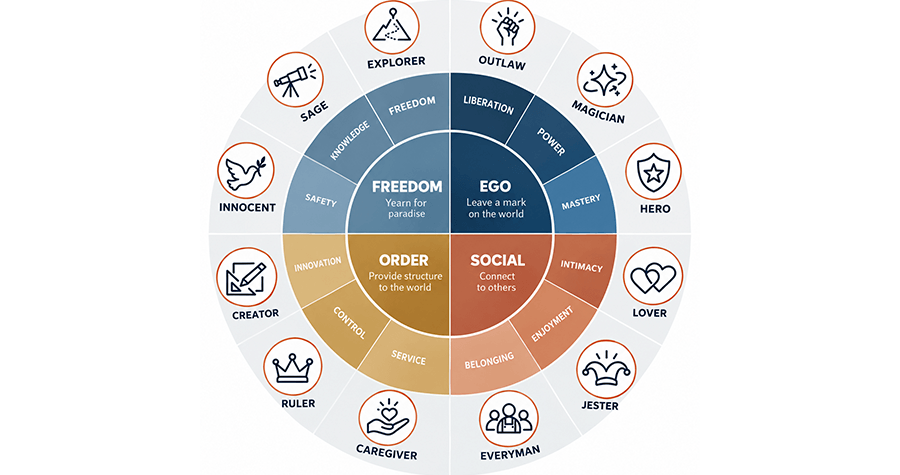
The reason archetypes work is that people already understand these characters intuitively. A Ruler behaves differently from an Everyman. A Sage approaches problems differently from a Jester. A Caregiver communicates differently from an Outlaw.
You do not need a 40-page brand standards manual to understand the basic difference.
That makes archetypes especially useful with construction leadership teams. I’ve used them off and on for about 10 years and, more recently, with more than a dozen brands. One of the easiest ways to start the conversation is simply to put the archetype wheel in front of the team and ask what feels right, what feels wrong, and why.
The discussion usually gets useful quickly.
Leadership teams begin connecting the archetypes to how customers experience the company, what employees value, and how they want the organization to be perceived. For companies with multiple operating brands, the exercise can be even more valuable because those brands may compete with each other for projects, employees, and attention.
If every company in the portfolio looks, sounds, and behaves the same, there is not much reason for the brands to remain distinct.
Brand personality helps give each one territory it can own.

Brand archetypes are a framework, not gospel
This is probably the most important point in this article:
Brand archetypes are a framework, not gospel.
I do not recommend taking an online quiz, learning that your company is 72% Hero, and rebuilding your brand around the result. The value is not in perfectly classifying the organization.
The value is in creating clarity.
Archetypes give leadership, marketing, business development, and creative teams a shared language for discussing something that is otherwise difficult to define. They create boundaries around how the brand should feel and behave.
I usually prefer one dominant archetype because it forces clearer decisions. Sometimes a secondary archetype helps. In other situations, two subtypes within one archetype provide enough nuance to make the personality distinctive.
The subtype lists below are not a rigid academic taxonomy. They are practical variations that help companies move beyond simply saying, “We are a Hero,” or, “We are a Sage.”
The goal is not to put the company in a box. The goal is to give the brand enough personality that people recognize it.
The 12 Brand Archetypes and Their Subtypes
1. The Outlaw
 Core motivation: disruption, liberation, and challenging the status quo.
The Outlaw believes something about the existing system needs to change. An industry may be bloated, outdated, inefficient, dishonest, or unnecessarily complicated, and the Outlaw is willing to say so publicly.
That can be a powerful position in construction technology, where many companies promise transformation while using nearly identical SaaS language. It can also work for contractors, manufacturers, or service companies that have built their reputation by rejecting an accepted way of doing business.
Strong Outlaw brands do not rebel merely to attract attention. They have a point of view and something meaningful they are pushing against.
Common traits: Bold, independent, provocative, unconventional, uncompromising.
Common Outlaw subtypes
- The Disruptor challenges established methods and introduces a materially different approach.
- The Revolutionary wants more than incremental improvement. It believes the system itself needs to change.
- The Maverick operates on its own terms and is comfortable doing things differently from the market.
- The Activist organizes its identity around a cause, belief, or injustice it wants to address.
- The Reformer sees a broken system and wants to rebuild it better.
Watch out for: Mistaking edginess for differentiation. An Outlaw without a meaningful point of view is just loud.
Brand examples: Harley-Davidson, Virgin, Diesel, BrewDog, and selected Patagonia campaigns.
2. The Hero
 Core motivation: mastery, courage, achievement, and overcoming difficult challenges.
The Hero wants to prove what is possible through effort, discipline, and competence. Hero brands are often driven by performance and become especially compelling when the work itself is difficult, high stakes, or demanding.
Construction naturally creates Hero stories because projects involve risk, complexity, schedules, weather, safety, logistics, and problems that have to be solved under pressure. That does not mean every contractor should choose Hero. If every project story becomes, “We overcame the impossible,” the brand can quickly become self-congratulatory.
The strongest Hero brands make the customer, project team, or larger mission part of the victory.
Common traits: Strong, determined, courageous, disciplined, competitive.
Common Hero subtypes
- The Warrior confronts difficult situations directly.
- The Champion fights on behalf of someone else and helps them succeed.
- The Defender protects people, organizations, or important values.
- The Rescue Hero enters when something has gone wrong and decisive action is required.
- The Competitor continually raises the standard and measures itself against difficult challenges.
Watch out for: Making the company the hero of every story. Constant chest beating gets old quickly.
Brand examples: Nike, FedEx, Duracell, The Home Depot, and the U.S. Marines.
3. The Everyman
 Core motivation: belonging, connection, familiarity, and acceptance.
The Everyman does not want to stand above the audience. It wants to stand beside them.
These brands tend to be approachable, practical, straightforward, and easy to trust. Their personality often sounds like a good superintendent, estimator, or company owner who knows the work and does not need to impress anyone with corporate language.
Construction is full of genuinely Everyman companies, which is part of the challenge. Contractors regularly describe themselves as hardworking, honest, relationship-driven people who treat customers like family and do what they say they are going to do.
Those qualities may all be true. They are also common.
Common traits: Approachable, grounded, straightforward, relatable, dependable.
Common Everyman subtypes
- The Realist tells it like it is without unnecessary polish or exaggeration.
- The Neighbor builds familiarity through friendliness and community.
- The Citizen values responsibility, dependability, and contributing to the greater whole.
- The Good Guy earns trust through decency, loyalty, and consistency.
- The Supporter is the person you know you can call when something needs to get done.
Watch out for: Confusing relatable with generic. If every competitor is “your trusted partner,” that phrase does not distinguish anybody.
Brand examples: IKEA, Wrangler, Folgers, classic Chevrolet positioning, and Budweiser.
4. The Sage
 Core motivation: truth, knowledge, understanding, and better decisions.
The Sage wants to understand how something really works and then help other people understand it too.
Sage brands teach, investigate, research, analyze, and explain. In the built environment, this can be especially powerful for engineering firms, technical contractors, consultants, manufacturers, construction technology companies, and organizations whose expertise genuinely influences project outcomes.
The strongest Sage brands do not need to keep calling themselves experts. They repeatedly demonstrate expertise through useful ideas, data, education, and clear thinking.
Common traits: Analytical, educational, thoughtful, objective, curious.
Common Sage subtypes
- The Expert develops deep specialization and earns authority through demonstrated mastery.
- The Researcher gathers evidence, tests assumptions, and looks for patterns.
- The Strategist connects individual decisions to a larger business or project picture.
- The Mentor shares knowledge to make other people more capable.
- The Analyst breaks complicated subjects apart and makes them understandable.
Watch out for: Becoming academic, condescending, or so cautious that the company never expresses an actual point of view.
A/E/C CMOs is predominantly a Sage brand. Original research, education, frameworks, benchmarking, and challenging unsupported assumptions about construction marketing all support that personality.
That does not mean we need to sound like professors. Sage is the underlying motivation, not permission to be boring.
Brand examples: The Economist, TED, PBS, Google, and National Geographic.
5. The Explorer
 Core motivation: freedom, discovery, independence, and new possibilities.
The Explorer wants to know what is over the next hill.
The archetype is commonly associated with travel and outdoor brands, but literal exploration is only one interpretation. At its core, Explorer is about independence, movement, discovery, and refusing to be constrained by conventional boundaries.
In the built environment, that mindset may appear in firms entering new markets, solving problems in remote locations, pioneering construction methods, or giving customers a better view of something that was previously difficult to see.
Common traits: Curious, adventurous, independent, ambitious, pioneering.
Common Explorer subtypes
- The Seeker continually searches for new ideas, experiences, or possibilities.
- The Trailblazer deliberately enters territory others avoid.
- The Pioneer creates a path that others may eventually follow.
- The Adventurer becomes energized by difficult or uncertain environments.
- The Wanderer values independence and resists conventional boundaries.
Watch out for: Exploration without direction. Constantly chasing what is new can look more restless than pioneering.
Brand examples: Jeep, The North Face, REI, GoPro, and Patagonia.
6. The Creator
 Core motivation: originality, imagination, craftsmanship, and bringing ideas to life.
The Creator looks at what exists and sees what it could become.
Construction companies sometimes overlook this archetype because the word “creator” sounds artistic, but the mindset fits much of the industry. Architecture, fabrication, custom building, specialty construction, product design, engineering, modular construction, and even sophisticated self-perform work can all express the Creator.
The core idea is not simply creativity. It is the desire to make something original, useful, beautiful, or exceptionally well crafted.
Common traits: Inventive, expressive, meticulous, imaginative, original.
Common Creator subtypes
- The Architect turns ideas into thoughtful, coherent systems.
- The Inventor develops new tools, products, methods, or solutions.
- The Maker takes pride in the act of building and the craft behind the result.
- The Artist prioritizes expression, aesthetics, and originality.
- The Visionary imagines something that does not exist yet and helps other people see it.
Watch out for: Falling so deeply in love with the work that the company forgets what the customer actually values.
Brand examples: LEGO, Adobe, Pixar, Dyson, and Apple’s design positioning.
7. The Caregiver
 Core motivation: service, protection, compassion, and responsibility.
The Caregiver’s instinct is to help, protect, and make someone’s situation better.
That personality can work particularly well when the customer is dealing with stress, risk, uncertainty, or something important enough that they need to trust the people doing the work. Residential construction, restoration, safety services, traffic control, healthcare construction, and other protective services are obvious examples, although the archetype can work much more broadly.
Caregiver does not mean soft. Protection can be one of the strongest expressions of the archetype.
Common traits: Supportive, compassionate, responsible, reassuring, dependable.
Common Caregiver subtypes
- The Helper recognizes a need and steps in.
- The Protector shields people from immediate risk, harm, or uncertainty.
- The Guardian takes responsibility for protecting people, places, assets, or systems over time.
- The Nurturer supports people as they grow, recover, or make an important transition.
- The Steward cares for something that has been entrusted to the organization.
- The Provider makes sure people have what they need.
Watch out for: Becoming overly sentimental or portraying customers as helpless.
We use the Caregiver archetype with Nastase Contracting, where helping homeowners make good decisions is central to the brand. Sometimes the right answer is a new roof. Other times it is telling a homeowner the roof still has useful life and does not need to be replaced yet.
We also use Caregiver with Guardian Traffic, with a stronger emphasis on the Protector and Guardian subtypes. Traffic control is ultimately about keeping people safe and helping crews, drivers, pedestrians, and communities move through work zones without unnecessary risk. The name Guardian reinforces the personality naturally rather than requiring the company to manufacture one.
Brand examples: Johnson & Johnson, UNICEF, Campbell’s, and selected Dove positioning.
8. The Ruler
 Core motivation: leadership, order, control, stability, and high standards.
The Ruler communicates a simple message: you are in capable hands.
These brands tend to be confident, disciplined, established, and structured. They often emphasize leadership, accountability, standards, and the ability to create order in complicated environments.
Construction has plenty of companies that want to look like Rulers because the archetype communicates scale and authority. The important question is whether the organization has the experience, culture, and discipline to support that position.
Common traits: Confident, polished, disciplined, commanding, structured.
Common Ruler subtypes
- The Leader provides direction and earns confidence.
- The Administrator creates order through systems, discipline, and consistency.
- The Sovereign communicates status, prestige, and elevated standards.
- The Manager organizes people and resources to produce dependable outcomes.
- The Judge emphasizes standards, accountability, fairness, and governance.
- The Patriarch/Matriarch leads with a sense of responsibility for the larger organization, industry, or community. Authority is not just about control; it is about setting standards and taking responsibility for what comes next.
Watch out for: Allowing confidence to become arrogance or structure to become bureaucracy.
We use the Ruler archetype with Legacy Utility Group, the parent company of Guardian Traffic. Legacy’s mission is broader than simply operating successful companies. The organization wants to improve the hydrovac and construction industry itself, which is why the Patriarch/Matriarch subtype fits particularly well.
The brand is not trying to act superior to the industry. It is taking a leadership position within it, with an expectation that its companies can help raise standards and improve how the work gets done.
That is a materially different personality from Guardian Traffic’s Caregiver orientation, even though the companies share ownership.
That distinction is exactly why archetypes can be useful in a multi-brand organization.
Brand examples: Mercedes-Benz, Rolex, American Express, and Ritz-Carlton.
9. The Magician
 Core motivation: transformation, possibility, and making difficult things achievable.
The Magician changes what people believe is possible.
Technology companies naturally gravitate toward this archetype because the promise is often larger than a feature or product. The software, equipment, process, or technology changes the experience itself.
Prefabrication, robotics, automation, reality capture, AI, advanced materials, and construction software can all support Magician positioning when the transformation is real.
Common traits: Visionary, imaginative, transformative, insightful, inspiring.
Common Magician subtypes
- The Visionary recognizes possibilities before most people can see them.
- The Healer restores something that is not working properly.
- The Catalyst causes change to begin.
- The Alchemist turns ordinary inputs into an extraordinary result.
- The Enabler removes barriers and makes something difficult easier to accomplish.
Watch out for: Falling into vague technology language. Once everything becomes revolutionary, seamless, game-changing, and transformative, none of those words mean much.
Brand examples: Disney, selected Apple positioning, immersive technology brands, and historically some Tesla positioning.
10. The Lover
 Core motivation: connection, beauty, passion, and meaningful experiences.
The Lover creates attraction.
Luxury is the most obvious expression of the archetype, but it is not the only one. Lover brands may emphasize craftsmanship, close relationships, aesthetics, comfort, material quality, or genuine passion for the work.
That can translate naturally to custom residential construction, architecture, interiors, hospitality, premium building products, or specialty trades where customers care deeply about how something looks and feels.
Common traits: Elegant, expressive, passionate, intimate, sensory.
Common Lover subtypes
- The Aesthete cares deeply about beauty, materials, detail, and design.
- The Partner places close relationships and mutual commitment at the center of the experience.
- The Harmonizer creates comfort, balance, and connection.
- The Enthusiast communicates with visible passion and excitement.
- The Sensualist builds the experience around sight, touch, sound, taste, atmosphere, or other senses.
Watch out for: Allowing aesthetics to substitute for substance. A beautiful brand cannot make up for an average customer experience.
Brand examples: Chanel, Ferrari, Tiffany & Co., Häagen-Dazs, and Godiva.
11. The Jester
 Core motivation: joy, humor, entertainment, and irreverence.
The Jester understands something B2B companies often forget: construction people still like to have fun.
A good Jester brand does more than publish memes or tell jobsite jokes. The personality gives the company permission to behave differently from the category around it.
That contrast can be especially powerful in construction, where much of the marketing is serious, polished, and predictable. A company with a genuinely playful culture may have an opportunity to stand apart simply by sounding more like the people inside the business.
Common traits: Funny, playful, unpredictable, energetic, irreverent.
Common Jester subtypes
- The Entertainer makes enjoyment part of the brand experience.
- The Trickster plays with expectations and uses surprise effectively.
- The Pleasure-Seeker emphasizes fun and enjoying the moment.
- The Provocateur uses humor to expose absurdity or question accepted norms.
- The Playmate creates an informal, energetic personality people want to join.
Watch out for: Becoming known for the joke instead of the company. Humor should strengthen recognition, not replace the business strategy.
Brand examples: Old Spice, Skittles, M&M’s, Duolingo, and classic Southwest Airlines campaigns.
12. The Innocent
 Core motivation: simplicity, goodness, optimism, and doing things the right way.
The Innocent believes things do not have to be complicated.
These brands tend to build confidence through transparency, simplicity, optimism, or a return to something straightforward and understandable. In construction, that can be powerful for companies operating in categories where customers expect confusion, hidden costs, unnecessary complexity, or aggressive sales tactics.
The brand promise becomes less about sophistication and more about making the experience clear and trustworthy.
Common traits: Honest, optimistic, wholesome, transparent, uncomplicated.
Common Innocent subtypes
- The Idealist believes there is a better way.
- The Optimist naturally focuses attention on possibility rather than fear.
- The Traditionalist finds reassurance in proven principles and timeless values.
- The Moralist places right and wrong at the center of the brand’s beliefs.
- The Purist emphasizes authenticity, transparency, simplicity, or cleanliness.
Watch out for: Becoming naive, overly sweet, or making claims about purity and goodness that the company cannot actually substantiate.
Brand examples: Burt’s Bees, Aveeno, The Honest Company, and classic Coca-Cola positioning.
What archetypes look like in actual construction brand strategy
The value of archetypes becomes much clearer once they leave the workshop and start affecting actual decisions.
One of my favorite examples is Linarc, a construction technology company. We landed on the Outlaw archetype and began giving the company permission to call out some of the bullshit in the ConTech SaaS industry.
That single decision gave the team more direction than a long mission statement probably would have. They immediately understood the kind of company we were trying to build, which influenced the language, attitude, visual direction, campaign concepts, and ideas the team pursued.
It also helped us shape the feel of another brand before that company even had a name.
Nastase Contracting required a completely different personality. Its Caregiver archetype directs the brand toward education, protection, honesty, and helping homeowners make smart decisions rather than pressuring them into unnecessary work.
Guardian Traffic is also a Caregiver, but the Protector and Guardian subtypes make it feel different from Nastase. Its personality is rooted more heavily in keeping people safe and taking responsibility for what happens around a work zone.
Legacy Utility Group sits above Guardian as the parent company, yet its Ruler archetype gives it a separate role. With the Patriarch/Matriarch subtype, Legacy is positioned as an organization that wants to lead, raise standards, and improve the hydrovac and construction industry.
A/E/C CMOs is predominantly Sage, which means our brand should earn authority through research, education, frameworks, analysis, and useful guidance rather than simply claiming expertise.
These brands do not need to behave the same way simply because they all operate in or around construction.
That is the point.
The two archetype mistakes I see most often in construction
After using this framework with construction companies for years, two mistakes show up repeatedly.
Mistake #1: Branding the CEO
Leadership teams sometimes look at the wheel, point at an archetype, and say, “That is definitely Steve.”
Steve might indeed be an Explorer, Outlaw, or Hero. That does not automatically mean the company should be.
Founder personality absolutely influences culture, particularly in privately held construction companies. Many firms still carry the fingerprints of the founder decades after the company was started.
The purpose of the exercise, though, is not to conduct a personality assessment on the CEO. We are defining the character the brand should consistently express to customers, employees, recruits, partners, and the market.
Those two things often overlap, but they are not always identical.
Mistake #2: Picking whatever every competitor already uses
This is where Everyman becomes the obvious construction example.
The industry genuinely contains a lot of straightforward, hardworking, relationship-driven people. It makes perfect sense that contractors naturally gravitate toward Everyman characteristics.
The strategic problem appears when the entire competitive set says essentially the same thing.
Your trusted partner.
People you can count on.
Built on relationships.
Doing things the right way.
Treating every customer like family.
None of those ideas are inherently bad. Taken together across an industry, they create sameness.
Our Brand Distinction in the Built Environment research looked at all 400 contractors in the 2026 ENR Top 400 and evaluated how effectively those firms differentiate their public-facing brands across ten dimensions, including brand voice and personality.
One of the conclusions from that work is that the bar is moving. Larger contractors are increasingly investing in stronger brands, better storytelling, more deliberate creative direction, and clearer positioning.
Small and midsize contractors are not only competing against the beige construction websites of the past anymore.
How to choose your construction company’s archetype
I do not start by asking leadership teams which archetype they like best. That turns the exercise into a popularity contest.
A better starting point is:
What personality should this brand portray, and what is already authentically true about the company?
Put the wheel in front of the leadership team and talk through it. Which archetypes feel natural? Which obviously do not? Which one would customers recognize? Which fits the culture? Which gives the company useful separation from competitors? Most importantly, which personality could employees actually sustain after the rebrand launch is over?
Then go into the subtypes.
You may discover that saying the company is a Sage is not specific enough. It might really be a Researcher and Mentor. Your Creator may be predominantly a Maker and Architect. Your Ruler may be more Patriarch/Matriarch than Sovereign.
Those differences matter because they begin turning a broad archetype into a usable personality.
Sometimes the most valuable part of the exercise is agreeing on what the company isn’t. That makes future decisions easier because the team has clearer boundaries around what fits the brand.
Your archetype should affect more than website copy
If your archetype only appears in the brand voice section of a PDF, it is not doing enough work.
A strong personality should affect the entire brand experience. A Ruler and an Everyman probably should not use identical photography. An Outlaw and an Innocent should not write the same LinkedIn post. A Sage and a Jester should not open a presentation the same way.
A Caregiver and a Hero might both talk about safety, but the emotional framing will be different. The Caregiver emphasizes protecting people. The Hero emphasizes overcoming risk and performing at a high standard.
The archetype can influence brand voice, messaging, visual identity, photography, video, advertising, thought leadership, recruiting, proposals, presentations, social media, sales language, and even the kinds of campaigns the marketing team chooses to pursue.
That is why I consider brand personality a core component of a Magnetic Brand.
It is not decoration. It is one of the things that makes the company recognizable.
AI can scale your personality. It should not create it.
This becomes increasingly important as construction companies adopt generative AI.
AI is very good at execution once it understands the parameters. Give it examples, approved vocabulary, real opinions, subject-matter expertise, strong source material, and a clearly defined personality, and it can help a team maintain consistency across a large amount of content.
Start instead with, “Write this in a professional, confident, approachable voice,” and you are asking the machine to find the middle.
That is where most AI slop lives.
The better order of operations is:
Human strategy → distinct brand personality → real expertise and opinions → AI-assisted execution
The technology itself is not the differentiator. The thinking you put into it is.
Construction companies already know this principle in another context. The best piece of equipment on a jobsite does not make an average operator exceptional. Technology multiplies the capability of the people using it.
AI works the same way with marketing.
Could someone recognize your company without seeing the logo?
Here is a practical test.
Take the company name and logo off your website copy, LinkedIn posts, recruiting ads, emails, proposals, presentations, and advertisements. Then put the content beside five competitors.
Would someone who knows the industry be able to tell which one belongs to you?
Most construction brands are not there yet.
They may look professional and communicate clearly, but that is different from being recognizable.
Brand archetypes will not solve that problem by themselves. Again, they are a framework, not gospel. What they can do is give leadership teams a simple language for deciding who the company is supposed to be.
Once everyone understands the character, a lot of other decisions become easier.
Does this sound like us? Would we actually say this? Does this photography fit? Would one of our competitors be equally comfortable running this campaign? Does this sister company need its own personality? Does this AI-generated content reinforce our brand or flatten it?
Those are much better questions than asking AI to make the copy “more engaging.”
In a world where competent marketing content is becoming cheap and abundant, being recognizable is becoming more valuable.
SEO for AEC Firms Has Changed: Expertise Is the New Search Advantage
For years, search engine optimization followed a fairly familiar formula. A company identified the terms its prospective clients were searching for, created pages and articles around those terms, optimized the website, built links, and tried to move higher in Google’s rankings.
That foundation has not disappeared, but the way people find and evaluate information is changing quickly. A construction executive researching a new technology, delivery method, contractor, engineering partner, or business challenge may still start with Google. Increasingly, though, that research may also include a Google AI Overview, ChatGPT, another AI assistant, YouTube, LinkedIn, industry publications, podcasts, and recommendations from peers. In many cases, the buyer may get a useful answer before ever clicking the first traditional search result.
That changes the strategic question for architecture, engineering, and construction firms. It is no longer enough to ask how a company can rank for a particular search. A better question is: How do we become one of the companies the market, search engines, and AI systems recognize as a credible authority on this subject?
That is a much bigger challenge, but it is also one that established A/E/C firms are unusually well positioned to solve. Most already possess the raw material: decades of projects, lessons learned, technical expertise, experienced people, customer relationships, field knowledge, proprietary processes, and informed opinions. The opportunity is to turn that institutional knowledge into visible authority.
What Has Changed About SEO for AEC Firms?
SEO is not disappearing. Google continues to say that traditional SEO fundamentals remain relevant to its generative AI search experiences, including AI Overviews and AI Mode. What has changed is the environment around those fundamentals and the way buyers interact with information before they ever reach a company website.
Traditional search primarily helped people find websites. Generative search can increasingly help people understand a subject, compare alternatives, explore questions, and evaluate possible decisions. Google describes AI Mode as especially useful for nuanced questions, comparisons, and topics that previously might have required several separate searches because its systems can break a complex question into related searches, gather information from multiple sources, and synthesize an answer.
Consider how that could apply to construction. A facility owner might once have searched for “industrial contractor Houston.” Today, that same person might ask, “What should I look for when selecting a contractor for an occupied industrial facility where shutdown time is expensive?”
That is not simply a keyword. It is a business problem, and the companies most capable of providing a meaningful answer are probably not SEO agencies or freelance writers. They are contractors and professionals who have actually managed shutdowns, coordinated work around operating facilities, planned complex phasing, dealt with unexpected field conditions, and learned what makes those projects succeed or fail.
That is where the next era of A/E/C search visibility starts.
Search Is Moving From Keywords Toward Questions, Problems, and Expertise
Construction buyers rarely wake up wanting marketing content. They have problems to solve, risks to reduce, decisions to make, and projects to move forward.
They may need to understand a delivery method, compare materials, improve a facility, meet a regulation, control costs, address a schedule problem, evaluate new technology, find qualified partners, or understand what could go wrong before signing a contract. Traditional SEO sometimes encouraged companies to turn these questions into keywords and then produce content designed primarily to capture search traffic.
The better opportunity now is to reverse that thinking and start with the knowledge inside the business. What does your company understand because of the work it has actually performed? What do your experienced people see that a generalist does not? What questions do sophisticated clients ask before making major decisions? What mistakes repeatedly cost owners time or money? Where does conventional wisdom differ from what your team sees in the field?
Those questions produce something much more valuable than keyword-driven content. They produce expertise.
Google’s own guidance increasingly emphasizes this distinction. Its current guidance for generative AI search encourages publishers to create unique, expert-led, non-commodity content that provides value beyond common knowledge.
That description should sound familiar to A/E/C leaders because it is essentially the difference between repeating what everybody already knows and explaining what your company has learned by doing the work.
E-E-A-T Matters More in an AI-Saturated World
Google uses the concept of E-E-A-T when discussing content quality: Experience, Expertise, Authoritativeness, and Trustworthiness. Google is careful to explain that E-E-A-T is not a single ranking factor or score. Instead, its systems use many signals intended to identify helpful and reliable information, with trust serving as the central idea supported by experience, expertise, and authority.
For construction leaders, the terminology matters less than the underlying question: Why should someone trust this source?
That is particularly relevant to A/E/C. If someone is searching for decorating ideas, being wrong may result in an ugly living room. If someone is researching structural systems, building envelopes, industrial shutdowns, safety practices, environmental remediation, utility construction, roofing systems, healthcare facilities, or major capital investments, poor information can carry far greater consequences.
Your company’s credibility matters.
Experience: Have You Actually Dealt With This?
A superintendent who has spent 25 years building hospitals understands issues that someone summarizing hospital construction articles does not. A roofing contractor that has inspected thousands of roofs after Midwestern storms sees patterns that generic internet content cannot easily replicate. An engineer who has worked through dozens of infrastructure projects understands where theoretical solutions collide with permitting, site conditions, budgets, and operations.
That firsthand experience has value precisely because it is difficult to manufacture. As AI makes it easier for anyone to summarize existing information, direct experience becomes a more meaningful distinction.
Expertise: Do You Understand the Subject Deeply Enough to Explain It?
A/E/C firms are full of expertise, although much of it has historically remained trapped inside the company. It lives inside estimators, engineers, architects, superintendents, project executives, safety professionals, operations leaders, technical specialists, and owners.
Those people do not need to become “content creators,” nor should they. Their job is to know the work. The company’s responsibility is to find effective ways to capture that knowledge, organize it, and make it useful to clients and the market without creating another burden for its best people.
Authoritativeness: Does the Broader Market Recognize You for This Expertise?
Authority develops when expertise becomes visible and is recognized beyond the company itself. That can happen when experts speak at conferences, appear on podcasts, contribute to industry discussions, participate in associations, conduct research, publish useful perspectives, appear in trade publications, educate clients, or are referenced by other credible sources.
Research from Ahrefs offers an important signal. In a study of 75,000 brands, branded mentions across the web had a substantially stronger correlation with brand visibility in Google AI Overviews than backlinks did. Ahrefs appropriately cautions that correlation does not prove causation, but the larger finding matters: companies that are widely discussed and recognized across the web tend to appear more frequently in AI-generated results.
A later Ahrefs analysis found branded web mentions remained highly correlated with visibility across ChatGPT, Google AI Mode, and AI Overviews, while simply having more website pages showed little relationship with AI visibility.
In plain construction language, publishing more pages does not automatically make a company an authority. Being recognized for something does.
Trustworthiness: Does the Evidence Support the Claim?
Trust ties the other elements together. People need confidence that your company knows what it is talking about, can support its claims, and is willing to provide useful information rather than simply manufacture sales copy.
For construction companies, trust is not an abstract branding concept. It influences whether an owner includes you on a shortlist, whether a recruit believes your culture claims, whether a journalist calls your executive, whether an industry organization asks your expert to speak, and whether someone believes the advice attached to your company’s name.
Increasingly, that visible reputation can also influence how digital systems interpret your company and its authority.
AI Has Made Content Easier to Produce. That Makes Expertise More Valuable.
Generative AI has dramatically reduced the effort required to produce average content. Almost any company can now generate an article about construction trends, the benefits of design-build, ways to improve safety, the importance of communication, technology adoption, or artificial intelligence in a matter of seconds.
Those topics are not inherently bad. The problem is that if your company’s article contains essentially the same information an AI model can already produce, there is little reason for a client to read yours, for Google to prioritize it, for an AI assistant to reference it, or for anyone to remember who produced it.
Google now explicitly distinguishes commodity information from content that brings original experience, expert analysis, or a perspective that goes beyond common knowledge. That creates a counterintuitive opportunity for A/E/C firms: AI does not make your experienced people less important. It makes them more important.
The internet does not need another generic explanation of preconstruction. It may need your preconstruction leader explaining why three recent projects uncovered budget problems earlier than expected. It does not need another generic article about safety, but it may need your safety director explaining what changed after investigating recurring near misses. It does not need another explanation of building envelopes, but it may need your specialist explaining why a detail commonly specified in one climate creates problems in another.
The value is not simply the subject. The value is what your people know about the subject that others do not.
Your Company’s Knowledge Is Becoming a Marketing Asset
Most established A/E/C firms possess an enormous library of intellectual property without recognizing it as such. It is rarely stored neatly in a database. Instead, it resides in hundreds or thousands of experiences accumulated across projects and careers.
A difficult project taught the team something. A design solution saved an owner money. A superintendent knows which early warning signs indicate a schedule problem. An estimator can spot unrealistic assumptions immediately. A project executive has watched procurement challenges evolve for twenty years. A specialist understands a regulation better than almost anyone in the market. An owner has seen three economic cycles and can explain how client behavior changes during each one.
Those insights have traditionally been exchanged through meetings, phone calls, proposals, conferences, and relationships. They still should be, but search and AI create another opportunity: allowing those ideas to become part of the company’s public body of knowledge.
That is bigger than blogging. It is the digital documentation of institutional expertise.
The Goal Is Not to Feed the Algorithm
The response to AI search should not be another generation of shortcuts designed to manipulate algorithms. Google explicitly warns against that thinking. Its current generative search guidance says there is no need to rewrite content specifically for AI systems, manufacture special AI content structures, or chase many of the so-called GEO or AEO hacks being promoted.
Instead, Google continues to recommend useful, original content created primarily for people. That is good news for construction leaders because they do not need to understand every new acronym.
SEO. AEO. GEO. LLMO. The labels will continue changing, but the business principle underneath them is more durable: become genuinely useful and genuinely credible in the areas where you want your firm to be known, then make that expertise visible.
SEO Is Becoming Part of Brand Strategy
This may be the largest strategic change of all.
Traditional SEO was often treated as a technical marketing function. Research keywords. Optimize pages. Acquire backlinks. Watch rankings. Those activities still have a place, but search visibility increasingly intersects with reputation and brand authority.
Consider the signals that show a company has become known for something. Someone searches for the company by name. An industry publication quotes one of its executives. A podcast invites its CEO. Another company references its research. A client shares something the company published. An association invites one of its specialists to speak. Those outcomes do not come from metadata alone. They come from becoming recognized.
Ahrefs’ research reinforces this relationship. Across its analysis of AI search visibility, off-site brand signals such as web mentions and branded searches correlated with AI visibility more strongly than many traditional link and website-volume metrics.
That suggests a broader definition of search strategy: your search presence is increasingly influenced by the reputation your company builds across the market, not simply the pages it publishes on its own website.
For an A/E/C leader, that means SEO should no longer live entirely in a marketing silo. It overlaps with brand, public relations, research, executive visibility, recruiting, business development, client education, speaking, associations, media, and thought leadership. The website remains important, but it is one piece of a larger authority system.
Small and Mid-Sized A/E/C Firms Have an Opportunity
It is easy to assume that this evolution favors the biggest firms with the largest marketing budgets. Size certainly creates advantages, but expertise is not distributed according to marketing spend.
A $75 million specialty contractor may know more about a narrow technical issue than a $10 billion general contractor. A regional engineering firm may understand local infrastructure challenges better than a global competitor. A second-generation contractor may have forty years of institutional knowledge about a market that a national consolidator entered three years ago.
Generative search creates more opportunities for people to ask increasingly specific questions, and specific questions reward specific knowledge. That creates room for companies willing to define what they know, capture their experts’ perspectives, and consistently build authority around the problems they understand best.
You do not have to become the internet’s leading authority on construction. You need to become a credible authority on the subjects that matter to your clients and your company’s strategy.
Your Subject Matter Experts Should Not Become Content Creators
This distinction matters for executives because the answer is not to give your best technical people another job.
Your superintendent does not need a weekly blogging quota. Your engineers do not need to become influencers, and your CEO does not need to spend half the day creating LinkedIn content. Subject matter experts should remain subject matter experts.
The marketing function should draw that knowledge out of them, organize it, strengthen it, and distribute it without turning knowledgeable professionals into part-time marketers. AI can help enormously with that process by organizing conversations, summarizing interviews, identifying themes, improving readability, and adapting ideas for different formats.
But AI should amplify expertise rather than replace it. The core message still needs to originate somewhere real: experience, expertise, research, evidence, or a defensible point of view. Otherwise, the company is simply using increasingly sophisticated technology to produce increasingly polished sameness.
What Construction Leaders Should Expect From SEO Now
Executives do not need to become search experts, but they do need to change the expectations they place on marketing.
The old conversation may have focused heavily on rankings, traffic, keywords, and how many articles were published. The better conversation is broader: Are we building authority in markets important to our growth? Are our experts visible? Does our company contribute something useful to the industry’s knowledge? Are we associated with the problems we are uniquely qualified to solve?
Construction leaders should also ask whether someone researching those problems would encounter their company’s thinking, whether the market has evidence supporting the claims the company makes about itself, and whether a sophisticated client would come away from the firm’s digital presence believing it understands their world.
Those questions connect search directly to business strategy, which is where it belongs.
From Ranking to Recognition
SEO for A/E/C firms is not dead. It is becoming more demanding.
Technical SEO still matters. Websites still need to be accessible, understandable, useful, and well organized. Search rankings still matter, and Google remains an important source of discovery. But ranking is no longer the entire objective.
The larger objective is recognition. You want the market to recognize your company as knowledgeable, prospective clients to recognize your experience, industry peers to recognize your authority, and search engines to find substantial evidence supporting that authority. As AI becomes a larger part of how people research companies, problems, products, technologies, and partners, you also want those systems to encounter the same pattern.
A company cannot manufacture that authority with a few optimized articles. It has to build it over time through real expertise, useful perspectives, visible proof, and consistent recognition.
Fortunately, many A/E/C firms already possess the hardest part. They have spent decades earning the experience. The next challenge is making that expertise easier for the market to see.
The New SEO Strategy for A/E/C Firms
The shift can be summarized simply.
Old SEO asked: How do we create content that ranks?
The next era asks: How do we become a source worth finding, trusting, citing, and remembering?
For architecture, engineering, and construction firms, the answer will not come from producing more generic content. It will come from the people who already know the work.
Their experience creates expertise. Consistently demonstrating that expertise creates authority. Authority, supported by evidence and recognized by others, builds trust.
That is E-E-A-T in practical terms, and increasingly, it is also the foundation of search visibility in an AI-driven world.

Fractional CMO vs. Marketing Agency: Which Does Your Construction Company Need?
Construction companies often reach a point where referrals, relationships, and occasional marketing projects are no longer enough to support where the business is going.
The company may want to enter a new market, attract larger clients, improve its hit rate, strengthen recruiting, integrate an acquisition, or build a more recognizable brand. Leadership knows marketing needs to improve, but the next step is not always clear.
Should you hire a marketing agency—or bring in a fractional Chief Marketing Officer?
The answer depends less on how much marketing work needs to be done and more on what kind of problem you are trying to solve.
A marketing agency provides specialized capabilities and production capacity. A fractional CMO provides senior leadership, business alignment, and accountability for the entire marketing function.
One primarily helps execute marketing. The other decides what marketing should accomplish, how it supports the business, and which resources are needed to make it happen.
What Is the Difference Between a Fractional CMO and a Marketing Agency?
A fractional CMO serves as a part-time senior marketing executive. The CMO works with company leadership to connect marketing decisions with growth, profitability, market expansion, recruiting, client retention, business development, and the long-term value of the brand.
A marketing agency is typically hired to provide specific creative, technical, or promotional services. Depending on the agency, those services may include branding, website development, advertising, SEO, content, video, public relations, social media, or campaign management.
The simplest distinction is:
A fractional CMO leads the marketing function. An agency delivers marketing services.
That does not mean an agency cannot offer strategic thinking. Strong agencies often provide excellent advice within their areas of expertise. But an agency is rarely positioned inside the contractor’s leadership team with authority and accountability across the entire marketing operation.
Fractional CMO vs. Marketing Agency at a Glance
| Area | Fractional CMO | Marketing Agency |
|---|---|---|
| Primary role | Senior marketing leadership | Specialized strategy or execution |
| Relationship | Part of the leadership team | External service provider |
| Starting point | Business goals and company strategy | Defined scope, project, or channel |
| Accountability | Overall marketing direction and performance | Performance within the assigned scope |
| Team leadership | Can lead and develop internal marketers | Usually works alongside a client contact |
| Business involvement | Growth, profitability, markets, recruiting, operations, and leadership priorities | Primarily the marketing services being delivered |
| Resource planning | Determines which internal and external resources are needed | Provides the services included in its agreement |
| Vendor management | Can select and manage agencies and specialists | Typically manages its own team and subcontractors |
| Construction knowledge | Depends on the individual CMO | Depends on the agency’s industry specialization |
| Best fit | Companies with a marketing leadership gap | Companies with clear strategy but insufficient capabilities or capacity |
The two models are not necessarily competitors. A fractional CMO may hire and manage agencies, while an agency may work extremely well under an experienced internal marketing leader.
The problem comes when a company hires one while expecting the other.
When a Construction Company Needs a Marketing Agency
A marketing agency is often the right choice when the company already knows what it needs and has someone qualified to lead the work.
For example, a contractor may have a capable marketing director and an established strategy but lack the internal resources to:
- Redesign its website
- Produce videos and project photography
- Manage a paid advertising campaign
- Improve technical SEO
- Develop a new visual identity
- Conduct public relations outreach
- Produce content consistently
- Implement marketing automation
- Create specialized recruitment campaigns
In those situations, the company has a capability or capacity gap—not necessarily a leadership gap.
The internal marketing leader can define the objectives, select the right agency, provide industry context, coordinate internal stakeholders, review the work, and hold the agency accountable.
Agencies are especially valuable when a company needs expertise that would be difficult or inefficient to hire full-time. Most contractors do not need a full-time web developer, videographer, advertising specialist, SEO technician, copywriter, or brand designer on staff. An agency provides access to those capabilities as needed.
A Marketing Agency Is Probably the Better Fit When:
- Your business and marketing strategies are already clear.
- You have an experienced internal leader who can direct the agency.
- You need help with a defined project or marketing channel.
- Your team lacks production capacity or a specialized technical skill.
- Leadership agrees on the company’s priorities and positioning.
- Someone inside the company can make decisions and provide timely feedback.
- You have the internal knowledge required to keep the work grounded in construction.
When those conditions exist, an agency can be an effective extension of the marketing department.
When a Construction Company Needs a Fractional CMO
A fractional CMO is usually the better choice when the company’s challenge is not simply producing more marketing.
The company may have a coordinator, manager, director, or outside agency completing assignments, but no senior marketing leader is deciding which priorities matter most. Marketing requests come from multiple executives. The CEO, CFO, business development leader, or owner oversees marketing between other responsibilities. Vendors operate independently, and no one is accountable for connecting their work.
The company may be busy without being strategic.
A fractional CMO fills that leadership gap.
The CMO helps leadership answer questions such as:
- Which clients and markets should we prioritize?
- What kinds of work are most profitable and strategically valuable?
- How should marketing support our growth plan?
- Are we positioning the company around meaningful distinctions?
- Where are we overdependent on relationships, clients, or markets?
- How can marketing strengthen business development?
- Why are we losing must-win pursuits?
- How should marketing support recruiting and retention?
- Which capabilities belong in-house, and which should be outsourced?
- What should we stop doing?
- How much should we invest?
- How should marketing performance be measured?
Those are executive questions, not production assignments.
A Fractional CMO Is Probably the Better Fit When:
- No senior leader owns the entire marketing function.
- The CEO or CFO is informally leading marketing.
- The marketing team receives conflicting requests from different executives.
- Your company has outgrown its current approach.
- You are entering new markets, services, or geographies.
- You want to shift toward better clients or more negotiated work.
- You have an internal marketer who needs strategic guidance and mentorship.
- Multiple agencies or freelancers are working without one coordinated plan.
- Marketing activities are disconnected from business development.
- Leadership cannot clearly explain what marketing is expected to accomplish.
- You are investing in marketing but cannot determine whether the right work is being done.
- The company is preparing for an acquisition, ownership transition, or rebrand.
In these situations, hiring another agency may add activity without resolving the leadership problem.
The Risk of Expecting an Agency to Act Like Your CMO
A construction company sometimes hires an agency because leadership knows marketing needs attention but does not have a clear strategy.
The agency begins with the services it knows how to sell. A website firm recommends a new website. An SEO agency recommends more SEO. A social media agency recommends more content. An advertising agency recommends a larger media budget.
These recommendations may be completely reasonable. The problem is that each provider sees the company through the lens of its own specialty.
Someone still needs to determine whether those investments support the contractor’s larger business priorities.
The contractor may not need more website traffic. It may need greater awareness among 75 carefully selected owners and developers.
It may not need more proposals. It may need a stronger go/no-go process and better pursuit support.
It may not need to increase recruiting applications. It may need to improve its reputation among experienced superintendents and project managers.
It may not need more content. It may need a clearer position, better client intelligence, and a more focused market strategy.
An agency can deliver its scope successfully while the company continues to struggle with the larger problem.
That is not necessarily an agency failure. It is often a leadership failure caused by asking a service provider to fill a role it was never designed to own.
The Risk of Hiring a Fractional CMO Without Execution Support
The opposite problem also occurs.
A fractional CMO can develop a strong strategy, establish priorities, and create an implementation roadmap. But someone still needs to do the work. (A/E/C CMOs’ engagements include an implementation team, so strategy and execution remain connected.)
If the company has no internal marketing team—or if the existing team is already overwhelmed—the contractor may receive a smart plan without enough capacity to execute it.
The company then has to hire and coordinate separate agencies, freelancers, and specialists for branding, website development, SEO, content, design, advertising, research, automation, and other needs.
Instead of solving fragmentation, a traditional fractional CMO may unintentionally create another layer for the client to manage.
Before hiring a fractional CMO, ask:
- Will the CMO only provide advice?
- Who will implement the strategy?
- Can the CMO lead our internal marketers?
- Will the CMO select and manage outside vendors?
- Does the engagement include delivery resources?
- How much additional budget will execution require?
- Who remains accountable when several specialists are involved?
Strategy without execution becomes a presentation. Execution without strategy becomes a collection of disconnected tasks.
Construction companies need both.
Construction Experience Matters in Either Model
Neither the title “fractional CMO” nor the word “agency” guarantees construction expertise.
A generalist fractional CMO may understand marketing leadership but still need significant time to understand how contractors pursue and win work. A generalist agency may know advertising, branding, or lead generation but misunderstand construction buying behavior.
Marketing for a commercial contractor must account for:
- Long and irregular sales cycles
- Prequalification requirements
- Go/no-go decisions
- Competitive and negotiated pursuits
- Proposals and interviews
- Bonding and available capacity
- Backlog and geographic constraints
- Relationships among owners, designers, contractors, and subcontractors
- Joint ventures with competitors
- Market-sector experience
- Safety performance and risk
- Recruiting skilled field and operations talent
- The importance of reputation and repeated relationships
- The difference between revenue growth and profitable growth
A provider that evaluates construction marketing primarily through clicks, form fills, impressions, or generic leads may optimize activity without understanding whether that activity supports the business.
That does not mean digital metrics are unimportant. It means they must be interpreted within the economics and realities of construction.
Whether you hire a fractional CMO or an agency, ask how well the provider understands the way your company actually makes money.
How Success Is Usually Measured
A marketing agency is typically accountable for the work within its scope. Depending on the engagement, it may measure:
- Website traffic
- Search visibility
- Advertising performance
- Leads or conversions
- Email engagement
- Social media reach
- Content production
- Media placements
- Project completion
- Campaign results
A fractional CMO should look across the entire marketing function and connect those indicators to broader business outcomes, including:
- Awareness among target accounts
- Quality of the opportunity pipeline
- Revenue concentration and diversification
- Pursuit and interview performance
- Hit rate among ideal opportunities
- Movement into desired markets
- Client retention and expansion
- Recruiting quality
- Employee retention and reputation
- Brand strength
- Sales-cycle progress
- Marketing-team performance
- Long-term profitability and enterprise value
Not every business outcome can be attributed exclusively to marketing. Construction growth depends on leadership, operations, estimating, business development, safety, finance, and project delivery.
The CMO’s responsibility is to ensure marketing strengthens those functions and contributes to the company’s priorities—not to claim credit for everything that goes well.
Can You Use a Fractional CMO and a Marketing Agency Together?
Yes. In many cases, that is the strongest structure.
The fractional CMO establishes the strategy, defines priorities, builds the budget, leads the internal team, and determines which capabilities are needed. The agency provides specialized expertise and production capacity.
The relationship might look like this:
- Company leadership establishes the business goals.
- The fractional CMO translates those goals into marketing priorities.
- Internal marketers provide company knowledge and manage ongoing activities.
- Agencies and specialists execute work requiring additional capacity or expertise.
- The fractional CMO keeps everyone aligned and accountable.
This structure gives the agency a knowledgeable client and clear direction. It gives the internal marketing team senior leadership. It gives company executives one person accountable for the overall marketing function.
Without that coordination, the CEO or marketing manager may become the person trying to keep every provider aligned.
Where A/E/C CMOs Fits
A/E/C CMOs combines fractional marketing leadership with integrated delivery support.
Your Construction Marketing Officer™ works with the leadership team to connect marketing with growth, profitability, positioning, business development, recruiting, client experience, market expansion, and the long-term value of the company.
When the strategy requires execution, our delivery capabilities can support brand development, websites, SEO, content, campaigns, research, design, marketing systems, automation, and other priorities.
Some construction companies already have strong internal marketers who need senior guidance and specialized support. Others have no marketing department and need help establishing the function. Multi-brand companies may need someone to coordinate several divisions, markets, teams, and outside providers.
The model adapts to the structure already in place.
The objective is not to make the company dependent on an outside provider. It is to build a stronger, more capable, and more accountable marketing function.
Fractional CMO vs. Agency: Which Should You Choose?
Choose a marketing agency when you have a clear strategy, qualified internal leadership, and a defined need for specialized execution.
Choose a fractional CMO when marketing lacks senior leadership, priorities are unclear, or the company needs someone to connect marketing decisions with the business strategy.
Choose both when you need executive-level direction and specialized delivery capacity.
Before making the decision, ask one question:
Do we need someone to complete marketing assignments—or someone to lead marketing?
If you cannot confidently define the strategy, prioritize the work, direct internal marketers, coordinate vendors, and connect marketing investment to business outcomes, another agency may not solve the underlying problem.
Your construction company may not need more marketing activity.
It may need a marketing leader.
Give Marketing the Leadership It Deserves
A/E/C CMOs provides fractional CMO leadership and integrated marketing support for growing construction companies.
If marketing has become too important to manage casually—but hiring a full-time CMO and building every capability internally does not make sense yet—let’s talk.

A/E/C CMOs Releases New Research on Construction Brand Distinction and Authority
A/E/C CMOs has released two new research reports examining how construction companies present their brands, demonstrate expertise, and build credibility online.
The Brand Distinction in the Built Environment report evaluates how effectively leading contractors differentiate themselves through visual identity, messaging, storytelling, careers content, project presentation, and other brand elements.
The Construction Authority Research Report examines how well contractor websites demonstrate the experience, expertise, authoritativeness, and trust signals that increasingly influence buyers, recruits, search engines, and AI-powered discovery.
Together, the two studies provide a broader view of how construction companies compete for attention and credibility in a crowded market.
Studying How Construction Brands Stand Apart
 The Brand Distinction research was created to answer a straightforward question: How many contractor brands are actually memorable?
A/E/C CMOs reviewed the websites of contractors in the ENR Top 400 and evaluated them across 10 dimensions of brand distinction, including visual identity, photography, positioning, brand voice, audience clarity, company story, employer brand, project presentation, and the broader brand ecosystem.
The report groups companies into five levels, from Hard Hat Wallpaper and Beige Builder to Recognizable Contractor, Memorable Market Player, and Ownable as Hell.
The study highlights a challenge familiar throughout the construction industry. Many companies are credible, capable, and successful, yet their brands still look and sound remarkably similar to their competitors.
The report identifies where that sameness appears most often and what more distinctive construction brands are doing differently.
Measuring Construction Industry Authority
 The second study focuses on a different question: Which construction companies are actually demonstrating authority online?
The Construction Authority Research Report evaluates contractors’ public authority footprint across areas such as original thought leadership, subject matter expertise, content quality, credibility signals, and evidence of real industry experience.
Companies were categorized across six levels, from Limited Public Authority through Industry Authority.
The research reinforces an important distinction between being an experienced contractor and publicly demonstrating that experience. A company can have decades of expertise, highly capable employees, and an outstanding project portfolio while still giving search engines, AI platforms, prospective clients, and potential employees little evidence of that expertise.
The strongest companies are turning institutional knowledge into visible, useful content that helps them become recognized resources within their markets.
Why the Research Matters
Construction companies increasingly compete long before an RFP is released, a recruiter makes contact, or a business development conversation begins.
Prospective clients research companies online. Candidates compare employers. Search engines evaluate credibility. AI platforms synthesize information from available sources. Owners, developers, architects, engineers, and partners build perceptions of companies before many contractors ever know they are being evaluated.
That makes brand distinction and authority increasingly connected.
A recognizable brand helps a company get remembered. Demonstrated authority gives buyers and talent a reason to trust it.
The two reports help construction leaders, marketers, and business development professionals benchmark where their companies stand today and identify practical opportunities to strengthen both.
Both research reports are now available through the A/E/C CMOs Research library.

The Construction Authority Gap: What 400 Contractor Websites Reveal About E-E-A-T
Construction companies know how to solve difficult problems. Their websites often fail to show that knowledge.
A/E/C CMOs evaluated the websites of the 2026 ENR Top 400 Contractors [download ungated research report] to understand how effectively construction companies demonstrate experience, expertise, authority, and trust online. The average score was just 44.9 out of 100. Eighty-one percent of contractors scored below the Established Thought Leader threshold, while only 8% reached the two highest authority tiers.
The results reveal an authority gap, but not an expertise gap. Contractors have decades of knowledge inside their project teams, estimating departments, safety programs, executive meetings, and closeout reports. The problem is that buyers rarely get to see it.
What is E-E-A-T?
E-E-A-T stands for Experience, Expertise, Authoritativeness, and Trustworthiness. Google uses the framework in its search quality evaluation process to help distinguish reliable, helpful content from information that merely sounds credible.
- Experience demonstrates firsthand knowledge gained by doing the work.
- Expertise reflects technical depth, useful teaching, and command of a subject.
- Authoritativeness shows that a company or expert is recognized beyond its own website.
- Trustworthiness is supported by clear authorship, evidence, sources, dates, disclosures, and a reliable website experience.
Google does not assign websites a public E-E-A-T score, and E-E-A-T is not a direct ranking factor. A/E/C CMOs adapted the principles for a construction buyer’s perspective and added a fifth category: Content Ecosystem. A few strong articles do not constitute an authority system unless the expertise is current, organized, discoverable, and sustained.
Why E-E-A-T matters more in the age of AI slop
AI has made polished content inexpensive and abundant. It has also made average content remarkably easy to imitate.
Contractors can now publish articles that look professional, use the correct terminology, and repeat familiar industry advice without contributing anything original. When every company publishes the same broad explanations of design-build, preconstruction, safety, sustainability, and construction technology, the content does not differentiate the contractor. It creates more sameness and further commoditizes construction.
The durable advantage is not content volume. It is specific, attributable, evidence-backed knowledge that could only come from people who have done the work.
A superintendent explaining how the team resolved a sequencing constraint carries more weight than another generic article about project planning. An estimator publishing a transparent regional cost analysis creates more value than a list of predictable cost-saving tips. A market leader documenting the decisions behind a successful delivery method demonstrates more authority than a project announcement declaring the job a success.
AI can help contractors capture, organize, draft, and repurpose knowledge. It cannot replace the lived experience, original evidence, and technical judgment that make the knowledge worth reading.
How we evaluated the ENR Top 400 Contractors
A/E/C CMOs reviewed the supplied corporate websites and directly connected official content platforms of the 2026 ENR Top 400 Contractors. Each company could earn up to 100 points across five equally weighted categories:
| Category | Points | What we evaluated |
|---|---|---|
| Experience | 20 | Firsthand observations, original cases, practical lessons, and sustained depth |
| Expertise | 20 | Educational usefulness, technical depth, named experts, research, and frameworks |
| Authority | 20 | Independent publication, speaking, citations, recognition, and expert continuity |
| Trust | 20 | Authorship, evidence, methods, dates, disclosures, and technical reliability |
| Content Ecosystem | 20 | Format breadth, organization, recency, continuity, and sustained expert participation |
Only publicly available evidence received credit. We did not review private proposals, internal knowledge systems, unlinked social media content, presentations or webinars we could not access, or interviews with subject-matter experts.
We also did not attempt to judge each contractor’s operational competence. Buyers are rarely qualified to evaluate technical mastery from the outside. They judge the proof a company chooses to make visible, which is the same buyer-view perspective we applied to this research.
Awards, promotions, project announcements, groundbreakings, community involvement, contract wins, and recruiting updates did not count as meaningful thought leadership. Those materials may strengthen credibility and culture, but they do not independently educate a buyer or establish topic authority.
Most contractor websites stop at credibility
The center of the market was concentrated in the Minimal Authority Footprint and Credible Operator tiers. Together, those two categories accounted for 302 contractors, or 75.5% of the entire ENR Top 400 sample.
| Authority tier | Score | Contractors | Share |
|---|---|---|---|
| Industry Authority | 91–100 | 11 | 2.8% |
| Authority Engine | 76–90 | 21 | 5.3% |
| Established Thought Leader | 60–75 | 44 | 11.0% |
| Credible Operator | 40–59 | 146 | 36.5% |
| Minimal Authority Footprint | 20–39 | 156 | 39.0% |
| Limited Public Authority | 0–19 | 22 | 5.5% |
Most contractor websites successfully demonstrate that the company can perform the work. They show completed projects, markets served, safety commitments, awards, community involvement, and years in business. Those are valuable trust signals, but they do not show buyers how the company thinks.
Thought leadership answers different questions. How does the contractor identify risk? What has its team learned across similar projects? Which delivery decisions improve cost, schedule, safety, quality, or constructability? What should an owner understand before choosing a partner or committing to an approach?
A project portfolio proves that the contractor was there. Authority content demonstrates what its people learned and why that knowledge should matter to the next buyer.
Five findings construction marketers should understand
1. Operational proof is common; educational proof is not
Construction companies are generally comfortable talking about what they built. They are less consistent about explaining the decisions, tradeoffs, lessons, and methods behind the work.
That creates a significant opening for contractors willing to turn project experience into buyer education. A useful article does not need to reveal confidential information or proprietary processes. It needs to help a buyer recognize a problem, understand the available options, or make a better decision.
2. A busy newsroom is not necessarily thought leadership
Many contractors publish regularly, but much of that activity consists of awards, new hires, promotions, project milestones, charitable work, and company announcements.
Company news answers, “What happened at our company?” Thought leadership answers, “What should the buyer understand or do next?” Both belong in a healthy communications program, but they perform different jobs and should not be mistaken for one another.
3. Attribution is a major dividing line
Higher-scoring contractors connect useful content to named practitioners. Their experts have substantive biographies, recognizable specialties, and a visible body of work that may include articles, research, webinars, conference presentations, or media commentary.
Anonymous content may be accurate, but it does little to build the authority of the people behind the company. Naming the expert makes the knowledge more inspectable, credible, and memorable. It also allows authority to compound as the expert contributes across multiple formats.
4. Original research creates disproportionate value
Recurring cost indices, market outlooks, technical studies, benchmarks, and proprietary frameworks give buyers something they cannot obtain from a generic summary. They also give journalists, associations, clients, and other experts something worth citing.
Original research does not have to begin as a national study. A contractor might analyze regional escalation, procurement lead times, recurring safety observations, schedule performance, labor conditions, or lessons across a specific project type. The strongest research is narrow enough to be credible and useful enough to influence a decision.
5. Authority is a system, not a campaign
The highest-scoring contractors do not rely on one impressive report or a temporary burst of articles. They have systems for identifying useful knowledge, involving subject-matter experts, producing multiple content formats, organizing material by topic, and maintaining continuity over time.
A campaign creates activity. An authority system builds an asset that becomes more valuable with every useful contribution.
Only 11 contractors reached Industry Authority
The companies that earned the highest designation were:
- AECOM
- Skanska USA
- Black & Veatch
- DPR Construction
- Turner Construction
- Burns & McDonnell
- Haskell
- Mortenson
- Suffolk Construction
- VINCI Construction
- CDM Smith
Most are among the largest companies in the ENR Top 400 or ENR Top 500 Design Firms. That is not surprising. Research, editorial operations, expert development, and multi-format publishing require resources and organizational continuity.
Scale alone, however, does not create authority. These companies distinguish themselves by deliberately converting technical expertise into public knowledge. They publish recurring research, maintain visible expert networks, develop useful intellectual property, and create content systems that buyers and industry audiences can return to.
Smaller contractors should not try to imitate the publishing volume of a global enterprise. They can compete by being more focused. A regional or specialized contractor can become the most useful source of knowledge around a narrow market, delivery challenge, client type, or technical problem.
How contractors can move to the next authority tier
 Limited Public Authority: 0–19
These websites offer corporate information and project proof but almost no visible thought-leadership system. The first step is to publish three or four genuinely useful lessons tied to completed work, with a named practitioner attached to each piece.
A functioning insights section, visible publication dates, and substantive expert biographies can establish the foundation. The goal is not volume; it is proving that the company has knowledge worth sharing.
 Minimal Authority Footprint: 20–39
These contractors show isolated examples of expertise but lack consistency. They should identify two or three buyer problems where the company has deep experience and a defensible perspective.
Publishing at least quarterly can create continuity, provided every piece includes specific examples, expert attribution, evidence, and practical value. Over 12 months, those contributions can become a recognizable educational archive rather than a collection of disconnected posts.
 Credible Operator: 40–59
These companies already have a real content system, but its depth, organization, cadence, or attribution is inconsistent. Their best next move is to convert occasional insights into recurring properties.
A quarterly market update, annual benchmark, technical webinar series, or owner’s guide creates an expectation that the company will continue contributing useful knowledge. Stronger expert profiles, topic clusters, documented methods, and external speaking opportunities can help move the contractor from credible to recognizable.
 Established Thought Leader: 60–75
These contractors sustain public education and demonstrate recognizable topic authority. To advance, they need more original intellectual property and stronger connections between their experts, content, and external authority.
Proprietary research, recurring reports, named frameworks, association education, and multiple complementary formats can deepen their position. Their priority should be producing work that other people reference, apply, and share.
 Authority Engine: 76–90
These companies operate mature, expert-led, multi-format content systems. Their opportunity is to move from participating in industry conversations to shaping them.
Benchmark research, flagship intellectual property, prominent conference roles, greater citation activity, and intentional development of the next generation of experts can elevate the system. Authority also needs institutional ownership so it survives leadership transitions and does not depend on one visible individual.
 Industry Authority: 91–100
These contractors already produce knowledge the market recognizes and trusts. Their challenge is maintaining rigor as the system grows.
Research must remain current, editorial standards must remain high, and experienced experts must continue transferring knowledge to emerging leaders. The objective is not simply to defend a score; it is to keep producing information that clients, partners, journalists, and the wider industry rely on.
Build the authority system from the work outward
Contractors do not need a publishing factory. They need a repeatable way to capture and package knowledge that already exists.
Start with two or three buyer problems where the company has meaningful experience. Identify the people who can explain the decisions and tradeoffs involved, then incorporate knowledge capture into project reviews, pursuit debriefs, estimating updates, safety meetings, and closeouts. Record the numbers, constraints, alternatives, and outcomes while they are still accessible.
From there, create a manageable publishing rhythm. One strong idea might become a technical article, executive briefing, webinar, conference submission, and media pitch, but every format should add value rather than repeat the same summary.
Name the experts and reviewers. Date the material, cite outside sources, explain the method, disclose limitations, and connect claims to real examples. Once the content is strong enough, distribute it through associations, conferences, contributed articles, partner programs, and media relationships.
The goal is not to sound like a thought leader. It is to become a reliable source of knowledge for the markets your company wants to lead.
Most contractors already have the raw material
The ENR Top 400 results show an industry rich in operating experience but uneven in public authority. The knowledge exists inside project teams, pursuit interviews, conference decks, client conversations, technical reviews, and lessons learned. It simply has not been converted into a visible, sustained system.
That is the opportunity. Contractors that combine real experience with named experts, original evidence, useful teaching, and consistent publication will become easier to discover, easier to trust, and harder to compare solely on price.
Download the ungated research report.
Research note: This study reflects publicly available website content reviewed as of September 7, 2026. Scores evaluate visible thought-leadership authority, not overall company quality, operational performance, safety, financial strength, or technical competence.
The Construction Authority Gap
 What the websites of the 2026 ENR Top 400 Contractors reveal about visible experience, expertise, authority, trust, and content systems.
Construction companies know how to solve difficult problems. Their websites often fail to make that knowledge visible.
A/E/C CMOs evaluated the websites of the 2026 ENR Top 400 Contractors to understand how effectively construction companies demonstrate experience, expertise, authority, and trust online. We found an industry rich in technical knowledge and operating experience, but inconsistent in turning that knowledge into useful, publicly available thought leadership.
The average contractor scored 44.9 out of 100. Eighty-one percent scored below the Established Thought Leader threshold, while only 8% reached the two highest authority tiers.






Construction Marketing Budget: How Much Should You Spend?
“How much should we budget for marketing?”
It is one of the most common questions construction leaders ask me, and one of the hardest to answer with a simple percentage.
There is no universal construction marketing budget that fits every contractor. The right investment depends on the company’s growth goals, markets, business model, existing team, backlog, competitive position, and what leadership includes under “marketing.”
A contractor trying to maintain its position in established markets needs a different budget than one entering a new geography, launching a new service, integrating an acquisition, or shifting from low-bid work toward negotiated opportunities.
Construction revenue also makes percentage-based comparisons unusually difficult. A general contractor may report hundreds of millions of dollars in revenue, but much of that money passes through the company to subcontractors, suppliers, equipment providers, and other project costs. Comparing its marketing expenses to total revenue can make a reasonable construction marketing budget appear unusually small.
Industry benchmarks can help, but use them as guardrails, not instructions.
What Should Be Included in a Construction Marketing Budget?
Before deciding how much to spend, define what your company considers a marketing expense.
Construction companies frequently classify the same costs differently. One contractor may include marketing salaries, proposal labor, association memberships, and client entertainment in its marketing budget. Another may distribute those expenses across business development, operations, recruiting, and overhead.
Your construction marketing budget may include:
- Marketing salaries, benefits, and freelance or agency support
- Fractional marketing leadership
- Website design, hosting, maintenance, SEO, and content
- Photography, videography, drone footage, and project documentation
- CRM, email marketing, proposal, design, and analytics software
- Advertising, retargeting, geofencing, and paid social media
- Branding, graphic design, and marketing collateral
- Proposals, presentations, interview preparation, and pursuit support
- Conferences, trade shows, association memberships, and sponsorships
- Client events, appreciation programs, and relationship marketing
- Public relations, awards, and media outreach
- Market research and competitive intelligence
- Recruiting campaigns and employer-brand initiatives
- Promotional products, jobsite signage, vehicle graphics, and branded apparel
- Travel and professional development for the marketing team
Sales commissions, business development salaries, charitable contributions, recruiting expenses, and client entertainment may or may not be included. There is no single required accounting structure, but comparisons become meaningless unless everyone understands what is being counted.
Consistency matters more than perfection. Define the categories, document them, and apply them the same way each year.
Why Revenue Percentage Can Mislead Contractors
Many general business articles recommend setting marketing budgets as a percentage of revenue. The method is easy to calculate, but gross revenue does not tell the full story in construction.
A $200 million general contractor and a $200 million professional-services firm have very different economics. The contractor’s revenue may include enormous pass-through costs associated with subcontractors and materials. As a result, a marketing budget that appears tiny as a percentage of total revenue may represent a meaningful investment relative to the revenue the contractor actually controls.
Architecture and engineering firms often use net service revenue when comparing marketing expenditures. Net service revenue generally excludes pass-through expenses such as subconsultants and reimbursable project costs. Contractors do not always track or define an equivalent number in the same way, but the underlying principle still applies: compare marketing investment to an economically meaningful revenue figure.
Depending on your company’s structure, leadership may evaluate the construction marketing budget against:
- Total revenue
- Revenue less subcontractor and other pass-through costs
- Gross profit
- Overhead
- Revenue within a specific market, division, or office
- The value of targeted opportunities
- The gross profit required to support the company’s growth goals
This is why benchmarking one contractor against another can be deceptive. Two companies may report similar revenue but have completely different self-perform capabilities, margins, market strategies, and cost structures.
Construction Marketing Budget Benchmarks
AEC and broader marketing benchmarks provide useful reference points, but they are not prescriptions.
Zweig Group has cited average marketing expenditures of approximately 4.5% to 6% of net service revenue for architecture, engineering, planning, and environmental consulting firms. Zweig also cautions that fast-growing firms and firms pursuing work as prime consultants may spend more, while firms working primarily as subconsultants may spend less.
Broader marketing studies often report higher percentages. Gartner’s 2025 CMO Spend Survey reported average marketing budgets equal to 7.7% of company revenue. However, the survey covered multiple industries, and most respondents represented companies with more than $1 billion in annual revenue. It should not be treated as a construction-specific benchmark.
High-growth AEC firms also tend to invest more heavily in marketing than average-growth firms. That does not necessarily mean every contractor should devote the same percentage of revenue to marketing. It means growth expectations and marketing investment should be connected.
Use benchmarks to ask better questions:
- Are we investing enough to accomplish the goals in our business plan?
- Are we comparing our spending to companies with similar economics?
- Are we funding growth or merely maintaining what we already have?
- Are important costs hidden in other departmental budgets?
- Are we spending heavily on activities that no longer support our strategy?
- Does our budget reflect the markets and clients we want—or only those we already have?
A benchmark can tell you whether your budget looks unusual. It cannot tell you whether the budget will accomplish your goals.
Four Ways to Build a Construction Marketing Budget
Construction companies typically use one of four approaches.
1. The Projection Method
The projection method uses the previous year’s marketing budget as the baseline for the next year. Leadership may add a modest percentage for inflation or adjust individual line items based on anticipated needs.
This method is simple, predictable, and practical for an established contractor in a maintenance year.
Its weakness is that it assumes next year should look like last year. It does not account well for a major growth initiative, new geography, acquisition, rebrand, changing competitive environment, or declining market.
The projection method works best when the company’s strategy and market conditions are relatively stable.
2. The Percentage Method
The percentage method allocates a set portion of revenue to marketing.
It is easy to calculate, communicate, and compare from year to year. It can also establish a minimum level of investment and prevent marketing from being rebuilt from scratch during every budgeting cycle.
However, the method can be misleading when it relies on gross construction revenue. It also causes marketing investment to shrink when revenue falls—which may be exactly when the company needs to increase visibility, strengthen relationships, and pursue new markets.
If you use the percentage method, be clear about which revenue figure you are using and why.
3. The Goal-Based Method
The goal-based—or bottom-up—method starts with the company’s business objectives.
If leadership wants to enter the healthcare market, for example, the marketing plan might require market research, an ideal-client profile, targeted account lists, new case studies, healthcare-specific website content, conference participation, association memberships, public relations, direct outreach, and pursuit support.
Each initiative is defined, priced, assigned, and placed on a timeline. Those costs become the marketing budget.
This is the most strategically accurate approach because the budget is built around what the company is trying to accomplish. It also requires a clear business plan, a practical marketing strategy, realistic cost estimates, and accountability.
The goal-based method takes more work, but it creates a direct relationship between leadership’s expectations and the resources provided to marketing.
4. The Belt-and-Suspenders Method
My preferred approach combines all three methods.
Start with the company’s goals and build a bottom-up budget around the work required to achieve them. Compare the total to last year’s spending. Then evaluate it against relevant industry benchmarks and the company’s financial capacity.
This method balances ambition with reality.
Its primary disadvantage is that it involves math, planning, and accountability—three things executives love to avoid.
Start With the Business Plan, Not the Marketing Wish List
A construction marketing budget should be an extension of the company’s business strategy.
Begin with the leadership team’s priorities:
- Which markets are expected to grow?
- Which markets should the company reduce its dependence on?
- Is the company entering a new geography?
- Does it want more negotiated work?
- Is it launching a new service or division?
- Does it need to improve its hit rate?
- Is the company preparing for an ownership transition?
- Is an acquisition or rebrand planned?
- Does recruiting need to accelerate?
- Is the company trying to attract larger, more profitable, or better-aligned clients?
Once those goals are clear, identify the marketing infrastructure and activities required to support them.
A company cannot announce aggressive growth goals, enter three new markets, and then give marketing the same budget it used during a maintenance year. That is not fiscal discipline. It is a strategy-resource mismatch.
Separate Maintenance, Growth, and One-Time Investments
One useful way to organize a construction marketing budget is to divide expenses into three groups.
Maintenance
These are the recurring investments required to keep the existing marketing operation running:
- Marketing staff
- Website hosting and maintenance
- CRM and software subscriptions
- Ongoing photography and content
- Association memberships
- Regular proposals and qualifications packages
- Existing events and sponsorships
- Routine client communications
Growth
These expenses support specific business-development or expansion goals:
- Account-based marketing campaigns
- New-market research
- Targeted advertising
- Thought-leadership programs
- New market-sector content
- Conference campaigns
- Public relations
- Strategic pursuit support
- Recruiting campaigns
- Client-experience initiatives
One-Time Investments
These are significant projects that should not necessarily be treated as permanent increases to the annual operating budget:
- Rebranding
- Building a new website
- Implementing a CRM
- Conducting major market research
- Producing a flagship video or photography library
- Integrating an acquired company’s brand
- Developing a new proposal or presentation system
Separating these categories helps leadership understand why the budget changed and prevents a major one-time investment from distorting future comparisons.
Construction Marketing Spending Should Follow Opportunity
Not every market, office, or division should receive the same marketing budget.
A mature division with a strong backlog and established relationships may require less investment than a new market where the company has limited awareness and few local relationships. A high-potential sector may justify more funding even if it currently represents a small percentage of revenue.
Evaluate each market or business unit based on:
- Current revenue and profitability
- Growth goals
- Available capacity
- Competitive intensity
- Existing awareness and relationships
- The number and value of potential opportunities
- Historical hit rates
- Strategic importance
- Time required to establish credibility
- Leadership’s willingness to support the effort
Equal distribution may feel fair, but strategic allocation is more useful.
Common Construction Marketing Budget Mistakes
Cutting Marketing First
When the market slows, marketing is often one of the first budgets reduced.
That may improve the next financial report, but it can weaken the company’s future pipeline. Economic uncertainty creates opportunities to gain attention and market share while competitors become less visible.
This does not mean every marketing expense should be protected. Weak or outdated initiatives should be eliminated. The goal is to invest more deliberately, not spend without scrutiny.
Shrinking the Budget When Revenue Falls
A percentage-only budget automatically reduces marketing when revenue declines. That may make sense if the decline reflects a deliberate reduction in volume. It makes far less sense when the company needs to replace backlog, diversify, or enter new markets.
Marketing investment should respond to the company’s goals and risks, not merely trail last year’s revenue.
Failing to Track the Full Cost
Small expenses hide throughout construction companies: sponsorships approved by different executives, association dues charged to departments, photography buried in project costs, software subscriptions on individual credit cards, and promotional products purchased by local offices.
Until those costs are consolidated, leadership may not know what the company is already spending.
Expecting Immediate Attribution
Construction sales cycles frequently last six to 18 months or longer. Prospects may encounter the company through relationships, search results, social media, conferences, project signs, articles, referrals, direct outreach, proposals, and interviews before awarding a contract.
No single tactic deserves all the credit.
Track leading indicators, engagement, target-account activity, pursuit performance, pipeline movement, and long-term revenue influence. Do not judge every marketing investment as if a LinkedIn post should immediately produce a multimillion-dollar contract.
Making Marketing Responsible for Everything
At many construction companies, marketing becomes the home for any assignment that no one else wants to own.
Marketing may be asked to plan internal events, manage administrative projects, troubleshoot technology, order promotional items, coordinate charitable requests, and handle anything vaguely involving graphics.
Some of those responsibilities may be appropriate. Many are not. Every hour spent filling the promotional closet or planning Taco Tuesday is an hour that cannot be spent strengthening positioning, researching markets, supporting pursuits, improving client experience, or building demand.
A marketing budget will not produce strategic results if the marketing team is primarily assigned nonstrategic work.
What If You Have Never Had a Marketing Budget?
Start by documenting what you are already spending.
Track every sales and marketing expense during the current year, including salaries, software, consultants, design, photography, video, printing, advertising, conferences, memberships, sponsorships, client events, and promotional products.
Do not panic when all those small expenses become one large number. The purpose is not to prove that the company has been spending too much. It is to create an accurate baseline.
Then:
- Categorize each expense as maintenance, growth, or one-time.
- Identify costs that should belong to another department.
- Eliminate spending that no longer supports the business strategy.
- Define next year’s growth priorities.
- Price the marketing initiatives required to support them.
- Compare the proposed budget to your historical spending and relevant benchmarks.
- Assign an owner and expected outcome to each major investment.
- Review the budget throughout the year instead of waiting until the next budgeting cycle.
The first construction marketing budget will not be perfect. It will still be more valuable than operating without one.
So, How Much Should Your Construction Company Spend on Marketing?
The honest answer is: enough to support the business strategy, compete effectively, and build the pipeline the company will need in the future—without spending money on activities disconnected from those goals.
A sound construction marketing budget should reflect:
- The company’s revenue model and margins
- Current backlog and available capacity
- Growth expectations
- Target clients and markets
- Sales-cycle length
- Competitive position
- Existing marketing team and infrastructure
- One-time strategic investments
- The cost of pursuing and winning the right work
- The consequences of remaining unknown
Use industry percentages as a reasonableness test. Use last year’s budget as historical context. But build the actual budget around the company you are trying to become.
If you will not invest in visibility, do not complain about obscurity.
Build a Construction Marketing Budget Around Your Growth Goals
A/E/C CMOs helps construction companies connect their marketing investment to the business strategy. We can evaluate current spending, identify gaps, prioritize opportunities, and build a practical plan for attracting better work, better talent, and stronger margins.
If your company is planning next year’s construction marketing budget—or questioning whether the current budget is producing enough value—let’s talk.

Marketing ESOP Construction Companies: Perryn Olson Joins Menke’s ESOP Radio
A/E/C CMOs President Perryn Olson recently joined Menke’s ESOP Radio to discuss how construction companies can strengthen marketing as they grow, transition ownership, and prepare for the next generation of leadership.
For many architecture, engineering, and construction companies, growth has historically depended on referrals, repeat clients, and relationships founders build. That model can work for decades, but it becomes harder to sustain when a company expands into new markets, completes an acquisition, or transitions ownership through an ESOP.
The conversation focused on marketing’s role in helping ESOP construction companies scale beyond relationship-only growth. Perryn discussed defining an ideal client profile, aligning sales and marketing around shared revenue goals, strengthening positioning, improving the company website, and creating content that demonstrates real project experience and problem-solving ability.
The topic is especially important for employee-owned construction companies preparing for generational change. A strong reputation may transfer to the next generation, but the personal networks that helped build the company often do not. Strategic marketing gives the organization a way to preserve that reputation, communicate its value, and build new relationships that don’t depend on a handful of longtime leaders.
Listen to the conversation on the ESOP Radio website.
ROI of a Rebrand for Construction Companies: What the Research Really Shows
Construction leaders rarely question the ROI of a new crane, estimating platform, or project-management system. Those investments have visible costs and measurable outcomes. A rebrand can be harder to evaluate.
The investment is easy to calculate, but the return may appear in several places: stronger recruiting, better clients, higher pursuit hit rates, improved margins, greater awareness, shorter sales cycles, and increased enterprise value.
That complexity sometimes leads contractors to treat branding as a cosmetic expense. Change the logo. Build a new website. Wrap the trucks. Order new hard hats. Then hope people notice.
Research into design-led companies suggests that this view is far too narrow. A strong brand can create meaningful business value, but only when branding extends beyond appearance and becomes part of how the company competes.
What Is the ROI of a Rebrand for a Construction Company?
The ROI of a rebrand compares the financial value created by the new brand with the total cost of developing and implementing it.
The basic formula is:
Rebrand ROI = (Financial gain attributable to the rebrand − Total rebrand investment) ÷ Total rebrand investment × 100
The calculation looks simple. Attribution is not.
A construction company’s rebrand can influence:
- Which clients invite the firm to compete
- Whether buyers understand what makes the contractor different
- How often the company advances from shortlist to interview
- Whether it wins on value or competes primarily on price
- The types of employees it attracts and retains
- How successfully it enters a new geography or market sector
- How well acquired companies become part of one organization
- How confidently employees tell the same company story
- What the business may be worth to future investors or buyers
A new logo alone is unlikely to produce those results. A strategically grounded rebrand can.
The Design Value Index: Evidence That Design Creates Business Value
The Design Management Institute and Motiv Strategies created the Design Value Index to examine the financial performance of publicly traded companies considered “design-centric.”
The original portfolio included companies such as Apple, Coca-Cola, Ford, IBM, Nike, Starbucks, Target, Walt Disney, and Whirlpool. These organizations were not selected merely because they produced attractive advertising. They demonstrated that design:
- Operated across the enterprise
- Held a prominent position within the organization
- Had support from senior leadership
- Was managed by experienced executives
- Received sustained investment
- Influenced strategy, products, services, and customer experience
From 2003 through 2013, the portfolio of design-centric companies reportedly outperformed the S&P 500 by 228%.
A hypothetical $10,000 investment during that period would have grown to approximately:
- $39,923 in the design-centric portfolio
- $17,522 in the S&P 500
The Design Value Index subsequently reported outperformance of more than 200% across three successive ten-year studies. Its 2005–2015 portfolio, composed of 16 design-centric companies, outperformed the S&P 500 by 211%.
Sources: Design Management Institute’s original Design Value research and 2015 Design Value Index report.
Does That Mean a Rebrand Produces a 228% ROI?
No, and construction marketers should resist making that claim.
The Design Value Index did not divide each company’s branding expenses by the revenue or profit directly attributable to those expenses. It compared the stock performance of a selected portfolio of design-centric companies with the performance of the S&P 500.
The study demonstrates an association between design maturity and long-term shareholder value. It does not prove that spending $100,000 on a rebrand will produce $228,000 in profit.
Several factors also limit how broadly we should apply the headline number:
- The portfolio included only 15 or 16 companies.
- The companies were selected partly through expert evaluation.
- Exceptional performers could materially influence the result.
- Design-centric companies may also have stronger leadership, innovation, operations, marketing, and customer experiences.
- The study examined publicly traded corporations, not privately held contractors.
- “Design” included much more than visual identity or branding.
The correct lesson is not that every rebrand produces the same return. It is that companies treating design and brand as strategic business capabilities have historically created substantially more shareholder value than companies treating design as decoration.
Broader Research Supports the Business Case
McKinsey later conducted a larger study involving 300 publicly listed companies, more than two million pieces of financial data, and more than 100,000 documented design actions.
Over five years, companies in the top quartile of the McKinsey Design Index achieved:
- 32% more revenue growth than their industry counterparts
- 56% more total shareholder return growth
- Approximately twice the revenue growth and shareholder returns of industry peers
The results held across consumer goods, medical technology, and retail banking. McKinsey also found that the market disproportionately rewarded top-quartile companies. Being slightly better than average did not produce the same advantage.
The highest-performing companies treated design as a leadership priority, measured its performance, built around the complete customer experience, worked across departmental boundaries, and continuously tested and improved their ideas.
Source: McKinsey, The Business Value of Design.
What This Research Means for Construction Companies
Construction companies do not sell consumer products, and most contractors are not publicly traded. The industry also has long sales cycles, relationship-driven buying, complex pursuits, and years of backlog. However, those differences don’t make brand less important; they just make its effects harder to isolate.
A contractor’s brand shapes how clients, employees, recruits, partners, and prospective sellers interpret the company before they ever speak with its leadership. Buyers may use similar words to describe competing contractors:
- Safe
- Experienced
- Trusted
- Quality-driven
- Relationship-focused
- On time and on budget
Those claims may all be true. Unfortunately, they do little to help one company become more memorable or preferable than another. A magnetic construction brand makes the contractor’s value recognizable. It gives the market a clear reason to choose the company while helping wrong-fit buyers recognize that it may not be for them.
That distinction can create returns well beyond marketing.
Where a Construction Rebrand Can Generate ROI
1. Better-fit opportunities
A clear position helps owners, developers, general contractors, and partners understand what the company does best. This can produce fewer wrong-fit leads and more invitations aligned with the contractor’s experience, delivery model, geography, and margin goals.
The goal is not simply to generate more opportunities. It is to attract better work.
2. Higher pursuit hit rates
Contractors spend significant time and money pursuing work. Estimating labor, preconstruction support, proposal development, travel, interviews, and executive time all contribute to the true cost of a pursuit.
If a stronger brand improves recognition, differentiation, and buyer confidence, even a modest increase in hit rate can generate substantial value.
Suppose a contractor pursues 40 projects annually at an average internal pursuit cost of $10,000. That represents a $400,000 investment before the company wins any work.
Moving from a 20% hit rate to a 25% hit rate would mean two additional wins. The financial return from those projects could outweigh the entire rebrand investment.
The example is hypothetical, but it shows why contractors should connect brand performance to pursuit data, not merely impressions alone.
3. Stronger pricing power
When buyers cannot see a meaningful difference between contractors, price becomes the deciding factor.
A strong brand will not eliminate competitive bidding. It can, however, make expertise, specialization, processes, people, and client experience easier to recognize.
That creates a better foundation for value-based conversations and may reduce pressure to win every project by offering the lowest number.
4. Improved recruiting and retention
Construction companies are competing for many of the same project managers, superintendents, estimators, craft professionals, and emerging leaders.
An employer brand that accurately communicates the company’s culture, opportunities, expectations, and purpose can improve applicant quality. It may also reduce dependence on outside recruiters and help employees determine whether the organization fits them before accepting an offer. The return can appear through:
- More qualified applicants
- Higher offer-acceptance rates
- Lower recruiting costs
- Shorter time to fill priority positions
- Improved first-year retention
- More employee referrals
A magnetic employer brand should attract the right people and repel those unlikely to thrive in the organization.
5. Faster entry into new markets
A contractor entering a new geography or sector does not automatically carry its existing reputation into that market.
A well-developed rebrand can clarify which experience transfers, establish relevance with a new audience, and give business-development teams a more compelling story. That support matters most when a company expands beyond the relationships that fueled its earlier growth.
6. More successful mergers and acquisitions
An acquisition may add revenue, people, clients, and geography without creating a unified company.
A strategic rebrand can help leadership define what the combined organization stands for, decide which brand equity to preserve, and establish a shared story for employees and clients. Without that work, the company may continue operating as a collection of disconnected firms under one ownership structure.
7. Greater enterprise value
A recognizable position, consistent client experience, a healthy reputation, transferable marketing systems, and a strong employer brand can make a construction company less dependent on one founder or a handful of relationships.
That does not guarantee a higher valuation. It can, however, create a more durable business—and durability matters to investors, successors, and potential buyers.
A Rebrand Is More Than a New Identity
Many disappointing rebrands begin with visual decisions before leaders answer the strategic questions.
A construction rebrand should establish:
- The company’s ideal clients and projects
- The opportunities it should and should not pursue
- Its most defensible market position
- The problems it is uniquely equipped to solve
- The experience clients should expect
- The culture and talent it wants to attract
- The evidence supporting its claims
- The story employees and seller-doers can repeat
- The changes required across the organization
- The metrics leadership will use to evaluate progress
Only then should the work translate into names, messages, logos, websites, proposals, jobsite graphics, fleet graphics, recruiting materials, signage, and other brand expressions.
Changing the appearance without addressing the underlying business creates a fresher-looking version of the same problem.
How to Measure the ROI of a Construction Rebrand
Establish a baseline before launching the new brand. Otherwise, leadership will have nothing meaningful to compare future performance against. Track a combination of leading and lagging indicators.
Not every improvement can be credited exclusively to the rebrand. The objective is to build a reasonable chain of evidence connecting brand changes to behavior and business outcomes.
How Long Does It Take to See a Return?
Construction companies should not evaluate a rebrand like a 30-day lead-generation campaign.
Early indicators may appear within three to six months:
- Increased website engagement
- Better recruiting response
- More consistent messaging
- Stronger employee participation
- Improved reactions from clients
- Greater engagement from target accounts
Revenue and profitability effects may require 12 to 36 months because construction sales cycles and backlogs are long. The company may also need time to implement the brand across proposals, interviews, jobsites, recruiting, client experience, and operations.
The rebrand launch is not the finish line. It is the point at which the organization begins delivering the new promise.
When a Rebrand Is Most Likely to Produce a Return
A construction rebrand is more likely to create measurable value when the company is:
- Entering new markets or geographies
- Pursuing larger or more sophisticated clients
- Shifting from hard-bid to negotiated work
- Integrating an acquisition
- Preparing for a leadership transition
- Struggling to recruit the right talent
- Known for work it no longer wants
- Losing to competitors it believes are less qualified
- Growing beyond a founder-led reputation
- Carrying an identity that no longer reflects the business
- Unable to explain why clients should choose it
A rebrand is less likely to succeed when leadership wants a new appearance but won’t change the client experience, pursuit strategy, internal behavior, or investment behind it.
The Real ROI Comes From Becoming Easier to Choose
The Design Value Index offers compelling evidence that design-centric companies can create extraordinary long-term value. McKinsey’s broader research reinforces the relationship between design excellence, revenue growth, and shareholder returns.
Neither study promises that every construction company will receive a predetermined return from rebranding.
They point to a more useful conclusion: design and brand create the greatest value when leadership treats them as business capabilities—not marketing decorations.
For a construction company, a rebrand’s ROI doesn’t come from unveiling a new logo. It comes from building a clearer, more credible, and more consistent company—one that attracts the right clients and talent, repels the wrong ones, and gives people a compelling reason to choose it.
That is the difference between looking different and becoming a magnetic brand.
Is Your Construction Brand Creating—or Costing You—Opportunities?
A/E/C CMOs helps construction companies evaluate their existing brands, uncover gaps between their reputation and growth goals, and build magnetic brands that attract better work, better talent, and better margins.
Grade your construction brand or talk with a Construction Marketing Officer™ about whether your company is ready for a rebrand.