

CMO vs. Marketing Director: What Does Your Construction Company Actually Need?
Construction companies are not particularly consistent with marketing titles.
At one firm, a Marketing Director may lead proposals, events, social media, and the annual marketing plan. At another, the Marketing Director sits beside the CEO and CFO in leadership meetings, advises on geographic expansion, evaluates acquisitions, influences growth strategy, and helps decide what the company should look like five years from now.
Those are not the same job.
The reverse happens too. Some companies hand out VP or CMO titles to marketers whose responsibilities are still primarily managing marketing initiatives. Titles can be misleading, so the more useful question is: What level of business responsibility does this person actually have?
A Marketing Director turns business strategy into marketing plans. A CMO helps create the business strategy.
That distinction becomes especially important as construction companies grow more complex and marketing begins influencing revenue, profit margins, market expansion, client selection, acquisitions, recruiting, and the future direction of the company.
TL;DR
The primary difference between a Marketing Director and a Chief Marketing Officer is not age, tenure, or how many people they manage. It is business responsibility and business acumen.
A Marketing Director leads the marketing function and translates company strategy into marketing plans and initiatives. A CMO helps the CEO and executive team determine where the company should grow, which markets and clients to pursue, how the company should position itself, and how marketing can contribute to revenue and profitability.
A true CMO should sit on the executive leadership team, understand the financial and operational implications of growth, work alongside the business development leader as a peer, and have enough trust with the CEO to shape, challenge, and communicate the company’s vision.
Some construction Marketing Directors are already doing that job without the title or compensation. Companies should recognize those people before someone else does.
Marketing Manager, Director, and CMO Are Different Jobs
Construction companies sometimes treat marketing titles as steps on a ladder where each promotion simply means managing more people and bigger projects. The differences should be more meaningful than that.
A Marketing Manager is typically given marketing initiatives to manage. They may oversee events, campaigns, content, proposals, digital marketing, vendors, or members of the marketing team. Their job is to make sure those initiatives are executed well.
A Marketing Director takes broader company objectives and translates them into a marketing plan. They determine priorities, allocate resources, lead the marketing team, coordinate initiatives, and increasingly influence business decisions.
A Chief Marketing Officer works another level upstream. The CMO helps leadership decide what the business strategy should be in the first place and then determines how marketing can help accomplish it.
That could mean evaluating a new market sector, identifying a geographic expansion opportunity, developing the business plan for a new service line, improving profit margins by targeting better-fit work, repositioning the company, integrating an acquisition, or strengthening client retention.
All three roles are valuable. They simply solve different problems.
A Marketing Director Leads Marketing. A CMO Helps Lead the Company.
This is the distinction I find most useful.
A good Marketing Director should be able to take a company goal such as, “We want to grow healthcare revenue by 20%,” and develop a marketing strategy to support it.
A CMO should be involved earlier in the discussion and help leadership answer questions such as:
- Should healthcare actually be where we invest?
- What does the market forecast look like?
- Where do we have capacity?
- What are our margins in that sector?
- Which clients are most attractive?
- What does our backlog tell us?
- Do we have the right experience?
- Can Operations deliver more work?
- How strong are our relationships?
- Who already owns the market, and how could we compete?
The CMO may ultimately recommend healthcare, a different sector, or no expansion at all.
That is the difference between marketing the business strategy and helping create the business strategy.
Business Acumen Is the Biggest Difference
Executive marketing leadership requires more than deeper marketing knowledge. A CMO needs business acumen.
They should understand the cause and effect between marketing decisions and company revenue. They should recognize that profit margin is influenced by far more than pricing and understand how project selection, operational efficiency, capacity, market conditions, and client fit affect profitability.
They should also understand backlog well enough to know when generating more demand is useful and when the company is already stretched. Bonding capacity can constrain growth even when the market is full of opportunity, and operational capacity determines whether winning more work is actually good for the company.
Most importantly, a CMO has to see beyond today’s market.
A Marketing Director may be focused on executing this year’s plan well. The CMO should also be asking what the company needs to become over the next three to five years. That requires comfort with ambiguity, finance, market intelligence, operations, competition, and risk in addition to marketing.
The CMO Should Be in the Leadership Meeting
If the most senior marketer learns about major business decisions after the leadership meeting, it is difficult for that person to function as a CMO.
The CMO should be part of the executive leadership team because the value of being in that room is not receiving assignments sooner. It is contributing while decisions are still being shaped.
I have been the only Director or VP sitting in meetings filled with C-suite executives. In those situations, I was not waiting for someone to tell Marketing what to do. I was expected to advise, challenge, and contribute.
If leadership is considering entering a new geography, the CMO should contribute market intelligence and positioning considerations. If the company is considering an acquisition, marketing should help evaluate brand implications and growth opportunities. If Operations is at capacity, the CMO should understand that before generating additional demand.
Marketing leadership should not wait outside the room until someone walks out and says, “Here’s what we decided. Go market it.”
The CEO-CMO Relationship Matters
A good CMO needs more than a reporting line to the CEO. There has to be trust.
The CEO should be able to bring the CMO an idea that is not fully formed yet: a new service, a market nobody has considered, a potential acquisition, an unusual partnership, or a slightly wild idea that might move the company forward.
The CMO’s job is not automatically to agree with the idea or kill it. They should help shape it by asking whether there is a viable market, whether it fits the brand, who would buy it, what would make the company credible, how competitors might respond, whether Operations can actually deliver it, and whether it reinforces the company’s long-term direction.
CMOs should bring some wild ideas of their own too.
Executive marketing leadership should introduce possibilities, not simply evaluate requests. The best CEO-CMO relationships allow both people to challenge each other while remaining aligned around the company’s success.
The CMO Helps Shape and Communicate the CEO’s Vision
Once the direction is clear, someone has to help the organization understand it.
CEOs often see several years into the future. They understand why the company is entering a market, changing direction, acquiring another business, restructuring services, or repositioning the brand. Employees may experience those decisions individually without understanding how they connect.
The CMO helps translate the CEO’s vision into positioning, internal communications, external messaging, growth initiatives, employer branding, business development priorities, and ultimately the brand experience.
Marketing becomes a bridge between where leadership wants to take the company and how clients, employees, prospects, and recruits experience that direction.
Business Development Should Be a Peer, Not a Department Marketing Serves
Construction is a relationship-driven industry, so the relationship between the CMO and business development leader matters enormously.
When both roles exist, I view them as peers.
The BD leader brings relationships, client intelligence, opportunities, and direct market feedback. The CMO brings positioning, research, target-account strategy, content, brand visibility, digital intelligence, and scalable ways to support those relationships.
Together, they should determine which markets to pursue, which accounts deserve the most attention, and what angles give the company the strongest opportunity to compete.
The CMO is not there merely to make brochures for BD, and Marketing should not try to replace strong business development. They are different disciplines aimed at the same growth goals.
Profit Matters More Than Activity
Marketing leadership also changes the way success is measured.
A Marketing Manager may reasonably be evaluated on the success of individual initiatives. A Director may own a broader set of marketing KPIs and annual goals. The CMO needs to look farther downstream and ask whether marketing is contributing to the economics of the business.
That means asking questions such as:
- Is revenue growing?
- Is qualified pipeline improving?
- Are we attracting the type of work we actually want?
- Is the hit rate improving?
- Are clients staying?
- Are we attracting better job applicants?
- Is the company becoming more profitable?
Marketing should not celebrate generating $100 million in new opportunities if the company should not win most of them.
A CMO needs enough knowledge of Operations and Finance to recognize that revenue quality matters as much as revenue quantity.
Proposal Expertise Is Not the Same as Executive Marketing Experience
Construction creates a particular challenge because the traditional AEC marketing career path has historically been heavily centered on proposals.
Someone becomes an excellent proposal coordinator, progresses to proposal manager, moves into marketing management, and eventually becomes a Marketing Director. Leadership may then expect that person to advise on brand strategy, market expansion, digital marketing, client retention, employer branding, acquisitions, growth, and business strategy.
That is a significant leap.
Proposal management is a specialty. It requires expertise, judgment, organization, and a deep understanding of pursuits. Being exceptional at it should be respected, but proposal expertise does not automatically create broad marketing knowledge or business acumen.
Companies need to deliberately expose emerging marketing leaders to strategy, finance, Operations, BD, digital marketing, branding, client experience, research, and executive decision-making if they expect those people to eventually function as CMOs.
Cross-Functional Work Happens at Every Level
Marketing has always been cross-functional in construction. Even a coordinator may need information from project managers, HR, Safety, Operations, executives, and business developers to complete their work.
The difference as marketing leaders become more senior is who is leading the collaboration.
A Manager may coordinate with HR to execute a recruiting campaign. A Director may help HR develop an annual recruitment marketing plan. A CMO may sit with the CEO and HR leader to ask why employee retention is weak, what type of people the company needs to support its growth strategy, whether the culture attracts those people, and how the employer brand needs to evolve.
The same departments may be involved at every level. The difference is the level of responsibility and who is guiding the effort.
Some Marketing Directors Are Already CMOs
This is where construction companies need to pay attention.
There are Marketing Directors in AEC firms who are already functioning as VPs or CMOs. They sit in executive meetings, advise the CEO, shape growth plans, guide positioning, influence acquisitions, lead cross-functional initiatives, understand the financial implications of marketing decisions, and help determine where the company should go next.
Their title simply never caught up.
Sometimes that happens because construction companies are conservative about executive titles. Sometimes leadership does not fully understand marketing. In other cases, the person gradually became more capable, gained trust, and assumed responsibilities nobody ever formally redefined.
Those companies are lucky, but they should not confuse luck with a retention strategy.
A talented Marketing Director who realizes they are already doing CMO-level work will eventually discover what that experience is worth somewhere else.
Recognize Your Rockstar Directors Before Someone Else Does
If a Marketing Director is already operating at the executive level, the answer should not be to keep expanding the job indefinitely while maintaining the same title and compensation.
Promote them, adjust their compensation, give them formal leadership-team access if they do not already have it, and continue developing their business and financial knowledge. The authority should match the responsibility.
One of the most striking examples I have seen involved a friend who left a general contractor while serving as a Director. The company later brought her back and eventually positioned her as the successor to the CEO. She has now served as CEO for more than seven years.
That progression is not as strange as it might initially sound.
A marketer with strong business acumen can develop an unusually broad understanding of an organization. Marketing touches clients, employees, growth strategy, market intelligence, culture, business development, communications, and almost every internal department.
A great executive marketer may have far more leadership potential than their title suggests.
The Opposite Problem Exists Too
Titles can also run ahead of capabilities.
Putting “Vice President” or “Chief Marketing Officer” on a business card does not automatically create an executive marketer. If the person is primarily managing campaigns, proposals, events, vendors, and a marketing team without meaningful responsibility for business strategy, the role may still function more like a Director.
That is not an insult.
There is nothing wrong with being an excellent Marketing Director or Marketing Manager. Construction companies desperately need both. Problems arise when the title, authority, capabilities, and expectations do not match.
A premature CMO promotion can also set a talented marketer up for failure. Someone may be outstanding operationally but still need experience with finance, strategic planning, profitability, market intelligence, or executive leadership before being ready for the role.
Challenge high-potential people, but do not throw them into a job they have not been prepared to succeed in.
How Do You Know Which Role Your Construction Company Needs?
A simple way to think about it is to examine the questions you need your senior marketer to answer.
If the questions sound like these, you probably need strong Manager- or Director-level leadership:
- How should we execute this campaign?
- What should our marketing calendar include?
- How should we improve our proposals?
- How do we manage our events, content, digital marketing, and vendors?
- How should the marketing team be structured?
If the questions increasingly sound like these, you are asking CMO-level questions:
- Where should we grow?
- Which markets are most attractive?
- How do we improve profitability?
- Should we enter this geography?
- How do we launch this service line?
- Should we reposition the company?
- How does this acquisition fit into our long-term strategy?
- Which clients should we pursue?
- What should the company become known for?
- How do we turn the CEO’s vision into something the market and employees understand?
The distinction is not that one list is more important than the other. The company needs to identify which level of problem it actually expects the marketer to solve.
There Is Nothing Wrong With Needing a Marketing Director
Not every construction company needs a CMO.
A strong Marketing Director can lead an excellent marketing function, manage a talented team, execute strategy, and create tremendous value for a company.
The problem comes when leadership needs CMO-level thinking but continues designing the marketing role around Director-level responsibility. Eventually, either the business outgrows the structure or the marketer outgrows the job.
The solution is not title inflation. It is matching the role to the business need and the individual’s actual capabilities.
The Difference Is Business Responsibility
Years of experience matter. Technical marketing knowledge matters. Leadership experience matters. But those things alone do not define the difference between a Marketing Director and a CMO.
A Marketing Director takes the business strategy and turns it into marketing strategy. A CMO helps the CEO create the business strategy, then uses marketing to help make it happen.
The CMO should understand growth, revenue, profitability, operational capacity, market cycles, bonding constraints, client behavior, and the company’s long-term direction. They should have enough access and trust to challenge the CEO, enough business acumen to hold their own with the rest of the executive team, and enough marketing expertise to turn those decisions into a brand and growth strategy the organization can execute.
A Marketing Director leads marketing.
A CMO helps lead the company.
 By perryn@aeccmos.com

What Is the ROI of a Fractional CMO for a Construction Company?
Construction companies should evaluate the ROI of a fractional CMO differently than most businesses.
Search for “fractional CMO ROI,” and much of the advice comes from SaaS, ecommerce, and venture-backed technology companies. The conversation quickly turns to customer acquisition cost (CAC), MQLs, conversion funnels, paid acquisition, and go-to-market strategy.
Those concepts are not necessarily wrong. They simply are not how most construction companies talk about growth. CAC and go-to-market strategy are not common terms in construction, and you cannot double a digital advertising budget and expect a predictable increase in $20 million projects.
Construction has long sales cycles. Proposals and interviews matter. Relationships can take years to develop. The contractor you compete against today may become your joint-venture partner tomorrow. Backlog, bonding capacity, workforce availability, and operational capacity all affect how much work you should pursue in the first place.
Then there is recruiting. You cannot grow construction revenue if you cannot hire enough people to build the work.
So, what is the ROI of a fractional CMO for a construction company? It should ultimately show up in net profit, but the path there includes better-fit pipeline, improved hit rates, stronger margins, better pursuit decisions, more negotiated and sole-source work, higher client retention, stronger recruiting, and a marketing organization that operates more effectively.
TL;DR: How Do You Measure Fractional CMO ROI in Construction?
A construction company should measure fractional CMO ROI by looking at the financial impact of better marketing leadership, not simply marketing activity.
The most useful measures include revenue and qualified pipeline, net profit, gross margin improvement, hit rate, backlog quality, client retention, pursuit costs, inbound job applications and recruiting savings, organic search visibility and domain authority, and growth in negotiated or sole-source opportunities.
A typical $7,500-per-month fractional CMO represents a $90,000 annual investment. One better pursuit decision, a modest improvement in margins, several avoided recruiter fees, or one additional profitable project can potentially offset that entire cost.
There is one major qualifier: construction companies need fractional CMOs who understand construction. Hiring an experienced marketer who spends the first six months learning why a SaaS playbook does not translate to contractors is not a shortcut.
What Does a Fractional CMO Cost?
The broader fractional CMO market is fairly wide. MarketerHire’s 2026 pricing research places most fractional CMO retainers between $3,000 and $15,000 per month, depending on experience, specialization, scope, and time commitment. It also notes that deep industry specialization typically increases rates because clients are paying for pattern recognition, a shorter learning curve, and fewer wrong turns. (MarketerHire)
For the examples in this article, I will use a $7,500-per-month fractional CMO, or $90,000 annually.
That is considerably less than the fully loaded cost of hiring many full-time executive marketers, but simply spending less than you would on a full-time CMO is not ROI. That is cost efficiency.
The real return comes from what better marketing leadership changes in the business.
Fractional CMO ROI Should Ultimately Reach Net Profit
Marketing loves revenue because revenue is easy to brag about. Construction executives know that more revenue does not necessarily mean a healthier company.
You can add $20 million to revenue while reducing profitability. The projects may carry poor margins, consume resources needed for better opportunities, stretch bonding capacity, force the company to hire too quickly, or create operational problems that damage client and employee relationships.
A good construction CMO should care more about profitable growth than simply increasing volume.
For that reason, I would ultimately calculate fractional CMO ROI against incremental net profit and verified cost savings:
Fractional CMO ROI = (Incremental Net Profit + Verified Cost Savings – Fractional CMO Fees) ÷ Fractional CMO Fees
Be careful not to double-count savings already reflected in the company’s net profit. This is a management framework, not an invitation for Marketing to claim credit for every dollar the company earns.
Attribution should also be intellectually honest. Marketing did not pour the concrete, manage the project, negotiate every contract, or suddenly make Operations 15% more productive. A CMO influences results alongside the CEO, business development, estimating, preconstruction, Operations, HR, and the rest of the organization.
The objective is not to fight over who gets credit. It is to determine whether the company is financially stronger because the CMO is there.
Gross Margin Is One of the Best Leading Indicators
Net profit is the ultimate financial measurement, but gross margin is an important leading indicator because marketing can influence the type of work the company pursues.
One commercial trade contractor I worked with increased its hit rate by approximately 10 percentage points while improving gross margins from roughly 12% to 18%. Those improvements did not come from a magical marketing campaign. We became more disciplined about which clients and opportunities the company pursued, strengthened positioning, and focused the organization on work where it had a stronger reason to win.
Consider what those six margin points mean on a $5 million project:
- At a 12% gross margin, the project produces $600,000 in gross profit.
- At an 18% gross margin, the same $5 million in revenue produces $900,000 in gross profit.
- The difference is $300,000 in gross profit without increasing revenue by a dollar.
Not all $300,000 flows through to net profit, and it would be irresponsible for Marketing to claim sole credit for the improvement. Operations, pricing, estimating, procurement, project selection, and execution affect margin too.
But this is exactly why construction marketing leadership needs business acumen. The conversation should not always be, “How do we get more work?” Sometimes the more valuable question is, “How do we get better work?”
A Better Hit Rate Can Create Enormous ROI
Hit rate is another construction-specific metric that matters far more to me than generic lead-generation numbers.
I helped one general contractor improve its hit rate from approximately 15% to 28% by tightening its Ideal Client Profile, strengthening the Go/No-Go process, and becoming more disciplined about which opportunities deserved company resources. The company also improved margins by roughly two percentage points on projects averaging around $25 million.
Two percentage points on a $25 million project represents $500,000 in additional gross profit.
Again, Marketing did not create all of that value alone. The company still had to estimate, price, win, staff, and successfully execute the work. The point is that better positioning, better client selection, stronger pursuit strategy, and disciplined Go/No-Go decisions can materially improve the economics of the company.
That is a much more meaningful measure of construction marketing ROI than clicks or impressions.
Pursuing Less Work Can Produce Positive ROI
This is one area where construction ROI can look backward to marketers from other industries: sometimes the CMO creates value by generating fewer opportunities.
Every pursuit has a cost. Executives participate. Estimators spend time pricing it. Preconstruction gets involved. Business development works the relationship. Marketing develops the proposal. Operations may spend time preparing for and attending interviews.
Assume your average pursuit costs approximately $10,000 in internal labor and resources. If a stronger ICP and Go/No-Go process eliminates ten pursuits during the year that the company had little chance of winning or should not have wanted anyway, that represents approximately $100,000 in avoided pursuit costs.
Your $90,000 fractional CMO engagement may have effectively paid for itself before counting a single additional win. More importantly, those estimators, executives, marketers, and operations leaders can spend their time pursuing projects the company actually wants.
Proposal volume is a terrible measure of marketing success. Nobody wins a trophy for submitting the most proposals.
The Goal May Be More Negotiated and Sole-Source Work
Some of the best construction marketing ROI occurs before a formal pursuit ever begins.
I have worked with a niche specialty contractor where the goal was not generating more bid invitations. The goal was positioning the company as the industry expert for a very specific problem.
That positioning helped generate more sole-source opportunities.
Thought leadership, relationships, branding, and specialization become financially powerful when the contractor is no longer evaluated as one interchangeable bidder among six companies. Instead, they become the company the client calls because the market believes they understand a particular problem better than anyone else.
There may never be a clean CRM field showing that one article created one contract. That does not mean the positioning had no ROI. It means construction buying is more complicated than last-click attribution.
CAC Is Useful, but Construction Rarely Works Like a SaaS Funnel
Fractional CMO content outside construction tends to discuss customer acquisition cost, or CAC, constantly.
Conceptually, CAC is useful. Contractors should understand what it costs to develop a new client. Practically, most construction companies do not have clean enough attribution to calculate CAC the way ecommerce or SaaS companies do.
Was the new client acquired because of the conference where you met three years ago? The business developer who stayed in touch? The superintendent who impressed one of their executives on another project? Your thought leadership? The website they researched? The architect who recommended you? The association event where your CEO sat beside them?
It was probably several of those things.
The same issue exists with go-to-market strategy. It is standard vocabulary in technology companies and almost foreign language inside many construction companies. Contractors still need strategies for entering new markets, introducing service lines, developing target accounts, and creating demand; they simply tend not to call those plans GTM.
A construction fractional CMO should understand these marketing concepts without trying to force construction into a business model that does not fit.
Long Sales Cycles Change How You Judge ROI
This may be the biggest mistake a construction company can make when evaluating a fractional CMO.
You hire someone in January, and by April the CFO asks, “Where’s the revenue?”
The answer may be: nowhere yet.
A construction opportunity influenced today may not become a signed project for 12 months. Revenue recognition may happen even later because the project itself could span years. That does not mean leadership should patiently write checks without seeing evidence of progress.
I generally believe six months is enough time to determine whether the strategy is moving in the right direction. By then, you should see leading indicators such as:
- A clearer Ideal Client Profile
- Better-defined target accounts
- Improved Go/No-Go discipline
- Stronger qualified pipeline
- Better alignment between Marketing and BD
- Clearer positioning and differentiation
- More disciplined pursuit strategies
- Improving hit-rate trends
- Better digital visibility
- A more focused and capable marketing team
By 12 months, I would expect stronger evidence in hit rate, backlog quality, projected margins, qualified pipeline, digital authority, client retention indicators, and recruiting performance, even if all of the resulting revenue has not yet been recognized.
Construction executives understand leading indicators everywhere else in the business. Marketing deserves the same sophistication.
Domain Authority Matters, but It Is Not Revenue
SEO and GEO create another attribution challenge.
If your domain authority improves, relevant organic traffic rises, your company appears more frequently for valuable construction searches, and AI platforms begin surfacing your expertise, Marketing has created a stronger digital asset.
That does not mean you can deposit domain authority at the bank.
Domain authority is a leading indicator. What matters is whether stronger online authority eventually helps the right people discover, research, trust, and contact the company.
This is particularly important because construction buyers increasingly research companies long before calling them. An owner, GC, EPC, developer, architect, or prospective employee who cannot find enough evidence about your expertise online may simply move on.
The financial return appears farther downstream.
Recruiting ROI Can Be Surprisingly Large
Construction growth has another constraint that many generic fractional CMO ROI models barely consider: you need people to build the work.
Marketing should therefore influence employer branding, careers messaging, digital visibility, social content, culture storytelling, and the applicant experience. Every strong candidate who finds the company organically and applies through the website may save an external recruiter fee.
I have seen stronger employer marketing help construction companies avoid between $250,000 and $1 million in recruiting fees over time.
Marketing should not take credit for hiring those people. HR still recruits. Leadership interviews. Operations determines whether the person is qualified, and the company’s culture determines whether they stay.
Marketing’s contribution is making the right people aware of the company and giving them a reason to raise their hand without requiring a recruiter to find every candidate.
Fractional CMO ROI Also Includes Time
There is another cost companies routinely ignore: executive and employee time.
Hiring a full-time executive means bringing that person fully into the organization. That has advantages, but it also includes onboarding, internal meetings, administrative processes, PTO, company events, benefits, performance management, and dozens of discussions that naturally come with being part of an organization.
A fractional CMO should operate differently. They should stay out of meetings that do not need them and concentrate their time around growth strategy, marketing leadership, team development, brand, business development alignment, client experience, and the relatively small number of initiatives where executive marketing judgment creates the most value.
MarketerHire’s current pricing research describes another speed advantage: it estimates a relevant fractional CMO can ramp in roughly two to four weeks, compared with three to six months for a typical full-time CMO, while also noting that specialization helps experienced fractionals skip part of the learning curve because they have encountered similar problems before. (MarketerHire)
That does not automatically make every fractional executive more productive than every full-time employee. It does mean a good fractional model can create unusually high productive output per executive hour because the engagement is designed around focus.
Do not measure executive marketing performance by butts in seats. Measure what changed.
Internal Hires Have a Learning Curve Too
Construction executives sometimes look at a fractional CMO fee and compare it with the salary of an internal marketing employee. That can be a false comparison.
If you hire someone who has never led marketing at the level the company needs, the CEO may spend months teaching them the business, reviewing their decisions, fixing mistakes, introducing them to stakeholders, and helping them develop strategic judgment.
The salary is only one part of the cost. There is also the CEO’s time, the marketing team’s time, slower execution, bad decisions, missed opportunities, and the possibility that the employee ultimately was not ready for the role.
Fractional executives are supposed to bring pattern recognition. You are not paying them to learn how to become a CMO while working for you. You are paying them because they have already seen enough problems to recognize yours faster.
That is also why relevant industry experience matters so much.
Construction Experience Is Not Optional for This Role
This is where I depart most strongly from generic fractional CMO advice.
I would be extremely cautious about hiring a fractional CMO for a commercial or industrial construction company who has no meaningful construction industry experience.
They may be a brilliant marketer. That is not the same as being a brilliant construction marketer.
Construction has spent decades underinvesting in marketing leadership. Many contractors still define Marketing primarily around proposals, events, and promotional support. That history has also shaped the industry’s talent pool: many experienced A/E/C marketers are outstanding proposal leaders but have not had enough exposure to broader marketing strategy, financial decisions, digital marketing, positioning, growth strategy, or executive leadership.
That makes true construction CMOs difficult to find.
As I discussed in CMO vs. Marketing Director: What Does Your Construction Company Actually Need?, a Marketing Director typically takes business strategy and turns it into marketing strategy. A CMO needs enough business acumen to sit with the CEO and help shape the growth strategy itself.
Finding someone capable of doing that and fluent in construction is considerably harder.
A Construction Fractional CMO Has to Understand the Rules of This Industry
A contractor should not spend the first year teaching its executive marketer how construction works. The CMO does not need to know how to run a project, estimate structural steel, or manage a crane pick, but they do need to understand how the pieces interact.
A qualified construction fractional CMO should understand:
- Proposals and pursuits: One must-win RFP may deserve more strategic attention than hundreds of generic leads.
- Long sales cycles: Relationships and marketing activity developed years ago may influence today’s shortlist.
- Competitors as partners: The company you compete against today may become your JV partner tomorrow.
- Bonding and backlog: Generating opportunities the company cannot safely take is not good marketing.
- Operational capacity: Growth has to align with the people and resources available to deliver the work.
- Field employees: Marketing has to collaborate credibly with project managers, superintendents, estimators, preconstruction, Operations, and Safety.
- Safety: Marketing needs enough awareness to avoid publishing unsafe jobsite imagery and to support Safety in communicating a stronger culture.
- Talent acquisition: Contractors cannot grow beyond their ability to recruit people capable of building the work.
- The industry’s interconnected ecosystem: GCs, specialty contractors, EPCs, architects, engineers, owners, suppliers, consultants, and competitors can have very different relationships depending on the opportunity.
MarketerHire’s broader fractional CMO research makes the same economic point about specialization: vertical experts tend to cost more because clients are paying for pattern recognition and fewer wrong turns. (MarketerHire)
In construction, those wrong turns can be particularly expensive.
Six Ways a Construction Fractional CMO Creates ROI
If I were sitting with a CEO and CFO evaluating a fractional CMO investment after a year, I would ask:
- Did we improve the quality of the pipeline? Are we generating more opportunities from the clients, sectors, services, geographies, and project types the company actually wants?
- Did the hit rate improve? Are better ICPs, Go/No-Go discipline, positioning, relationships, proposal strategy, and must-win pursuit planning helping us convert more of the opportunities we choose to pursue?
- Did margins improve? Are we winning work where we have stronger differentiation, expertise, leverage, and client fit instead of competing primarily on price?
- Are clients staying? Is the company improving client communication and experience in ways that support retention and repeat work?
- Did recruiting improve? Are more qualified candidates discovering the company directly, and is the employer brand reducing dependence on outside recruiters?
- Did we build a stronger marketing system? Do we now have better CRM usage, ICPs, Go/No-Go criteria, account-based marketing, positioning, playbooks, SEO/GEO authority, content systems, reporting, client communication, and a stronger internal marketing team?
Those questions are considerably more meaningful than, “How many LinkedIn impressions did we get?”
How Quickly Should a Fractional CMO Show ROI?
I would give a construction fractional CMO approximately six months to show meaningful progress, but that does not necessarily mean recognized revenue.
By then, leadership should be able to identify what has changed. The strategy should be clearer, priorities sharper, target clients defined, business development better supported, pursuit discipline stronger, the pipeline healthier, and the marketing team more focused.
After approximately 12 months, I expect more tangible evidence. Hit rate should be improving. Backlog should become healthier. Projected margins should move in the right direction. Qualified pipeline should improve. Client retention indicators should strengthen. Recruiting and digital visibility should show progress.
Some of the resulting projects may still be sitting in backlog rather than recognized revenue. That is normal in construction.
The important question is whether the leading indicators show that the business is becoming stronger.
When Should You Fire a Fractional CMO?
A fractional model should not become a permanent excuse machine.
Construction has long sales cycles, and that is a legitimate reason not to expect immediate revenue attribution. It is not permission to produce PowerPoints for two years while nothing changes.
If, after a year, I hear more excuses than successes, I have a problem.
Leadership should be asking hard questions if:
- Hit rate has not improved.
- Qualified pipeline has not improved.
- Positioning is still unclear.
- Marketing and business development remain disconnected.
- Target accounts have not been defined.
- The marketing team is no stronger.
- Digital authority has not improved.
- There is no evidence of healthier backlog or stronger projected margins.
- The CEO still has to personally drive every significant marketing decision.
Leading indicators exist precisely because lagging financial results take time.
A good fractional CMO should agree on those indicators before the engagement begins.
Is a Fractional CMO Worth It for a Construction Company?
For the right contractor, yes. But the return does not come simply from replacing a $250,000 executive with a $90,000 fractional one.
The return comes from making better business decisions.
One avoided bad pursuit could save approximately $10,000. Ten avoided pursuits could save $100,000. A six-point improvement in gross margin on a $5 million project represents $300,000 in additional gross profit, while a two-point margin improvement on a $25 million project represents $500,000.
A stronger employer brand can eliminate hundreds of thousands of dollars in recruiter fees. A better hit rate can turn the same estimating and proposal resources into substantially more profitable backlog. Better positioning can create negotiated and sole-source opportunities where the contractor is no longer forced to win by being cheapest.
That leads to a better question than simply asking what a fractional CMO costs:
What could better marketing leadership change in the economics of this construction company?
For a growth-minded contractor, the answer can be worth considerably more than the retainer. Just make sure the person sitting in the CMO seat understands construction well enough to know which levers to pull.

When Should a Construction Company Hire a Fractional CMO?
There is usually a point in a construction company’s growth when marketing stops being a collection of tasks and starts becoming a leadership issue.
For many contractors, that tipping point appears somewhere between $25 million and $50 million in annual revenue. The exact number is less important than what is happening inside the business. The company has grown more complex, leadership has bigger ambitions, business development is harder to manage informally, and the marketing person who has been keeping proposals, social media, events, and the website moving can no longer solve the bigger growth questions.
That is when a contractor may need a fractional Chief Marketing Officer, not another marketing task-doer.
A fractional CMO provides executive marketing leadership for a portion of the week. Instead of spending 40 hours inside the company, they may spend five to ten focused hours helping leadership translate business goals into marketing strategy, guide the marketing team, align marketing with business development, and create the plans needed to enter new markets, launch services, strengthen the brand, and improve profitable growth.
TL;DR
A construction company should consider hiring a fractional CMO when marketing decisions begin affecting growth and profit margins, but the company does not yet need a full-time executive marketer.
That often happens between $25 million and $50 million in annual revenue, although growth goals and complexity matter more than size alone. Common triggers include entering new geographies or market sectors, pursuing more negotiated work, launching new services, preparing for acquisitions, rebranding, replacing a damaged reputation, supporting new leadership, or trying to break through a period of stagnation.
A Marketing Director manages marketing initiatives. A CMO helps translate the company’s business goals into a growth strategy and makes sure marketing, business development, brand, client experience, talent acquisition, and the marketing team support that strategy.
If you need approximately five to ten hours per week of executive marketing leadership, fractional may be a good fit. If the role requires 25 to 40 hours every week, it may be time for a full-time CMO.
The Tipping Point Is Usually About Complexity, Not Revenue
Revenue is a useful indicator because larger companies typically have more complexity. More markets. More offices. More employees. More pursuits. More services. More business development activity. More marketing requests.
But revenue alone does not determine whether you need a CMO.
A $30 million contractor preparing to double in size, enter two new markets, and acquire another company may need CMO-level leadership more urgently than a $150 million contractor that is perfectly happy serving the same clients in the same geography for the next decade.
The real question is whether leadership is trying to create meaningful change.
If the company is comfortable competing primarily on price, relying on existing relationships, and maintaining its current position, executive marketing leadership may not be necessary.
If leadership wants to grow significantly, improve margins, become more differentiated, expand into new markets, attract stronger talent, and create a more predictable growth engine, somebody needs to own the marketing strategy behind those ambitions.
You Need a Marketing Leader, Not Another Marketing Task-Doer
Construction companies are usually very good at finding things for marketing people to do.
There are proposals to submit, conferences to prepare for, social posts to publish, project photos to organize, awards to enter, sponsorships to manage, websites to update, and promotional materials to order.
Those tasks can consume an entire marketing department.
The problem is that none of them answers the bigger questions.
- Which clients should we pursue?
- Where are we most profitable?
- What should we be known for?
- Which market sectors offer the strongest opportunities?
- How should we enter a new geography where nobody knows us?
- Why are we losing desirable projects?
- What should our next service line be?
- How should an acquisition fit into the existing brand?
- How do we move toward more negotiated work and less hard-bid work?
Those are leadership questions. A fractional CMO helps the company answer them and then gives the marketing team clearer direction about what needs to be done.
Marketing Director vs. CMO: They Have Different Jobs
A strong Marketing Director can be one of the most valuable people in a construction company.
But a Marketing Director and a CMO do not have the same mandate.
A Marketing Director manages marketing initiatives. They help execute campaigns, oversee the team, manage proposals and content, coordinate vendors, maintain the brand, and keep the marketing function operating.
A CMO or senior marketing executive translates the company’s goals into marketing and growth strategy.
That can include creating portions of the business plan when leadership wants to launch a new service, enter a new geography, develop a market sector, reposition the company, or build demand among a new type of client.
The distinction is not about which title is more important. It is about the level of problem each person is expected to solve.
A company can have an excellent Marketing Director and still need a fractional CMO.
In fact, that can be one of the best combinations. The CMO provides executive strategy, while the Marketing Director and team turn the strategy into action.
Sign #1: You Want More Negotiated Work and Less Hard-Bid Work
Many contractors eventually reach a point where leadership becomes tired of competing primarily on price.
They want more negotiated opportunities, better relationships, earlier involvement, and clients who recognize the value their company brings before the bid tab arrives.
That transition requires more than asking business developers to have more lunches.
The company needs stronger positioning, better target-account selection, consistent visibility, thought leadership, relevant proof, and a coordinated strategy between marketing and business development.
A fractional CMO can help define the Ideal Client Profile, prioritize target accounts, build account-based marketing strategies, strengthen the company’s value proposition, and create the visibility required to become known before an RFP hits the street.
You cannot consistently move away from hard-bid commoditization while marketing yourself like a commodity.
Sign #2: You Are Entering a New Geographic Market
Geographic expansion can expose how much of a contractor’s success depends on relationships built over decades.
At home, everybody may know the company.
Enter a new state and suddenly nobody does.
The logo traveled. The relationships did not.
A fractional CMO can help leadership evaluate the market before making a large investment. That may include market research, competitive analysis, client interviews, identifying existing relationships that can provide an entry point, defining target accounts, building local visibility, and determining how the company should position itself against established competitors.
This work should happen before leadership signs a long-term office lease and tells marketing to add another city to the website.
Dip a toe in the water first. Understand whether the market makes strategic sense and how the company can earn credibility there.
Sign #3: You Want to Enter a New Market Sector
The same principle applies when moving into a new industry.
A contractor experienced in hotels may identify opportunities in student housing. A light industrial contractor may see a path into distribution facilities. An existing client may pull the company into an adjacent market.
Sometimes those connections are logical. Sometimes leadership is simply chasing whatever market happens to be hot.
A fractional CMO can help create a feasibility assessment around the opportunity: total addressable market, growth forecasts, competitors, existing relationships, likely market share, customer needs, differentiation, and what proof the company needs to be credible.
If the opportunity passes that test, marketing can help create the business plan for entering the market while Operations determines whether the company can execute it.
That is very different from deciding to “get into healthcare” and asking someone to create a healthcare page on the website.
Sign #4: You Are Launching a New Service Line
Construction companies frequently add services before developing a real growth strategy around them.
Someone with expertise joins the company. Leadership sees an opportunity. A service gets added to the website.
Then everyone waits.
A fractional CMO can help determine who actually needs the service, what problem it solves, how large the opportunity is, which existing clients are most likely to buy it, who the competitors are, how the offering should be positioned, and how business development should introduce it.
The CMO should be involved early enough to help determine whether there is a viable market, not simply brought in afterward to “make a brochure.”
Sign #5: You Are Preparing to Acquire Companies
M&A creates some of the biggest marketing and brand challenges construction companies face.
What happens to the acquired brand? Does the name stay? How do the capabilities fit together? What do employees tell clients? How do the websites, social channels, proposals, recruiting materials, and business development efforts integrate?
Those questions should not wait until six months after closing.
A fractional CMO can help leadership develop the brand architecture, communication strategy, client messaging, internal messaging, and growth plan around an acquisition before confusion sets in.
Marketing should be involved early because an acquisition is not simply a financial transaction. It changes what the company is, what it can offer, how employees understand the organization, and how the market perceives it.
Sign #6: Your Brand No Longer Matches the Company
Sometimes the company has outgrown its brand.
Maybe leadership has changed. The business has become more sophisticated. Services have expanded. The culture is different. The company is pursuing much larger clients, but the brand still looks like the regional contractor it was 15 years ago.
Other companies need a more significant reset because stagnation has set in or the existing name and reputation are actively working against them.
A rebrand or repositioning should start with business strategy.
A fractional CMO can help leadership determine what needs to change, what should remain, what the company wants to be known for, which audiences matter most, and how the future brand should support the growth strategy.
That should happen before hiring a branding agency to start drawing logos.
Sign #7: New Leadership Is Ready to Grow
Leadership transitions frequently create a natural inflection point.
A next-generation owner takes over. A new CEO arrives. An ESOP develops a more ambitious growth strategy. Leadership decides the company has spent long enough operating the way it always has.
The new vision may include acquisitions, expansion, better margins, stronger recruiting, a refreshed brand, or more disciplined client targeting.
Someone then has to translate that vision into the market.
The CMO can become a valuable sounding board for leadership while building the marketing strategy, communication framework, positioning, and systems needed to support the next chapter of the business.
Sign #8: The CEO Has Become the CMO by Default
This is common in growing construction companies.
The CEO is approving website copy, deciding sponsorships, guiding business development, reviewing proposals, weighing in on social media, shaping recruiting messages, fielding brand questions, and figuring out how to communicate new initiatives.
Nobody intentionally assigned the CEO the marketing job.
It simply accumulated there.
That may work for a while because the CEO understands the company better than anyone else. Eventually, though, it becomes a poor use of executive time.
A fractional CMO gives the CEO another executive who understands the business well enough to turn the vision into a marketing strategy, challenge ideas when necessary, and guide the team without requiring the CEO to manage every marketing decision personally.
Sign #9: Marketing Reports Too Far Away From the CEO
Marketing needs proximity to business strategy.
If the marketing leader reports through administration, HR, proposals, or another function with no direct connection to the company’s growth strategy, marketing can become increasingly tactical.
The CMO should report directly to the CEO and work closely with whoever leads sales or business development.
That reporting structure matters because the CMO needs context. They need to understand where leadership wants to grow, where margins are strongest, where capacity exists, which markets are changing, and what major initiatives are coming next.
You cannot build a strategic marketing function while keeping marketing several layers removed from strategy.
Sign #10: Your Marketing Leader Needs More Business Acumen
Construction companies frequently promote excellent performers into leadership roles and then discover that the skills required for the new job are different.
Marketing is no exception.
Someone can be outstanding at proposals, events, content, communications, or managing a team without yet having the business acumen required to advise the CEO about growth, profitability, acquisitions, market entry, or positioning.
That does not mean the person failed.
It means they need development.
A fractional CMO can provide that executive layer while mentoring the internal marketing leader. Over time, that may help the Marketing Director develop into a VP or CMO themselves.
The objective should be to strengthen the internal team, not make them dependent on an outside executive forever.
Fractional CMO or Full-Time CMO?
The biggest deciding factor is usually volume of executive marketing work.
If the company needs approximately five to ten hours per week of senior-level strategy, leadership, coaching, and oversight, a fractional model can work extremely well.
Those hours can be surprisingly productive because a fractional executive should not be attending every internal meeting, navigating office distractions, filling time because they are salaried, or getting pulled into unrelated responsibilities.
Judge the role by outcomes, not by how many hours someone sits in the building.
If the company consistently needs 25 to 40 hours per week of executive marketing leadership, that is a strong signal that the organization has grown complex enough to support a full-time CMO.
The goal is not to keep a fractional CMO forever.
It is to use the right leadership model for the company’s current stage.
When You Are Not Ready for a Fractional CMO
Not every construction company needs one.
If leadership is satisfied with the current level of growth, there may be little reason to add executive marketing leadership.
If the company is comfortable competing primarily on price, does not want to differentiate, and has no ambition to enter new markets or improve its position, a CMO will probably become frustrated.
The same is true if leadership wants marketing to remain purely tactical.
If the CEO does not want marketing involved in growth decisions, client strategy, business development, brand, talent, acquisitions, or market expansion, then hiring someone with a CMO title will not change much.
You do not need a CMO if what you really want is a more experienced person to produce proposals and social posts.
Hire for the problem you actually want solved.
What Should a Fractional CMO Do First?
The first priority should be understanding the business.
Where does leadership want to go? Which markets and service lines are most profitable? What does backlog look like? Where does the company have capacity? Which clients are the best fit? How strong is the pipeline? Why are pursuits being won or lost? What does the market think the company is known for? Does the current team have the right structure and skills?
From there, the CMO can help establish priorities around the Ideal Client Profile, positioning, business development alignment, brand, CRM and marketing systems, pursuit strategy, client experience, employer brand, internal communications, and the marketing team itself.
The answer will not be identical for every contractor.
That is why the strategy comes before the tactics.
How Do You Know Whether It Is Working?
Executive marketing leadership should eventually show up in business results.
The metrics I care about include qualified lead generation, pipeline value, client retention, hit rate, online job applications, revenue growth, and profit margin.
Not every number moves immediately. Construction sales cycles are long, and marketing changes often need time before they appear in revenue.
But over 12 to 18 months, the organization should be moving in the right direction.
The pipeline should contain more of the work leadership actually wants. The company should become more visible among ideal prospects. Marketing and business development should operate with greater alignment. The team should have clearer priorities. Recruiting should get easier. Client relationships should strengthen. Pursuits should become more disciplined.
And the CEO should spend less time personally managing marketing.
Hire the Leadership Before the Crisis
The worst time to begin building a growth strategy is when the company desperately needs work.
The same is true when preparing for an acquisition, entering a new market, launching a service, or rebranding the company.
Bring the marketing leader into the conversation early enough to shape the strategy rather than asking them to promote decisions that have already been made.
For many construction companies, the tipping point arrives somewhere between $25 million and $50 million in revenue. For others, it comes sooner or much later.
The revenue number is not the real trigger.
Hire a fractional CMO when marketing decisions begin materially affecting growth and profit margins, but the company does not yet need 40 hours per week of executive marketing leadership.
At that point, you do not need more marketing activity.
You need someone helping leadership decide what the marketing should accomplish.
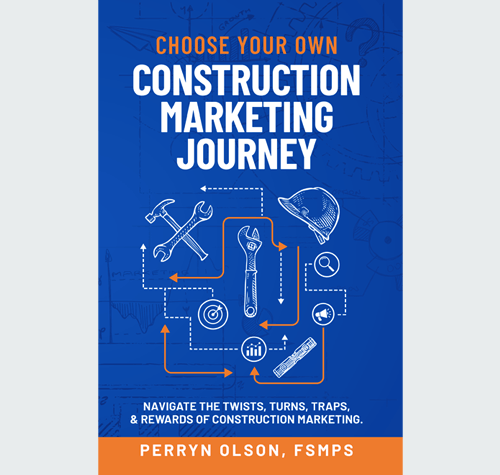
Choose Your Own Construction Marketing Journey Is Now Available
The decisions are yours now.
Perryn Olson’s new book, Choose Your Own Construction Marketing Journey, is officially available from Plumb & True Press.
Written specifically for construction marketers and company leaders, the book takes a different approach to business education.
Rather than giving readers another collection of marketing rules, Olson presents realistic construction-industry situations and asks readers to choose what happens next.
Every scenario offers three paths. Every decision has consequences. And there is rarely one universally correct answer.
The book draws on more than two decades of construction marketing experience to explore questions involving business growth, pursuits, positioning, marketing leadership, client relationships, differentiation, and the sometimes messy realities of trying to improve marketing inside a construction company.
Readers will also find Executive Briefs, practical Field Manuals, CMO’s Take commentary, deeper Plumb & True observations, and Reframes designed to challenge conventional industry thinking.
The book can be read individually, but its scenarios are also designed to spark conversation among marketing teams, business-development professionals, and company leadership.
Ask several people inside the same construction company to solve the same scenario, and you may discover they are solving completely different problems.
That is part of the point.
Choose Your Own Construction Marketing Journey is available in paperback for $24.99.
ISBN: 979-8-9972837-0-4
- ‹ Previous
- 1
- 2