
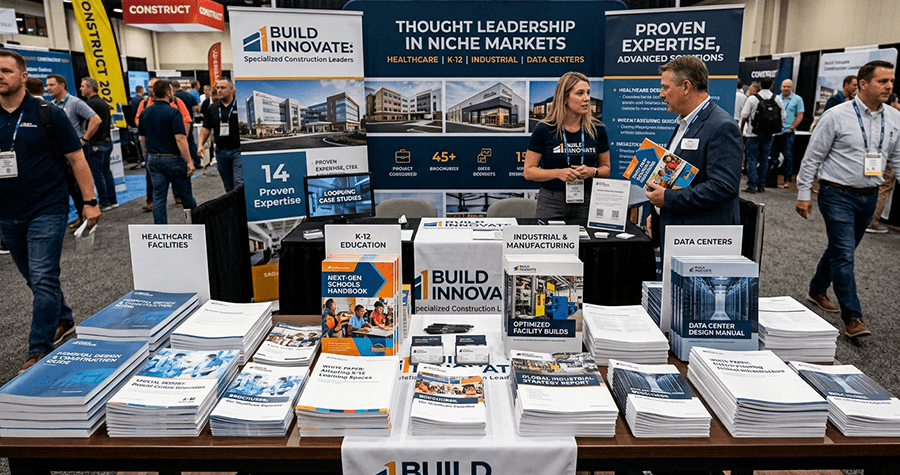
Build a Content Ecosystem, Not a Content Calendar
Most construction companies do not have a shortage of things to talk about. They have a system problem.
Marketing publishes a project announcement on Monday, a safety photo on Wednesday, and realizes on Friday that nobody has posted to LinkedIn recently. Someone writes a blog article because SEO is on the annual plan. An executive speaks at a conference, the presentation is uploaded to a folder, and almost nobody outside the room ever sees it again.
A month later, marketing starts over and asks the same question: What should we post next?
That approach creates activity, but it rarely builds authority.
A better approach is to build a content ecosystem, where the company’s strongest ideas, expertise, projects, and perspectives move through multiple channels and formats while reinforcing the same positioning.
The goal is not to publish more content. It is to make your best content work harder.
Most Contractors Are Sitting on More Content Than They Realize
Construction companies are full of subject matter expertise.
Project executives know why certain jobs go sideways. Superintendents solve problems every day that clients never see. Estimators recognize the decisions that create budget problems before construction begins. Safety professionals understand risks that rarely appear in a marketing brief, while recruiters know why good people accept one offer and reject another.
Executives have decades of perspective on clients, markets, labor, risk, growth, and leadership.
The problem is that most of this knowledge stays inside people’s heads, email inboxes, meetings, jobsite conversations, and project folders.
Marketing’s job should not be to manufacture expertise for these people. It should capture what they know, find the ideas that matter to clients and employees, and make those ideas easier to understand and share.
That distinction matters even more as generative AI makes generic content nearly free to produce. Anyone can create another article called “Five Tips for a Successful Construction Project.” Very few companies can publish a project executive’s firsthand explanation of the three preconstruction decisions that repeatedly cause occupied renovation schedules to fail.
One is information. The other is expertise.
Start With an Idea, Not a Platform
A content calendar often starts with empty boxes.
We need two LinkedIn posts this week. We need a blog on Thursday. We need something for Facebook. We have not sent an email this month.
That approach forces the team to constantly generate new material to satisfy the schedule.
A content ecosystem begins somewhere else.
What do we want to be known for? What problems do our clients care about? What buying situations are important to our growth strategy? What does our team know about those problems that would genuinely help someone?
Those questions produce the core idea. Only then should marketing decide how that idea should appear on different channels.
For example, imagine a project executive spends 30 minutes with marketing discussing this question:
What causes the most avoidable problems during occupied renovations?
That conversation can produce far more than one article. The important thing is not producing ten pieces of content from one interview for the sake of volume. It is identifying the useful ideas inside that conversation and presenting each one in the format where it works best.
One Strong Idea Can Become an Entire Content Series
The full conversation with that project executive might become a long-form website article explaining the major risks in occupied renovations.
A particularly strong opinion could become a LinkedIn post under the executive’s name. Three recurring mistakes could become a carousel. A real project example could become a case study. A short explanation could become a video, while common owner questions could become FAQs on the website.
A deeper version could become a webinar, association presentation, or client lunch-and-learn. The primary lessons could become a section in an email newsletter, while a business developer could send the article directly to a prospect planning an occupied renovation.
Months later, the company might combine this material with several related pieces and create a larger guide to planning construction in occupied facilities.
The company did not need ten unrelated ideas. It needed one valuable subject and a system for extending it.
That is the foundation of a content ecosystem.
Repurposing Does Not Mean Copying and Pasting
Repurposing gets a bad reputation because many companies do it poorly.
They publish an article on the website, copy the opening paragraph into LinkedIn, paste the same copy into Facebook, send the article in an email, and call it a multichannel campaign.
That is distribution.
Good repurposing recognizes that people behave differently on different platforms. The core expertise can remain consistent while the format, depth, opening, visuals, and call to action change.
Your Website Is the Permanent Library
The website should usually hold the deepest version of an important idea.
This is where the company can explain the issue thoroughly, answer related questions, incorporate project examples, show proof, introduce subject matter experts, and connect the topic to relevant services.
Long-form articles also create something permanent. A good social post might disappear from most people’s feeds within days, while a strong website resource can continue to be found through search, shared by business development, referenced in proposals, linked from future content, and discovered by AI search tools long after it was published.
Your website should gradually become a useful library of what your company knows.
LinkedIn Needs a Point of View
LinkedIn is not your blog.
Instead of copying the article introduction, identify an observation that can stand on its own.
The project executive might say, “The worst time to discover your renovation phasing plan does not work is after your client’s employees have already moved into temporary space.”
That idea can become a useful post without requiring the reader to leave LinkedIn. Another post might share a project lesson, a third might challenge a common assumption, and a fourth might use a photograph to demonstrate the logistical issue.
Each one reinforces the same expertise without simply repeating the article.
Instagram and Facebook Need More Visual Translation
Some ideas that work as detailed articles need to become simpler and more visual for Instagram or Facebook.
Three renovation mistakes might become a carousel. A project lesson could become before-and-after photography with a concise explanation. A superintendent might record a 45-second video explaining something customers frequently misunderstand.
A complex process could become a simple diagram. The message remains connected to the larger content theme, but the execution fits how people consume information on that platform.
Email Creates Continuity
A newsletter should not simply list everything the company published that month.
It should help the reader make sense of the best material. Explain why a topic matters now, share the most useful insight, connect it to another resource, and give the reader a reason to continue exploring if the issue applies to them.
Email is especially useful because it creates continuity between individual pieces of content. Someone may not need the information today, but six months later, when the relevant buying trigger occurs, they may remember the company that has been consistently helping them understand the issue.
Video Lets Buyers Experience the Expert
Some expertise becomes more credible when buyers can hear the person explaining it.
That does not require a studio or highly produced corporate video. A project executive who can clearly answer a real owner question on camera demonstrates expertise differently than a polished article does.
Video gives prospective clients a sense of how someone communicates, thinks, and approaches problems. Longer conversations can also create multiple shorter clips, but the clips should be selected because each contains a useful idea rather than because marketing needs six reels this month.
Presentations and Webinars Should Keep Working After the Event
Construction companies put significant effort into presentations.
An executive develops an AGC session. A technical leader prepares a webinar. A project team presents lessons learned. A CEO spends weeks developing a keynote.
Then the event ends and the content largely disappears.
That is wasted intellectual capital.
A strong presentation can become articles, videos, social posts, graphics, newsletter content, follow-up resources, FAQs, and future presentations. Questions from the audience can reveal additional topics buyers care about.
The event should be one expression of the idea, not the end of it.
Build the Ecosystem Around Content Pillars
An ecosystem still needs boundaries.
Without them, repurposing can simply create more random content.
Start with a small number of subjects your company needs to be known for. These content pillars should come from the business strategy, positioning, expertise, and growth priorities rather than whatever topics happen to be popular online.
A commercial contractor might use pillars such as:
- Client challenges and buying triggers
- Technical expertise and project execution
- People, culture, and career development
- Market perspective and company point of view
A specialty contractor might organize content around specific applications, common project risks, preconstruction decisions, field expertise, and workforce development.
The exact pillars matter less than the discipline behind them. If a topic does not help the company reinforce a useful area of expertise, position, relationship, or business objective, it probably does not deserve much marketing energy.
Marketing Teams Are Evolving Around the Content Ecosystem
Building this kind of system is also changing the people construction companies need inside their marketing departments.
Over the past few years, one of the roles I have recommended most often is some version of a content curator or content coordinator.
That title can mean different things depending on the size of the company, but the function is increasingly important. This person is not expected to be the technical expert on preconstruction, safety, roofing, healthcare construction, industrial shutdowns, or whatever markets the company serves.
Their job is to find the expertise that already exists.
They identify the people worth interviewing, listen for useful ideas in meetings, watch for strong project stories, capture frequently asked questions, coordinate with subject matter experts, organize photos and video, maintain the content pipeline, and make sure valuable knowledge does not disappear after a presentation or project meeting.
They also help connect the dots.
A content curator should be able to recognize that something a project executive said during an interview could become an article, three social posts, a short video, a newsletter section, and a discussion point for an upcoming webinar. They should know that a great project photograph becomes more valuable when it is accompanied by the lesson behind the work, not simply the square footage and completion date.
This is fundamentally different from hiring someone whose primary responsibility is to “post on social media.” The content curator coordinates expertise.
The Curator Is Not the SME
This distinction deserves to be explicit because it is where many content programs go wrong.
A 25-year-old content coordinator should not be expected to invent a veteran superintendent’s perspective on jobsite logistics. They should know how to get that perspective out of the superintendent.
The curator needs curiosity, interviewing ability, organization, enough understanding of the business to recognize a useful idea, and the communication skills to translate technical expertise without flattening it into generic marketing language.
The subject matter expert still owns the substance. That might be a project executive, estimator, engineer, superintendent, safety leader, recruiter, CEO, or client-facing specialist.
The curator creates the system around them.
This model is particularly effective in construction because the people with the deepest expertise are usually the people with the least time to create content themselves. Asking them to write a 1,500-word blog post is often unrealistic, while asking them thoughtful questions for 30 minutes can be much more productive.
Marketing can take it from there.
AI Makes the Curator More Powerful, Not Less Necessary
AI is accelerating this shift.
A good content coordinator can now take a recorded SME conversation, generate a transcript, identify themes, create an initial outline, organize supporting material, draft variations, and reformat approved content far faster than was possible a few years ago.
That does not eliminate the curator. It increases their leverage.
Someone still needs to recognize which SME is worth interviewing, ask the questions that uncover useful experience, distinguish a generic answer from an interesting one, challenge unclear statements, verify claims, protect the company’s voice, understand the audience, and decide what deserves to be published.
AI can help transform expertise. It cannot be allowed to manufacture expertise the company does not actually have.
That is why I expect content curation and coordination to become an increasingly important marketing capability. The companies that win will not necessarily employ the most writers; they will be better at capturing and distributing what their people genuinely know.
Connect the Ecosystem to Buying Triggers
Content becomes much more valuable when it reflects the reasons buyers enter the market.
Imagine a contractor wants to grow its manufacturing practice.
The marketing team could publish generic posts about manufacturing construction, or it could study what happens before a manufacturer begins looking for construction help.
A production line needs to be added. Capacity is constrained. A plant is being expanded. Equipment has been purchased. A company is reshoring production. An acquisition creates a facility need. A shutdown is scheduled. A capital plan receives approval.
Those situations should shape the content.
Instead of another “Why Choose Us for Manufacturing Construction” article, the contractor could publish guidance on planning a production-line expansion without disrupting operations. An executive could discuss the five questions manufacturers should answer before purchasing equipment that requires facility modifications, while a project team could explain how early contractor involvement affected the schedule of a recent plant expansion.
A webinar could address shutdown planning, and business development could share those materials with manufacturers before they have active projects.
Now the content ecosystem is building an association between the contractor and the situations that eventually create work.
Repetition Is Part of the Strategy
One reason companies publish random content is that marketers and executives become bored with their own themes.
They assume the audience must be bored too.
Usually, the audience barely saw the first post.
People are busy. Algorithms control what appears in their feeds. Emails go unread. Prospects are not studying your content strategy or noticing that the project executive discussed phasing six weeks ago.
Strong brands repeat important ideas.
If your company wants to become known for prefabrication, occupied healthcare construction, complex industrial work, higher education, preconstruction, safety innovation, or developing exceptional field leaders, those subjects should appear repeatedly.
The stories and formats should change, while the association should strengthen.
There is a difference between saying exactly the same thing every week and consistently reinforcing what you want to be known for. Random content avoids repetition; effective positioning requires it.
A Content Ecosystem Makes Thought Leadership More Sustainable
One of the biggest barriers to thought leadership in construction is subject matter expert time.
Your project executives have projects to run. Your superintendent is not waiting for marketing to schedule a content interview. Your estimator has bids due, and your CEO has a company to lead.
A good content system respects that reality.
Marketing should capture expertise efficiently, then do the work of multiplying its value. A focused 45-minute SME interview might support several weeks of content. One quarterly webinar could support an entire campaign, while a podcast conversation might create an article, several clips, executive social content, a newsletter feature, and new ideas for future interviews.
A piece of original research can fuel content for months.
The SME should provide the experience, expertise, examples, opinions, and judgment. Marketing should shape the material, organize it, challenge it when necessary, and determine how to make it useful for the audience.
The content curator or coordinator is often the person who keeps that entire process moving.
Not Every Piece Needs to Be Completely New
Marketers sometimes feel guilty repurposing material because they think every post should deliver a new idea.
That standard is unnecessary and inefficient.
A strong article might contain six ideas worth exploring separately. Research can produce dozens of useful observations, while a project can reveal several different lessons depending on whether the audience is an owner, architect, candidate, estimator, or operations professional.
An executive’s perspective can evolve over time.
Repurposing also allows the company to meet different people where they are. Someone who will never read a 2,000-word article might watch a one-minute video. Someone who ignores the video might save a carousel, while another person may encounter the idea during a webinar six months later.
The value is not how many unique thoughts marketing produces each week. The value is how effectively the company’s best expertise reaches and stays with the right people.
Build Paths Between Content
An ecosystem also means content connects.
A LinkedIn post can introduce an issue and point to a deeper article. The article can link to a related project, while the project can feature the people who solved the problem. Those subject matter experts can have other articles or videos.
A newsletter can bring the reader back to another part of the topic later. A webinar can take the discussion deeper. Business development can use the best resources during a pursuit.
Over time, someone interested in one subject can move naturally through a body of expertise instead of encountering an isolated blog post and leaving.
The website stops functioning like a brochure with a blog attached. It becomes a knowledge base for the problems your company is best equipped to solve.
The Return Compounds
This is where an ecosystem becomes more valuable than a content calendar.
Random content is consumed and replaced. An ecosystem accumulates.
After a year, the company does not simply have 50 articles and 150 social posts. It has a searchable body of expertise, answers to buyer questions, firsthand perspectives from employees, project proof, resources business development can use, content that supports recruiting, material executives can present, and stronger associations between the company and the problems it wants to own.
That body of work also improves the economics of future content creation.
Marketing does not start with a blank page each Monday. New ideas connect to existing ones. Old material can be updated. Research can be revisited, and an SME interview can expand an established pillar rather than creating a completely new direction.
The ecosystem gets deeper as it grows.
Stop Asking What You Should Post This Week
A content calendar is still useful.
Someone needs to know what is publishing, where it is going, who owns it, and when it needs to be completed. The problem is confusing the calendar with the strategy.
Instead of beginning with empty publishing slots, begin with better questions.
What do we want this company to be known for? What problems do our best clients face? What events cause those problems to become urgent? What expertise does our team have that the market would find useful?
What evidence can we provide? Which subject matter experts have earned a point of view? What major ideas are worth reinforcing for the next year, not merely the next week?
Then make sure somebody owns the system that captures those answers.
For a growing construction marketing department, that person may increasingly be a content curator or coordinator rather than another traditional marketing generalist.
Capture the ideas. Build substantial anchor content when the subject deserves it. Break the strongest ideas into useful pieces. Adapt them for each platform instead of copying and pasting, connect those pieces to one another, and keep reinforcing the areas of expertise your company wants the market to remember.
That is how you stop feeding a content calendar and start building an authority engine.
 By perryn@aeccmos.com
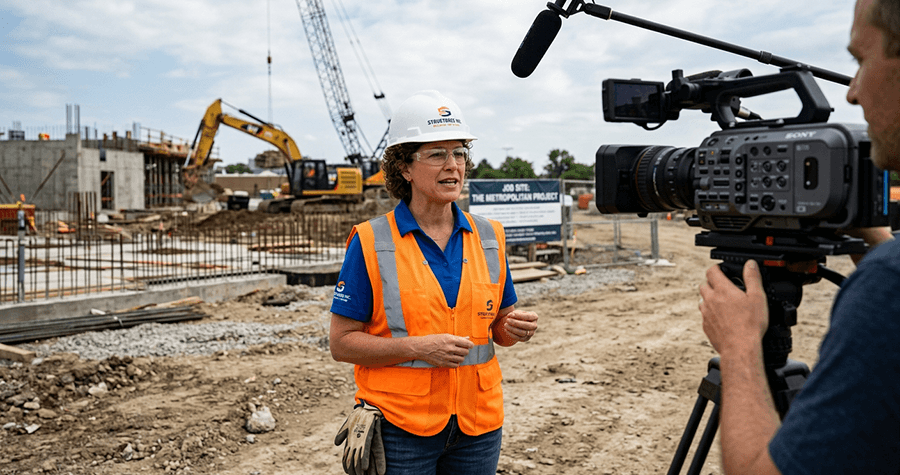
SEO for AEC Firms Has Changed: Expertise Is the New Search Advantage
For years, search engine optimization followed a fairly familiar formula. A company identified the terms its prospective clients were searching for, created pages and articles around those terms, optimized the website, built links, and tried to move higher in Google’s rankings.
That foundation has not disappeared, but the way people find and evaluate information is changing quickly. A construction executive researching a new technology, delivery method, contractor, engineering partner, or business challenge may still start with Google. Increasingly, though, that research may also include a Google AI Overview, ChatGPT, another AI assistant, YouTube, LinkedIn, industry publications, podcasts, and recommendations from peers. In many cases, the buyer may get a useful answer before ever clicking the first traditional search result.
That changes the strategic question for architecture, engineering, and construction firms. It is no longer enough to ask how a company can rank for a particular search. A better question is: How do we become one of the companies the market, search engines, and AI systems recognize as a credible authority on this subject?
That is a much bigger challenge, but it is also one that established A/E/C firms are unusually well positioned to solve. Most already possess the raw material: decades of projects, lessons learned, technical expertise, experienced people, customer relationships, field knowledge, proprietary processes, and informed opinions. The opportunity is to turn that institutional knowledge into visible authority.
What Has Changed About SEO for AEC Firms?
SEO is not disappearing. Google continues to say that traditional SEO fundamentals remain relevant to its generative AI search experiences, including AI Overviews and AI Mode. What has changed is the environment around those fundamentals and the way buyers interact with information before they ever reach a company website.
Traditional search primarily helped people find websites. Generative search can increasingly help people understand a subject, compare alternatives, explore questions, and evaluate possible decisions. Google describes AI Mode as especially useful for nuanced questions, comparisons, and topics that previously might have required several separate searches because its systems can break a complex question into related searches, gather information from multiple sources, and synthesize an answer.
Consider how that could apply to construction. A facility owner might once have searched for “industrial contractor Houston.” Today, that same person might ask, “What should I look for when selecting a contractor for an occupied industrial facility where shutdown time is expensive?”
That is not simply a keyword. It is a business problem, and the companies most capable of providing a meaningful answer are probably not SEO agencies or freelance writers. They are contractors and professionals who have actually managed shutdowns, coordinated work around operating facilities, planned complex phasing, dealt with unexpected field conditions, and learned what makes those projects succeed or fail.
That is where the next era of A/E/C search visibility starts.
Search Is Moving From Keywords Toward Questions, Problems, and Expertise
Construction buyers rarely wake up wanting marketing content. They have problems to solve, risks to reduce, decisions to make, and projects to move forward.
They may need to understand a delivery method, compare materials, improve a facility, meet a regulation, control costs, address a schedule problem, evaluate new technology, find qualified partners, or understand what could go wrong before signing a contract. Traditional SEO sometimes encouraged companies to turn these questions into keywords and then produce content designed primarily to capture search traffic.
The better opportunity now is to reverse that thinking and start with the knowledge inside the business. What does your company understand because of the work it has actually performed? What do your experienced people see that a generalist does not? What questions do sophisticated clients ask before making major decisions? What mistakes repeatedly cost owners time or money? Where does conventional wisdom differ from what your team sees in the field?
Those questions produce something much more valuable than keyword-driven content. They produce expertise.
Google’s own guidance increasingly emphasizes this distinction. Its current guidance for generative AI search encourages publishers to create unique, expert-led, non-commodity content that provides value beyond common knowledge.
That description should sound familiar to A/E/C leaders because it is essentially the difference between repeating what everybody already knows and explaining what your company has learned by doing the work.
E-E-A-T Matters More in an AI-Saturated World
Google uses the concept of E-E-A-T when discussing content quality: Experience, Expertise, Authoritativeness, and Trustworthiness. Google is careful to explain that E-E-A-T is not a single ranking factor or score. Instead, its systems use many signals intended to identify helpful and reliable information, with trust serving as the central idea supported by experience, expertise, and authority.
For construction leaders, the terminology matters less than the underlying question: Why should someone trust this source?
That is particularly relevant to A/E/C. If someone is searching for decorating ideas, being wrong may result in an ugly living room. If someone is researching structural systems, building envelopes, industrial shutdowns, safety practices, environmental remediation, utility construction, roofing systems, healthcare facilities, or major capital investments, poor information can carry far greater consequences.
Your company’s credibility matters.
Experience: Have You Actually Dealt With This?
A superintendent who has spent 25 years building hospitals understands issues that someone summarizing hospital construction articles does not. A roofing contractor that has inspected thousands of roofs after Midwestern storms sees patterns that generic internet content cannot easily replicate. An engineer who has worked through dozens of infrastructure projects understands where theoretical solutions collide with permitting, site conditions, budgets, and operations.
That firsthand experience has value precisely because it is difficult to manufacture. As AI makes it easier for anyone to summarize existing information, direct experience becomes a more meaningful distinction.
Expertise: Do You Understand the Subject Deeply Enough to Explain It?
A/E/C firms are full of expertise, although much of it has historically remained trapped inside the company. It lives inside estimators, engineers, architects, superintendents, project executives, safety professionals, operations leaders, technical specialists, and owners.
Those people do not need to become “content creators,” nor should they. Their job is to know the work. The company’s responsibility is to find effective ways to capture that knowledge, organize it, and make it useful to clients and the market without creating another burden for its best people.
Authoritativeness: Does the Broader Market Recognize You for This Expertise?
Authority develops when expertise becomes visible and is recognized beyond the company itself. That can happen when experts speak at conferences, appear on podcasts, contribute to industry discussions, participate in associations, conduct research, publish useful perspectives, appear in trade publications, educate clients, or are referenced by other credible sources.
Research from Ahrefs offers an important signal. In a study of 75,000 brands, branded mentions across the web had a substantially stronger correlation with brand visibility in Google AI Overviews than backlinks did. Ahrefs appropriately cautions that correlation does not prove causation, but the larger finding matters: companies that are widely discussed and recognized across the web tend to appear more frequently in AI-generated results.
A later Ahrefs analysis found branded web mentions remained highly correlated with visibility across ChatGPT, Google AI Mode, and AI Overviews, while simply having more website pages showed little relationship with AI visibility.
In plain construction language, publishing more pages does not automatically make a company an authority. Being recognized for something does.
Trustworthiness: Does the Evidence Support the Claim?
Trust ties the other elements together. People need confidence that your company knows what it is talking about, can support its claims, and is willing to provide useful information rather than simply manufacture sales copy.
For construction companies, trust is not an abstract branding concept. It influences whether an owner includes you on a shortlist, whether a recruit believes your culture claims, whether a journalist calls your executive, whether an industry organization asks your expert to speak, and whether someone believes the advice attached to your company’s name.
Increasingly, that visible reputation can also influence how digital systems interpret your company and its authority.
AI Has Made Content Easier to Produce. That Makes Expertise More Valuable.
Generative AI has dramatically reduced the effort required to produce average content. Almost any company can now generate an article about construction trends, the benefits of design-build, ways to improve safety, the importance of communication, technology adoption, or artificial intelligence in a matter of seconds.
Those topics are not inherently bad. The problem is that if your company’s article contains essentially the same information an AI model can already produce, there is little reason for a client to read yours, for Google to prioritize it, for an AI assistant to reference it, or for anyone to remember who produced it.
Google now explicitly distinguishes commodity information from content that brings original experience, expert analysis, or a perspective that goes beyond common knowledge. That creates a counterintuitive opportunity for A/E/C firms: AI does not make your experienced people less important. It makes them more important.
The internet does not need another generic explanation of preconstruction. It may need your preconstruction leader explaining why three recent projects uncovered budget problems earlier than expected. It does not need another generic article about safety, but it may need your safety director explaining what changed after investigating recurring near misses. It does not need another explanation of building envelopes, but it may need your specialist explaining why a detail commonly specified in one climate creates problems in another.
The value is not simply the subject. The value is what your people know about the subject that others do not.
Your Company’s Knowledge Is Becoming a Marketing Asset
Most established A/E/C firms possess an enormous library of intellectual property without recognizing it as such. It is rarely stored neatly in a database. Instead, it resides in hundreds or thousands of experiences accumulated across projects and careers.
A difficult project taught the team something. A design solution saved an owner money. A superintendent knows which early warning signs indicate a schedule problem. An estimator can spot unrealistic assumptions immediately. A project executive has watched procurement challenges evolve for twenty years. A specialist understands a regulation better than almost anyone in the market. An owner has seen three economic cycles and can explain how client behavior changes during each one.
Those insights have traditionally been exchanged through meetings, phone calls, proposals, conferences, and relationships. They still should be, but search and AI create another opportunity: allowing those ideas to become part of the company’s public body of knowledge.
That is bigger than blogging. It is the digital documentation of institutional expertise.
The Goal Is Not to Feed the Algorithm
The response to AI search should not be another generation of shortcuts designed to manipulate algorithms. Google explicitly warns against that thinking. Its current generative search guidance says there is no need to rewrite content specifically for AI systems, manufacture special AI content structures, or chase many of the so-called GEO or AEO hacks being promoted.
Instead, Google continues to recommend useful, original content created primarily for people. That is good news for construction leaders because they do not need to understand every new acronym.
SEO. AEO. GEO. LLMO. The labels will continue changing, but the business principle underneath them is more durable: become genuinely useful and genuinely credible in the areas where you want your firm to be known, then make that expertise visible.
SEO Is Becoming Part of Brand Strategy
This may be the largest strategic change of all.
Traditional SEO was often treated as a technical marketing function. Research keywords. Optimize pages. Acquire backlinks. Watch rankings. Those activities still have a place, but search visibility increasingly intersects with reputation and brand authority.
Consider the signals that show a company has become known for something. Someone searches for the company by name. An industry publication quotes one of its executives. A podcast invites its CEO. Another company references its research. A client shares something the company published. An association invites one of its specialists to speak. Those outcomes do not come from metadata alone. They come from becoming recognized.
Ahrefs’ research reinforces this relationship. Across its analysis of AI search visibility, off-site brand signals such as web mentions and branded searches correlated with AI visibility more strongly than many traditional link and website-volume metrics.
That suggests a broader definition of search strategy: your search presence is increasingly influenced by the reputation your company builds across the market, not simply the pages it publishes on its own website.
For an A/E/C leader, that means SEO should no longer live entirely in a marketing silo. It overlaps with brand, public relations, research, executive visibility, recruiting, business development, client education, speaking, associations, media, and thought leadership. The website remains important, but it is one piece of a larger authority system.
Small and Mid-Sized A/E/C Firms Have an Opportunity
It is easy to assume that this evolution favors the biggest firms with the largest marketing budgets. Size certainly creates advantages, but expertise is not distributed according to marketing spend.
A $75 million specialty contractor may know more about a narrow technical issue than a $10 billion general contractor. A regional engineering firm may understand local infrastructure challenges better than a global competitor. A second-generation contractor may have forty years of institutional knowledge about a market that a national consolidator entered three years ago.
Generative search creates more opportunities for people to ask increasingly specific questions, and specific questions reward specific knowledge. That creates room for companies willing to define what they know, capture their experts’ perspectives, and consistently build authority around the problems they understand best.
You do not have to become the internet’s leading authority on construction. You need to become a credible authority on the subjects that matter to your clients and your company’s strategy.
Your Subject Matter Experts Should Not Become Content Creators
This distinction matters for executives because the answer is not to give your best technical people another job.
Your superintendent does not need a weekly blogging quota. Your engineers do not need to become influencers, and your CEO does not need to spend half the day creating LinkedIn content. Subject matter experts should remain subject matter experts.
The marketing function should draw that knowledge out of them, organize it, strengthen it, and distribute it without turning knowledgeable professionals into part-time marketers. AI can help enormously with that process by organizing conversations, summarizing interviews, identifying themes, improving readability, and adapting ideas for different formats.
But AI should amplify expertise rather than replace it. The core message still needs to originate somewhere real: experience, expertise, research, evidence, or a defensible point of view. Otherwise, the company is simply using increasingly sophisticated technology to produce increasingly polished sameness.
What Construction Leaders Should Expect From SEO Now
Executives do not need to become search experts, but they do need to change the expectations they place on marketing.
The old conversation may have focused heavily on rankings, traffic, keywords, and how many articles were published. The better conversation is broader: Are we building authority in markets important to our growth? Are our experts visible? Does our company contribute something useful to the industry’s knowledge? Are we associated with the problems we are uniquely qualified to solve?
Construction leaders should also ask whether someone researching those problems would encounter their company’s thinking, whether the market has evidence supporting the claims the company makes about itself, and whether a sophisticated client would come away from the firm’s digital presence believing it understands their world.
Those questions connect search directly to business strategy, which is where it belongs.
From Ranking to Recognition
SEO for A/E/C firms is not dead. It is becoming more demanding.
Technical SEO still matters. Websites still need to be accessible, understandable, useful, and well organized. Search rankings still matter, and Google remains an important source of discovery. But ranking is no longer the entire objective.
The larger objective is recognition. You want the market to recognize your company as knowledgeable, prospective clients to recognize your experience, industry peers to recognize your authority, and search engines to find substantial evidence supporting that authority. As AI becomes a larger part of how people research companies, problems, products, technologies, and partners, you also want those systems to encounter the same pattern.
A company cannot manufacture that authority with a few optimized articles. It has to build it over time through real expertise, useful perspectives, visible proof, and consistent recognition.
Fortunately, many A/E/C firms already possess the hardest part. They have spent decades earning the experience. The next challenge is making that expertise easier for the market to see.
The New SEO Strategy for A/E/C Firms
The shift can be summarized simply.
Old SEO asked: How do we create content that ranks?
The next era asks: How do we become a source worth finding, trusting, citing, and remembering?
For architecture, engineering, and construction firms, the answer will not come from producing more generic content. It will come from the people who already know the work.
Their experience creates expertise. Consistently demonstrating that expertise creates authority. Authority, supported by evidence and recognized by others, builds trust.
That is E-E-A-T in practical terms, and increasingly, it is also the foundation of search visibility in an AI-driven world.

Fractional CMO vs. Marketing Agency: Which Does Your Construction Company Need?
Construction companies often reach a point where referrals, relationships, and occasional marketing projects are no longer enough to support where the business is going.
The company may want to enter a new market, attract larger clients, improve its hit rate, strengthen recruiting, integrate an acquisition, or build a more recognizable brand. Leadership knows marketing needs to improve, but the next step is not always clear.
Should you hire a marketing agency—or bring in a fractional Chief Marketing Officer?
The answer depends less on how much marketing work needs to be done and more on what kind of problem you are trying to solve.
A marketing agency provides specialized capabilities and production capacity. A fractional CMO provides senior leadership, business alignment, and accountability for the entire marketing function.
One primarily helps execute marketing. The other decides what marketing should accomplish, how it supports the business, and which resources are needed to make it happen.
What Is the Difference Between a Fractional CMO and a Marketing Agency?
A fractional CMO serves as a part-time senior marketing executive. The CMO works with company leadership to connect marketing decisions with growth, profitability, market expansion, recruiting, client retention, business development, and the long-term value of the brand.
A marketing agency is typically hired to provide specific creative, technical, or promotional services. Depending on the agency, those services may include branding, website development, advertising, SEO, content, video, public relations, social media, or campaign management.
The simplest distinction is:
A fractional CMO leads the marketing function. An agency delivers marketing services.
That does not mean an agency cannot offer strategic thinking. Strong agencies often provide excellent advice within their areas of expertise. But an agency is rarely positioned inside the contractor’s leadership team with authority and accountability across the entire marketing operation.
Fractional CMO vs. Marketing Agency at a Glance
| Area | Fractional CMO | Marketing Agency |
|---|---|---|
| Primary role | Senior marketing leadership | Specialized strategy or execution |
| Relationship | Part of the leadership team | External service provider |
| Starting point | Business goals and company strategy | Defined scope, project, or channel |
| Accountability | Overall marketing direction and performance | Performance within the assigned scope |
| Team leadership | Can lead and develop internal marketers | Usually works alongside a client contact |
| Business involvement | Growth, profitability, markets, recruiting, operations, and leadership priorities | Primarily the marketing services being delivered |
| Resource planning | Determines which internal and external resources are needed | Provides the services included in its agreement |
| Vendor management | Can select and manage agencies and specialists | Typically manages its own team and subcontractors |
| Construction knowledge | Depends on the individual CMO | Depends on the agency’s industry specialization |
| Best fit | Companies with a marketing leadership gap | Companies with clear strategy but insufficient capabilities or capacity |
The two models are not necessarily competitors. A fractional CMO may hire and manage agencies, while an agency may work extremely well under an experienced internal marketing leader.
The problem comes when a company hires one while expecting the other.
When a Construction Company Needs a Marketing Agency
A marketing agency is often the right choice when the company already knows what it needs and has someone qualified to lead the work.
For example, a contractor may have a capable marketing director and an established strategy but lack the internal resources to:
- Redesign its website
- Produce videos and project photography
- Manage a paid advertising campaign
- Improve technical SEO
- Develop a new visual identity
- Conduct public relations outreach
- Produce content consistently
- Implement marketing automation
- Create specialized recruitment campaigns
In those situations, the company has a capability or capacity gap—not necessarily a leadership gap.
The internal marketing leader can define the objectives, select the right agency, provide industry context, coordinate internal stakeholders, review the work, and hold the agency accountable.
Agencies are especially valuable when a company needs expertise that would be difficult or inefficient to hire full-time. Most contractors do not need a full-time web developer, videographer, advertising specialist, SEO technician, copywriter, or brand designer on staff. An agency provides access to those capabilities as needed.
A Marketing Agency Is Probably the Better Fit When:
- Your business and marketing strategies are already clear.
- You have an experienced internal leader who can direct the agency.
- You need help with a defined project or marketing channel.
- Your team lacks production capacity or a specialized technical skill.
- Leadership agrees on the company’s priorities and positioning.
- Someone inside the company can make decisions and provide timely feedback.
- You have the internal knowledge required to keep the work grounded in construction.
When those conditions exist, an agency can be an effective extension of the marketing department.
When a Construction Company Needs a Fractional CMO
A fractional CMO is usually the better choice when the company’s challenge is not simply producing more marketing.
The company may have a coordinator, manager, director, or outside agency completing assignments, but no senior marketing leader is deciding which priorities matter most. Marketing requests come from multiple executives. The CEO, CFO, business development leader, or owner oversees marketing between other responsibilities. Vendors operate independently, and no one is accountable for connecting their work.
The company may be busy without being strategic.
A fractional CMO fills that leadership gap.
The CMO helps leadership answer questions such as:
- Which clients and markets should we prioritize?
- What kinds of work are most profitable and strategically valuable?
- How should marketing support our growth plan?
- Are we positioning the company around meaningful distinctions?
- Where are we overdependent on relationships, clients, or markets?
- How can marketing strengthen business development?
- Why are we losing must-win pursuits?
- How should marketing support recruiting and retention?
- Which capabilities belong in-house, and which should be outsourced?
- What should we stop doing?
- How much should we invest?
- How should marketing performance be measured?
Those are executive questions, not production assignments.
A Fractional CMO Is Probably the Better Fit When:
- No senior leader owns the entire marketing function.
- The CEO or CFO is informally leading marketing.
- The marketing team receives conflicting requests from different executives.
- Your company has outgrown its current approach.
- You are entering new markets, services, or geographies.
- You want to shift toward better clients or more negotiated work.
- You have an internal marketer who needs strategic guidance and mentorship.
- Multiple agencies or freelancers are working without one coordinated plan.
- Marketing activities are disconnected from business development.
- Leadership cannot clearly explain what marketing is expected to accomplish.
- You are investing in marketing but cannot determine whether the right work is being done.
- The company is preparing for an acquisition, ownership transition, or rebrand.
In these situations, hiring another agency may add activity without resolving the leadership problem.
The Risk of Expecting an Agency to Act Like Your CMO
A construction company sometimes hires an agency because leadership knows marketing needs attention but does not have a clear strategy.
The agency begins with the services it knows how to sell. A website firm recommends a new website. An SEO agency recommends more SEO. A social media agency recommends more content. An advertising agency recommends a larger media budget.
These recommendations may be completely reasonable. The problem is that each provider sees the company through the lens of its own specialty.
Someone still needs to determine whether those investments support the contractor’s larger business priorities.
The contractor may not need more website traffic. It may need greater awareness among 75 carefully selected owners and developers.
It may not need more proposals. It may need a stronger go/no-go process and better pursuit support.
It may not need to increase recruiting applications. It may need to improve its reputation among experienced superintendents and project managers.
It may not need more content. It may need a clearer position, better client intelligence, and a more focused market strategy.
An agency can deliver its scope successfully while the company continues to struggle with the larger problem.
That is not necessarily an agency failure. It is often a leadership failure caused by asking a service provider to fill a role it was never designed to own.
The Risk of Hiring a Fractional CMO Without Execution Support
The opposite problem also occurs.
A fractional CMO can develop a strong strategy, establish priorities, and create an implementation roadmap. But someone still needs to do the work. (A/E/C CMOs’ engagements include an implementation team, so strategy and execution remain connected.)
If the company has no internal marketing team—or if the existing team is already overwhelmed—the contractor may receive a smart plan without enough capacity to execute it.
The company then has to hire and coordinate separate agencies, freelancers, and specialists for branding, website development, SEO, content, design, advertising, research, automation, and other needs.
Instead of solving fragmentation, a traditional fractional CMO may unintentionally create another layer for the client to manage.
Before hiring a fractional CMO, ask:
- Will the CMO only provide advice?
- Who will implement the strategy?
- Can the CMO lead our internal marketers?
- Will the CMO select and manage outside vendors?
- Does the engagement include delivery resources?
- How much additional budget will execution require?
- Who remains accountable when several specialists are involved?
Strategy without execution becomes a presentation. Execution without strategy becomes a collection of disconnected tasks.
Construction companies need both.
Construction Experience Matters in Either Model
Neither the title “fractional CMO” nor the word “agency” guarantees construction expertise.
A generalist fractional CMO may understand marketing leadership but still need significant time to understand how contractors pursue and win work. A generalist agency may know advertising, branding, or lead generation but misunderstand construction buying behavior.
Marketing for a commercial contractor must account for:
- Long and irregular sales cycles
- Prequalification requirements
- Go/no-go decisions
- Competitive and negotiated pursuits
- Proposals and interviews
- Bonding and available capacity
- Backlog and geographic constraints
- Relationships among owners, designers, contractors, and subcontractors
- Joint ventures with competitors
- Market-sector experience
- Safety performance and risk
- Recruiting skilled field and operations talent
- The importance of reputation and repeated relationships
- The difference between revenue growth and profitable growth
A provider that evaluates construction marketing primarily through clicks, form fills, impressions, or generic leads may optimize activity without understanding whether that activity supports the business.
That does not mean digital metrics are unimportant. It means they must be interpreted within the economics and realities of construction.
Whether you hire a fractional CMO or an agency, ask how well the provider understands the way your company actually makes money.
How Success Is Usually Measured
A marketing agency is typically accountable for the work within its scope. Depending on the engagement, it may measure:
- Website traffic
- Search visibility
- Advertising performance
- Leads or conversions
- Email engagement
- Social media reach
- Content production
- Media placements
- Project completion
- Campaign results
A fractional CMO should look across the entire marketing function and connect those indicators to broader business outcomes, including:
- Awareness among target accounts
- Quality of the opportunity pipeline
- Revenue concentration and diversification
- Pursuit and interview performance
- Hit rate among ideal opportunities
- Movement into desired markets
- Client retention and expansion
- Recruiting quality
- Employee retention and reputation
- Brand strength
- Sales-cycle progress
- Marketing-team performance
- Long-term profitability and enterprise value
Not every business outcome can be attributed exclusively to marketing. Construction growth depends on leadership, operations, estimating, business development, safety, finance, and project delivery.
The CMO’s responsibility is to ensure marketing strengthens those functions and contributes to the company’s priorities—not to claim credit for everything that goes well.
Can You Use a Fractional CMO and a Marketing Agency Together?
Yes. In many cases, that is the strongest structure.
The fractional CMO establishes the strategy, defines priorities, builds the budget, leads the internal team, and determines which capabilities are needed. The agency provides specialized expertise and production capacity.
The relationship might look like this:
- Company leadership establishes the business goals.
- The fractional CMO translates those goals into marketing priorities.
- Internal marketers provide company knowledge and manage ongoing activities.
- Agencies and specialists execute work requiring additional capacity or expertise.
- The fractional CMO keeps everyone aligned and accountable.
This structure gives the agency a knowledgeable client and clear direction. It gives the internal marketing team senior leadership. It gives company executives one person accountable for the overall marketing function.
Without that coordination, the CEO or marketing manager may become the person trying to keep every provider aligned.
Where A/E/C CMOs Fits
A/E/C CMOs combines fractional marketing leadership with integrated delivery support.
Your Construction Marketing Officer™ works with the leadership team to connect marketing with growth, profitability, positioning, business development, recruiting, client experience, market expansion, and the long-term value of the company.
When the strategy requires execution, our delivery capabilities can support brand development, websites, SEO, content, campaigns, research, design, marketing systems, automation, and other priorities.
Some construction companies already have strong internal marketers who need senior guidance and specialized support. Others have no marketing department and need help establishing the function. Multi-brand companies may need someone to coordinate several divisions, markets, teams, and outside providers.
The model adapts to the structure already in place.
The objective is not to make the company dependent on an outside provider. It is to build a stronger, more capable, and more accountable marketing function.
Fractional CMO vs. Agency: Which Should You Choose?
Choose a marketing agency when you have a clear strategy, qualified internal leadership, and a defined need for specialized execution.
Choose a fractional CMO when marketing lacks senior leadership, priorities are unclear, or the company needs someone to connect marketing decisions with the business strategy.
Choose both when you need executive-level direction and specialized delivery capacity.
Before making the decision, ask one question:
Do we need someone to complete marketing assignments—or someone to lead marketing?
If you cannot confidently define the strategy, prioritize the work, direct internal marketers, coordinate vendors, and connect marketing investment to business outcomes, another agency may not solve the underlying problem.
Your construction company may not need more marketing activity.
It may need a marketing leader.
Give Marketing the Leadership It Deserves
A/E/C CMOs provides fractional CMO leadership and integrated marketing support for growing construction companies.
If marketing has become too important to manage casually—but hiring a full-time CMO and building every capability internally does not make sense yet—let’s talk.

Construction Marketing Budget: How Much Should You Spend?
“How much should we budget for marketing?”
It is one of the most common questions construction leaders ask me, and one of the hardest to answer with a simple percentage.
There is no universal construction marketing budget that fits every contractor. The right investment depends on the company’s growth goals, markets, business model, existing team, backlog, competitive position, and what leadership includes under “marketing.”
A contractor trying to maintain its position in established markets needs a different budget than one entering a new geography, launching a new service, integrating an acquisition, or shifting from low-bid work toward negotiated opportunities.
Construction revenue also makes percentage-based comparisons unusually difficult. A general contractor may report hundreds of millions of dollars in revenue, but much of that money passes through the company to subcontractors, suppliers, equipment providers, and other project costs. Comparing its marketing expenses to total revenue can make a reasonable construction marketing budget appear unusually small.
Industry benchmarks can help, but use them as guardrails, not instructions.
What Should Be Included in a Construction Marketing Budget?
Before deciding how much to spend, define what your company considers a marketing expense.
Construction companies frequently classify the same costs differently. One contractor may include marketing salaries, proposal labor, association memberships, and client entertainment in its marketing budget. Another may distribute those expenses across business development, operations, recruiting, and overhead.
Your construction marketing budget may include:
- Marketing salaries, benefits, and freelance or agency support
- Fractional marketing leadership
- Website design, hosting, maintenance, SEO, and content
- Photography, videography, drone footage, and project documentation
- CRM, email marketing, proposal, design, and analytics software
- Advertising, retargeting, geofencing, and paid social media
- Branding, graphic design, and marketing collateral
- Proposals, presentations, interview preparation, and pursuit support
- Conferences, trade shows, association memberships, and sponsorships
- Client events, appreciation programs, and relationship marketing
- Public relations, awards, and media outreach
- Market research and competitive intelligence
- Recruiting campaigns and employer-brand initiatives
- Promotional products, jobsite signage, vehicle graphics, and branded apparel
- Travel and professional development for the marketing team
Sales commissions, business development salaries, charitable contributions, recruiting expenses, and client entertainment may or may not be included. There is no single required accounting structure, but comparisons become meaningless unless everyone understands what is being counted.
Consistency matters more than perfection. Define the categories, document them, and apply them the same way each year.
Why Revenue Percentage Can Mislead Contractors
Many general business articles recommend setting marketing budgets as a percentage of revenue. The method is easy to calculate, but gross revenue does not tell the full story in construction.
A $200 million general contractor and a $200 million professional-services firm have very different economics. The contractor’s revenue may include enormous pass-through costs associated with subcontractors and materials. As a result, a marketing budget that appears tiny as a percentage of total revenue may represent a meaningful investment relative to the revenue the contractor actually controls.
Architecture and engineering firms often use net service revenue when comparing marketing expenditures. Net service revenue generally excludes pass-through expenses such as subconsultants and reimbursable project costs. Contractors do not always track or define an equivalent number in the same way, but the underlying principle still applies: compare marketing investment to an economically meaningful revenue figure.
Depending on your company’s structure, leadership may evaluate the construction marketing budget against:
- Total revenue
- Revenue less subcontractor and other pass-through costs
- Gross profit
- Overhead
- Revenue within a specific market, division, or office
- The value of targeted opportunities
- The gross profit required to support the company’s growth goals
This is why benchmarking one contractor against another can be deceptive. Two companies may report similar revenue but have completely different self-perform capabilities, margins, market strategies, and cost structures.
Construction Marketing Budget Benchmarks
AEC and broader marketing benchmarks provide useful reference points, but they are not prescriptions.
Zweig Group has cited average marketing expenditures of approximately 4.5% to 6% of net service revenue for architecture, engineering, planning, and environmental consulting firms. Zweig also cautions that fast-growing firms and firms pursuing work as prime consultants may spend more, while firms working primarily as subconsultants may spend less.
Broader marketing studies often report higher percentages. Gartner’s 2025 CMO Spend Survey reported average marketing budgets equal to 7.7% of company revenue. However, the survey covered multiple industries, and most respondents represented companies with more than $1 billion in annual revenue. It should not be treated as a construction-specific benchmark.
High-growth AEC firms also tend to invest more heavily in marketing than average-growth firms. That does not necessarily mean every contractor should devote the same percentage of revenue to marketing. It means growth expectations and marketing investment should be connected.
Use benchmarks to ask better questions:
- Are we investing enough to accomplish the goals in our business plan?
- Are we comparing our spending to companies with similar economics?
- Are we funding growth or merely maintaining what we already have?
- Are important costs hidden in other departmental budgets?
- Are we spending heavily on activities that no longer support our strategy?
- Does our budget reflect the markets and clients we want—or only those we already have?
A benchmark can tell you whether your budget looks unusual. It cannot tell you whether the budget will accomplish your goals.
Four Ways to Build a Construction Marketing Budget
Construction companies typically use one of four approaches.
1. The Projection Method
The projection method uses the previous year’s marketing budget as the baseline for the next year. Leadership may add a modest percentage for inflation or adjust individual line items based on anticipated needs.
This method is simple, predictable, and practical for an established contractor in a maintenance year.
Its weakness is that it assumes next year should look like last year. It does not account well for a major growth initiative, new geography, acquisition, rebrand, changing competitive environment, or declining market.
The projection method works best when the company’s strategy and market conditions are relatively stable.
2. The Percentage Method
The percentage method allocates a set portion of revenue to marketing.
It is easy to calculate, communicate, and compare from year to year. It can also establish a minimum level of investment and prevent marketing from being rebuilt from scratch during every budgeting cycle.
However, the method can be misleading when it relies on gross construction revenue. It also causes marketing investment to shrink when revenue falls—which may be exactly when the company needs to increase visibility, strengthen relationships, and pursue new markets.
If you use the percentage method, be clear about which revenue figure you are using and why.
3. The Goal-Based Method
The goal-based—or bottom-up—method starts with the company’s business objectives.
If leadership wants to enter the healthcare market, for example, the marketing plan might require market research, an ideal-client profile, targeted account lists, new case studies, healthcare-specific website content, conference participation, association memberships, public relations, direct outreach, and pursuit support.
Each initiative is defined, priced, assigned, and placed on a timeline. Those costs become the marketing budget.
This is the most strategically accurate approach because the budget is built around what the company is trying to accomplish. It also requires a clear business plan, a practical marketing strategy, realistic cost estimates, and accountability.
The goal-based method takes more work, but it creates a direct relationship between leadership’s expectations and the resources provided to marketing.
4. The Belt-and-Suspenders Method
My preferred approach combines all three methods.
Start with the company’s goals and build a bottom-up budget around the work required to achieve them. Compare the total to last year’s spending. Then evaluate it against relevant industry benchmarks and the company’s financial capacity.
This method balances ambition with reality.
Its primary disadvantage is that it involves math, planning, and accountability—three things executives love to avoid.
Start With the Business Plan, Not the Marketing Wish List
A construction marketing budget should be an extension of the company’s business strategy.
Begin with the leadership team’s priorities:
- Which markets are expected to grow?
- Which markets should the company reduce its dependence on?
- Is the company entering a new geography?
- Does it want more negotiated work?
- Is it launching a new service or division?
- Does it need to improve its hit rate?
- Is the company preparing for an ownership transition?
- Is an acquisition or rebrand planned?
- Does recruiting need to accelerate?
- Is the company trying to attract larger, more profitable, or better-aligned clients?
Once those goals are clear, identify the marketing infrastructure and activities required to support them.
A company cannot announce aggressive growth goals, enter three new markets, and then give marketing the same budget it used during a maintenance year. That is not fiscal discipline. It is a strategy-resource mismatch.
Separate Maintenance, Growth, and One-Time Investments
One useful way to organize a construction marketing budget is to divide expenses into three groups.
Maintenance
These are the recurring investments required to keep the existing marketing operation running:
- Marketing staff
- Website hosting and maintenance
- CRM and software subscriptions
- Ongoing photography and content
- Association memberships
- Regular proposals and qualifications packages
- Existing events and sponsorships
- Routine client communications
Growth
These expenses support specific business-development or expansion goals:
- Account-based marketing campaigns
- New-market research
- Targeted advertising
- Thought-leadership programs
- New market-sector content
- Conference campaigns
- Public relations
- Strategic pursuit support
- Recruiting campaigns
- Client-experience initiatives
One-Time Investments
These are significant projects that should not necessarily be treated as permanent increases to the annual operating budget:
- Rebranding
- Building a new website
- Implementing a CRM
- Conducting major market research
- Producing a flagship video or photography library
- Integrating an acquired company’s brand
- Developing a new proposal or presentation system
Separating these categories helps leadership understand why the budget changed and prevents a major one-time investment from distorting future comparisons.
Construction Marketing Spending Should Follow Opportunity
Not every market, office, or division should receive the same marketing budget.
A mature division with a strong backlog and established relationships may require less investment than a new market where the company has limited awareness and few local relationships. A high-potential sector may justify more funding even if it currently represents a small percentage of revenue.
Evaluate each market or business unit based on:
- Current revenue and profitability
- Growth goals
- Available capacity
- Competitive intensity
- Existing awareness and relationships
- The number and value of potential opportunities
- Historical hit rates
- Strategic importance
- Time required to establish credibility
- Leadership’s willingness to support the effort
Equal distribution may feel fair, but strategic allocation is more useful.
Common Construction Marketing Budget Mistakes
Cutting Marketing First
When the market slows, marketing is often one of the first budgets reduced.
That may improve the next financial report, but it can weaken the company’s future pipeline. Economic uncertainty creates opportunities to gain attention and market share while competitors become less visible.
This does not mean every marketing expense should be protected. Weak or outdated initiatives should be eliminated. The goal is to invest more deliberately, not spend without scrutiny.
Shrinking the Budget When Revenue Falls
A percentage-only budget automatically reduces marketing when revenue declines. That may make sense if the decline reflects a deliberate reduction in volume. It makes far less sense when the company needs to replace backlog, diversify, or enter new markets.
Marketing investment should respond to the company’s goals and risks, not merely trail last year’s revenue.
Failing to Track the Full Cost
Small expenses hide throughout construction companies: sponsorships approved by different executives, association dues charged to departments, photography buried in project costs, software subscriptions on individual credit cards, and promotional products purchased by local offices.
Until those costs are consolidated, leadership may not know what the company is already spending.
Expecting Immediate Attribution
Construction sales cycles frequently last six to 18 months or longer. Prospects may encounter the company through relationships, search results, social media, conferences, project signs, articles, referrals, direct outreach, proposals, and interviews before awarding a contract.
No single tactic deserves all the credit.
Track leading indicators, engagement, target-account activity, pursuit performance, pipeline movement, and long-term revenue influence. Do not judge every marketing investment as if a LinkedIn post should immediately produce a multimillion-dollar contract.
Making Marketing Responsible for Everything
At many construction companies, marketing becomes the home for any assignment that no one else wants to own.
Marketing may be asked to plan internal events, manage administrative projects, troubleshoot technology, order promotional items, coordinate charitable requests, and handle anything vaguely involving graphics.
Some of those responsibilities may be appropriate. Many are not. Every hour spent filling the promotional closet or planning Taco Tuesday is an hour that cannot be spent strengthening positioning, researching markets, supporting pursuits, improving client experience, or building demand.
A marketing budget will not produce strategic results if the marketing team is primarily assigned nonstrategic work.
What If You Have Never Had a Marketing Budget?
Start by documenting what you are already spending.
Track every sales and marketing expense during the current year, including salaries, software, consultants, design, photography, video, printing, advertising, conferences, memberships, sponsorships, client events, and promotional products.
Do not panic when all those small expenses become one large number. The purpose is not to prove that the company has been spending too much. It is to create an accurate baseline.
Then:
- Categorize each expense as maintenance, growth, or one-time.
- Identify costs that should belong to another department.
- Eliminate spending that no longer supports the business strategy.
- Define next year’s growth priorities.
- Price the marketing initiatives required to support them.
- Compare the proposed budget to your historical spending and relevant benchmarks.
- Assign an owner and expected outcome to each major investment.
- Review the budget throughout the year instead of waiting until the next budgeting cycle.
The first construction marketing budget will not be perfect. It will still be more valuable than operating without one.
So, How Much Should Your Construction Company Spend on Marketing?
The honest answer is: enough to support the business strategy, compete effectively, and build the pipeline the company will need in the future—without spending money on activities disconnected from those goals.
A sound construction marketing budget should reflect:
- The company’s revenue model and margins
- Current backlog and available capacity
- Growth expectations
- Target clients and markets
- Sales-cycle length
- Competitive position
- Existing marketing team and infrastructure
- One-time strategic investments
- The cost of pursuing and winning the right work
- The consequences of remaining unknown
Use industry percentages as a reasonableness test. Use last year’s budget as historical context. But build the actual budget around the company you are trying to become.
If you will not invest in visibility, do not complain about obscurity.
Build a Construction Marketing Budget Around Your Growth Goals
A/E/C CMOs helps construction companies connect their marketing investment to the business strategy. We can evaluate current spending, identify gaps, prioritize opportunities, and build a practical plan for attracting better work, better talent, and stronger margins.
If your company is planning next year’s construction marketing budget—or questioning whether the current budget is producing enough value—let’s talk.

What Is the ROI of a Fractional CMO for a Construction Company?
Construction companies should evaluate the ROI of a fractional CMO differently than most businesses.
Search for “fractional CMO ROI,” and much of the advice comes from SaaS, ecommerce, and venture-backed technology companies. The conversation quickly turns to customer acquisition cost (CAC), MQLs, conversion funnels, paid acquisition, and go-to-market strategy.
Those concepts are not necessarily wrong. They simply are not how most construction companies talk about growth. CAC and go-to-market strategy are not common terms in construction, and you cannot double a digital advertising budget and expect a predictable increase in $20 million projects.
Construction has long sales cycles. Proposals and interviews matter. Relationships can take years to develop. The contractor you compete against today may become your joint-venture partner tomorrow. Backlog, bonding capacity, workforce availability, and operational capacity all affect how much work you should pursue in the first place.
Then there is recruiting. You cannot grow construction revenue if you cannot hire enough people to build the work.
So, what is the ROI of a fractional CMO for a construction company? It should ultimately show up in net profit, but the path there includes better-fit pipeline, improved hit rates, stronger margins, better pursuit decisions, more negotiated and sole-source work, higher client retention, stronger recruiting, and a marketing organization that operates more effectively.
TL;DR: How Do You Measure Fractional CMO ROI in Construction?
A construction company should measure fractional CMO ROI by looking at the financial impact of better marketing leadership, not simply marketing activity.
The most useful measures include revenue and qualified pipeline, net profit, gross margin improvement, hit rate, backlog quality, client retention, pursuit costs, inbound job applications and recruiting savings, organic search visibility and domain authority, and growth in negotiated or sole-source opportunities.
A typical $7,500-per-month fractional CMO represents a $90,000 annual investment. One better pursuit decision, a modest improvement in margins, several avoided recruiter fees, or one additional profitable project can potentially offset that entire cost.
There is one major qualifier: construction companies need fractional CMOs who understand construction. Hiring an experienced marketer who spends the first six months learning why a SaaS playbook does not translate to contractors is not a shortcut.
What Does a Fractional CMO Cost?
The broader fractional CMO market is fairly wide. MarketerHire’s 2026 pricing research places most fractional CMO retainers between $3,000 and $15,000 per month, depending on experience, specialization, scope, and time commitment. It also notes that deep industry specialization typically increases rates because clients are paying for pattern recognition, a shorter learning curve, and fewer wrong turns. (MarketerHire)
For the examples in this article, I will use a $7,500-per-month fractional CMO, or $90,000 annually.
That is considerably less than the fully loaded cost of hiring many full-time executive marketers, but simply spending less than you would on a full-time CMO is not ROI. That is cost efficiency.
The real return comes from what better marketing leadership changes in the business.
Fractional CMO ROI Should Ultimately Reach Net Profit
Marketing loves revenue because revenue is easy to brag about. Construction executives know that more revenue does not necessarily mean a healthier company.
You can add $20 million to revenue while reducing profitability. The projects may carry poor margins, consume resources needed for better opportunities, stretch bonding capacity, force the company to hire too quickly, or create operational problems that damage client and employee relationships.
A good construction CMO should care more about profitable growth than simply increasing volume.
For that reason, I would ultimately calculate fractional CMO ROI against incremental net profit and verified cost savings:
Fractional CMO ROI = (Incremental Net Profit + Verified Cost Savings – Fractional CMO Fees) ÷ Fractional CMO Fees
Be careful not to double-count savings already reflected in the company’s net profit. This is a management framework, not an invitation for Marketing to claim credit for every dollar the company earns.
Attribution should also be intellectually honest. Marketing did not pour the concrete, manage the project, negotiate every contract, or suddenly make Operations 15% more productive. A CMO influences results alongside the CEO, business development, estimating, preconstruction, Operations, HR, and the rest of the organization.
The objective is not to fight over who gets credit. It is to determine whether the company is financially stronger because the CMO is there.
Gross Margin Is One of the Best Leading Indicators
Net profit is the ultimate financial measurement, but gross margin is an important leading indicator because marketing can influence the type of work the company pursues.
One commercial trade contractor I worked with increased its hit rate by approximately 10 percentage points while improving gross margins from roughly 12% to 18%. Those improvements did not come from a magical marketing campaign. We became more disciplined about which clients and opportunities the company pursued, strengthened positioning, and focused the organization on work where it had a stronger reason to win.
Consider what those six margin points mean on a $5 million project:
- At a 12% gross margin, the project produces $600,000 in gross profit.
- At an 18% gross margin, the same $5 million in revenue produces $900,000 in gross profit.
- The difference is $300,000 in gross profit without increasing revenue by a dollar.
Not all $300,000 flows through to net profit, and it would be irresponsible for Marketing to claim sole credit for the improvement. Operations, pricing, estimating, procurement, project selection, and execution affect margin too.
But this is exactly why construction marketing leadership needs business acumen. The conversation should not always be, “How do we get more work?” Sometimes the more valuable question is, “How do we get better work?”
A Better Hit Rate Can Create Enormous ROI
Hit rate is another construction-specific metric that matters far more to me than generic lead-generation numbers.
I helped one general contractor improve its hit rate from approximately 15% to 28% by tightening its Ideal Client Profile, strengthening the Go/No-Go process, and becoming more disciplined about which opportunities deserved company resources. The company also improved margins by roughly two percentage points on projects averaging around $25 million.
Two percentage points on a $25 million project represents $500,000 in additional gross profit.
Again, Marketing did not create all of that value alone. The company still had to estimate, price, win, staff, and successfully execute the work. The point is that better positioning, better client selection, stronger pursuit strategy, and disciplined Go/No-Go decisions can materially improve the economics of the company.
That is a much more meaningful measure of construction marketing ROI than clicks or impressions.
Pursuing Less Work Can Produce Positive ROI
This is one area where construction ROI can look backward to marketers from other industries: sometimes the CMO creates value by generating fewer opportunities.
Every pursuit has a cost. Executives participate. Estimators spend time pricing it. Preconstruction gets involved. Business development works the relationship. Marketing develops the proposal. Operations may spend time preparing for and attending interviews.
Assume your average pursuit costs approximately $10,000 in internal labor and resources. If a stronger ICP and Go/No-Go process eliminates ten pursuits during the year that the company had little chance of winning or should not have wanted anyway, that represents approximately $100,000 in avoided pursuit costs.
Your $90,000 fractional CMO engagement may have effectively paid for itself before counting a single additional win. More importantly, those estimators, executives, marketers, and operations leaders can spend their time pursuing projects the company actually wants.
Proposal volume is a terrible measure of marketing success. Nobody wins a trophy for submitting the most proposals.
The Goal May Be More Negotiated and Sole-Source Work
Some of the best construction marketing ROI occurs before a formal pursuit ever begins.
I have worked with a niche specialty contractor where the goal was not generating more bid invitations. The goal was positioning the company as the industry expert for a very specific problem.
That positioning helped generate more sole-source opportunities.
Thought leadership, relationships, branding, and specialization become financially powerful when the contractor is no longer evaluated as one interchangeable bidder among six companies. Instead, they become the company the client calls because the market believes they understand a particular problem better than anyone else.
There may never be a clean CRM field showing that one article created one contract. That does not mean the positioning had no ROI. It means construction buying is more complicated than last-click attribution.
CAC Is Useful, but Construction Rarely Works Like a SaaS Funnel
Fractional CMO content outside construction tends to discuss customer acquisition cost, or CAC, constantly.
Conceptually, CAC is useful. Contractors should understand what it costs to develop a new client. Practically, most construction companies do not have clean enough attribution to calculate CAC the way ecommerce or SaaS companies do.
Was the new client acquired because of the conference where you met three years ago? The business developer who stayed in touch? The superintendent who impressed one of their executives on another project? Your thought leadership? The website they researched? The architect who recommended you? The association event where your CEO sat beside them?
It was probably several of those things.
The same issue exists with go-to-market strategy. It is standard vocabulary in technology companies and almost foreign language inside many construction companies. Contractors still need strategies for entering new markets, introducing service lines, developing target accounts, and creating demand; they simply tend not to call those plans GTM.
A construction fractional CMO should understand these marketing concepts without trying to force construction into a business model that does not fit.
Long Sales Cycles Change How You Judge ROI
This may be the biggest mistake a construction company can make when evaluating a fractional CMO.
You hire someone in January, and by April the CFO asks, “Where’s the revenue?”
The answer may be: nowhere yet.
A construction opportunity influenced today may not become a signed project for 12 months. Revenue recognition may happen even later because the project itself could span years. That does not mean leadership should patiently write checks without seeing evidence of progress.
I generally believe six months is enough time to determine whether the strategy is moving in the right direction. By then, you should see leading indicators such as:
- A clearer Ideal Client Profile
- Better-defined target accounts
- Improved Go/No-Go discipline
- Stronger qualified pipeline
- Better alignment between Marketing and BD
- Clearer positioning and differentiation
- More disciplined pursuit strategies
- Improving hit-rate trends
- Better digital visibility
- A more focused and capable marketing team
By 12 months, I would expect stronger evidence in hit rate, backlog quality, projected margins, qualified pipeline, digital authority, client retention indicators, and recruiting performance, even if all of the resulting revenue has not yet been recognized.
Construction executives understand leading indicators everywhere else in the business. Marketing deserves the same sophistication.
Domain Authority Matters, but It Is Not Revenue
SEO and GEO create another attribution challenge.
If your domain authority improves, relevant organic traffic rises, your company appears more frequently for valuable construction searches, and AI platforms begin surfacing your expertise, Marketing has created a stronger digital asset.
That does not mean you can deposit domain authority at the bank.
Domain authority is a leading indicator. What matters is whether stronger online authority eventually helps the right people discover, research, trust, and contact the company.
This is particularly important because construction buyers increasingly research companies long before calling them. An owner, GC, EPC, developer, architect, or prospective employee who cannot find enough evidence about your expertise online may simply move on.
The financial return appears farther downstream.
Recruiting ROI Can Be Surprisingly Large
Construction growth has another constraint that many generic fractional CMO ROI models barely consider: you need people to build the work.
Marketing should therefore influence employer branding, careers messaging, digital visibility, social content, culture storytelling, and the applicant experience. Every strong candidate who finds the company organically and applies through the website may save an external recruiter fee.
I have seen stronger employer marketing help construction companies avoid between $250,000 and $1 million in recruiting fees over time.
Marketing should not take credit for hiring those people. HR still recruits. Leadership interviews. Operations determines whether the person is qualified, and the company’s culture determines whether they stay.
Marketing’s contribution is making the right people aware of the company and giving them a reason to raise their hand without requiring a recruiter to find every candidate.
Fractional CMO ROI Also Includes Time
There is another cost companies routinely ignore: executive and employee time.
Hiring a full-time executive means bringing that person fully into the organization. That has advantages, but it also includes onboarding, internal meetings, administrative processes, PTO, company events, benefits, performance management, and dozens of discussions that naturally come with being part of an organization.
A fractional CMO should operate differently. They should stay out of meetings that do not need them and concentrate their time around growth strategy, marketing leadership, team development, brand, business development alignment, client experience, and the relatively small number of initiatives where executive marketing judgment creates the most value.
MarketerHire’s current pricing research describes another speed advantage: it estimates a relevant fractional CMO can ramp in roughly two to four weeks, compared with three to six months for a typical full-time CMO, while also noting that specialization helps experienced fractionals skip part of the learning curve because they have encountered similar problems before. (MarketerHire)
That does not automatically make every fractional executive more productive than every full-time employee. It does mean a good fractional model can create unusually high productive output per executive hour because the engagement is designed around focus.
Do not measure executive marketing performance by butts in seats. Measure what changed.
Internal Hires Have a Learning Curve Too
Construction executives sometimes look at a fractional CMO fee and compare it with the salary of an internal marketing employee. That can be a false comparison.
If you hire someone who has never led marketing at the level the company needs, the CEO may spend months teaching them the business, reviewing their decisions, fixing mistakes, introducing them to stakeholders, and helping them develop strategic judgment.
The salary is only one part of the cost. There is also the CEO’s time, the marketing team’s time, slower execution, bad decisions, missed opportunities, and the possibility that the employee ultimately was not ready for the role.
Fractional executives are supposed to bring pattern recognition. You are not paying them to learn how to become a CMO while working for you. You are paying them because they have already seen enough problems to recognize yours faster.
That is also why relevant industry experience matters so much.
Construction Experience Is Not Optional for This Role
This is where I depart most strongly from generic fractional CMO advice.
I would be extremely cautious about hiring a fractional CMO for a commercial or industrial construction company who has no meaningful construction industry experience.
They may be a brilliant marketer. That is not the same as being a brilliant construction marketer.
Construction has spent decades underinvesting in marketing leadership. Many contractors still define Marketing primarily around proposals, events, and promotional support. That history has also shaped the industry’s talent pool: many experienced A/E/C marketers are outstanding proposal leaders but have not had enough exposure to broader marketing strategy, financial decisions, digital marketing, positioning, growth strategy, or executive leadership.
That makes true construction CMOs difficult to find.
As I discussed in CMO vs. Marketing Director: What Does Your Construction Company Actually Need?, a Marketing Director typically takes business strategy and turns it into marketing strategy. A CMO needs enough business acumen to sit with the CEO and help shape the growth strategy itself.
Finding someone capable of doing that and fluent in construction is considerably harder.
A Construction Fractional CMO Has to Understand the Rules of This Industry
A contractor should not spend the first year teaching its executive marketer how construction works. The CMO does not need to know how to run a project, estimate structural steel, or manage a crane pick, but they do need to understand how the pieces interact.
A qualified construction fractional CMO should understand:
- Proposals and pursuits: One must-win RFP may deserve more strategic attention than hundreds of generic leads.
- Long sales cycles: Relationships and marketing activity developed years ago may influence today’s shortlist.
- Competitors as partners: The company you compete against today may become your JV partner tomorrow.
- Bonding and backlog: Generating opportunities the company cannot safely take is not good marketing.
- Operational capacity: Growth has to align with the people and resources available to deliver the work.
- Field employees: Marketing has to collaborate credibly with project managers, superintendents, estimators, preconstruction, Operations, and Safety.
- Safety: Marketing needs enough awareness to avoid publishing unsafe jobsite imagery and to support Safety in communicating a stronger culture.
- Talent acquisition: Contractors cannot grow beyond their ability to recruit people capable of building the work.
- The industry’s interconnected ecosystem: GCs, specialty contractors, EPCs, architects, engineers, owners, suppliers, consultants, and competitors can have very different relationships depending on the opportunity.
MarketerHire’s broader fractional CMO research makes the same economic point about specialization: vertical experts tend to cost more because clients are paying for pattern recognition and fewer wrong turns. (MarketerHire)
In construction, those wrong turns can be particularly expensive.
Six Ways a Construction Fractional CMO Creates ROI
If I were sitting with a CEO and CFO evaluating a fractional CMO investment after a year, I would ask:
- Did we improve the quality of the pipeline? Are we generating more opportunities from the clients, sectors, services, geographies, and project types the company actually wants?
- Did the hit rate improve? Are better ICPs, Go/No-Go discipline, positioning, relationships, proposal strategy, and must-win pursuit planning helping us convert more of the opportunities we choose to pursue?
- Did margins improve? Are we winning work where we have stronger differentiation, expertise, leverage, and client fit instead of competing primarily on price?
- Are clients staying? Is the company improving client communication and experience in ways that support retention and repeat work?
- Did recruiting improve? Are more qualified candidates discovering the company directly, and is the employer brand reducing dependence on outside recruiters?
- Did we build a stronger marketing system? Do we now have better CRM usage, ICPs, Go/No-Go criteria, account-based marketing, positioning, playbooks, SEO/GEO authority, content systems, reporting, client communication, and a stronger internal marketing team?
Those questions are considerably more meaningful than, “How many LinkedIn impressions did we get?”
How Quickly Should a Fractional CMO Show ROI?
I would give a construction fractional CMO approximately six months to show meaningful progress, but that does not necessarily mean recognized revenue.
By then, leadership should be able to identify what has changed. The strategy should be clearer, priorities sharper, target clients defined, business development better supported, pursuit discipline stronger, the pipeline healthier, and the marketing team more focused.
After approximately 12 months, I expect more tangible evidence. Hit rate should be improving. Backlog should become healthier. Projected margins should move in the right direction. Qualified pipeline should improve. Client retention indicators should strengthen. Recruiting and digital visibility should show progress.
Some of the resulting projects may still be sitting in backlog rather than recognized revenue. That is normal in construction.
The important question is whether the leading indicators show that the business is becoming stronger.
When Should You Fire a Fractional CMO?
A fractional model should not become a permanent excuse machine.
Construction has long sales cycles, and that is a legitimate reason not to expect immediate revenue attribution. It is not permission to produce PowerPoints for two years while nothing changes.
If, after a year, I hear more excuses than successes, I have a problem.
Leadership should be asking hard questions if:
- Hit rate has not improved.
- Qualified pipeline has not improved.
- Positioning is still unclear.
- Marketing and business development remain disconnected.
- Target accounts have not been defined.
- The marketing team is no stronger.
- Digital authority has not improved.
- There is no evidence of healthier backlog or stronger projected margins.
- The CEO still has to personally drive every significant marketing decision.
Leading indicators exist precisely because lagging financial results take time.
A good fractional CMO should agree on those indicators before the engagement begins.
Is a Fractional CMO Worth It for a Construction Company?
For the right contractor, yes. But the return does not come simply from replacing a $250,000 executive with a $90,000 fractional one.
The return comes from making better business decisions.
One avoided bad pursuit could save approximately $10,000. Ten avoided pursuits could save $100,000. A six-point improvement in gross margin on a $5 million project represents $300,000 in additional gross profit, while a two-point margin improvement on a $25 million project represents $500,000.
A stronger employer brand can eliminate hundreds of thousands of dollars in recruiter fees. A better hit rate can turn the same estimating and proposal resources into substantially more profitable backlog. Better positioning can create negotiated and sole-source opportunities where the contractor is no longer forced to win by being cheapest.
That leads to a better question than simply asking what a fractional CMO costs:
What could better marketing leadership change in the economics of this construction company?
For a growth-minded contractor, the answer can be worth considerably more than the retainer. Just make sure the person sitting in the CMO seat understands construction well enough to know which levers to pull.

Introducing the Magnetic Brand Grader

0–24: Fragmented

25–39: Reactive

40–54: Building

55–64: Strategic

65–74: Integrated

75–89: Advanced
Why Doesn’t the Online Grader Go to 100?
Technically, it does. We just make the last points intentionally difficult.
The 10-question grader is designed to provide a useful snapshot, not certify a construction company as having world-class marketing.
Scores above 89 should require evidence.
That might include meaningful marketing attribution, bottom-up budgeting, marketing automation, relevant lead or account scoring, a significant marketing-generated pipeline, substantial digital authority, and thought leadership strong enough that the company is creating original information the rest of the industry cites.
For many small and midsized construction companies, a score in the 60s or 70s would already represent a very sophisticated marketing operation.
Nobody needs a 98 to have excellent marketing.
Your Score Is a Starting Point
The final number is useful because it creates a benchmark. The more important question is:
What should we improve next?
A company scoring 38 does not need to copy everything a company scoring 78 is doing. It needs to identify the few improvements that will create the biggest impact at its current stage.
That could mean sharpening the value proposition, defining the ICP, improving pursuit discipline, developing a content strategy, establishing better marketing leadership, strengthening the employer brand, improving client retention, or connecting marketing and business development more effectively.
Maturity comes from building the right capabilities in the right order.
The Goal Isn’t More Marketing
Construction companies do not need another reason to add activities to an already busy marketing department.
The objective of the Magnetic Brand Grader is exactly the opposite.
It should help leadership prioritize.
Where are we strong? Where are we reactive? What is holding us back? What should we stop doing? What capability would make sales easier? What would improve client retention? What would help recruiting? What could make us less dependent on individual relationships or economic conditions outside our control?
Those are more valuable questions than whether the company needs another social platform.
A higher Magnetic Brand Score should represent a stronger marketing system, not a longer marketing to-do list.
How Magnetic Is Your Construction Brand?
You probably already have a feeling about whether your marketing is working.
The Magnetic Brand Grader gives you a framework for evaluating it.
Answer 10 straightforward questions, get your Magnetic Brand Score, see your marketing maturity level, and identify where your company has the greatest opportunities to improve.
It takes about three minutes.
The objective is not to build a perfect marketing department.
It is to build a company that is more valuable, more differentiated, more profitable, and more resilient because marketing is doing the job it should be doing.

Why Business Development Isn’t Enough for Mid-sized Construction Companies
For decades, business development has been one of the primary engines of growth for construction companies.
Hire people who know people. Build relationships with owners, developers, architects, and other influencers. Attend association events. Sponsor golf tournaments. Take prospects to lunch. Make hundreds of phone calls, send hundreds more texts, follow up on upcoming projects, and keep changing the anticipated close date in the CRM when the project inevitably slides another three months.
None of that is inherently wrong. Strong business development is incredibly valuable in construction.
But it needs reinforcements.
For a midsized general contractor trying to grow from roughly $100 million to $500 million in revenue, relying primarily on one-to-one business development relationships is no longer enough. Buying behavior has changed, decision-making groups have expanded, buyers have access to more information, and your competitors are fighting for attention across far more channels than they were a decade ago.
Business development needs marketing as a partner.
Buying has gotten more complicated
Dreamdata’s 2026 LinkedIn Ads B2B Benchmarks Report analyzed more than 66 million sessions across 3.5 million B2B customer journeys. According to its research, the average B2B customer journey now lasts 272 days from first touch to closed-won, includes 88 trackable touchpoints, involves 10 stakeholders, and crosses four channels.
Perhaps the most important statistic is this: 81% of the customer journey occurs outside the sales pipeline.
These are not construction-specific benchmarks, and they shouldn’t be presented as such. Dreamdata’s customers also tend to be sophisticated B2B organizations with technology capable of tracking digital interactions, so the 88 touchpoints represent observable interactions rather than every conversation, recommendation, text message, internal meeting, or peer discussion that influences a decision.
But the broader lesson is extremely relevant to construction.
Your business developer doesn’t control most of the buying journey.
By the time someone agrees to meet with your BD person—or even answers their phone call—they may already have researched your company, visited your website, looked at your projects, checked your LinkedIn presence, asked colleagues about your reputation, evaluated your leadership team, compared you with competitors, and formed an initial opinion about whether you belong on the shortlist.
Buyers are more informed than they have ever been.
Unfortunately, they still have a difficult time telling most general contractors apart.
Your BD person may have a relationship. Your company needs one.
Construction companies often organize business development around individual relationships. One BD professional knows the developer. Another knows someone at the architecture firm. Someone else played golf with the owner’s representative last month.
Those relationships matter, but there is an important weakness in this model: the relationship often belongs to the business developer instead of the company.
That creates risk.
When a rainmaker retires, resigns, moves to a competitor, or simply becomes overloaded, the company can discover that much of its pipeline was tied to one individual’s personal network. I’ve seen departures like this cripple construction companies because institutional relationships were never developed around the people doing the actual work or around the brand itself.
That dependency can create enterprise risk as well. A company whose future revenue depends heavily on a handful of individuals is less durable than one with established market recognition, institutional client relationships, repeatable demand generation, and a broader system for developing opportunities.
Marketing helps turn personal relationships into company relationships.
It doesn’t replace the BD professional. It creates more connections around them.
One person cannot create 88 touchpoints
Imagine expecting your business development team to personally create every interaction required to keep your company relevant during a nine-month buying journey.
They would need more lunches, more texts, more golf outings, more association events, more phone calls, more coffee meetings, and many more “just checking in” emails.
That isn’t a growth system. It’s a stamina contest.
Business development is fundamentally one-to-one. Marketing can operate one-to-many while still being highly targeted to a particular geographic market, client type, or market sector.
A strong article about healthcare construction can influence dozens of hospital executives, architects, owner’s representatives, and consultants simultaneously. Primary research about data center development can open conversations with prospects the BD team has never met. A well-ranked page about higher education construction can create the first interaction with a university months before an RFQ appears.
Marketing creates scale around the relationships your BD team is already developing.
It also fills the enormous gaps between those personal interactions.
Marketing is the glue between BD touchpoints
One of the most overlooked roles of construction marketing is simply giving business development something valuable to talk about.
Without marketing, the follow-up often sounds something like:
“Just checking in.”
“Wanted to see where that project stands.”
“Any update on the schedule?”
“Wanted to make sure we’re still on your radar.”
There are only so many ways to ask whether the project has moved without becoming the person the prospect stops answering.
Now imagine the BD person can instead send the client a new piece of research your company produced about construction costs in their market. They can share an article your preconstruction leader wrote about reducing escalation risk. They can invite the client to a webinar about changes affecting their capital program or forward a case study showing how your team solved a problem remarkably similar to theirs.
The interaction stops being What can you tell me?
It becomes Here’s something that might help you.
That’s a completely different relationship.
Thought leadership, original research, market insights, case studies, public relations, SEO, social media, digital advertising, and other marketing tools give BD professionals credible reasons to stay connected while simultaneously demonstrating the value your company brings before anyone asks you to price a project.
The architect may know more about your reputation than the owner does
The Dreamdata research found an average of 10 stakeholders in a B2B customer journey. Again, that doesn’t mean every construction selection involves exactly 10 people, but anyone who has worked around major construction pursuits knows how many people can influence the outcome.
And not all of them are on the owner’s organizational chart.
Architects can have tremendous influence before a contractor is ever invited to bid or interview. They recommend contractors they trust, advocate for teams they believe can execute the project, and sometimes steer owners away from firms based on previous experiences.
Inside your own company, the experience your preconstruction, estimating, project management, and operations teams create matters too. A business developer may have opened the door, but those people frequently determine whether the client wants to keep walking through it.
This is another reason a one-to-one BD strategy is incomplete. Your company needs a reputation that extends beyond one relationship.
The architect should know what makes you different.
The owner’s representative should recognize your expertise.
The prospective client should understand your value before meeting your team.
And when someone Googles your company after hearing your name, what they find should reinforce everything your BD professional has been telling them.
“Trust me, we can do it” isn’t a differentiation strategy
I’ve seen this problem repeatedly: a strong business developer uses a personal relationship to get the contractor into consideration, but the company gives them very little else to work with.
The positioning sounds like every other contractor.
The website says the same things.
The qualifications package lists projects without explaining the value created.
The interview team talks about safety, quality, relationships, and completing projects on time—the same claims their competitors are making.
Eventually, the sales argument comes down to something uncomfortably close to: Trust me. My team can do this job.
Relationships can get you opportunities. Strong positioning helps you win them.
Marketing’s job is to uncover and communicate the meaningful reasons a client should choose your company: expertise, processes, insights, specialization, experience, approach, results, people, intellectual property, or a point of view that separates you from the pack.
If you can’t explain why your company is meaningfully different, don’t expect a buyer to figure it out for you.
Referrals are wonderful. They aren’t a growth strategy.
In my experience, a large majority of small and midsized contractors still depend heavily on relationships and referrals for growth. The largest contractors are much more likely to have built formal sales and marketing systems around those relationships.
That distinction matters.
Referrals are fantastic opportunities. Long-standing client relationships are incredibly valuable. Neither should be abandoned in favor of chasing every shiny new marketing tactic.
But ask yourself a simple question:
Is your growth consistent, reliable, and fast—or slow and bumpy?
If annual revenue rises and falls depending on which relationships happen to produce projects that year, you don’t have a predictable growth system. You have a collection of relationships producing inconsistent opportunities.
Marketing gives construction companies more control over where growth comes from.
It allows a contractor to deliberately build awareness in a new geographic market, establish expertise in a new sector, support a new service line, reach specific accounts, attract clients beyond the existing referral network, and reduce dependence on a few rainmakers.
That’s particularly important for a $100 million contractor that wants to become a $250 million contractor, or a $250 million contractor that intends to reach $500 million. At some point, growth can no longer depend entirely on how many relationships a handful of people can personally maintain.
Marketing doesn’t compete with BD. It makes BD better.
Construction companies sometimes treat business development and marketing as competing philosophies.
They’re partners.
Business development works primarily one-to-one. Marketing works across the broader market—or very deliberately within a niche—and makes those individual conversations more productive.
BD develops personal relationships, uncovers opportunities, advances accounts, understands client needs, and helps convert opportunities into revenue.
Marketing builds awareness, creates differentiation, establishes credibility, demonstrates expertise, generates demand, equips business development with useful content, and keeps the company visible during the long stretches between personal conversations.
Good marketing can create the first touch.
It can reinforce the twentieth.
It can give BD a reason for the forty-fifth.
And when your team finally sits down for the pursuit interview, it can make sure the client already has some understanding of why your company deserves to be there.
The construction buying process changed. Your growth strategy needs to change with it.
Sales has become harder over the last decade because buyers have more information, more choices, more stakeholders, and more ways to research companies without ever speaking to someone from sales.
Construction isn’t immune to that shift.
Relationships remain essential. Business developers remain essential. Golf tournaments, lunches, networking events, phone calls, and personal connections will continue to play an important role in how construction companies grow.
But they cannot carry the entire load.
Midsized contractors need a system that builds relationships with the market, not merely with individual contacts. They need expertise that can travel farther than the people who possess it. They need a recognizable brand that survives employee turnover. They need ways to demonstrate value before an RFQ lands in someone’s inbox, and they need a steady presence during the months or years between opportunities.
That’s what marketing provides.
For construction companies that intend to keep growing, marketing isn’t optional anymore. It’s part of the infrastructure required to survive.
Source: Dreamdata, 2026 LinkedIn Ads B2B Benchmarks Report, 2026. Analysis of 66+ million sessions across 3.5+ million B2B customer journeys. Dreamdata reports an average B2B journey of 272 days from first touch to closed-won, 88 touchpoints, 10 stakeholders, four channels, and 81% of the journey occurring outside the sales pipeline.

How Marketing Improves a Construction Company’s Resilience
Construction companies spend a lot of time thinking about risk.
Safety risk. Contract risk. Schedule risk. Supply-chain risk. Bonding risk. Labor risk.
But there is another kind of risk that is easier to overlook when times are good: economic concentration risk.
A contractor may have a healthy backlog, strong margins, and years of growth while most of that success depends on one market sector, one geography, or one service line. As long as that market stays strong, the strategy looks brilliant.
Then the cycle changes.
Office construction slows. Multifamily financing dries up. Retail development stops. Commodity prices crush capital spending in oil and gas. A regional economy weakens. A once-booming niche finally builds most of what it needs.
Suddenly, the company discovers that its sturdy-looking stool only had one leg.
Marketing can help add more.
TL;DR
Marketing improves a construction company’s resilience by helping leadership strategically diversify into multiple profitable market sectors, service lines, and geographic markets.
That does not mean becoming a generalist that chases anything with a construction budget. The strongest contractors can still specialize. They simply develop several niches instead of depending on one economic basket.
A Construction Marketing Officer™ can research new opportunities, interview clients, evaluate adjacent markets, analyze competition and market size, develop feasibility studies and growth plans, build awareness before the company desperately needs work, and help leadership determine where diversification makes strategic sense.
The best time to build the next leg of the stool is when the other legs are still strong.
Niche Is Good. One Niche Can Be Dangerous.
I am a believer in specialization.
Construction companies usually become more valuable when they develop genuine expertise in specific markets rather than trying to be all things to all people. Specialization creates relevant experience, stronger relationships, repeatable processes, better positioning, and a clearer reason for clients to choose you.
But specialization and concentration are not the same thing.
A $1 billion contractor may have five, six, or eight market sectors it can serve exceptionally well. A $10 million contractor may struggle to develop deep expertise in more than two. Both can be specialized.
The larger company simply has more legs supporting the stool.
That is an important distinction because diversification should not mean adding random services until the company becomes a generic contractor with no compelling value beyond a low price.
The objective is to develop multiple areas of legitimate expertise that do not all rise and fall together.
Construction Markets Move in Cycles
Anyone who has worked around construction long enough has watched a hot market cool down.
Urgent care is a good example. I have seen contractors ride that wave while healthcare systems built facility after facility within a few hours of their headquarters. That can create incredible growth for years.
Eventually, though, the market becomes saturated.
COVID created much more dramatic examples. Office construction slowed as companies reevaluated their real estate needs. Retail faced major disruption. Multifamily markets changed as financing conditions and demand shifted. Other construction sectors moved very differently.
Oil and gas offers another lesson. A contractor can do everything right operationally and still see opportunities disappear because commodity prices change investment decisions hundreds of miles away.
Marketing cannot eliminate market cycles.
It can help make sure one cycle does not control the entire company.
Add More Legs to the Stool Before You Need Them
Imagine a contractor whose revenue depends heavily on one market sector.
As long as that market is booming, the company may have no obvious reason to change. Backlog is strong. People are busy. Profits are healthy.
That is precisely when leadership should be thinking about what comes next.
The worst time to enter a new market is when the existing one has already collapsed and everyone is suddenly desperate for work.
Building credibility takes time. Relationships take time. Learning a market takes time. Developing relevant project experience takes time. Search visibility and thought leadership take time. Even determining whether the opportunity is worth pursuing takes time.
A contractor that waits until the backlog has a hole in it may find itself accepting work it would normally reject simply to keep people busy.
A more resilient contractor invests some of today’s profits in reducing tomorrow’s risk.
Diversification Should Be Strategic, Not Random
There is a dangerous version of diversification that sounds like this:
“Data centers are hot. We should get into data centers.”
Maybe.
Or maybe that is an expensive distraction.
The fact that a market is growing does not mean your company belongs in it. Leadership needs to understand whether the opportunity connects to existing capabilities, relationships, experience, geography, people, and economics.
Sometimes those connections are obvious. Often, they are not.
A contractor with deep hotel experience may have highly transferable knowledge for student housing and dormitories. A company experienced in light industrial facilities may have a logical path into distribution centers. In the right circumstances, those capabilities may even provide pieces of the foundation needed for data-center work.
The goal is to identify adjacencies where the company can credibly answer the question every new prospect will eventually ask:
Why should we pick you?
If you do not have a compelling answer, the market may not be ready for you yet.
Marketing Can Help Determine Whether the Opportunity Is Real
This is where executive marketing leadership becomes much more important than promotion.
Before spending heavily to enter a market, the CMO can help develop a feasibility assessment.
Start with industry news and market research. What is driving demand? What could disrupt it? How large is the opportunity? What is the forecasted investment? How crowded is the competitive landscape?
Then talk to people.
Interview existing clients. Speak with owners, developers, architects, engineers, general contractors, and others already active in the sector. Ask how projects are awarded, what buyers value, which competitors are strong, where clients are dissatisfied, and what barriers a new entrant will face.
Most importantly, look for opportunities already inside the company.
Existing relationships can often provide the lowest-risk path into an adjacent market. A client may already operate in another sector. A developer you know may be expanding geographically. A GC may need a trusted trade partner for a different type of project.
Rather than starting completely cold, expand from the trust you have already earned.
A Feasibility Study Should Come Before the Brochure
Construction companies sometimes handle expansion backward.
Leadership decides to enter a new market and then tells marketing to update the website.
That is promotion, not strategy.
A Construction Marketing Officer™ can first develop a feasibility report that answers whether the market is worth pursuing. If the answer is yes, marketing can develop the business plan for entering and positioning the company in that market.
Operations then has an equally important job: determine whether the company can actually execute that plan.
Can we staff the work? Do we have the technical expertise? What additional people or equipment would we need? What operational risks are different? Can we deliver the same quality the existing brand promises?
Marketing determines whether the market opportunity makes sense.
Operations determines whether the company can execute it.
Leadership decides whether the two align well enough to invest.
Measure the Market Before You Enter It
A new market should not be evaluated because everyone seems to be talking about it.
There are better questions.
What is the total addressable market?
How much construction spending is forecast in the sector?
What percentage could the company realistically capture?
Who already dominates the space?
Why do clients choose them?
Where are competitors vulnerable?
What existing relationships could produce early opportunities?
What would the company have to become known for to compete effectively?
Those answers help leadership distinguish between an attractive market and an attractive market for this company.
There is a significant difference.
Geographic Diversification Can Reduce Risk Too
Economic cycles are not uniform geographically.
A contractor concentrated in one metro area can be exposed to local economic conditions, development patterns, public policy, weather, population trends, and the fortunes of a relatively small collection of major employers.
Expanding geographically can spread that risk.
But opening an office in another city and adding the location to the website footer does not create a market presence.
Sometimes geographic expansion makes sense because a good client asks the contractor to follow them. Sometimes an acquisition provides established people, projects, relationships, and credibility. Other times the company has identified an underserved market adjacent to its existing footprint.
Whatever the reason, I generally prefer dipping a toe in the water before jumping in.
Test the relationships. Pursue selected projects. Understand local competition. Learn how buying decisions differ. Determine whether the existing brand travels well.
That last point is particularly revealing.
A New Market Tests Whether Your Brand Can Stand on Its Own
A contractor that has operated in the same region for 50 years may have tremendous brand equity without realizing how much of it rests on longstanding personal relationships.
Everybody knows the company.
Then leadership expands into another state and discovers that nobody does.
The logo traveled.
The reputation did not.
Entering a new geography or market sector forces a construction company to answer a more fundamental branding question:
Why should someone with no history with us choose us?
That is where positioning becomes critical.
“We have been in business since 1978” may carry enormous meaning at home. It means considerably less to a prospective client 500 miles away who has never heard of you.
The brand has to communicate relevant expertise and value without relying on decades of familiarity to fill in the gaps.
That is a healthy test.
Thought Leadership Can Build Credibility Before the First Project
Thought leadership can be especially valuable when entering a new market.
You cannot pretend to have project experience you do not possess, and you should not try. But you can demonstrate how your existing expertise applies to the challenges clients face.
If your company has solved complex phasing, prefabrication, occupied-facility, procurement, commissioning, or logistics challenges in another sector, you can share those lessons.
Good thought leadership shows how your people think.
That helps answer the question a new market is asking: “These people may not have 100 projects here yet, but do they understand the kinds of problems we need solved?”
That perceived expertise can help shorten the distance between being unknown and being credible.
Service-Line Expansion Creates Another Leg
Diversification can also happen without changing geography or market sector.
A contractor may identify an adjacent service that its existing clients already need.
This can be one of the strongest forms of expansion because the company does not have to build every part of the market from scratch. It already has relationships, brand recognition, and client trust.
But new service lines still need strategy.
Who needs it? What problem does it solve? How profitable could it be? Who currently provides it? Why would a client buy it from you instead? Does it strengthen the existing business or distract from it?
A new service line is not a growth strategy simply because the company hired someone who knows how to deliver it.
Marketing can help validate the opportunity, define the value proposition, identify target accounts, and create the growth plan before a lot of money gets committed.
Acquisitions Can Accelerate Diversification
An acquisition can add a new leg to the stool almost overnight.
A contractor can acquire geographic reach, a specialized capability, experienced people, established relationships, or credibility in a market that might otherwise take years to develop.
That can be tremendously valuable.
It can also become expensive chaos when acquisition strategy amounts to, “They were available, so we bought them.”
The same principle applies: diversification needs to be strategic.
What risk does the acquisition reduce? What capability does it add? What markets become available? How do the brands fit together? Can the combined company cross-sell effectively? Do the cultures and operating models support the strategy?
Buying another company creates diversification on paper.
Integrating it well creates diversification in reality.
Diversification Can Develop Future Leaders Too
There is another benefit to expanding while the core business is healthy: it can create a proving ground for up-and-coming leaders.
A promising executive, operations leader, or business developer can take responsibility for helping build the new market, geography, or service line while the company still has the resources and patience to learn.
That is very different from handing someone a distressed business line during a downturn and telling them to save it.
Strategic diversification gives companies room to experiment, develop leadership, and build expertise without betting the entire organization on the outcome.
That makes the business more resilient in more ways than one.
Resilience Gives You the Power to Say No
This may be the most important benefit.
A construction company dependent on one economic engine has fewer choices when that engine slows.
Backlog drops. Leadership becomes nervous. The company starts stretching the Go/No-Go criteria. Margins get thinner. Projects that would have been easy “no” decisions six months earlier suddenly start looking acceptable.
Desperation has a way of making bad work look better.
A diversified contractor has more options.
If one market slows, another may still be healthy. If pricing becomes irrational in one geography, the company can focus elsewhere. If a service line becomes commoditized, leadership has other profitable areas to invest in.
That gives the company permission to walk away from work that does not make sense.
The power to say no is one of the best indicators of a healthy construction business.
More Legs, Not a Bigger Stool
Marketing diversification is not about becoming everything to everyone.
A $10 million contractor should not wake up tomorrow with strategies for eight market sectors, four states, and six new service lines. It probably does not have the resources or operational depth to execute any of them particularly well.
A much larger contractor can support more niches because it has more people, systems, capital, relationships, and management capacity.
The number of legs should fit the size and capabilities of the company.
What matters is that leadership understands where its economic dependencies are and deliberately develops enough additional areas of expertise to reduce the risk that one downturn can destabilize the whole business.
Build Resilience While Business Is Good
Marketing is usually associated with growth.
It should also be associated with risk reduction.
A good construction marketing strategy helps leadership understand which markets are changing, where adjacent opportunities exist, which existing relationships can open new doors, how the company should position itself, and whether there is enough demand to justify an investment.
It helps build new markets before the old ones dry up.
The strongest time to make those investments is not when the company is desperate for backlog. It is when the business is profitable, the existing markets are healthy, and leadership has the resources to make deliberate decisions.
Use some of those profits to reduce future risk.
Keep your niches. Keep your expertise. Keep the things that make the company valuable.
Just make sure the stool has enough legs to stay standing when one of them inevitably gets shaky.

Why Do Construction Companies Need Marketing?
Many construction companies grow for years without what most industries would consider a formal marketing strategy. A founder builds relationships, estimators respond to invitations, business developers work their networks, and good projects lead to referrals. When the backlog is healthy, marketing can appear unnecessary.
Until it isn’t.
Relationships and referrals remain enormously valuable in construction, but they are not a complete growth strategy. They give a company limited control over which opportunities appear, when they appear, and whether they fit the company’s capabilities, capacity, and financial goals. A contractor can be busy while pursuing the wrong work, becoming too dependent on one market, or losing ground with the clients and employees it needs for the future.
Strategic marketing gives construction companies more control over growth. It helps leadership determine where the company should compete, what it should be known for, whom it needs to reach, and why those people should choose it.
Marketing Is More Than Promotion
Construction leaders often think of marketing as proposals, social media, project photography, events, sponsorships, and branded giveaways. Those activities may support the business, but they are tools—not the strategy itself.
Marketing begins with business decisions. Which markets offer the strongest opportunity? Which clients are profitable, compatible, and likely to become long-term partners? Where does the company have a credible advantage? Which service lines should it expand, and which opportunities distract it from its strengths?
A strong marketing function helps answer those questions and turns the answers into a coordinated plan. It aligns leadership, business development, operations, recruiting, and communications around the kind of company the organization is trying to become.
That work can influence revenue, profitability, hit rate, client retention, employee retention, market diversification, and the quality of opportunities entering the pipeline. Those outcomes matter considerably more than likes, impressions, or how many people picked up a koozie at the last golf tournament.
Buyers Research Construction Companies Differently
Construction remains a relationship-driven industry, but relationships no longer develop exclusively through lunches, conferences, associations, and personal introductions. Clients research companies before returning a call, accepting a meeting, or adding a contractor to a shortlist.
They visit the website. They search for relevant experience. They look at leadership profiles, project examples, reviews, news coverage, and employee activity. They ask colleagues for recommendations and then validate those recommendations online. Increasingly, they also consult AI-powered search and research tools that synthesize information from many of those sources.
A referral may introduce the company, but the brand helps the buyer decide whether the company belongs in the conversation.
If the website looks dated, the messaging sounds like every competitor, and the company cannot clearly demonstrate relevant expertise, the business developer begins at a disadvantage. Marketing does not replace the relationship. It gives that relationship credibility before, during, and after the first conversation.
Good Marketing Makes Business Development More Effective
Business developers are often expected to generate awareness, educate prospects, maintain hundreds of relationships, attend industry events, uncover future projects, monitor changing close dates, and keep every opportunity moving. That is an unreasonable burden for one department to carry alone.
Marketing provides reinforcements.
It can keep the company visible between personal conversations, give business developers useful insights to share, demonstrate expertise before the pursuit begins, and nurture potential clients who are not ready to buy. Account-based marketing can help leadership concentrate resources on the clients and markets that best fit the company instead of waiting for random opportunities to enter the pipeline.
When marketing and business development work together, BD spends less time explaining the basics and more time developing meaningful relationships. The company becomes better prepared before the RFP arrives, which is particularly important in an industry where the strongest pursuit advantage is often built months or years before the proposal is due.
Marketing Helps Contractors Compete on More Than Price
Most construction-company messaging is interchangeable. Firms promise quality, safety, integrity, relationships, experience, and on-time delivery. Those qualities matter, but they rarely explain why one qualified company is the better choice for a particular client.
Without a clear value proposition, buyers are left to compare familiar names, project lists, fees, and gut feelings. Price becomes more influential because the companies have not given the client enough meaningful distinction to evaluate.
Marketing helps uncover and communicate the differences that matter. Those differences may include specialized expertise, a better preconstruction process, greater cost certainty, a particular approach to complex renovations, stronger communication, unique self-perform capabilities, or a deeper understanding of a client’s operating environment.
The objective is not to manufacture a clever slogan. It is to identify a valuable truth about the company, prove it, and communicate it consistently enough that the market recognizes it.
Marketing Makes Growth More Resilient
Contractors become vulnerable when too much revenue depends on one market, geographic area, service line, client, or referral source. A strong backlog can conceal that exposure until economic conditions change, a major program ends, or a dependable client changes direction.
Strategic marketing helps leadership identify adjacent opportunities before the company is desperate for work. A hospitality contractor may have relevant experience for student housing. A light-industrial contractor may be able to move into distribution facilities or selected data-center work. A company with strong relationships in one geographic market may be able to build credibility in another.
Those decisions require research, client conversations, competitive intelligence, positioning, and disciplined market development. They should not begin when the backlog is already falling. Marketing allows a company to invest some of today’s success in reducing tomorrow’s risk.
The Brand Also Affects Recruiting and Retention
Construction companies do not compete only for projects. They compete for estimators, project managers, superintendents, craft professionals, marketers, and future leaders.
Candidates evaluate a company much like clients do. They want to understand its reputation, culture, leadership, opportunities, and direction. What they encounter during the applicant process either reinforces or contradicts the employer brand.
Marketing can help the company communicate what makes it a worthwhile place to build a career, but communication alone is not enough. A credible employer brand must reflect the actual employee experience. When leadership, operations, human resources, and marketing work together, the company can attract better-aligned applicants and give its best people more reasons to stay.
Construction Companies Need Marketing Leadership
The need for marketing does not mean every contractor needs a large internal department. The right structure depends on the company’s size, goals, markets, and existing team.
It does mean someone must connect marketing decisions to business strategy. Without that leadership, marketing becomes a collection of requests: update this proposal, post this photo, order this giveaway, sponsor this event, and redesign this brochure. The team stays busy, but the company may not become more competitive.
A Construction Marketing Officer™ works on the business more than in it. This leader helps the company choose markets, define its position, develop growth plans, strengthen the client and employee experience, guide must-win pursuits, support business development, and build a brand capable of carrying the company forward.
Construction companies need marketing because reputation alone does not create direction. Relationships alone do not provide diversification. A healthy backlog does not guarantee future demand. Strategic marketing connects what the company does well with the clients, employees, and opportunities it needs next.

CMO: Construction Marketing Officer™
CMO traditionally stands for Chief Marketing Officer. In construction, I think it should also stand for Construction Marketing Officer™.
That isn’t just wordplay. Construction companies operate in a market where buying decisions can take years, competitors sometimes become joint-venture partners, subcontractors are both vendors and extensions of the client experience, and a single pursuit can represent tens or hundreds of millions of dollars in future revenue.
You don’t market a construction company the same way you market SaaS, consumer products, or even most professional services firms. You can’t simply increase the digital advertising budget, optimize a funnel, and expect predictable growth. “Go-to-market strategy,” a staple of marketing conversations in many industries, isn’t even common language inside most construction companies.
Construction has its own ecosystem, sales process, risks, relationships, and culture. It needs marketing leaders who understand them.
TL;DR: What Is a Construction Marketing Officer™?
A Construction Marketing Officer™ is an executive marketing leader who understands how construction companies actually grow. They understand long sales cycles, business development, proposals, estimating, project delivery, market sectors, bonding, backlog and capacity, joint ventures, subcontractor relationships, client retention, recruiting, safety culture, and the interconnected nature of the industry.
They aren’t expected to estimate a project, run a jobsite, or write every proposal. Their role is to understand how those pieces fit together and use marketing to help the company grow more profitably.
A Construction Marketing Officer™ doesn’t simply market construction. They drive growth at construction companies.
Construction Marketing Doesn’t Operate Like Most Industries
A marketer moving into construction quickly discovers that many conventional marketing assumptions don’t fit particularly well.
A buyer may know your company for five years before giving you a meaningful opportunity. A project that appears to have a six-week sales cycle may actually be the culmination of three years of relationships, visibility, positioning, and smaller interactions.
Your competitor on Tuesday may be your joint-venture partner on Thursday. Your subcontractors affect the experience your client associates with your company, despite not technically working for you. Your employees regularly perform work in public, often surrounded by your company name on trucks, equipment, fencing, hard hats, and safety vests.
Even generating more demand is not automatically desirable. If your backlog is full, your bonding capacity is constrained, or you don’t have enough people to deliver another $100 million of work well, “more leads” can create more problems than growth.
A Construction Marketing Officer™ needs to understand those dynamics. They don’t need to become an estimator, project executive, superintendent, safety professional, or CFO, but they need to understand how those roles fit together and how marketing decisions affect them.
Construction Knowledge Doesn’t Mean Knowing How to Run a Jobsite
I have spent my career in construction marketing. I have not spent it building projects. Those are different kinds of expertise.
A construction marketing leader doesn’t need to know how to sequence every trade, calculate an estimate, or manage a concrete pour. They do need to understand enough about the business to ask intelligent questions, recognize what makes the company’s expertise valuable, and translate that expertise for clients, prospects, recruits, and employees.
Industry immersion matters. You need to understand what owners worry about, how contractors make money, why bonding matters, how backlog affects growth decisions, and why the ideal client in one market sector may look completely different from the ideal client in another. You should understand how owners, architects, engineers, GCs, EPCs, specialty contractors, subcontractors, suppliers, and consultants interact because construction is an unusually interconnected industry.
You also need enough curiosity to learn what your own company actually does.
I once knew a sales and marketing director who had worked for an MEP contractor for more than a year and thought the “E” stood for Emergency.
That’s not a minor vocabulary mistake. It tells me the marketer never became sufficiently immersed in the company they were supposed to help grow.
Jobsite visits help because they build credibility with field teams and deepen the marketer’s understanding of the work. So do conversations with estimators, project managers, superintendents, safety leaders, preconstruction teams, and executives. You don’t need to do their jobs, but you should understand what they do, what matters to them, and how their work creates value for the client.
A Construction CMO Works on the Business, Not Just in Marketing
Construction marketing departments have historically been heavily focused on execution: proposals, conferences, golf tournaments, sponsorships, social media, award submissions, shirts, signage, and events.
Those things aren’t inherently bad. Some are important. They simply aren’t executive marketing leadership.
If your CMO spends most of the week formatting proposals, scheduling social posts, ordering giveaways, and figuring out the menu for the client event, you may have upgraded the title without changing the job.
A Construction Marketing Officer™ needs to spend more time working on the business than working in the business. That means participating in strategic planning and growth decisions. Which markets should we enter? Which should we leave? Where should we expand geographically? Should we launch this service line? How should an acquisition fit into the existing brand? What should the company be known for five years from now?
Those are marketing questions because they involve markets, clients, positioning, value, demand, reputation, and growth.
Growth Doesn’t Mean More Revenue at Any Cost
One of the most important jobs of a Construction Marketing Officer™ is helping leadership pursue the right growth.
Construction companies can become addicted to revenue, but revenue alone doesn’t tell you whether the company is getting healthier. A contractor can grow its top line while reducing margins, exhausting its strongest employees, taking on unnecessary risk, and filling its backlog with work it wishes it had never won.
A marketing leader should understand capacity, backlog, bonding, market-sector profitability, service-line profitability, and the company’s Ideal Client Profiles well enough to help steer demand toward the areas where growth makes business sense.
That might mean expanding a profitable service line rather than marketing everything equally. It could mean moving into an adjacent geography, reducing dependence on one market sector, targeting owners whose projects better match the company’s strengths, or deliberately pursuing less volume in a market where the company makes very little money.
The goal isn’t simply to make the revenue number bigger. The goal is to help improve the bottom line.
Marketing and Business Development Should Work Together
Construction’s relationship-driven sales process makes the connection between marketing and business development especially important.
When a company has a strong BD leader, the Construction Marketing Officer™ should be a partner. Marketing brings positioning, research, account intelligence, content, brand visibility, communications, systems, and scalable touchpoints. Business development brings relationships, market knowledge, personal outreach, and direct intelligence from clients and prospects.
Those capabilities should reinforce each other.
When a company doesn’t have mature business development leadership, marketing may need to take a stronger role in creating targeted outreach. That’s where account-based marketing can be particularly effective in construction.
Instead of trying to generate thousands of generic leads, identify the owners, developers, GCs, EPCs, architects, or other organizations that fit the company’s ICP. Prioritize them, research them, build awareness, create relevant content, coordinate executive outreach, and develop relationships before an RFP arrives.
Construction growth is rarely a high-volume lead-generation game. More often, it is a specific-companies-we-want-to-work-with game.
A Construction CMO Should Influence Must-Win Pursuits
Proposals are a specialty. Being excellent at proposal management is valuable, difficult work, but it is not the same profession as being an executive marketing leader.
That distinction matters because construction has historically created a marketing career ladder that can become too proposal-centric. Someone succeeds at coordinating proposals, moves into marketing management, and eventually gets responsibility for strategy without necessarily having been exposed to broader marketing disciplines or business strategy.
We shouldn’t diminish proposal expertise. We should stop pretending it automatically teaches everything else.
The Construction Marketing Officer™ should not be buried in day-to-day proposal production, but they should help drive win strategy for pursuits that matter most. Why are we pursuing this project? What does the client actually value? What makes our experience relevant? Where are our relationships strong or weak? How should we position against the competition? What can we say that genuinely differentiates us? How do we make choosing us feel less risky?
That is where executive marketing leadership belongs in the pursuit process.
Relevant Experience Matters More Than a Bigger Project Count
Construction companies love counting projects.
“We’ve completed 34 hospitals.”
Great. If your competitor has completed 29, that alone probably isn’t why you’re going to win.
Clients care about relevance because they are trying to reduce risk. Have you solved the particular challenge they are facing? Have you performed similar work in occupied facilities? Managed a complicated shutdown? Worked within the same regulatory environment? Dealt with the same procurement constraints? Delivered around the same operational sensitivities?
A Construction Marketing Officer™ should help the company identify and communicate those connections.
The client wants a smooth project with minimal surprises. Marketing’s job isn’t merely to document your experience; it is to explain why that experience makes you safer to hire.
Client Experience Is Marketing
Winning the project isn’t the end of marketing. A construction company’s reputation is built during delivery.
How was the handoff from pursuit to operations? Did communication remain strong after the contract was signed? Were problems communicated early? Was closeout painful? Did the client disappear into a CRM after completion until somebody needed another project?
A Construction Marketing Officer™ should examine the client experience across the entire relationship and look for ways to improve it at every touchpoint. Better client experience improves retention, strengthens references, creates repeat work, and gives business development much stronger relationships to build on.
Repeat clients are easier to sell to because trust already exists. Marketing should help strengthen that trust rather than disappearing after the pursuit is won.
Construction Growth Also Depends on Talent
There is another constraint that makes construction marketing different: you can’t build more work if you don’t have the people to deliver it.
Talent acquisition is therefore part of the growth equation.
The Construction Marketing Officer™ should own employer brand and external recruiting communications while partnering closely with HR on messaging and the applicant experience. That doesn’t mean marketing becomes HR. It means someone has to take responsibility for how the company presents itself to prospective employees.
What does the careers page communicate? Does social media show the actual culture or a sanitized corporate version of it? What does the application process feel like? Are job candidates getting the same impression of the company that employees experience once they join?
The CMO should also help define the kind of employee the company wants to attract. Instead of starting only with credentials and years of experience, ask leadership about the company’s best people. What characteristics would they clone? Those answers should influence employer branding just as the Ideal Client Profile influences client marketing.
If sales gets easier but recruiting gets harder, the growth strategy still has a problem.
Safety Is Part of the Brand, Even If Marketing Doesn’t Own Safety
Marketing should not own the safety program. That responsibility belongs with the people trained and accountable for safety.
But construction marketers absolutely need to understand safety.
One obvious reason is visual communications. Photos and videos from jobsites get used on websites, social media, recruiting materials, presentations, and PR. Marketing needs enough safety awareness to recognize when those images show unsafe working conditions before publishing them for the world to see.
Marketing can also help safety leaders communicate more effectively. Safety campaigns, internal themes, field communications, recognition programs, and storytelling can all reinforce a safer working culture when marketing and safety collaborate well.
Marketing supports the message. Safety owns the discipline.
The Construction CMO Owns the Communication Framework
Another major distinction is internal communication.
Construction companies can become fragmented quickly: office and field, operations and BD, estimating and project management, headquarters and regional offices, legacy employees and acquired teams, executives and the people actually building the work.
A Construction Marketing Officer™ should help create the framework that keeps those groups informed and aligned. That includes helping the CEO communicate the company’s vision through the right messaging, cadence, channels, and supporting tools.
The CEO may know exactly where the company is going, but that doesn’t mean the next 500 employees have heard the same version of the strategy. By the time a message travels through several layers of management, it can become diluted, reinterpreted, or replaced by rumor.
Marketing can help create consistency.
That contributes directly to culture. When people understand where the company is going, why decisions are being made, and what leadership expects, organizations tend to become a little calmer.
The Construction CMO Helps Build What the Company Will Be Known for Next
Construction marketing shouldn’t only promote what the company already does. It should help create what comes next.
That includes entering new markets, launching and integrating service lines, expanding geographically, repositioning the company, sharpening the value proposition, and integrating acquired brands.
Too many construction firms introduce a new service line by hiring someone with experience, adding a page to the website, and announcing on LinkedIn that they are now “excited to offer” something new.
That’s not a growth strategy.
The Construction Marketing Officer™ should help determine who needs the service, why the company’s version is valuable, how it fits with the existing brand, which clients are the best initial targets, how sales and BD should introduce it, and what evidence the market needs before believing the claim.
Marketing should help build demand, not merely announce decisions that were made elsewhere.
Brand Integration Matters During M&A
Construction companies also have a habit of treating branding as something to figure out after an acquisition closes.
That creates avoidable messes.
Which name survives? Does the acquired company remain a sub-brand? How do we explain the change to clients? What do employees say when someone asks who they work for? What happens to the website, social channels, proposals, jobsite signage, email domains, and recruiting materials? How do we introduce the combined capabilities without confusing the market?
A Construction Marketing Officer™ should be involved early enough to help leadership answer those questions strategically. Brand architecture, internal and external messaging, and the growth strategy behind the acquisition should not be afterthoughts.
M&A creates financial value only if the combined organization can turn that transaction into stronger relationships, capabilities, and growth.
The CMO Doesn’t Need to Predict the Future Alone
Market intelligence often falls naturally to the CEO in construction, and that makes sense. CEOs should be thinking about what comes next.
The Construction Marketing Officer™ complements that perspective by bringing another set of signals into the conversation: client interviews, competitive positioning, market feedback, search behavior, digital visibility, pursuit results, brand perception, content performance, and what business development is hearing in the field.
The CMO doesn’t replace the CEO as the company’s futurist. They help the CEO see the market from additional angles and turn those signals into smarter growth decisions.
Measure the Business Outcomes
If a Construction Marketing Officer™ is an executive business leader, the scorecard should reflect the business.
I would pay attention to revenue growth, qualified inbound pipeline, client retention, hit rate, domain authority and organic visibility, and inbound job applications.
Those measurements don’t all belong exclusively to marketing, and that’s the point. Executive functions overlap. Marketing influences sales. Operations influences retention. Brand affects recruiting. Business development affects pipeline. Client experience affects referrals.
The CMO’s role is to improve the system, not fight for credit.
Construction Companies Need More Than Better Marketing Departments
For decades, construction marketing has been too narrowly associated with proposals and events. The industry has incredibly talented people doing both, but neither should define the ceiling of the marketing profession.
Construction companies need marketing leaders who understand differentiation, value propositions, client experience, digital visibility, employer brand, pursuit strategy, communications, acquisitions, new service lines, and profitable growth.
When that happens, marketing starts producing different outcomes. The company wins more of the work it actually wants. Sales gets easier because prospects understand the value. Recruiting gets easier because the employer brand is stronger. Client retention improves. Employees receive clearer communication. Hit rates improve. The company differentiates instead of sounding like every other contractor promising quality, safety, integrity, and relationships.
Ideally, the culture gets a little calmer because people understand where the company is going and how the pieces fit together.
That’s what I mean by a Construction Marketing Officer™: not someone who happens to market a construction company, but an executive marketing leader who understands this industry’s peculiarities well enough to use marketing to help drive growth.