Introducing the Magnetic Brand
Construction companies often describe a strong brand as one that is well known. Recognition certainly helps, but familiarity alone does not make a company magnetic.
A magnetic brand attracts the right clients, the right employees, and meaningful attention within the markets it wants to serve. It gives people a clear reason to notice the company, understand its value, and want to become part of what it is building.
That kind of brand does all three together. A company that attracts clients but cannot recruit the people needed to perform the work has a growth problem. A company that attracts applicants but is overlooked by its best prospects has a revenue problem. A company that receives attention without turning it into trust, relationships, and opportunities has a visibility problem.
A magnetic brand aligns those forces around the company’s business strategy.
A Brand Is Not a Logo
Construction companies frequently reduce branding to visual identity. They update a logo, adjust the colors, redesign the website, and describe the result as a rebrand.
Those elements matter. An outdated or inconsistent identity can make a sophisticated contractor appear smaller, less capable, or less disciplined than it is. Visual improvements can help a company communicate its evolution and present itself more credibly.
But a brand is not the logo. It is the collection of expectations, impressions, experiences, and stories associated with the company. It exists in the client’s perception of the preconstruction team, the subcontractor’s experience getting paid, the candidate’s interaction with a recruiter, and the employee’s confidence in leadership. It lives in what people say about the company when its representatives are not in the room.
A new logo can signal change. It cannot create a magnetic brand by itself.
Magnetic Brands Know What They Want to Attract
Magnets do not attract everything, and neither should a construction brand.
The strongest construction companies are not trying to appeal equally to every buyer, market, employee, and project type. They understand where they provide the most value and focus their energy accordingly.
That requires leadership to make choices. Which clients fit the company’s culture and capabilities? Which projects generate healthy returns? Which markets offer sustainable opportunities? Which employees are most likely to thrive? What reputation will help the company reach its next stage?
Without those decisions, the brand becomes broad and beige. The company promises quality, safety, integrity, experience, and relationships because those statements feel safe and familiar. Unfortunately, nearly every qualified competitor is making the same claims.
A magnetic brand is specific enough to attract the right people and distinct enough to help them understand why the company deserves consideration.
Magnetic Brands Are Known for Something
Ask ten leaders what their company is known for, and they may provide ten different answers. Ask clients, employees, and subcontractors, and the picture may become even less consistent.
That inconsistency is not merely a messaging problem. It may indicate that the company has not made the strategic choices necessary to build a clear market position.
Being known for something does not require trapping the company in a tiny niche. A contractor can serve multiple markets, regions, and client types while maintaining a recognizable point of view and a consistent standard of value. The company might be known for bringing clarity to complicated preconstruction decisions, protecting ongoing operations during occupied renovations, or understanding the regulatory and operational demands of a specific market.
The important question is not whether the company can write a memorable tagline. It is whether the market can connect the company’s name with a meaningful strength.
Attraction Must Be Supported by Experience
Marketing can generate interest, but the experience determines whether the attraction lasts.
A polished website may bring a prospect into the conversation, but an unfocused interview can push the prospect away. Strong recruiting content may increase applications, but a disorganized hiring process can undermine the employer brand. A compelling proposal may help win the project, but inconsistent communication during construction will shape whether the client returns.
This is why brand building cannot belong exclusively to the marketing department. Marketing can help define the promise, communicate it, and measure how it is perceived. Leadership and operations must ensure that the company consistently delivers it.
The strongest brands create alignment between what they say and what people experience. Over time, that consistency builds trust.
Magnetic Brands Create More Than Awareness
Awareness is useful, but it is not the final objective. A company can sponsor every event in town and still struggle to explain its value. It can have thousands of social-media followers and remain absent from the right pursuit lists.
A magnetic brand turns recognition into preference.
Clients invite the company into conversations earlier because they value its perspective. Business developers encounter prospects who already understand the company’s strengths. Employees recommend the organization to people in their networks. Candidates arrive with a clearer picture of the culture. Journalists, associations, and industry partners look to the company for informed opinions.
None of those outcomes happens because the brand is louder. They happen because it is relevant, credible, distinct, and consistently reinforced.
Smaller Companies Can Be More Magnetic Than Goliaths
A magnetic brand is not reserved for the largest companies with the largest marketing budgets. Smaller contractors can outperform much larger competitors when they possess a clearer position, stronger relationships, and a better understanding of their ideal clients.
Large companies often have more awareness, but their messaging can become diluted across offices, markets, and service lines. A focused company can communicate with greater specificity and demonstrate a depth of understanding that a generalist struggles to match.
The objective is not to appear bigger than the company is. It is to make the company’s actual strengths more visible, valuable, and credible.
Building a Magnetic Brand Takes Discipline
Magnetic brands are built through repeated choices. Leadership chooses where the company will compete. Marketing develops research, positioning, messaging, and campaigns around those decisions. Business development reinforces the position through relationships. Operations delivers the promised experience. Human resources connects it to recruiting and retention.
Measurement matters too. Revenue growth, profitability, hit rate, client retention, employee retention, inbound opportunities, qualified applicants, and market recognition can all provide evidence of whether the brand is becoming stronger.
Some of those indicators take time to change. That is why brand building requires more discipline than launching a new campaign or redesigning a website. It is an ongoing business practice.
A magnetic construction brand does not chase every opportunity or try to be everything to everyone. It creates a clear and credible pull toward the clients, employees, and attention the company needs to grow.
That is the standard A/E/C CMOs believes construction companies should pursue—and the conventional industry thinking we intend to challenge.
 By perryn@aeccmos.com
Why Is My Construction Company Losing to Inferior Competitors?
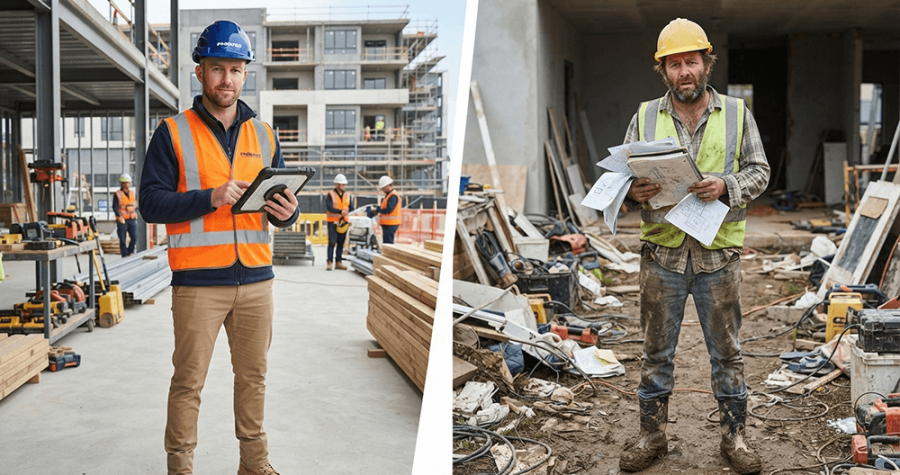
There are few things more frustrating to a construction executive than losing a good project to a contractor they know is weaker.
Maybe the competitor has less relevant experience. Maybe they have a bad reputation, are difficult to work with, or are known for sloppy, poor-quality work. Maybe everyone in the market knows they win work by buying jobs and figuring out the consequences later.
And yet they keep winning.
The instinctive explanation is usually, “They were cheaper.”
Sometimes that is true. But contractors often do not lose because their price was too high. They lose because the client did not trust them enough to pay more, did not understand why they were worth more, or did not know them well enough to consider them in the first place.
Being the better contractor is not enough. The client has to know you are better, understand why you are better, and trust that you will be better for their project.
TL;DR
If your construction company keeps losing to competitors you believe are less capable, the problem usually falls into three categories: positioning, awareness, or relationships.
Poor positioning means the client does not understand your value. Poor awareness means you were not on the client’s radar early enough, or at all. Weak relationships make a competitor feel like the safer choice, even when your capabilities are stronger.
Price is often blamed because it is easy to measure. But clients regularly pay more when they believe one contractor presents less risk, has more relevant experience, or will make the project go more smoothly.
The goal is not to win every project. It is to become the obvious choice for the right ones.
Being Better and Being Perceived as Better Are Two Different Things
Construction companies tend to believe the quality of their work should speak for itself.
It does not.
Your clients are not inside your company watching how carefully your preconstruction team reviews a set of drawings. They do not see the superintendent catch an issue before it becomes a change order. They may never know how many problems your team quietly solves before the owner hears about them.
They see the evidence you give them.
That is why a technically inferior contractor can still be a stronger competitor. They may be better positioned, more visible, more connected, or simply better at communicating what the client gets from choosing them.
The client is not choosing between what you know about your companies. They are choosing between what they perceive.
When that perception does not match reality, you have a marketing and business development problem.
Problem #1: Your Positioning and Messaging Do Not Explain Your Value
Construction messaging has a sameness problem.
Quality. Safety. Integrity. Relationships. On time. On budget. Great people. Client-focused.
Those things matter, but they are not compelling differentiators when everyone in your market says the same thing. They are table stakes.
If your website, proposal, interview, and business development conversations all sound interchangeable with your competitors, you force the client to find another way to distinguish between you.
Price is conveniently sitting right there.
Good positioning answers a more useful question: Why is this contractor particularly well suited for this type of client, project, and challenge?
That requires understanding what you genuinely do better and translating it into value from the client’s perspective.
“We have extensive healthcare experience” is not particularly strong positioning. Neither is, “We have completed five more healthcare projects than our competitor.”
Once both contractors have substantial experience, the numerical difference probably matters less than contractors think it does. The client wants to know whether you have dealt with their kind of problem.
Have you worked around active hospital operations? Can you maintain infection-control requirements? Have you phased renovations around patients and staff? Have you solved complicated shutdown and utility issues without turning them into emergencies?
Relevance beats volume.
The owner is not buying your project count. They are buying confidence that you have encountered similar challenges and know how to handle them.
Clients Are Buying a Smooth Project
Most owners are not looking for the contractor with the largest trophy case. They are looking for the least risky choice.
They want the project to go smoothly. They want fewer surprises, fewer uncomfortable phone calls, fewer disputes, fewer schedule problems, and fewer moments when someone has to explain to leadership why the project suddenly costs more.
That changes the way contractors should communicate their value.
A proposal should not merely say, “We have an experienced preconstruction team.” It should demonstrate how that experience helps uncover constructability, procurement, phasing, or budget issues early enough to do something about them.
Do not just tell clients what you have. Explain why it matters to them.
This is where thought leadership can become particularly powerful. A contractor that consistently teaches its market how to approach difficult problems demonstrates expertise long before it needs to claim that expertise in a proposal.
You are not saying, “Trust us, we are experts.” You are letting the client watch you be one.
You Probably Did Not Lose Because Your Price Was Too High
Price is one of construction’s favorite explanations for losing work because it is simple.
“We were 4% higher.”
“We were $250,000 apart.”
“They bought the job.”
Those statements may all be factually correct. They still do not necessarily explain the decision.
Clients pay premiums when they believe the additional cost reduces risk or creates greater value. So when a contractor loses with a higher number, I want to know two things.
First, did the client trust you enough to pay the premium?
Second, did you clearly explain what the premium bought them?
If neither happened, the price comparison becomes predictable.
If Contractor A costs $10 million and Contractor B costs $10.4 million, but both appear to offer essentially the same outcome, why would the owner spend the extra $400,000?
Your team may know exactly why. That does not mean the client does.
Price becomes the deciding factor when contractors fail to give clients better reasons to decide.
Sometimes the Right Answer Is to Stop Competing on Price
One specialty contractor I worked with had exactly this problem.
A competitor was aggressively chasing volume and regularly winning work at or near cost. The frustrating part was that this competitor was not known for superior quality. Quite the opposite. Their reputation included sloppy work, but they kept taking projects because they were cheap.
Trying to beat them at their own game would have been a terrible strategy. You cannot build a healthy business by out-discounting a competitor willing to hurt itself more than you are willing to hurt yourself.
So we changed the competition.
First, we focused on scopes and materials where our contractor had stronger expertise and where the low-cost competitor could not perform as effectively. We also emphasized smart value engineering, not simply cutting cost, but helping general contractors find better solutions without creating downstream problems.
Second, we attacked the relationship gap.
The contractor began having lunch with a different GC every week. These were not sales pitches disguised as lunches. They talked shop.
The trade contractor discussed challenges they had solved, asked questions, listened to what the GC was seeing in the market, and paid attention when those general contractors complained about problems created by the low-cost competitor.
Those conversations built rapport, demonstrated expertise, created market intelligence, and gave the GCs another way to understand the value of choosing the better contractor.
Meanwhile, the competitor continued chasing volume at unsustainable pricing.
Sometimes you do not need to beat a bad competitor at their game. You need to stop playing their game.
Problem #2: Your Ideal Clients Do Not Know You Exist
Before a client can decide you are the best choice, you have to become a choice.
This is where plenty of excellent contractors fail.
They do great work. Existing clients love them. Their employees are experienced. Their reputation among people who know them is solid.
Unfortunately, the next ideal client does not know any of that because they have barely heard of the company.
Contractors frequently say they want more opportunities in healthcare, higher education, industrial, data centers, or another attractive sector. Then you ask what they are doing to become visible within that market, and the answer is essentially, “We are waiting for an RFP.”
That is too late.
If your first meaningful interaction with the client happens during the procurement process, you are competing against firms that may have been building awareness and trust for years. They have met the client at conferences, shared useful insights, appeared in industry conversations, completed visible projects, and stayed in touch without constantly asking for work.
They have also made themselves easy to find.
If They Cannot Find You Online, You Do Not Exist
A developer, EPC, general contractor, architect, or owner is going to research you.
They may search your company name. They may search for contractors with experience in a particular market sector, geography, delivery method, or technical challenge. Increasingly, they may ask an AI platform for recommendations instead of starting with a traditional Google search.
That makes both SEO and GEO, or Generative Engine Optimization, part of awareness building.
SEO helps your company appear when prospects search for the work you do, the markets you serve, and the problems you solve. GEO helps make your expertise understandable and discoverable by AI-powered search and answer engines.
Neither is about stuffing “commercial construction company” into every page on your website.
The goal is to create enough clear, relevant evidence that search engines, AI platforms, and, most importantly, prospective clients can understand what you do, where you do it, who you do it for, what kinds of projects you understand, what challenges you know how to solve, and why your company deserves consideration.
If a developer, EPC, or GC cannot find you online, you do not exist to them.
That may sound harsh, but invisibility is still invisibility, even when the company behind it does exceptional work.
You Cannot Get Invited to a Pursuit You Are Invisible To
Construction companies spend enormous energy improving proposals after they are invited to compete.
That is important.
But the first competition happened before the proposal team ever knew the project existed.
Who got invited?
If an owner is selecting five contractors from a list of 20 potential firms, the other 15 already lost.
Awareness matters because buyers cannot shortlist contractors who do not come to mind, or contractors they cannot find when they go looking.
That does not mean your company needs mass-market fame. A commercial contractor does not need every resident in its city to recognize its name.
You need relevant awareness.
The right owners, developers, EPCs, architects, consultants, general contractors, referral partners, and industry influencers should know who you are and what you are particularly good at doing.
That awareness can come from thought leadership, SEO, GEO, PR, social media, project signage, strategic industry involvement, speaking, useful email communication, and good old-fashioned business development.
Visibility for the sake of visibility is vanity. Visibility among the people you actually want to work with is strategy.
Problem #3: The Other Contractor Has the Stronger Relationship
Construction is a relationship business because construction is a risk business.
Clients make decisions involving millions of dollars, aggressive schedules, public visibility, complicated stakeholders, and consequences that can follow them for years.
Trust matters. So does familiarity.
An owner may know your competitor is not perfect. They may even complain about them. But they also know what working with that contractor feels like.
There is an old human tendency at work here: the pain we know often feels safer than the pain of change.
Switching contractors introduces uncertainty. Will the new superintendent work well with our team? Will their billing process be a headache? Will they communicate when things go sideways? Will they understand our culture? Will they actually perform the way their proposal claims?
The incumbent may have weaknesses, but those weaknesses are familiar. Your job is to reduce the perceived risk of choosing someone new.
Relationships Are Not Built With an Annual Golf Tournament
Strong construction relationships come from quality face time and consistent, useful contact.
That could mean lunch, a jobsite visit, an industry event, a useful article, a phone call about something affecting their business, a thoughtful introduction, or a project debrief. The common denominator is relevance.
A weekly lunch with a different GC worked for that specialty contractor because the meetings were not built around, “What can you bid for us?”
They were built around talking shop.
That gives you opportunities to demonstrate expertise without constantly claiming expertise. You learn what clients are struggling with. You hear what competitors are doing well and badly. You understand upcoming needs before they become formal opportunities.
Eventually, you are no longer the company asking to be considered. You are one of the people the client calls when they are thinking through a problem.
That is a much stronger position.
Build Zipper Relationships, Not One-Thread Relationships
Construction companies also need to be careful when the entire client relationship belongs to one person.
Maybe the owner knows your president. The project executive knows one decision-maker. Or a business developer has carried the account for 15 years.
That is useful, but fragile.
Strong client relationships should zip the two organizations together. Your executives know theirs. Your project leaders know their operational people. Your preconstruction team has credibility with their technical decision-makers. Marketing keeps the company visible between active projects. Different people have useful, authentic relationships across both organizations.
That creates resilience and makes it much harder for a competitor to displace your company by developing one strong relationship with one individual.
Then You Still Have to Win the Interview
Positioning, awareness, and relationships help get you to the shortlist. You can still blow it.
Interviews are crucial because the owner is no longer evaluating only the company’s qualifications. They are evaluating the human beings who may spend the next two years sitting across the table from them.
Unfortunately, construction interviews are often filled with very smart people who are not particularly good at communicating why they are the safest choice.
They recite résumés. They describe processes. They answer the technical question correctly while missing the concern behind it. They spend too much time talking about themselves and not enough demonstrating that they understand the client’s situation.
Relevant experience matters here again.
Do not simply show that your superintendent completed 17 similar projects. Have that superintendent explain what they learned from problems the client is likely to face and how they would approach those challenges.
Confidence does not come from the résumé alone. It comes from hearing someone think.
Stop Assuming the Buyer Made the Wrong Decision
This may be the hardest part.
You may be right that the competitor who won is objectively worse at construction. They may have less experience, their work may be sloppier, their culture may be rougher, or their reputation may eventually catch up with them.
But if they were better known, better positioned, better connected, or better at explaining their value, they were not inferior at winning the work.
That is an important distinction.
Instead of asking, “How could they possibly pick that contractor over us?” ask, “What did the client believe about them that they did not believe about us?”
Now you have something useful to work with.
Maybe the buyer understood their value better. Maybe your company was not visible early enough. Maybe the competitor had stronger relationships. Maybe the client could not see enough difference to justify your price. Maybe the incumbent simply felt less risky.
Those are problems you can solve.
The Best Contractor Does Not Automatically Win
Technical excellence matters. Quality matters. Good people matter. Safety matters. Relevant experience matters.
But markets do not reward capabilities they cannot see.
To consistently win the right construction work, you need all three: positioning tells clients why you are the better choice, awareness makes sure the right clients know you exist, and relationships give them confidence that choosing you is worth the risk.
Then pursuit strategy has to turn those advantages into a win.
If you do those things well, you will not win every project, and you should not.
Some competitors will buy work. Some clients will make decisions almost entirely on price. Some projects were never a good fit in the first place.
Let someone else have those.
The goal is not to convince every client that you are the cheapest contractor. It is to make the right clients understand why you are worth more.
- ‹ Previous
- 1
- 2