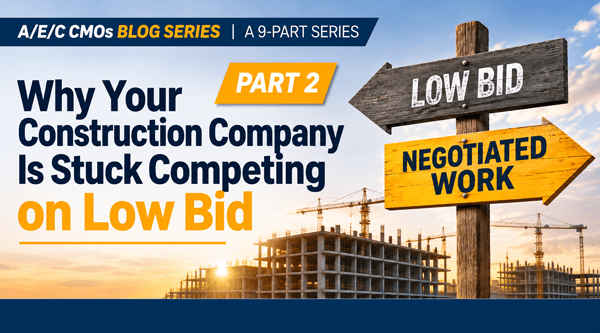
Why Your Construction Company Is Stuck Competing on Low Bid
Most construction companies don’t start with a long list of loyal clients willing to negotiate their next project. They start by bidding work, building relationships, proving themselves, and hoping they can deliver projects profitably enough to keep growing.
For a young contractor with limited overhead, competitive bidding can be a practical way to get established. You don’t necessarily need a sophisticated business development department, years of client relationships, or a recognized brand. You need the right qualifications, the ability to estimate and deliver the work, and a competitive price.
For decades, that was how much of the construction industry operated, especially on public projects. Owners hired designers, completed the plans and specifications, and awarded construction contracts to the lowest responsible bidder.
There’s nothing inherently wrong with that approach. In fact, competitive bidding can create excellent opportunities for contractors that understand their costs, manage risk, and execute projects efficiently.
The problem comes when a contractor grows into a $50 million, $100 million, or $250 million company but continues approaching the market like a startup trying to win its first project.
The company has grown up, but its approach to winning work hasn’t.
The Construction Industry Has Evolved. Has Your Business?
Traditional design-bid-build still has an important place in construction, but owners have increasingly embraced delivery methods that allow contractors to participate earlier and contribute more than a competitive price.
According to FMI Consulting’s 2025 Design-Build Utilization Study, design-build represented an estimated 44% of construction spending during 2019–2023 in the market segments studied. Another 37% involved alternative delivery methods, including construction management at risk (CMAR), construction manager/general contractor (CM/GC), engineering-procurement-construction (EPC), and integrated project delivery (IPD).
FMI forecasts design-build’s share rising to 47% during 2024–2028, with other alternative methods accounting for another 42%. These figures represent estimated construction spending in the assessed market segments, not the percentage of all construction projects.
This doesn’t mean every design-build or CMAR project is negotiated. Many involve competitive best-value selection, qualifications evaluations, or other formal procurement requirements.
However, it does demonstrate an important change. In many markets, owners have options that allow them to consider a contractor’s expertise, experience, approach, and ability to create value before construction begins.
Contractors that only know how to compete on price are limiting the opportunities they can realistically pursue.
The Biggest Obstacle Is Often the Contractor’s Mindset
When I talk with contractors about moving toward more negotiated work, the initial discussion usually centers on business development. They believe they need better relationships, more meetings with owners, or someone who can open doors.
Those things certainly help, but the bigger challenge is often how leadership thinks about winning work.
I’ve encountered contractors that obsess over lowering their prices without being able to explain why their services should be worth more. Their proposals describe what they’re going to build, but not the expertise, efficiencies, or risk reduction they bring to the project.
Some genuinely believe low-bid competition is the fairest way to award construction work. Others lack confidence that clients will select them for anything beyond price. They may have spent decades competing successfully through estimating, so it’s difficult to imagine a different approach.
Unfortunately, that mindset can influence decisions throughout the company.
Estimating becomes focused on reducing costs rather than evaluating alternatives that create value. Subcontractor selection emphasizes the lowest number instead of the best combination of price, reliability, quality, and expertise. Business development becomes primarily about finding the next project to bid rather than understanding what clients need.
Eventually, the contractor becomes exceptionally good at competing on price without becoming particularly good at explaining why someone should prefer them.
A Million Dollars Cheaper and Still Lost the Project
More than a decade ago, I helped a civil construction contractor debrief its first public best-value proposal. It was approximately an $8 million project, and the contractor’s leadership couldn’t understand why they lost.
Their price was approximately $1 million less than the winning proposal. They were also roughly three times the size of the joint venture that won the project.
From their perspective, the decision made no sense. They were bigger, had significantly more resources, and were substantially cheaper.
But the public agency wasn’t selecting a contractor based solely on price.
I actually liked the agency’s evaluation process. The selection committee scored the technical proposals without knowing the contractors’ prices. The agency then divided each contractor’s proposed price by its technical score to determine the evaluated result.
My client scored 30 points lower than the winning team.
When we reviewed their proposal, the reason became clearer. They hadn’t meaningfully differentiated themselves, demonstrated their advantages, or explained why they would deliver greater value. Worse, they had skipped entire sections of the proposal, including questions specifically designed to evaluate that value.
They approached a best-value procurement as though submitting a low price would be enough.
Had they answered the questions thoroughly and narrowed the technical-score gap, their substantial price advantage might have made the difference. We can’t know whether they would have won, but they had failed to give the evaluation committee a compelling reason to choose them.
The lesson wasn’t that they needed a better proposal writer. They needed to understand how their prospective client defined value and communicate how their company could deliver it.
Being the cheapest contractor doesn’t automatically make you the best value. And being the largest doesn’t automatically make you the most qualified.
Becoming a Preferred Contractor Means Changing How You Operate
Contractors sometimes approach negotiated work as though it’s simply a different business development strategy. Hire someone with owner relationships, make the right connections, and opportunities will follow.
But becoming a preferred contractor requires more than changing how you sell. It requires evolving what you offer and how clients experience working with your company.
That might mean developing stronger preconstruction capabilities, offering constructability reviews, helping owners evaluate materials and systems, or identifying value engineering opportunities before designs are finalized.
For some contractors, it could mean incorporating 4D modeling to demonstrate construction sequencing, using virtual reality to help clients visualize projects, or introducing prefabrication strategies that reduce schedule disruptions.
Technology isn’t inherently valuable because it’s impressive. It becomes valuable when it helps owners make better decisions, reduce risk, improve outcomes, or solve challenges they haven’t fully considered.
The same principle applies to your subcontractors. Selecting the cheapest subcontractor might lower your proposed construction cost, but an unreliable or inexperienced trade partner can create schedule delays, quality problems, and expensive rework. A more capable subcontractor may also identify constructability improvements and cost-saving alternatives that the cheapest bidder never considered.
If the only value you can explain is your cost to build plus a markup, you haven’t given a client much reason to negotiate with you.
Start Treating Every Client Like a Preferred Client
One of the best heavy civil contractors I’ve worked with demonstrated this philosophy through its company culture.
They performed substantial competitively bid public work, but leadership insisted those projects receive the same customer experience as their private work.
Their teams communicated proactively, maintained friendly and collaborative relationships, and approached challenges as though they were on the client’s team rather than on the opposite side of the negotiating table.
Instead of waiting for instructions and treating every problem as a potential dispute, they looked for opportunities to help clients solve problems and improve outcomes.
The company established one standard for how employees treated clients, regardless of the procurement method.
That approach also contributed to improved employee retention. Employees weren’t expected to operate with two different attitudes depending on whether the job came from competitive bidding or a longstanding client relationship. They could take pride in consistently delivering a better experience.
This illustrates something important about the transition toward negotiated work.
You don’t have to wait until you win a negotiated project to start behaving like a preferred contractor.
Better Relationships Begin With Understanding the Client
When contractors decide they want more negotiated work, I recommend starting with clients who already know and trust them.
These relationships give contractors an opportunity to have conversations that would be more difficult with unfamiliar prospects.
Ask about the client’s upcoming projects, their challenges with past construction experiences, and where they believe contractors could provide more value. Learn what causes their projects to exceed budgets, miss schedules, or create unnecessary headaches.
Sometimes the most valuable market research is simply talking with your clients and genuinely listening to their answers.
You may discover opportunities to provide earlier budgeting assistance, participate in design decisions, improve communication with stakeholders, or address recurring project challenges.
Then explore whether the client has opportunities for negotiated, best-value, design-build, or other collaborative procurement approaches.
Public agencies deserve special consideration. Some have expanded their use of alternative delivery methods, while others operate under procurement laws that require competitive low-bid selection for particular projects. Contractors must understand the applicable rules rather than assuming a relationship can change how a public contract is awarded.
Even when a client must use low-bid procurement, understanding its challenges can help you become a better partner and improve your ability to compete on future opportunities.
A Simple Three-Question Go/No-Go Test
One exercise I’ve used with contractors is a simple Go/No-Go assessment built around three questions:
- Do we have relevant project experience? Have we successfully completed similar work, and can we demonstrate that experience in a way that’s meaningful to this client?
- Does the client know our capabilities? Do the decision-makers understand our expertise, resources, strengths, and how we differ from other contractors?
- Do we understand the client’s real challenges and pain points? Do we know what matters beyond the plans, specifications, and construction budget?
These questions don’t replace a comprehensive Go/No-Go evaluation that considers profitability, capacity, risk, and other factors. They help reveal whether the contractor has the experience, relationships, and client understanding needed to compete on value.
If you have relevant experience but the client doesn’t know your capabilities, you have a positioning and relationship-building challenge.
If the client knows you but you don’t understand its real problems, you have more discovery to do.
And if you don’t have relevant experience, you need to determine whether the opportunity fits your growth strategy or whether you’re simply chasing revenue.
Notice that none of these questions asks whether you’re willing to offer the lowest price.
Evolve One Project at a Time
Transitioning toward negotiated work doesn’t mean abandoning competitive bidding, and it certainly doesn’t happen overnight.
Contractors have employees to support, equipment to utilize, and backlog to maintain. Making a sudden change to their pursuit strategy could create unnecessary financial risk.
Start with one existing client relationship. Find one upcoming project where you can demonstrate more value. Explore one additional service that solves a meaningful client problem. Improve one part of the client experience that distinguishes your company.
Then build on what you learn.
Negotiated work can create opportunities for stronger margins because contractors have more room to demonstrate differentiation, collaborate earlier, and compete on value rather than price alone. But negotiation doesn’t guarantee profitability. Owners still have budgets, financing constraints, and projects that may be delayed or canceled if the economics don’t work.
The objective isn’t to eliminate competitive bids or maximize the percentage of negotiated contracts. It’s to build a healthier mix of more profitable, predictable, better-fit work.
Your company shouldn’t be defined by how cheaply it can build a project. It should be known for the value it creates for the clients it serves.
That transition starts with how leadership thinks about growth, continues through how the company operates, and becomes visible in the relationships and opportunities it earns.
Next in the Series: Stop Bidding Everything: Find the Construction Work Worth Winning
More bids don’t necessarily mean more wins or better profits. In Part 3, we’ll examine the hidden costs of chasing every opportunity, how better Go/No-Go decisions can improve your hit rate, and why sometimes the smartest business decision is to let a competitor win the project.
 By perryn@aeccmos.com
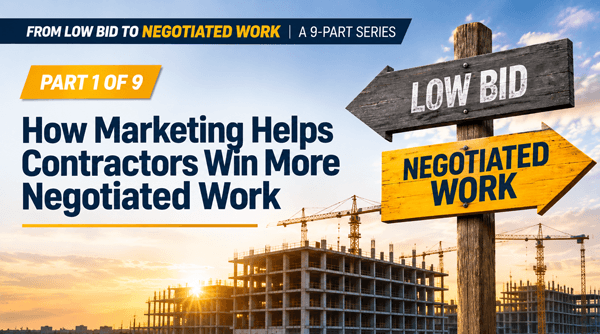
How Marketing Helps Contractors Win More Negotiated Work
When a contractor tells me they want more negotiated work, there is usually another problem hiding underneath that goal. Margins are getting squeezed. They’re losing projects they believe they should win. They’re tired of competing against a dozen contractors on price, spending time estimating jobs they will never get, and running faster for less profit.
They want off the hamster wheel, and the instinct is often to put the responsibility on business development. Build more relationships. Make more calls. Attend more events. Get in front of more owners.
Those things matter, but negotiated work is rarely created by business development alone. It starts with building preference before the project exists, which is where marketing becomes much more important than lead generation and proposals.
Winning Negotiated Work Starts With a Mindset Shift
Contractors that consistently earn negotiated opportunities tend to think differently about the market. They become pickier about the clients and projects they pursue, make clearer choices about where they are particularly valuable, and demonstrate expertise rather than acting like order takers.
They are also willing to tell buyers how they would solve a problem instead of simply waiting for plans and specifications. Marketing helps translate that mindset into the market.
I’ve seen contractors use stronger positioning, improved brand identities, clearer messaging, thought leadership, differentiation, and account-based marketing to make themselves more relevant to the clients they actually want. None of those tactics magically creates negotiated work on its own, but together they change what a buyer knows and believes about the contractor before the buying decision begins.
Marketing Should Start Before Anyone Knows About the Project
The highest-leverage time to market to a future client is often before anyone knows there is a project. By the time an opportunity is publicly bid, much of the advantage is already gone.
A future client may have been reading your insights for a year. They might follow one of your executives on LinkedIn, recognize your trucks around town, have seen projects you’ve completed, heard your name from peers, and regularly received useful information from your company. Then a project begins taking shape, and your firm is already familiar.
That’s the opportunity marketing should help create. Its job is not simply to generate a form submission at the moment someone needs a contractor. Marketing should help attract the right clients, nurture them over time, and position your people as subject-matter experts long before the project reaches procurement.
People Buy From People. Marketing Helps Them Choose Which People.
Construction is still a relationship business, and I don’t expect that to change. But “people buy from people” is sometimes used as an excuse for contractors to underinvest in marketing because it assumes the relationship begins when the salesperson shakes someone’s hand.
It doesn’t. Prospective clients research contractors constantly, and I’ve seen that throughout my career in construction marketing. They look at your website, search your executives, review projects, look at social media, ask peers about you, and evaluate whether your company appears to understand their type of work.
Marketing determines much of what they find. It doesn’t replace the human relationship, but it can attract the right clients, nurture those clients, establish your people as subject-matter experts, and give the relationship somewhere stronger to start.
Reputation Does Not Automatically Travel
This becomes painfully obvious when a successful contractor enters a new geography or market sector. You may have a phenomenal reputation in your hometown. Your phone rings because owners have known your company for 30 years, your superintendent has built five projects for the same client, and your CEO knows half the market personally.
Drive three hours away, and none of that necessarily matters. Without a strong portfolio, recognizable brand, clear differentiation, and visible expertise, you can be dead on arrival in a new market.
That’s why expansion requires more than opening an office and hiring a business developer. Marketing has to transfer the company’s credibility into a form that strangers can understand. From the start, buyers need to see what you’re good at, where you’ve done it, what problems you’ve solved, and why you’re worth considering.
Your Project Pages Are Probably Showing the Wrong Things
Most construction project profiles focus heavily on finished-project statistics: square footage, contract value, location, architect, completion date, and then a collection of beautiful professional photographs.
Those things provide useful proof, but they’re usually not what makes the story persuasive. A stronger project profile answers a different question: What made the project difficult, and what did your team do about it?
Maybe the client had to keep an occupied facility operational throughout construction. Perhaps the schedule was compressed, material availability threatened the critical path, the site was constrained, safety risks were unusually high, or existing conditions were different than expected. Those are the details that reveal how your team actually creates value.
Progress photos can sometimes be more persuasive than polished final photography because they reveal phasing, coordination, logistics, temporary protection, sequencing, prefabrication, problem-solving, and the messy reality behind the finished project.
The completed building proves you built it. The story of how you built it demonstrates why someone should trust you with the next one.
Thought Leadership Should Demonstrate How You Solve Problems
Construction thought leadership does not have to mean publishing grand predictions about the future of the industry. Some of the best content simply answers practical questions clients are already wrestling with and demonstrates how your people think.
How can an owner protect the schedule when procurement lead times are increasing? How should construction be phased inside an occupied facility? What design decisions create unnecessary costs? What safety risks should an industrial owner consider before work begins? How can preconstruction improve budget certainty?
These topics demonstrate expertise in the things buyers care about most, including budget, schedule, safety, risk, and communication. Occupied construction is a particularly strong example because a contractor can demonstrate expertise around logistics, employee or customer safety, noise, dust, access, phasing, shutdown planning, and communication.
That is much more compelling than publishing another article saying your company is committed to “quality, safety, and integrity.” Show the buyer how you think instead.
Business Development and Marketing Need the Same Target
Marketing cannot build preference effectively if marketing and business development are pursuing different companies. At minimum, the two functions should share the same ideal client profile, target account list, understanding of the brand personality and positioning, CRM, and approach to attribution.
If business development has 50 dream accounts, marketing should know who they are. Those accounts should influence the content you produce, projects you feature, events you attend, campaigns you run, leaders you promote, and expertise you develop publicly.
This is where account-based marketing can be particularly useful for contractors. Rather than asking marketing to produce a large number of anonymous “leads,” marketing and business development work together to increase familiarity, relevance, and engagement inside a defined group of companies the contractor actually wants to work with.
Do Not Forget the Clients You Already Have
The other high-leverage opportunity is client retention. Contractors can spend enormous amounts of energy winning a client and remarkably little staying relevant after the project ends, which is a mistake if the goal is more negotiated work.
Past clients already know whether you can perform, so the trust hurdle is much lower. Marketing can keep the relationship warm between projects through useful content, project updates, executive communication, newsletters, client events, and expertise that continues helping clients make better decisions.
That matters when the next project arrives 18 months later. Being remembered is part of being invited, and client retention should be treated as part of the negotiated-work strategy rather than something marketing stops thinking about after the ribbon cutting.
How Do You Measure Whether This Is Working?
Marketing’s contribution to negotiated work will never fit neatly into a last-click attribution report. A $50 million opportunity may begin with a relationship developed over several years and involve a referral, six executive conversations, a dozen pieces of content, three completed projects, a conference, and repeated visits to your website.
Assigning all of that revenue to the last website visit would be ridiculous. Instead, I would watch a combination of business and marketing indicators, including inbound inquiries from the types of clients you actually want, the percentage of work that is negotiated versus hard bid, engagement from target accounts, repeat and referral opportunities, and whether business development is becoming easier.
That last measure is underrated. Ask the people responsible for growth whether prospects are more familiar with the company when they walk into the room, whether clients understand the firm’s value faster, whether the right companies are reaching out, and whether the team is getting invited into conversations earlier.
Those are meaningful signs that preference is growing.
The Goal Isn’t More Leads. It’s More Preference.
Construction marketing often gets reduced to websites, social media, proposals, and lead generation, but those are outputs. The larger job is to help the market understand why your company is worth choosing.
That means attracting the right clients, nurturing them before they have an immediate need, making your expertise visible, equipping business development with a stronger story, and giving current clients reasons to continue seeing value in the relationship.
If you’re tired of competing for low-margin work after the project has already hit the street, don’t simply ask how marketing can generate more leads. Ask how you can become the contractor the client already wants before the project ever goes out to bid.
That is where negotiated work begins.
Next in the Series: Why Your Construction Company Is Stuck Competing on Low Bid
Most contractors start by competing on price, but that approach can eventually limit their growth. In Part 2, we’ll explore why contractors become dependent on low-bid work, the mindset that keeps them there, and what it takes to evolve into a preferred contractor.

Fractional CMO vs. Marketing Consultant: What’s the Difference?
I became a fractional CMO because I hated being a marketing consultant. Not because I disliked the work. I enjoyed digging into contractors’ brands, interviewing clients, developing positioning, helping launch new services, improving CRM systems, and planning major website changes. The problem was what happened after I delivered the recommendations.
Too often, not enough happened.
Years ago, I worked with a general contractor that was attracting a lot of retail stores, distribution centers, and strip-center work. They were good at it, but the margins were tight and the schedules were brutal. I recommended positioning the company around quality and speed, playing off the old construction adage: fast, good, cheap. Pick two. If this contractor could own fast and good, price would become a less important part of the buying decision.
Leadership loved the idea. They even tested it with several clients, who loved it too. But they never implemented it, and nearly a decade later, they still hadn’t.
That experience was not unusual, and it eventually changed the way I wanted to work with clients.
The Problem Wasn’t the Strategy. It Was Ownership.
I originally tried solving the implementation problem by extending my consulting engagements. Instead of developing a strategy and leaving, I added three-month retainers with biweekly check-ins. I would hold everyone accountable, carry part of the implementation load, and keep projects moving.
It worked while I was there, but when the engagement ended, nobody truly took ownership and momentum slowed. So I tried six months and ran into the same problem. Eventually, I realized I wasn’t trying to become a better consultant. I was trying to fill a leadership void.
That’s the fundamental difference between a marketing consultant and a fractional CMO. A consultant primarily advises the company on what to do. A fractional CMO becomes part of the company’s leadership structure and helps make sure it gets done.
Fractional Does Not Mean Part-Time Consultant
One reason the distinction is confusing is that the term “fractional” is still unfamiliar to many construction leaders. Some assume a fractional CMO is simply a consultant with a monthly retainer. Others assume that if they need CMO-level leadership, they should hire someone full-time.
Neither is necessarily true. Fractional describes how much of an executive you employ, not a lighter version of consulting.
A true fractional CMO should be embedded enough in the business to lead. For some of my clients, that means participating in EOS Level 10 meetings and annual planning, working alongside the company’s EOS or strategic-planning facilitator, advising the CEO, leading sales and marketing meetings, coordinating with the head of sales, managing major initiatives, and directing the people responsible for implementation.
That is very different from handing leadership a list of recommendations once a month. At a minimum, I believe a fractional CMO should have a strong ear with the CEO, interact regularly with other key leaders, and usually meet with company leadership at least every other week. If you are never close enough to the business to understand what is changing, it is difficult to function as an executive.
Fractional CMO vs. Consultant vs. Interim CMO vs. Advisor
Fractionals United uses a helpful framework for distinguishing fractional executives from consultants, interim executives, and advisors. I would add some nuance when applying that framework to construction marketing because there are fewer absolutes in practice.
| Fractional CMO | Marketing Consultant | Interim CMO | Advisor | |
|---|---|---|---|---|
| Primary role | Lead marketing | Solve or advise on a defined challenge | Temporarily fill a vacant executive role | Provide perspective and counsel |
| Embedded with team | Yes | Usually limited | Yes | Usually no |
| Leads people/vendors | Often | Usually no | Yes | No |
| Owns implementation | Yes | Sometimes assists | Yes | No |
| Works with CEO/leadership | Regularly | As needed | Regularly | Periodically |
| Typical commitment | Part-time | Project-based | Usually full-time | Light-touch |
| Typical duration | Often 3–24 months | Defined project | Until permanent hire | Ongoing or as needed |
Framework adapted from Fractionals United.
The key distinction is not simply the number of hours someone works. It is the role that person occupies inside the organization and the level of ownership they have for what happens next.
Consultants Are Valuable When You Already Have an Owner
Consulting is not inferior to fractional leadership. It solves a different problem and can be exactly what a construction company needs when there is already a strong internal person capable of owning the work.
A contractor might have an experienced marketing director who can implement a strategy but does not have the time to develop it. The director may be excellent at execution but have never led a positioning exercise, market research initiative, or major rebrand. Leadership might simply want an experienced second opinion before committing significant time or money to a decision.
Those are good consulting engagements because someone internally has the skills, authority, and capacity to carry the work forward after the consultant leaves. The warning sign is when everyone agrees with the strategy, but nobody inside the company can truly own it.
A Fractional CMO Has to Live With the Consequences
One thing I prefer about fractional leadership is that I cannot simply recommend an idea and disappear. I have to live with what happens next, which means I also have the ability to adjust when the market tells us something different than we expected.
I once worked with a general contractor that had a strong industrial construction portfolio. We launched a new website around that expertise, but the early search traffic coming into the site wasn’t particularly relevant. We could have waited six months and blamed SEO, but instead I changed the page titles and content to use the language buyers were actually searching for, including industrial building contractor.
Within days, the traffic became much more relevant. We then created additional landing pages for specific building types, including blast-resistant buildings. The original strategy was directionally correct, but implementation gave us new information and allowed us to improve it.
That is normal. Marketing strategies are based on the best information available at the time, but markets respond differently than expected. Sales teams learn something. Campaigns underperform. Competitors change direction. Leadership pursues opportunities that did not exist six months earlier.
A fractional CMO is still there when those things happen, with the responsibility and authority to adjust.
Implementation Changes the Relationship
Today, I do not only develop strategies for my fractional clients. My team and I can help implement them, whether that means managing a website project, coordinating a brand change, leading a positioning initiative, directing outside agencies, or keeping an internal marketing team moving.
Regular meetings create accountability, but accountability alone isn’t enough. Someone has to carry part of the load, remove roadblocks, make decisions, and maintain momentum.
That ongoing involvement also creates a deeper relationship with the company. Over time, I learn how the CEO makes decisions, where the sales team struggles, what operations can realistically support, which leaders move quickly, and where an initiative is likely to get stuck. That context makes the next marketing decision better because it is informed by how the business actually operates, not just what appears in a strategy document.
Why Not Just Hire a Full-Time CMO?
Sometimes you should. A contractor with the size, complexity, marketing team, and workload to support a full-time executive may benefit from having that person entirely inside the organization.
But many growing construction companies do not need 40-plus hours a week of executive-level marketing strategy and leadership. If I worked internally for many of the contractors I serve, I suspect only 10 to 15 hours of my week would actually be spent on high-level marketing work. The rest would inevitably get absorbed by internal meetings, administrative responsibilities, and initiatives that have little to do with marketing.
A fractional model allows the company to buy the executive-level capability it actually needs without creating a full-time executive position simply to get access to that level of experience. There is no PTO to cover, and the relationship can also provide more continuity than many traditional marketing leadership roles.
Fractional does not mean forever, either. An engagement might last three months, two years, or somewhere in between depending on the company and the business problem being addressed.
When Does a Construction Company Need a Fractional CMO?
The strongest signal is usually a marketing leadership void. You may have capable marketing people but nobody connecting their work to company strategy, or the business may be approaching an initiative that requires more experienced leadership than the current team has handled before.
A rebrand, acquisition, geographic expansion, new service line, leadership transition, or major growth push can all create that need. Sometimes the company has simply outgrown the marketing structure that got it this far.
A consultant can help you solve a defined marketing problem. A fractional CMO can help you lead marketing through a business problem.
That distinction matters because many of the issues contractors call marketing problems aren’t really marketing problems at all. They’re growth, positioning, leadership, sales, market, or organizational challenges that happen to show up in marketing, and those usually require more than recommendations.
Need marketing leadership without hiring another full-time executive?
A/E/C CMOs provides fractional marketing leadership specifically for construction companies, helping contractors connect marketing strategy to growth, sales, brand, and implementation.
Stop Marketing Your Services. Market the Problems You Solve.
Most construction company marketing starts with services: general contracting, preconstruction, design-build, roofing, electrical, civil construction, mechanical, service and maintenance.
Those pages matter because buyers need to understand what you do, and search engines and AI platforms need clear information about your capabilities. The mistake is building the entire marketing strategy around those service lines.
Buyers rarely begin their journey thinking about your organizational chart or service menu. They usually begin because something changed, something hurts, or something is not working the way it should. That problem is what creates the opportunity.
Buyers Usually Start With the Problem
Think about the way an owner experiences the beginning of a project.
A manufacturer realizes it does not have enough production capacity. A hospital needs to renovate a department without disrupting patient care. A developer discovers that an existing building requires substantial exterior repairs before it can support the next phase of the investment.
The buyer may not yet know whether they need preconstruction, design-build, an electrical contractor, a civil specialist, or another specific service. They just know they have a problem that needs to be solved.
That difference matters because the company that helps the buyer understand the problem early has an opportunity to influence how the solution is defined. The company that waits until the buyer searches for a specific service may arrive after the buyer has already decided what they need, assembled a list of comparable vendors, and started comparing prices.
That is when services become commodities.
Understand the Trigger, Problem, and Pain
I like separating the buying journey into three related ideas: trigger, problem, and pain.
The trigger is what changed. The problem is what now needs to be solved. The pain is why the problem matters enough to act.
For example, imagine a manufacturer approves the addition of a new production line. The trigger is the approved production expansion. The problem is that the existing facility does not have the power, space, utilities, or layout required to support the new equipment. The pain may be the risk of missing production targets, delaying revenue, disrupting current operations, or explaining to leadership why expensive new equipment is sitting idle.
The contractor who understands all three is in a much stronger position than the contractor simply advertising “industrial construction services.”
This is also why buyer interviews and customer research matter. Clients often describe their problems differently than contractors expect, and those words can reveal better ways to position services, develop content, and structure campaigns.
One Heavy Civil Contractor Was Really Selling Better Farms
I saw this clearly with a heavy civil contractor that performed subsurface drainage work for agricultural clients.
The easy way to market that service was to describe the equipment, installation process, drainage systems, and technical capabilities. All of that mattered, but it was not why a farmer cared.
The farmer cared because poorly drained land could reduce crop yields and limit the long-term value of the property. The contractor was not simply installing subsurface drainage. They were helping farmers improve the productivity and value of their land.
That creates a very different marketing conversation.
The service still needs to be explained, but it is explained in the context of the result the client actually wants. The marketing becomes about yield, land performance, water management, and asset value rather than only the equipment and installation process.
That is what problem-led marketing looks like.
I Have Shifted Content Strategies This Way Repeatedly
I have made this change in several content strategies over the years.
One technology company I worked with had organized most of its content around its service lines. The result was predictable: each service needed a certain amount of content, so the calendar became a rotation of topics that were important internally but not necessarily compelling to buyers.
We shifted the strategy toward the problems executives were actually trying to solve. The services did not disappear. They became the solutions underneath a more useful set of conversations.
I increasingly build content pillars this way because it gives marketing more room to demonstrate expertise. Instead of repeatedly explaining what the company sells, the content explores why the buyer needs help, what decisions they face, what mistakes create risk, and what good outcomes look like.
That is far more useful to someone who is not yet ready to buy.
This Connects Directly to Buying Triggers
This is also why buying triggers should inform content strategy.
Most potential clients are not actively buying at any given moment. They may fit your ideal customer profile perfectly and still have no immediate reason to engage.
Then something changes. A production line gets approved. Funding becomes available. A building is acquired. A storm causes damage. A facility reaches capacity. A major maintenance shutdown is scheduled. Leadership decides to enter a new market.
The trigger creates urgency, and problem-focused content allows you to become useful before the buyer has fully defined the solution.
A healthcare system planning an occupied renovation may search for information about minimizing disruption long before it searches for “healthcare general contractor.” An industrial owner may research how to expand production capacity without shutting down operations before deciding what contractor or delivery model is needed.
If your content helps them at that stage, you have entered the conversation before the service becomes a line item. That is a strategically better place to be.
Service Pages Still Matter
Problem-led marketing does not mean removing your service pages.
In most cases, I still want clear pages explaining what the company does. Buyers need to confirm capabilities, and those pages remain important for search, AI discovery, navigation, and due diligence.
The balance depends on the market and the maturity of the company’s thought leadership. A contractor just beginning to improve its digital presence may need strong service pages first, while a more mature company may already have that foundation and should invest much more heavily in content around buyer pains, challenges, triggers, and industry issues.
Even service pages themselves can become more buyer-focused. Instead of beginning with a list of capabilities, explain the problems the service solves. Incorporate relevant projects, FAQs, thought leadership, and related resources.
Then use the content ecosystem to go deeper into the buyer’s situation and link back to the appropriate service when the reader is ready.
A Better Industrial Content Strategy
Imagine an industrial contractor wants to grow its manufacturing practice.
A service-led content strategy might rotate through general contracting, preconstruction, safety, electrical, scheduling, and design-build. Those topics are not wrong, but they are inward-facing.
A problem-led strategy would start with what manufacturers are dealing with. How do you add production capacity without disrupting current operations? What happens when equipment arrives before the facility is ready? How should owners plan construction around a shutdown? What facility changes should be evaluated before expensive equipment is ordered?
You could also address utility constraints, schedule risk, construction in active plants, and the sequencing decisions that create production disruptions.
Each topic can naturally introduce the contractor’s relevant services, but the buyer does not need to know which service category applies before the content becomes useful. The contractor is meeting them where they are.
Healthcare Works the Same Way
Healthcare provides another good example because buyers often care deeply about the consequences of construction, not construction itself.
A hospital executive may care about maintaining patient access, controlling noise and dust, protecting infection-control requirements, keeping departments operational, and communicating around disruptions. Those pains create the context.
The contractor’s expertise in phasing, preconstruction, infection control, logistics, scheduling, and occupied renovation becomes valuable because it solves those problems.
If marketing starts only with “Healthcare Construction Services,” the company risks sounding like every other qualified healthcare contractor. If it demonstrates a deep understanding of the operational challenges healthcare leaders face, the conversation changes.
The company is no longer merely claiming experience. It is demonstrating it.
Problems Produce Better Thought Leadership
This approach also makes content substantially better.
“Five Benefits of Design-Build” is easy to create, but it is also easy for a buyer to ignore. “Why Owners Lose Six Months Before a Design-Build Project Even Starts” creates a more useful conversation.
“Our Preconstruction Services” tells the market what you sell. “The Three Decisions Owners Need to Make Before They Can Trust the Budget” shows how your team thinks.
This matters because subject matter experts are usually much better when asked about problems than when asked to talk about services. Ask a project executive to explain “our construction management services,” and you will probably get marketing language.
Ask them why occupied renovations go wrong, and you may get 30 years of hard-earned experience.
That experience is what creates authority.
Buyer Research Should Shape the Content
Marketers should not guess at every pain point.
Talk to customers. Interview business developers, estimators, project executives, superintendents, and other people close to the client. Review lost opportunities and listen to questions that appear repeatedly during pursuits and project kickoff meetings.
Ask clients what was happening inside their organization before they decided to start the project. What had changed? What were they worried about? What alternatives did they consider? What happened if they did nothing? What made the issue urgent?
Those answers are often much more valuable than another internal brainstorming session about blog topics because they give marketers the language clients actually use.
AI Search Makes This Even More Important
AI search is accelerating this shift from service searches toward problem searches.
Traditional Google behavior encouraged short phrases such as “industrial contractor Houston” or “healthcare GC Dallas.” Those searches are not disappearing, but buyers can now ask much longer, more specific questions.
They can describe a facility, a challenge, a location, a schedule constraint, and the characteristics they want in a contractor all at once. They may ask how to solve the problem before they ask who provides the service.
That is important because if someone asks an AI platform how to add manufacturing capacity without interrupting production, a company with useful content about that problem has an opportunity to become part of the research process. A company whose website simply says “Industrial Construction Services” has provided much less evidence of relevant expertise.
Problem-based content makes your experience more legible to both people and AI systems.
Getting In Early Helps Prevent Commoditization
This may be the strongest commercial argument for problem-based marketing.
When a buyer searches for a service line, they are often further along in the process. They may already have a scope, already know what they think the solution is, and already be assembling a list of contractors.
At that point, comparisons become easier. Experience versus experience. Fee versus fee. Schedule versus schedule. Sometimes price becomes the easiest differentiator.
When your content enters earlier, while the buyer is still trying to understand the problem, you have a chance to shape how they think about the solution. You can introduce considerations they had not thought about, demonstrate expertise, identify risks, and potentially become involved before a formal competitive process begins.
That is where thought leadership can support negotiated work. You are not merely another contractor responding to a defined request. You helped define the problem.
Content Pillars Should Reflect Problems You Want to Own
This is why I often build content pillars around pains and challenges rather than service lines.
If your company wants to become known for complex occupied construction, the content should repeatedly address the operational problems that make occupied work difficult. If you want more manufacturing expansions, build expertise around the problems manufacturers face when increasing capacity.
If you want to grow in healthcare, focus on the issues healthcare owners must solve while facilities remain operational.
The goal is not to create content about every possible pain. It is to decide which problems are strategically valuable for your company to become associated with.
That requires discipline, because your growth strategy should determine which buyer problems deserve marketing investment.
Your Services Are Still the Solution
Construction companies should still clearly explain what they do.
Service pages remain important, project experience remains important, and buyers still need to confirm that you can perform the work. The shift is about where the conversation starts.
If all of your marketing begins with your services, you are asking buyers to already understand the solution. If your marketing begins with their problem, you have an opportunity to reach them earlier, educate them, demonstrate expertise, and shape how they think about solving it.
The best content does not hide the service. It earns the right to introduce it by first helping the buyer understand what changed, why it matters, and what they should do next.

Your Founder May Be Holding Back Your Growth and Hurting Your Valuation
Many construction companies are built on the founder’s relationships.
The founder knows the owners, developers, architects, engineers, bankers, suppliers, and other contractors in town. They win the work, solve problems, maintain the key relationships, and often become closely associated with the company itself. For a young construction business, that is usually an advantage.
Eventually, it can become a liability.
One of the most common triggers for construction companies to hire me is that the business has grown beyond what the founder can personally carry. The company may have capable project teams, a strong reputation, and ambitious growth goals, but too much of the pipeline, too many relationships, and too much market credibility still run through one person.
When that happens, the founder is no longer just driving growth. They may also be limiting it.
Worse, if too much of the company’s revenue, reputation, client relationships, and project delivery depend on the founder, the business can become less valuable to a future buyer, ESOP, or next-generation ownership team.
The Model That Built the Company Can Eventually Hold It Back
Founder-led growth works incredibly well for many construction companies.
The founder gets the company started, wins early projects, develops a reputation, builds relationships, hires good people, and creates enough trust that clients keep calling. Over time, the company becomes successful because the founder is successful at selling, delivering, and maintaining relationships.
The problem appears when the company grows but the operating model does not.
A $5 million contractor can survive with the founder involved in nearly every major client relationship. A $50 million contractor cannot scale that way forever. A $200 million contractor certainly cannot.
There are only so many lunches, client meetings, association events, project interviews, business development calls, and executive conversations one person can handle. Eventually, the founder’s calendar becomes the company’s growth ceiling.
I see this often enough that it is one of the first things I look for when evaluating a founder-led contractor. If major opportunities still need the founder in the room, if clients expect the founder to solve every problem, or if younger leaders have never been allowed to establish their own credibility, the business has not fully transitioned from a founder-led company into an institution.
Founder Dependence Is a Valuation Risk
This is where the issue moves beyond marketing and succession planning.
If the founder is the primary rainmaker, a buyer has to ask a basic question: What happens to the revenue when this person leaves?
That uncertainty creates risk.
I have discussed this issue with several construction M&A advisors over the years, and their perspective has consistently reinforced what I see operationally. When a disproportionate share of client relationships, new business, or delivery expertise resides in the founder, the business becomes harder to transfer.
The stronger the dependence, the greater the risk.
If the founder generates most of the work but a strong leadership team delivers it, there is still a business to transition. If the founder sells the work, owns all the client relationships, and personally manages most of the projects too, there may be very little transferable enterprise value beyond backlog, equipment, and other tangible assets.
A buyer is not purchasing the founder.
They are purchasing the company’s ability to continue producing cash flow after the founder is gone.
That ability becomes much more valuable when the business has diversified client relationships, visible leadership depth, repeatable marketing and business development systems, strong project delivery teams, and a company brand that carries credibility on its own.
The Founder Was Often the Original Brand
In smaller construction companies, the founder frequently becomes the brand without intentionally setting out to do so.
Clients know their name. Employees know their personality. The founder’s values become the company’s values, and their reputation becomes the company’s reputation.
That can be incredibly powerful, but it creates a problem if the market cannot separate the individual from the institution.
I have worked with companies where the founder’s personality was so closely tied to the organization that the next generation struggled to establish itself. Clients continued calling the founder because that was the relationship they trusted, even when the younger leaders were perfectly capable of handling the work.
The founder often makes that problem worse unintentionally.
They step into a client conversation because they can solve the issue faster. They lead the bid presentation because they know the client best. They approve the final decision because they have always made the important decisions.
Each individual choice feels rational.
Collectively, those decisions prevent other leaders from developing the credibility they will eventually need.
You Cannot Transfer a Relationship With One Introduction
Succession plans often focus on ownership structure, tax implications, leadership titles, and financial planning. Those things matter enormously, but there is another succession question that deserves just as much attention:
Who owns the client relationships when the founder is gone?
A founder cannot solve that problem by introducing the next generation during their final year before retirement.
Relationships need time.
One approach I recommend is the zipper strategy. Instead of one founder owning one relationship with one client executive, you deliberately create multiple relationships across both organizations.
The founder may know the CEO, while the next-generation president develops a relationship with the COO. A project executive builds trust with the client’s facilities leader. A preconstruction leader develops relationships with the people planning future capital projects.
The organizations gradually become connected through multiple people rather than one pair of individuals.
That is much harder for a competitor to disrupt, and it makes the relationship far more transferable.
Let the Next Generation Earn Credibility
Founders also need to create situations where younger leaders can lead.
That includes bid presentations.
If the next-generation president is expected to eventually run the company, they should not spend every major interview sitting quietly beside the founder. Give them meaningful parts of the presentation. Eventually, let them lead it.
The same principle applies to client meetings, industry events, panels, conferences, and media opportunities.
Thought leadership can be particularly effective here.
A younger leader does not have 30 years of relationships yet, but they may have exceptional expertise in preconstruction, technology, industrial work, safety, workforce development, or another area that matters to the market.
Give them a platform.
Help them publish thoughtful content. Put them on panels. Encourage them to present at industry events. Let them be interviewed. Make them visible as experts instead of waiting for them to inherit credibility through a title change.
The goal is not to manufacture authority. It is to make the expertise they already have visible.
ESOPs Can Be a Powerful Transition for Rainmakers
ESOP transitions are particularly interesting for founder-rainmakers because the founder does not necessarily disappear the day the ownership transaction occurs.
That creates an opportunity.
Instead of treating succession as an abrupt handoff, the founder can remain involved while gradually transferring relationships, visibility, and business development responsibility to the next generation.
That transition period can be used intentionally.
The founder can introduce younger leaders to key clients, involve them earlier in pursuits, co-present at conferences, participate in thought leadership alongside them, and visibly support their authority.
Over time, the market begins recognizing more than one face.
The founder’s reputation becomes a platform for building the next generation rather than a moat around the founder.
That is a much healthier use of founder influence.
Marketing Helps Make Reputation Transferable
This is where marketing has a much larger role than many founders realize.
Marketing can capture the knowledge that currently lives in the founder’s head. It can turn project success into case studies, elevate younger leaders as subject matter experts, strengthen the corporate brand, document the company’s expertise, and create visibility in markets where the founder does not already have relationships.
It can also reduce the number of times the founder has to personally explain what makes the company good.
A strong brand, visible project experience, relevant thought leadership, clear positioning, and credible leaders create trust before the founder enters the room.
That becomes especially important when a company expands geographically.
A founder may be extremely well known in one city and virtually unknown 500 miles away. Personal relationships that took 30 years to build cannot simply be transferred to a new market.
The company brand has to travel farther than the founder can.
This Requires Long-Term Thinking
The hardest part is often psychological.
Founders are used to being the person everyone calls. They know how to win the work, and they know they can probably handle the conversation better than the younger executive who has only been doing it for five years.
Letting go can feel risky.
So can investing in marketing, leadership development, and business development systems that may not create an immediate return.
That is where short-term thinking gets expensive.
Keeping every client relationship close may protect revenue this quarter. It can also prevent the next generation from developing relationships that will matter five years from now.
Leading every interview may improve the odds of winning today. It can also reinforce the market’s belief that the founder is still the only person who matters.
Avoiding a meaningful marketing investment preserves profit this year. It may also leave the company dependent on the same finite network of personal relationships.
Founders have to decide whether they are optimizing for this year’s income or the long-term value of the company.
Start the Transition Years Before You Need It
Founder dependence is not something to address six months before retirement.
A healthy transition can take three to five years, sometimes longer.
During that period, the company should intentionally broaden key client relationships, elevate younger leaders, distribute business development responsibility, strengthen the company brand, document expertise, build thought leadership, and reduce the number of critical decisions that require the founder.
The founder can still remain highly visible.
The difference is that they are no longer the only person who can carry the company’s credibility.
That transition should also include client account planning. Identify which relationships depend most heavily on the founder, determine who needs to become part of those relationships, and create opportunities for that trust to develop naturally.
Do the same thing with prospects, referral sources, architects, engineers, trade partners, and community relationships.
The goal is not to create a dramatic handoff.
It is to make the eventual handoff feel almost uneventful.
Ask What Happens If You Disappear for 90 Days
Founders can test their dependence with a simple thought experiment.
Imagine you disappear from the company for 90 days.
Would meaningful opportunities still enter the pipeline? Would major pursuits move forward? Would key clients know who to call? Could your leadership team resolve problems without waiting for you? Would prospective clients still discover the company and trust what they find?
Would your next-generation leaders be comfortable representing the company publicly? Would business development know what to say? Would the market continue hearing useful ideas from the company?
If too many of those answers are no, the company still depends too heavily on you.
That may not create a crisis today, but it creates a ceiling on growth and a risk for whoever eventually owns the business after you.
Build a Company That Is More Valuable Without You
The goal of succession is not to make the founder irrelevant.
It is to make the company independent.
A successful founder should leave behind more than projects, equipment, and a list of client contacts. They should leave behind leaders who can win work, teams clients trust, a brand the market recognizes, business development systems that continue producing opportunities, and a reputation that belongs to the company rather than one individual.
That is a stronger company.
It is easier to scale, easier to transition, and more valuable to whoever owns it next.
If you want the company you built to outlast you, the work starts before you are ready to leave.

Your Next Client Doesn’t Know You Yet
Construction has always been a relationship business. That has not changed.
What has changed is where some of those relationships begin.
Your next client may not know your CEO, your business developer, or anyone who has worked with your company. They may never have driven past your office, seen one of your jobsites, or attended the same industry association meetings.
They may simply have a project in your market and need to figure out who can do the work.
An out-of-town developer needs a commercial exterior contractor in Omaha. A national GC lands a project in Louisiana and needs an industrial demolition contractor. A project executive traveling into a new market needs local electricians, roofers, concrete contractors, suppliers, or other trade partners.
Their first relationship with your company may begin with a Google search, Google Maps, or a question asked to an AI platform.
If you are not easily found and credible when that happens, your decades of local reputation may not matter because, to that buyer, you effectively do not exist yet.
Relationships Are Increasingly Starting Online
The point is not that digital marketing is replacing relationships. It is expanding the way relationships begin.
A local developer who has worked in your market for 25 years may already know who to call. An out-of-town developer entering Omaha for the first time does not have that advantage.
The same thing happens when a national GC enters a new city. Their preconstruction team may have strong relationships in Dallas, Atlanta, or Chicago, but those relationships may not help them find the right specialty contractor in New Orleans.
They need to build a shortlist somehow.
That often starts with search.
Someone may type:
Omaha multifamily commercial exterior contractor
or:
quality industrial demolition company Louisiana
They may search Google, look at Maps, ask peers, check industry directories, or increasingly ask an AI platform to help identify potential partners.
The companies that appear credible during that discovery process have an opportunity to start a relationship that did not exist 15 minutes earlier.
We See This Happen Regularly
This is not a theoretical buyer journey.
Demo Diva receives website leads weekly, with meaningful opportunities coming in monthly. Some of those buyers had no previous relationship with the company. They found a distinctive demolition contractor online, looked at its experience, and decided it was worth starting a conversation.
Recently, Demo Diva’s team texted me that they were preparing to sign what would be the largest contract in the company’s history.
The lead originated from the website.
The prospective client is a globally recognized company, although we cannot share more about the project until the work is completed. What matters for this discussion is how the relationship began: the client needed a contractor, found Demo Diva online, reviewed its project experience, and reached out.
Demo Diva has another advantage. Its competitive set is relatively weak online, which makes a strong brand and useful website even more visible.
That gap will not remain forever.
We Have Seen the Same Thing at Nastase
Nastase Contracting has also generated substantial opportunities through online discovery, particularly for commercial siding work.
An out-of-town buyer searching for an Omaha multifamily commercial exterior contractor is not necessarily going to know which Omaha companies have the strongest reputation. They are going to search, evaluate what they find, and begin narrowing the field.
This was one reason we separated Nastase’s commercial and residential web presence. The audiences, services, buying journeys, and search intent are different enough that forcing everything through one website made it harder to create a strong, focused commercial presence.
A multifamily developer looking for a commercial exterior contractor does not need to wade through residential storm-damage content. Likewise, a homeowner replacing a roof does not need the commercial website structured around multifamily exteriors and larger projects.
Separating them created a clearer story for each audience and a more focused search footprint.
Most importantly, it makes it easier for an unfamiliar prospect to quickly answer the question that matters most:
Can this company do the type of work I need?
AI Search Makes the Question More Specific
Traditional search trained marketers to think in keywords.
Someone might type three, five, or seven words into Google and evaluate the results.
AI search changes that behavior because people can describe exactly what they want in natural language. Instead of searching simply for “Houston electrical contractor,” someone might ask for a:
large, family-owned electrical contractor in Houston with a strong safety record and high-voltage experience.
I know of a job applicant who used essentially that type of AI search while evaluating potential employers.
That example matters because the user was not just looking for an electrical contractor. They had already identified several characteristics that mattered to them: size, ownership structure, safety, geography, and technical experience.
That is a much richer signal of intent.
The same behavior can apply to buyers. A developer can ask for contractors with experience in occupied multifamily renovations. A GC can look for Louisiana demolition contractors with industrial experience. An owner can search for contractors experienced in a specific facility type, project size, construction method, or technical challenge.
Those prospects are not merely browsing a directory. They are describing the company they hope to find.
The question is whether enough evidence exists online for Google or an AI platform to connect that description to you.
Your Offline Reputation Has to Be Legible Online
A contractor might genuinely have a phenomenal reputation.
It may have been in business for 60 years, completed difficult projects, maintained an excellent safety record, retained clients for decades, and developed employees who are recognized throughout the local industry.
But an unfamiliar buyer cannot automatically see any of that.
Your reputation has to become digitally legible.
That does not mean manufacturing a reputation through marketing. It means making the reputation you have already earned visible and understandable to someone who was not there to experience it.
Trust signals can include:
- Years in business
- Safety performance
- Google review rating and volume
- Relevant project experience
- Client relationships
- Certifications
- Geographic experience
- Technical capabilities
- Leadership experience
- Thought leadership
- Case studies
- Employee expertise
- Awards and industry recognition
- Clear photographs and project descriptions
- Testimonials and reviews
An unfamiliar buyer is assembling these signals quickly.
They are trying to reduce uncertainty.
Your job is to give them enough evidence to continue.
Project Experience Is Often the Real Conversion Page
Construction companies sometimes treat their Projects section as a photo gallery.
That wastes one of the most valuable sections of the website.
An unfamiliar buyer does not care only that you completed an attractive building. They are trying to determine whether you have solved a problem similar to theirs.
What was the scope?
What type of client was involved?
What made the project difficult?
What services did you perform?
What market was it in?
How large was it?
Was the facility occupied?
Did the project involve unusual phasing, logistics, safety, technology, or technical requirements?
That context helps a stranger move from “I’ve never heard of this contractor” to “They have done exactly what we need.”
Demo Diva’s recent opportunity reinforces this. The buyer did not merely land on the site and admire the branding. They reviewed project experience.
Distinctive branding may get someone to notice you, but relevant proof gives them a reason to call.
The Buyer Journey Happens Faster Than Many Contractors Realize
We mapped a similar journey while working on Nastase’s customer experience.
An unfamiliar prospect might first discover the company through search, Maps, an AI recommendation, a referral, an advertisement, or seeing the brand somewhere in the market. From there, the journey becomes a rapid credibility check.
They may:
- Visit the website.
- Review relevant services.
- Look at project experience.
- Check Google reviews.
- Search the company’s name separately.
- Look at social media.
- Review leadership or employee profiles.
- Examine credentials and trust signals.
- Compare the company with a few alternatives.
- Decide whether anyone is worth contacting.
A commercial buyer might also ask a colleague about the company, search individual executives on LinkedIn, or look for examples of work in the same market.
This process may happen over several weeks, or it may happen in 20 minutes.
Marketing’s job is to make sure each additional step increases confidence rather than introducing another reason to leave.
You May Already Be Getting Traffic and Repelling It
This is an uncomfortable possibility.
A contractor can assume, “We don’t get leads from our website,” when the real problem is that potential clients are visiting the website and choosing not to contact them.
Analytics may show traffic without revealing all the buyers who quietly disqualified the company.
They may see an outdated website and assume the company is smaller or less sophisticated than it actually is. They may not find projects that match their needs, even though the contractor has completed dozens of them.
They may be unsure whether the company works in their geography. The service page may be so generic that they cannot determine whether the contractor has the right technical experience.
There may be no meaningful information about safety, company history, leadership, or relevant credentials. The contact form may be difficult to use, or the website may look terrible on the phone they are using to research contractors from an airport.
They leave.
Nobody at the construction company knows the opportunity ever existed.
This is why website performance should not be judged only by how many form submissions it generated. The website has another job before conversion: it has to keep qualified prospects from eliminating you.
Google Maps and Reviews Are Part of the Same Experience
For local contractors and specialty trades, the Google Business Profile can be just as important as the website.
A buyer may see the company name, rating, reviews, photographs, location, hours, and contact information before visiting the website at all. Those signals immediately begin shaping expectations.
This becomes particularly important for companies with relatively little awareness outside their home market. A strong review profile gives an unfamiliar buyer evidence that other people have trusted the company and had a positive experience.
Reviews are not just a residential marketing tactic.
A commercial buyer may not hire a $10 million subcontractor because it has a 4.9-star Google rating, but a weak review profile can still create doubt. A strong one becomes another supporting trust signal alongside safety, experience, projects, credentials, and reputation.
Your Content Helps Buyers Vet You
Thought leadership matters for the same reason.
Imagine a prospect finds two contractors that both appear capable.
One website consists primarily of service descriptions and project photos.
The other includes articles, videos, presentations, research, or insights from the people who actually perform the work. Its project executives explain recurring challenges. Its safety leaders discuss risk. Its estimators explain preconstruction decisions. Its executives have a point of view on the market.
Which company gives an unfamiliar buyer more information to evaluate?
Thought leadership is not simply about driving website traffic. It helps strangers determine whether your people understand their problems.
That becomes particularly important with AI-driven discovery because these platforms can evaluate far more context than a traditional list of blue links. A company with rich, useful, specific information gives both human buyers and search systems more evidence about where the company has expertise.
Job Candidates Are Buyers Too
The same dynamic affects recruiting.
A talented construction professional moving to Houston may not know which contractors have the best culture or reputation. They may know the largest national companies, but not the strong regional family-owned contractor with exceptional safety performance and deep high-voltage expertise.
So they search.
Increasingly, that search can look exactly like a client search: describe the type of employer you want and ask an AI platform to recommend companies that fit.
That means your employer brand also has to be digitally legible.
Candidates need to understand what you build, where you work, how long you have been around, what you value, what kind of people succeed there, how employees grow, and why your company might be a better fit than another employer.
Your next A player may not have a friend working for you.
They may meet you through search.
Search Can Create Better Opportunities, Not Just More Leads
This type of inbound opportunity can also be particularly attractive because the buyer often has something specific in mind.
An out-of-town developer is not necessarily looking for the cheapest contractor in the city. They may be looking for the company most qualified for a particular scope.
A traveling GC may care more about reliability, relevant experience, schedule, safety, and the ability to perform than shaving a few dollars from a proposal.
These opportunities can enter the conversation before a formal bid list has been built. In some cases, the work may be negotiated because the buyer’s goal is to identify the right partner rather than create the largest possible competitive bid pool.
That is a very different marketing opportunity than simply generating more website traffic.
You want to be discoverable for the work you most want to win.
Then You Have to Answer the Phone
Digital visibility only gets you so far.
If a buyer finds you, determines that you appear qualified, and reaches out, the next part of the experience has to reinforce everything they just saw.
Forms need to work.
Calls need to be answered or returned.
Emails need to reach someone capable of recognizing a significant opportunity.
Response time matters because an unfamiliar buyer is probably talking with more than one company.
The website may have done its job perfectly and still fail to produce revenue if an inquiry spends four days sitting in a generic inbox.
Construction companies should map what happens from the moment someone raises their hand through qualification, estimating, follow-up, award, and long-term nurture.
Marketing creates the opportunity to start a relationship. The company still has to build it.
Search Your Company Like a Stranger
One of the simplest exercises a construction leader can perform is to stop searching for the company’s name.
Instead, pretend you have never heard of it.
Search for the type of contractor you would need if you were entering your market for the first time. Include the geography, project type, technical expertise, or other criteria that actually matter.
Try Google.
Try Maps.
Then ask an AI platform a detailed question such as:
Which contractors should I consider for [type of project] in [market], especially companies with experience in [specific requirements]?
Look at which companies appear.
Then look at your own presence through the eyes of someone who knows nothing about you.
Can they quickly tell what you do?
Can they see relevant projects?
Does the site establish trust?
Can they understand where you work?
Does your experience match the search?
Are your reviews credible?
Do your people demonstrate expertise?
Is it obvious how to contact someone?
Most importantly, would you put your own company on the shortlist if the name meant nothing to you?
Your Next Relationship May Start With a Search
Construction will remain a relationship business.
But we need to expand our definition of how those relationships begin.
Sometimes they begin on the golf course, at an association event, through a referral, or after two companies work together on another project.
Sometimes they begin when a project executive sitting in another state types a problem into Google.
Sometimes a developer asks an AI platform who can handle a specific scope in a market they barely know.
Sometimes your future employee asks which family-owned contractors in a new city have the culture and technical experience they are looking for.
Those people do not know you yet.
Your digital presence is the introduction.
Make sure it gives them a reason to want the second conversation.
Could Your Next Best Client Find You?
If your company has a strong reputation but your website, search presence, project experience, reviews, or thought leadership do not reflect it, you may be invisible to buyers who would otherwise be a great fit.
Contact A/E/C CMOs to discuss how to make your company easier to find, understand, trust, and choose.

What Your Jobsite Says About Your Company
Construction companies spend a lot of time thinking about what their websites, proposals, presentations, and social media say about their brands. Meanwhile, the biggest brand experience they have may be sitting on a city block for 18 months.
Your jobsite is probably the most visible expression of your construction brand, and it may be the most impactful.
Thousands of people can drive or walk past it. Clients visit it. Architects and engineers attend meetings there. Prospective employees see it. Neighbors live beside it. Other contractors work inside it. Your client’s executives may bring their own leaders or customers through to show off the project.
All of those people are forming opinions about your company before they ever read your About page. A clean, organized, professional jobsite reinforces confidence, while a sloppy one can undermine millions of dollars spent trying to position the company as sophisticated, safe, innovative, or detail-oriented.
Your website tells people what kind of contractor you are. Your jobsite gives them evidence.
The Jobsite Is a Giant Brand Experience
Think about the physical footprint of a significant construction project. There may be fencing around an entire city block, a tower crane visible for miles, multiple trailers, dozens of workers entering every morning, delivery trucks moving throughout the day, equipment operating in public view, and hundreds or thousands of vehicles passing the site every week.
For many people, this is the only interaction they will ever have with your company. That makes the jobsite far more than an operations environment. It is a billboard, workplace, client experience, recruiting tool, community presence, and demonstration of how your company operates.
The best contractors recognize that. Brand standards should not stop when someone leaves the corporate office.
Start With the Obvious: Can Anyone Tell Whose Jobsite It Is?
I am still surprised by how many substantial construction projects have little or no contractor identification. There may be a small project sign tucked behind a fence, an old banner flapping in the wind, or a sun-faded logo that looked good when it was installed 14 months ago. Sometimes the only obvious branding belongs to the equipment rental company.
If you are going to occupy a highly visible piece of real estate for a year or two, use it. Depending on the project, branding opportunities might include:
- Project identification signs
- Fence banners and scrims
- Jobsite trailer graphics
- Entrance and directional signage
- Safety signage
- Branded gates
- Crane signage
- Tower wraps
- Equipment decals
- Temporary walls and barricades
- Project information boards
- QR codes linking to project information, careers, or the company website
- Recruiting messages
- Community information
- Client and project-team recognition
Not every site needs every one of these. A remote industrial project and a downtown high-rise clearly have different audiences and requirements. But no signage, damaged signage, crooked banners, dirty graphics, or six different versions of the company logo communicate something too, and usually it is not the message marketing intended.
Maintaining the signage matters just as much as installing it. If your banner is torn, replace it. If the project sign is covered in mud, clean it. If the temporary fencing has become a collection of sagging panels and zip ties, somebody should own fixing it. Details communicate standards.
Your People Are Wearing the Brand
PPE creates another interesting branding opportunity because construction sites are inherently multi-brand environments. The GC or CM might have its logo on hard hats and safety vests, but so do the electricians, plumbers, mechanical contractor, concrete subcontractor, steel erector, safety consultants, and dozens of other companies.
That is fine. A strong jobsite does not need everyone wearing the general contractor’s logo. Trade partners should maintain their own identities, and seeing a variety of respected companies on a project can reinforce the scale and complexity of the work.
What matters is whether the GC or CM’s team looks intentional and identifiable. Consistent hard hats, vests, shirts, jackets, and other field gear reinforce the company’s presence and help clients immediately recognize the project team.
They also build internal identity. Well-executed branded PPE can create team pride in the same way uniforms do in sports, because it communicates that there is a company behind the individual and a standard associated with being part of that company.
Heavy Equipment Can Become Brand Media
Few industries own more impressive physical assets than construction: excavators, dozers, cranes, loaders, trucks, lifts, and specialized equipment. Yet many contractors barely think of that equipment as part of the brand.
It does not need to become a rolling billboard, but recognizable equipment creates repeated impressions in the market. A clean logo on an excavator working beside a highway may be seen by tens of thousands of people, while a tower crane can dominate a skyline for months.
Some companies take this much further. Demo Diva is one of the most obvious examples. Its pink demolition equipment is inseparable from the brand, and you can recognize Demo Diva without reading the company name because the equipment itself has become a distinctive brand asset.
Most contractors should not paint their excavators hot pink. The lesson is not the color. The lesson is recognizing that your physical assets communicate your brand whether you manage them intentionally or not.
A Dirty Jobsite Is Still a Dirty Jobsite
This is where the brand conversation needs to get blunt. A filthy, chaotic, poorly organized jobsite makes your company look sloppy.
You can have an award-winning website, beautiful proposal templates, professional photography, and an expensive new brand identity. If the owner walks the site and sees trash everywhere, poorly organized materials, damaged signage, unclear pathways, and crews who appear to be operating without control, all that polish becomes less convincing.
Construction is messy, and nobody expects an active jobsite to look like an Apple Store. But there is an obvious difference between construction happening and a site being poorly managed.
Housekeeping, material organization, clean access points, clear pedestrian paths, orderly laydown areas, dumpsters that are actually being used, and good wayfinding communicate discipline. Clients may not understand every technical aspect of the work being performed, but they understand order.
If the jobsite appears under control, they are more likely to believe the project is under control. If it looks chaotic, they start wondering what else is chaotic.
Your Client Visits More Often Than You Think
It is easy for marketing teams to think of the jobsite as primarily an operations environment. The client sees something different.
Owners regularly come to the site for OAC meetings, progress walks, milestone events, inspections, tours, and executive visits. They may bring senior leadership, investors, board members, donors, tenants, customers, or other stakeholders with them, and sometimes the construction project itself is something they are proud to show off.
Imagine an owner bringing their CEO onto the project and immediately encountering confusing parking, poor wayfinding, trash near the entrance, and a trailer that looks like nobody has cleaned it in six months.
Now imagine the opposite. The site is easy to enter. Parking is clear. Visitors know where to go. The team greets them professionally. PPE is available. The trailer is organized. Plans, visuals, safety information, schedules, and project branding reinforce that this is an important project being run by professionals.
Those experiences affect confidence. They also affect whether that client wants to work with the team again.
People Judge How Your Employees Behave
Brand is not just visual. Your team’s behavior may be even more memorable than your signage.
How do workers park? Do they block neighboring businesses or residential driveways? Are radios blasting? How do employees interact with pedestrians? What happens when someone has a question? Are workers respectful around occupied facilities? Are crews leaving trash outside the project perimeter? How do they behave when they go to the convenience store or restaurant next door wearing your logo?
Those moments count.
Bad parking sounds trivial until 20 workers take every available space outside a neighboring business for three months. At that point, your project has created a group of people who may never hire your company but absolutely have an opinion about it.
Construction marketing does not control those behaviors, but the brand still gets credit or blame for them.
The Internet Means the Neighborhood Is Watching
A recent Instagram phenomenon illustrates this perfectly. The “Office Girlies” have been talking about the construction jobsite next door to their office. They are not construction executives reviewing the contractor’s formal marketing. They are simply neighbors observing what is happening outside their window, and the construction site has become part of their content and conversation.
That should be a reminder for every contractor. People notice jobsites. They notice the workers, progress, unusual activity, equipment, and anything that feels impressive, funny, disruptive, thoughtful, or frustrating.
And now they have cameras in their pockets and platforms where they can tell thousands of other people what they noticed. Your communications team is no longer the only one documenting your project.
Public-Facing Projects Create Even More Opportunity
The branding impact becomes especially important when construction happens in downtown areas, neighborhoods, hospitals, schools, universities, retail environments, or other occupied spaces.
Instead of treating the surrounding community as an inconvenience to manage, great contractors can involve them. Building next to an elementary school? Create a safe opportunity for students to learn about construction. Explain what the crane does. Let them decorate hard hats. Show them how the building is coming together.
Working at a children’s hospital? There may be opportunities to engage patients and families from a safe distance, decorate a crane, celebrate milestones, or make construction part of a positive experience rather than simply a disruption outside their window.
Working downtown? Think about what neighboring businesses and pedestrians experience every day.
These activities need to be coordinated with clients, safety teams, and site operations, but they can turn the unavoidable disruption of construction into community goodwill. They can also introduce children and young adults to careers they may never have considered, creating brand value and workforce development at the same time.
The GC Owns the Overall Experience
On a large project, there could be dozens of companies represented. That does not mean the GC gets to say, “That wasn’t our employee.”
From the client’s perspective, the general contractor or construction manager owns the jobsite experience. Trade partners should absolutely maintain their own brands, and there is no reason everyone needs matching logos.
But the GC sets expectations for housekeeping, safety, logistics, access, parking, signage, professionalism, and the overall condition of the site. The superintendent may therefore be one of the most important brand managers in the entire company, even if they do not think of themselves that way.
The superintendent influences what the client, architect, subcontractors, employees, neighbors, and visitors experience every day for the life of the project. Few people in the organization have more opportunities to prove what the company’s brand actually means.
A Jobsite Can Recruit Your Next A Player
There is also an enormous employer-brand opportunity here. Construction professionals notice other jobsites.
They see which companies appear organized. They see the equipment. They see how people are treated. They hear from friends working on the project. They notice whether the superintendent seems to have control of the job or whether everyone is constantly putting out fires.
Prospective employees are evaluating you long before they visit your Careers page.
A strong jobsite tells an A player that this looks like a place where good people can do good work. It can also repel the wrong people, which is equally valuable.
If your company expects clean jobsites, disciplined planning, professional behavior, strong safety practices, organized logistics, and high accountability, someone who dislikes those standards may decide your company is not for them.
Good. A strong employer brand should attract people who fit and discourage people who do not.
Your jobsites are one of the clearest demonstrations of what the organization actually expects.
Make Every Jobsite Camera Ready
Years ago, I worked with a contractor that used the phrase “camera ready” for every jobsite, a concept they had borrowed from Disney World.
The idea was simple: at any moment, someone could take a picture. It might be marketing, the client, an employee, a neighbor, or someone posting to social media.
So the site should be ready to represent the company.
I still think that is one of the best jobsite brand standards I have heard. It does not mean hiding the realities of construction or stopping work every time someone pulls out a phone. It means establishing a baseline level of organization and pride so that the company is comfortable with what people see.
That standard also makes marketing dramatically easier. If the site is consistently camera ready, project teams can send photos without marketing having to crop out piles of trash, damaged signs, inappropriate graphics, or someone wearing a competitor’s shirt front and center.
Field photography becomes more useful for recruiting, social media, project profiles, award submissions, proposals, case studies, and client communications. The operations standard creates marketing assets almost automatically.
I Have Seen the Difference Firsthand
A few years ago, I had the opportunity to tour a Rogers-O’Brien jobsite in Waco while demonstrating construction robotics.
What stuck with me was not a giant branding gimmick. The site was organized, the wayfinding was good, the team was professional, and the environment felt controlled.
That matters.
I have visited enough construction companies and jobsites throughout my career to know that you start forming opinions quickly. You notice whether people seem prepared. You notice the trailer. You notice how visitors are handled. You notice whether you know where to go. You notice whether the team appears proud of the place.
Those impressions reinforce everything the company claims elsewhere about its culture, quality, safety, and professionalism, or they contradict it.
Your Jobsite Is Also Content
A well-run site creates another advantage: proof.
Marketers spend a tremendous amount of time looking for ways to demonstrate expertise, experience, trust, and authority. The jobsite is full of all four.
It shows real people doing real work. It demonstrates the scale and complexity of your projects. It gives subject matter experts things to explain. It provides visible evidence of planning, technology, safety, coordination, craftsmanship, and problem-solving.
It also creates stories.
Instead of staging generic corporate content, marketing can document the expertise already happening in the field. A clean mechanical room can demonstrate coordination. A complicated logistics plan can become an educational post. A crane pick can become a video explaining planning and safety. A superintendent can explain why the team sequenced part of the job a particular way.
A student tour can become both community and recruiting content.
The brand becomes far more credible when people can see the company doing what it says it does.
Walk Your Own Jobsite Like a Stranger
Construction leaders should occasionally walk onto one of their projects and pretend they know nothing about the company. Do not start by evaluating production. Look at the experience.
Could you tell immediately who is building the project? Is the signage in good condition? Can a visitor figure out where to park and where to go? Does the site appear organized? Are entrances clean? Do your people look like a team?
How are neighboring properties being treated? What would a client’s CEO notice? What would an experienced superintendent working for a competitor notice? What would a parent walking a child past the fence notice?
And if someone pulled out their phone and started filming right now, would you be comfortable with the result?
Those are brand questions. They are also operations questions, recruiting questions, client-experience questions, and leadership questions.
That overlap is exactly why the jobsite matters so much.
Your Brand Is Already on Display
A construction company does not get to decide whether its jobsites are part of the brand. They already are.
The only decision is whether you manage them that way.
Put up good signage and maintain it. Make your people recognizable. Take pride in your equipment. Keep the site organized. Set expectations for behavior. Respect the neighborhood. Think about visitors. Create community engagement when appropriate. Give employees a workplace they are proud to show other people.
Most importantly, make sure the experience in the field supports the promises being made everywhere else.
Because your website may be the place where someone reads about your commitment to quality, professionalism, safety, innovation, or people. Your jobsite is where they decide whether they believe you.

Why Construction Companies Need a Company Store

The Problem Usually Starts Small
A company with 10 employees can probably manage apparel with a spreadsheet and a few emails. Someone asks everyone for their shirt size, marketing orders 20 polos, and a box arrives at the office. It is not elegant, but it works.
Then the company grows. There are 50 employees instead of 10, some work remotely, others are assigned to projects hours away from headquarters, and maybe a second office opens. Field employees need different gear than office employees, leadership wants higher-end apparel for client-facing staff, and new hires arrive throughout the year.
Those are all good problems for a growing company to have, but now marketing has an Excel sheet containing everybody’s sizes, except three people never responded and somebody has lost 30 pounds since the last order, and a new hire starts next week. The process starts consuming time that nobody planned to spend on clothing.
A company store removes much of that friction because employees select their own items, choose their own sizes, provide the correct shipping information, and place their orders themselves from a catalog that marketing has already approved. It shifts marketers from processing individual orders to managing the overall system.
Employees Already Know How to Use an Online Store
One of the biggest advantages is also the simplest: nobody has to teach an employee how to order a jacket online.
Employees select the item, pick their size, choose any approved options, enter or confirm their shipping information, and complete the order. The experience is essentially the same as buying something from any other e-commerce site.
That eliminates one of the most annoying recurring jobs for marketing and administrative teams: collecting sizes. Instead of emailing 75 people asking for polo, jacket, vest, and T-shirt sizes and then trying to reconcile the responses, employees are responsible for selecting what actually fits them.
The same applies to delivery. Most companies I work with consolidate orders to their respective offices, while remote employees can have items shipped directly to them. Marketing no longer needs to receive six boxes at headquarters and spend an afternoon figuring out how to get one jacket to a superintendent working three states away.
More importantly, marketing’s purpose is to help the company grow. Moving repetitive, time-consuming, non-revenue-generating fulfillment tasks to a trusted outside partner gives marketers more time to focus on positioning, business development support, recruiting, content, campaigns, and the other work that actually drives the business forward.
Give Employees Freedom to Choose Without Giving Up Brand Control
A company store solves another common tension. Employees generally appreciate branded apparel more when they have some choice, while marketing and leadership still need to control how the company’s brand and image are represented in public.
A store gives you both.
Many construction companies provide each employee with an annual apparel stipend or credit. Instead of giving everyone the exact same shirt, employees can choose from an approved collection of polos, button-downs, T-shirts, jackets, vests, hats, and other items.
 One employee may want a quarter-zip while another would rather have a jacket. Someone who always wears long sleeves can choose accordingly, while another employee may prefer polos. Let’s not forget female employees can pick out options that actually fit their bodies instead of being forced to wear the same polo shirt as everyone else. Employees can often purchase additional approved items for themselves or their families after using their company allowance.
This also works well for recognition and bonuses. Instead of giving everyone the same piece of swag, a company can award store credit and let the employee choose something they will actually use.
Marketing controls the catalog, products, and designs, while leadership determines the budget. That is a much better division of responsibility than asking the marketing coordinator to become everyone’s personal shopper.
A Store Protects Your Brand Identity
Construction companies accumulate old branded material surprisingly quickly. There is the current logo, the previous logo, the version somebody stretched horizontally, the old safety vest that uses the wrong shade of blue, the polo embroidered by a local vendor who recreated the mark instead of asking for the artwork, and the project sign using a logo that was retired four years ago.
It happens because physical brand assets are often decentralized. A superintendent needs something quickly and orders it locally. An office manager has a vendor they have used forever. A project manager finds an inexpensive website. Someone sends the wrong artwork because it is the first logo file they find.
A company store dramatically reduces that problem because employees are selecting from products and designs that have already been approved. Marketing can control the logo, colors, placement, product quality, decoration method, artwork, and available options before anything is ordered.
When the brand changes, marketing updates the store rather than chasing old artwork throughout the company. I have also seen contractors use apparel buy-back programs during a rebrand, where employees turn in old company apparel and receive credit toward new apparel. That helps remove obsolete logos from circulation much faster without making the transition feel punitive.
It Also Controls Your Vendors
Vendor sprawl is another hidden headache. One office uses a local embroiderer. Another orders promotional products online. Operations has a favorite sign company. HR orders new-hire items somewhere else, and somebody has an account with a national promotional-products website.
Individually, each decision may be reasonable. Collectively, they create inconsistent quality, inconsistent pricing, duplicate vendors, multiple invoices, and almost no control over the company’s physical brand.
A company store lets you consolidate much of that spending through a smaller number of trusted vendors. That does not mean one vendor has to manufacture everything, because a good store provider can manage the supplier relationships behind the scenes while employees experience one ordering system.
For a multi-office or multi-brand company, that single pane of glass becomes particularly valuable. Marketing can see what is available, employees know where to order, leadership knows where the money is going, accounting deals with fewer purchasing processes, and individual offices have less reason to create their own solutions.
A well-designed store can also collect variable information during checkout, such as office, department, project number, job cost code, or other accounting data. That makes cost allocation and invoicing considerably easier for accounts payable instead of requiring someone to decipher every order after the fact.
Apparel Is the Best Place to Start
I would not try to move every physical branded item into a store on day one. Start with the biggest pain point, which for many contractors is apparel because it creates the most sizing issues, employee requests, and administrative work.
Get that working first, then add other categories as the need becomes clear. Over the next year, that might include PPE, jobsite signage, promotional products, new-hire kits, awards, event materials, stationery, or temporary campaigns.
This approach is easier for employees too. They become accustomed to using the store for apparel before additional categories and workflows are introduced.
PPE Belongs in the System Too, but It May Need Its Own Rules
PPE is a natural extension, particularly for contractors with a large field workforce, but it operates differently from optional employee apparel. Required safety equipment is company-funded and may need different controls, approvals, and fulfillment rules.
Depending on the organization, PPE can live in a standalone store or in a protected section of the main store that employees access through an approved code or allowance. This keeps company-paid safety purchases separate from an employee’s apparel stipend while maintaining one familiar ordering experience.
The company can maintain approved branded hard hats, safety vests, gloves, field shirts, and other gear alongside non-branded safety items employees routinely need. This can be particularly helpful during onboarding because essential PPE and new-hire gear can be kept in inventory and ready when the employee starts.
A hybrid inventory model usually makes the most sense. Keep stock of the PPE and essential gear needed continually, place bulk apparel orders a few times per year for better pricing, and use print-on-demand where the added flexibility is worth a slightly higher unit cost.
The store remains the interface even though the purchasing rules and fulfillment methods behind different products may vary.
Jobsite Signage Is a Great Next Step
This is one of the applications construction companies often overlook. If every jobsite needs signage, why should every project team reinvent the ordering process?
A centralized signage store can standardize items such as:
 Fence mesh and banners
- Wayfinding
- Project identification
- Safety requirements
- Visitor check-in
- Surveillance notices
- Restricted-access areas
- Recruiting signage
- Project-team signs
- Community information
- Other frequently used site graphics
Using one trusted signage partner that can ship nationally means the sign installed in Texas can look like the one installed in Florida, Minnesota, or Louisiana. Marketing gets involved in developing and approving the design system once instead of recreating or correcting signs project by project.
The project team selects what it needs, enters the project-specific information, and has the signage delivered directly to the jobsite. The project pays for it, while marketing maintains control over the design and approved artwork.
When I CMO at REX Construction, REI Promos developed a store specifically around jobsite signage and it saved my marketing team 5-10 hours per project. It is a good reminder that a “company store” should not be thought of only as a place to buy polo shirts, it can solve a real construction operations problem.
Multi-Brand Companies Benefit Even More
The administrative case gets stronger when one organization owns multiple brands. I worked with a national ESOP with five different brands using a store structure to help manage apparel across the organization. Without a centralized system, imagine the potential complexity: five logos, different colors, multiple employee groups, separate budgets, numerous apparel choices, and employees spread around the country.
A company store gives marketing and leadership one place to manage the system while preserving the distinct identity of each brand. That becomes increasingly useful as construction companies grow through acquisitions.
Also, an acquirer does not necessarily want every acquired company to adopt the same name immediately. A store allows the parent organization to centralize purchasing and administration without forcing every business into the same visual identity.
One backend can support multiple brands without creating five separate administrative headaches.
Stores Are Useful for Temporary Campaigns Too
Not every store needs to live forever. A heavy civil contractor client developed a special USA 250 store around America’s 250th anniversary. A temporary collection gives employees access to campaign-specific apparel and merchandise without cluttering the permanent company catalog.
The same model could support company anniversaries, rebrands, ESOP celebrations, safety campaigns, major project milestones, recruiting campaigns, conferences, community initiatives, acquisitions, holiday programs, or employee recognition.
This gives marketing room to do something interesting without creating another manual ordering process. When the campaign ends, the collection can simply be removed.
The Same Model Works Beyond Contractors
Although contractors have particularly strong use cases, the concept works throughout A/E/C.
A friend who leads marketing for a large architecture firm uses the same type of system for stationery and other printed material. Approved business cards, letterhead, envelopes, presentation folders, notepads, and related items can all be standardized and ordered without marketing individually processing every request.
The underlying problem is the same whether someone is ordering a hard hat or a business card. You want the right item, with the right brand, going to the right person or location without creating unnecessary administrative work.
With the right store partner, much of that administrative burden moves away from marketing so marketers can spend more time marketing the business.
A Company Store Can Make Onboarding Easier
New hires expose how fragmented these systems can become.
HR tells marketing someone is starting. Marketing asks for their size. Someone checks whether there are enough shirts. Operations needs a hard hat. Business cards have to be ordered, and a jacket gets forgotten. The employee arrives, and half the materials are ready.
With a well-managed store and a small inventory of essential products, much of that can become standardized. New employees can receive their required company-paid PPE immediately and then use an apparel allowance to select approved items that fit their role, climate, and preferences.
For employees, the experience feels more professional. For marketing and HR, it removes another series of small manual tasks. Those tasks do not look expensive individually, but multiply them across every employee hired over several years and the administrative cost becomes substantial.
When Does a Company Store Make Sense?
You do not need to be a billion-dollar contractor.
I would start evaluating a company store when you have 25 or more employees, especially if you have multiple offices, remote employees, several brands, different needs for field and office employees, numerous vendors, frequent signage orders, or recurring new-hire fulfillment.
It is also worth considering when marketing is maintaining employee sizing spreadsheets, employees regularly request additional apparel, different offices are making independent branded purchases, or the company is preparing for a rebrand.
The trigger is not really employee count by itself. It is complexity. Once the system requires one person to remember who orders what, from whom, using which logo, delivered where, and charged to which budget, you have probably outgrown the spreadsheet.
Who Should Own the Store?
Marketing should own the brand side of the system. That means determining what products are appropriate, approving artwork and designs, establishing logo and decoration standards, and working with leadership to decide what should be offered.
Leadership should establish budgets and spending policies, while operations, safety, HR, and project teams provide input where their needs are involved. The key is that marketing governs the system without manually processing every transaction.
That is what makes the store valuable: marketing maintains control without becoming the fulfillment department.
A Vendor I Have Trusted for More Than 15 Years
 I have worked with REI Promos and Matt Lundy for more than 15 years, and they are the vendor I recommend when construction companies want to build this type of system.
I do not receive a referral fee or financial incentive for recommending them. I recommend them because I have seen them solve these problems repeatedly for companies in my client base and professional network.
Those solutions have included the REX Construction jobsite signage store, a special USA 250 store for a heavy civil contractor, apparel for a national ESOP managing five brands, PPE for a New Orleans general contractor, and stationery for a large architecture firm.
The applications are different, but the objective is consistent: make the purchase of branded materials, whatever they may be, easier without sacrificing control.
If your marketing team is still collecting shirt sizes in a spreadsheet, forwarding individual sign requests, tracking down logo files, and coordinating deliveries by email, I would talk with Matt Lundy at REI Promos about what a company store could look like for your organization.
The goal is not another online store to manage. It is a system that keeps marketing in control of the brand while allowing somebody else to handle much of the administrative burden.

Most Construction Buyers Aren’t Ready Yet
Most companies want marketing to generate more leads, more meetings, and more prospects responding to business development. There is one problem with that expectation: most of your potential buyers do not need what you sell right now.
LinkedIn’s B2B Institute calls this the 95–5 Rule. Its research suggests that in many B2B categories, roughly 5% of potential buyers are in-market at a given time while the other 95% are out-market and may not buy for months or even years. The exact percentage will vary by category and buying cycle, but the larger point matters: most of the people you want to reach are not actively shopping today.
That has major implications for construction marketing. It helps explain why cold outreach so often falls on deaf ears, why an obsession with immediate lead generation can create unrealistic expectations, and why consistent brand building and thought leadership matter even when they cannot be tied to a new project next Tuesday.
Marketing cannot control when someone needs you. It can influence whether they think of you when they do.
Cold Outreach Has a Timing Problem
Cold outreach is easy to measure. You send 1,000 emails, make 100 calls, book a certain number of meetings, and calculate the conversion rate. That makes it attractive to companies looking for quick marketing ROI.
The limitation is timing.
You might identify exactly the right company, find the right decision-maker, and send a thoughtful message about a problem you genuinely solve. If that company has no reason to address the problem today, your message still may go unanswered.
That does not necessarily mean the prospect is bad, your offer is bad, or the outreach was poorly executed. They may simply not be in-market yet.
Consider how construction companies themselves purchase professional services. A contractor with a capable marketing director is unlikely to wake up tomorrow and decide it needs a fractional CMO. A company satisfied with its current accounting system is unlikely to schedule software demos because a salesperson sent a clever email. An owner happy with its current general contractor is unlikely to replace that firm because another GC sent a capabilities brochure.
There needs to be a reason for something to change. That is the buying trigger.
Buyers Move Into the Market When Something Changes
LinkedIn’s research makes an important distinction: advertising generally does not push an out-market buyer into the market. Buyers enter when they have a need for a new product or service, while marketing works over the longer term by building and refreshing memories so the brand is easier to recall when that buying situation eventually occurs.
In construction, triggers are everywhere.
For a contractor considering outside marketing leadership, the trigger might be stalled growth, a push for more negotiated work, an acquisition, geographic expansion, a leadership transition, the departure of a marketing leader, aggressive growth goals, a stronger competitor, a recruiting constraint, or a company that has simply outgrown founder-led business development.
Before that trigger, the company might be a perfect fit for A/E/C CMOs and still have no reason to call us.
The same thing happens to your potential clients. An industrial owner may not need a contractor until a capital project is approved, a plant expansion is announced, new equipment is purchased, or an upcoming shutdown creates a deadline. A developer may not need a GC until financing closes, a site is acquired, or a tenant commits. A healthcare system may not need a renovation contractor until a department expands, regulations change, a new piece of medical equipment is purchased, or an existing facility can no longer support patient demand.
The trigger changes the buyer from someone who could theoretically purchase your service into someone who has a reason to act.
This Is Why Buying Triggers Matter More Than Personas Alone
Construction marketing has traditionally spent a lot of time defining audiences: owners, developers, facility managers, architects, municipalities, manufacturers, healthcare executives, and other decision-makers.
Those categories matter, but knowing who buys is only part of the strategy. You also need to understand what is happening when they become buyers.
A CEO may fit your ideal client profile for three years without having a reason to change anything. Then the company acquires a competitor and suddenly needs to combine two brands, two marketing teams, two websites, two cultures, and two go-to-market strategies.
Same person. Same company. Completely different level of urgency.
That is why I increasingly think about positioning through buying triggers rather than demographics alone. The useful marketing question is not simply, “Who is our buyer?” It is, “What happens inside their business that makes this problem important enough to address now?”
You Need to Be Known Before the Trigger Happens
The moment a buyer enters the market is not necessarily the moment they begin discovering every available option. In many cases, they begin with companies they already know.
LinkedIn’s B2B Institute describes this as mental availability, or the probability that a brand comes to mind in a future buying situation. Its research argues that brands should build associations with relevant buying situations before the customer enters the market because familiar brands are more likely to make the shortlist.
Construction has always worked this way.
An owner says, “We should talk to ABC. They do a lot of this type of work.” An executive says, “I keep seeing XYZ everywhere. Let’s include them.” A principal says, “Call Sarah. She helped another company through this.” A project manager says, “I heard their presentation at AGC last year. They know this market.”
Those moments can look spontaneous, but the awareness behind them was built over time. The buyer saw the brand, heard the name, read the article, met the executive, saw the project, watched the presentation, received the newsletter, or saw someone else share the research.
Then the trigger happened.
This is why the return on consistent marketing can be difficult to measure through last-touch attribution. The final website visit might happen on Monday, but the reason that company was on the shortlist could have been built over the previous two years.
Thought Leadership Gives Buyers Something Useful to Remember
Visibility by itself is not enough.
If buyers repeatedly see your logo but cannot associate your company with anything meaningful, you may have awareness without relevance. Thought leadership helps create that association.
A contractor that wants to become known for occupied healthcare renovations should consistently demonstrate expertise around operating in occupied environments, infection control, phasing, communication, shutdown planning, patient experience, and other problems healthcare owners encounter.
An industrial contractor pursuing shutdown work should demonstrate expertise around planning, schedule risk, labor, safety, logistics, and minimizing lost production. A specialty contractor trying to move upstream should educate buyers about the decisions that create problems before the specialty contractor normally gets involved.
Over time, buyers begin associating the company with the buying situations where that expertise matters. This is much more useful than publishing random content simply to remain active on LinkedIn.
Consistent Messaging Matters for the Same Reason
Construction companies sometimes become bored with their own messaging long before the market has absorbed it.
Marketing launches a new positioning statement in January. By March, leadership is asking what comes next.
Usually, the answer should be more of the same idea.
Your prospects are not studying your marketing plan. They do not attend your internal meetings, review every social post, read every email, or memorize your website. Most barely notice any individual piece of marketing.
Consistency is how individual impressions eventually become memory.
If you want to be known as the contractor for complicated occupied renovations, you should expect to talk about complicated occupied renovations repeatedly. If you want to own a niche in mission-critical construction, your expertise in that space should appear throughout your projects, thought leadership, presentations, social media, website, business development materials, and subject matter experts.
The message should evolve, but the position should compound. Random marketing makes the audience start over every time, while consistent marketing gives each new touchpoint something to build on.
Marketing to the 95% Is Not About Asking Them to Buy
This is where many companies get uncomfortable with long-term brand marketing. If someone is not buying, why spend time marketing to them?
Because they will not always be out-market.
The purpose of reaching future buyers is not to repeatedly ask for a meeting they do not need. It is to become familiar and useful before they need one.
That changes what good marketing looks like.
Instead of every piece ending with “Schedule a consultation,” some content should simply help. Explain a problem. Share a perspective. Teach the market something. Publish research. Show how your team thinks. Explain a project lesson. Challenge a common assumption.
LinkedIn’s 95–5 research argues that brand marketing primarily works on future buyers by creating memories that can be activated when they enter the market later. That is fundamentally different from lead generation, which is designed to capture demand that already exists.
Construction companies need both.
The 5% Still Matters
None of this means abandoning lead generation.
If someone is actively looking for a contractor, architect, engineer, software platform, or marketing partner today, you absolutely want to capture that demand. Search, strong service pages, calls to action, retargeting, business development, CRM follow-up, and good proposals all matter.
The point is that the 5% cannot be your entire growth strategy.
If every competitor is fighting over the small group of buyers who are already actively searching, the competition gets intense quickly. Costs rise, inboxes fill up, and the buyer has multiple companies asking for attention at the same moment.
Building awareness with the future market gives you an opportunity to arrive earlier.
Stop Treating Every Prospect Like a Lead
One of the side effects of modern marketing technology is that we can track almost everything, so we start treating everyone as though they should convert.
They downloaded something. They visited a page. They watched a video. They clicked an email. Sales gets the notification and starts pursuing them.
Sometimes that makes sense. Sometimes the person was simply interested.
A construction CEO can read an article about succession planning without planning to retire this year. A developer can research construction costs without having an approved project. A marketing director can read about fractional CMOs without intending to hire one.
Those interactions still have value because the individual learned something, encountered the brand, and perhaps associated that brand with useful expertise. The mistake is assuming the only valuable next step is an immediate sales conversation.
Measure the Long Game Differently
If you judge every marketing activity by how many meetings it creates this month, marketing will naturally drift toward chasing the 5%. The problem is that short-term metrics can understate the value being created with future buyers.
That does not mean brand marketing should escape measurement. It means we need the right measures.
Track branded search, direct traffic, newsletter growth, returning visitors, share of voice, engagement from ideal accounts, speaking invitations, referral sources, inbound opportunity quality, assisted conversions, and whether prospects arrive already understanding what makes the company different.
Ask new clients how long they had known about the company before reaching out. Ask what they had seen and what made them include you.
You may discover the first meaningful touch happened much earlier than the lead-generation dashboard suggests.
The Goal Is to Be Easy to Remember When the Market Moves
Construction leaders often want marketing to create urgency. Sometimes it can, but marketing cannot manufacture a plant expansion that has not been funded, create a leadership transition that is not happening, force a contractor into a new geography, or make an owner suddenly need a new building.
Those triggers belong to the buyer.
What marketing can do is make sure your company has earned a place in the buyer’s memory before the situation changes.
Know the buyers you want. Understand the situations that move them into the market. Build messaging around those situations. Share useful expertise consistently. Develop a distinctive brand people can recognize, and stay visible without constantly asking for something.
Then, when the trigger occurs, you are not another stranger sending a cold email at exactly the same time as everyone else. You are already one of the companies they know.
That is the long game.

Your Employees Are Brand Ambassadors, for Better or Worse
A friend recently texted me after reading one of the stories in my book, Choose Your Own Construction Marketing Journey. She wanted to know if it was really true. Unfortunately, it was.
A business developer I knew had spent more than three years pursuing what would have been the largest project in his company’s history, worth more than $100 million. His company was qualified, competitive, and, from what he later learned, the team managing the selection process was prepared to recommend them.
Then, on the day the client was making its final decision, one of the contractor’s employees got into a traffic altercation. The employee was driving a branded company truck, wearing company apparel, and gave another driver the “one-finger salute”.
That other driver happened to be the CEO of the prospective client.
The CEO walked into the selection meeting and said he would never hire that contractor. The client’s team, which had planned to recommend them, reportedly hid the contractor’s bid rather than even put it forward for consideration.
More than three years of business development disappeared because of a few seconds in traffic. The employee was disciplined, and the incident prompted company-wide education about how employee behavior affects the organization, but the $100 million-plus opportunity was gone.
Marketing did not lose that project. Business development did not lose it. Estimating did not lose it. An employee representing the company in public did.
That is why every employee is a brand ambassador, whether they volunteered for the role or not.
Your Brand Does Not Belong Only to Marketing
Construction companies tend to think about brand through things marketing can control: the logo, website, proposals, presentations, signage, social media, project photography, and advertising.
Those things matter, but the market experiences your company through people too. A superintendent talks with an owner. A project manager attends an OAC meeting. A driver pulls into a gas station wearing a company shirt. An estimator attends an association event. An executive comments on LinkedIn. A laborer answers a neighbor’s question outside a jobsite.
Every one of those interactions creates an impression.
The individual involved may think they are simply being themselves, while the person watching may see the company logo on their chest or truck and make a much broader judgment. That is especially true in construction because our brands are unusually visible in the physical world.
Employees wear branded PPE and apparel, drive branded vehicles, work on highly visible jobsites, and regularly interact with clients, trade partners, neighbors, and the public. You do not get to turn the brand off when someone leaves the marketing department.
Branded Vehicles Turn Driving Into a Public Brand Experience
Company vehicles may be one of the clearest examples. When someone drives a truck with your logo across the door, they are driving a billboard through the community.
If they are courteous, professional, and responsible, nobody may consciously think, “What excellent brand behavior,” and that is fine. Good behavior simply reinforces the expectation that a professional company employs professional people.
Bad behavior is much more noticeable. Aggressive driving, cutting people off, excessive speeding, blocking entrances, road rage, littering, or parking like nobody else matters creates a very different impression. The $100 million-plus story is an extreme example, but the mechanism is not unusual because you rarely know who is in the car beside you.
It could be a prospective client, the architect on an upcoming project, a job candidate considering your company, a supplier, or your client’s board member. It could also simply be someone who now has a reason to tell several other people that your employees are jerks.
The employee may experience the incident as a private moment of frustration. The branded truck makes it public.
The Logo on Your Shirt Changes the Context
Apparel works the same way. Construction companies invest heavily in branded shirts, jackets, hats, safety vests, and other gear because they want employees to look like a team and represent the company well. That visibility comes with a tradeoff.
If you are wearing the logo, people can associate your behavior with the organization. How you treat the server at lunch matters. How you talk to someone at a convenience store matters. How you behave at an association event matters. How loudly a group of employees acts at a restaurant after work can matter.
Nobody expects employees to behave like corporate spokespeople every hour of the day. They are people, and companies cannot control every moment of an employee’s life. But wearing the brand creates an obvious association.
Even without the logo, that association can still exist. In close-knit construction markets, people often know where other people work, and your reputation follows you beyond your uniform because clients, competitors, architects, engineers, and trade partners often move within the same relatively small professional network.
Your behavior becomes part of how they experience your employer.
The Positive Side Is Much More Powerful
This should not become a paranoid discussion about all the ways employees can embarrass the company. The upside is much bigger.
Good employees strengthen a construction brand every day without ever thinking of themselves as marketers. They volunteer in the community, participate in industry associations, answer questions patiently, treat trade partners with respect, help a young person understand what a career in construction could look like, stay positive when a project becomes difficult, and make clients feel heard.
Those interactions are often more credible than formal marketing because people are experiencing the company rather than hearing the company describe itself.
Marketing can claim that your company has great people. A client interacting with a great project manager proves it.
A careers page can say the company cares about the community. Twenty employees showing up to volunteer proves it.
A proposal can describe a collaborative culture. The way your superintendent treats a trade partner when something goes wrong proves it.
Brand is strongest when what marketing says and what people experience are the same thing.
Your Jobsite Is Full of Brand Ambassadors
This connects directly to the way companies manage their jobsites.
The jobsite is probably the most visible expression of a construction brand, and employees are a major part of that experience. Owners visit for OAC meetings and progress walks. Architects and engineers come through. Neighbors see the crews every day. Employees from other contractors see how your people operate, and clients bring executives and customers through to show off the project.
Those visitors notice behavior.
They notice whether people appear organized, whether someone offers to help when they look lost, whether the team seems proud of the project, and whether employees communicate professionally. They also notice bad parking, trash, disrespect toward neighboring businesses, inappropriate language, and people acting as though the public around the site is an inconvenience.
Marketing may never hear about most of those moments, but they still affect the brand.
Your Employees Are Also Recruiting
The same principle applies to your employer brand. Candidates do not only evaluate what recruiters tell them. They watch your employees.
Someone considering a move may know one of your project managers, work alongside your superintendent on a joint venture, see your people at an industry event, or have friends who interact with your teams. They pay attention to whether those employees seem engaged, professional, burned out, proud, miserable, ambitious, helpful, or cynical.
That information carries enormous weight because it feels less filtered than the Careers page. A recruiter can say the company has a great culture. A candidate who repeatedly meets employees with positive attitudes has evidence.
The reverse is true too. A construction company can spend heavily on an employer-brand campaign and still struggle if its employees consistently tell people not to work there.
This is one reason culture and brand cannot be separated neatly. What employees experience internally eventually becomes visible externally.
Brand Expectations Should Start Before Someone Is Hired
I would not turn this into a long list of etiquette rules. Most adults know they should not give someone the finger while driving a company truck. The larger issue is whether employees understand that their actions can affect the business in ways they may never see. That conversation can begin during the interview process.
If professionalism, respect, community involvement, teamwork, or accountability are truly part of the company culture, talk about those expectations with candidates. Ask questions that help you understand how they respond to difficult people, stressful situations, mistakes, or conflict.
Then reinforce those expectations during onboarding. Do not simply hand a new employee a branded shirt and explain the dress code. Help them understand what the company stands for and what it means to represent it.
The goal is not to make employees afraid to be themselves. It is to create awareness that the reputation everyone depends on is built collectively.
Core Values Matter Most When the SOP Does Not Exist
This is one reason I care about meaningful core values. Policies and procedures can address many recurring situations, but no company can write an SOP for every decision an employee will ever face. There will always be ambiguous moments.
A neighbor is angry about construction noise. A client makes an unreasonable request. Someone cuts you off in traffic. A subcontractor makes a mistake. A visitor shows up at the jobsite confused. An employee sees something that technically belongs to another person’s responsibility.
What guides behavior when there is no policy telling someone exactly what to do? That is where real core values should matter.
If values are only words painted on an office wall, they are not very useful. When they are genuinely understood, they give employees principles for making decisions when the correct response is not obvious.
Respect. Accountability. Service. Safety. Humility. Teamwork.
Whatever values a company chooses, employees need to understand what they mean behaviorally. If “respect” is a core value, it should apply to the client, the apprentice, the neighboring business owner, and the stranger in traffic.
Leaders Carry Even More Brand Weight
This conversation cannot focus only on field employees. Leaders are even more visible.
A CEO’s behavior at an industry event carries more weight than most employees’ behavior because people know who the CEO is. The same applies to presidents, executives, business developers, and other highly visible representatives.
Their LinkedIn comments matter. How they treat association staff matters. How they interact with people they do not perceive as important matters. How they handle conflict matters.
Their reputation can become inseparable from the company’s reputation, particularly in founder-led businesses.
Leadership therefore has to model the behavior it expects from everyone else. It is difficult to tell employees they are brand ambassadors if executives behave as though the rules do not apply to them.
Social Media Has Made the Line Even Blurrier
Employees also represent companies in digital spaces, although the connection can be less obvious than a wrapped truck. LinkedIn profiles usually identify employers directly. Other social platforms may not, but people who know the employee know where they work.
That does not mean employers should police every personal opinion or try to control employees’ private lives. It does mean employees should understand that the wall between personal and professional reputation is thinner than it used to be.
Screenshots travel. Comments are searchable. Videos can spread far outside the original audience.
The safest principle is not “never say anything.” It is simply to understand that public behavior can have professional consequences, particularly when the connection to an employer is obvious.
Give Employees Opportunities to Strengthen the Brand
If employees are already brand ambassadors, companies should make it easier for them to be good ones.
Encourage community involvement. Support participation in industry associations. Give subject matter experts opportunities to speak and share what they know. Recognize employees who represent the organization well. Provide good apparel employees are proud to wear, and create jobsites they are proud to show people.
Help younger leaders build visibility in the industry, and explain the company’s values in practical terms rather than assuming everyone interprets them the same way.
None of this requires turning employees into influencers or asking them to repost every company announcement. In fact, forced employee advocacy often feels exactly like what it is: forced.
The strongest advocacy happens when employees genuinely like the company, understand what it stands for, and are proud to be associated with it.
One Employee Can Reinforce Years of Brand Building or Undermine It
The employee who gave the prospective client’s CEO the finger probably had no idea what was at stake.
They almost certainly did not know the other driver was about to participate in a decision involving a project worth more than $100 million. They did not know their business development team had spent three years building that opportunity. That is exactly the point.
Employees rarely know who is watching, and the consequences are usually far less dramatic than losing the largest project in company history. But smaller interactions accumulate too.
Every positive interaction strengthens trust. Every professional jobsite visit reinforces the company’s reputation. Every employee who participates constructively in the industry expands the company’s relationships, and every person who treats the community well adds another small piece of goodwill.
The opposite accumulates too. Your employees are already brand ambassadors, along with your executives, project managers, superintendents, drivers, estimators, and business developers. For better or worse, the market experiences your brand through all of them.
The goal is not to control every interaction. It is to hire people who fit your values, make those values meaningful, help employees understand the impact they have, and create a culture they are proud to represent.
Because sometimes the most important impression your company makes has nothing to do with marketing. It may happen at a jobsite, at an association event, in a restaurant, or in the lane next to your future client’s CEO.