
What Your Jobsite Says About Your Company
Construction companies spend a lot of time thinking about what their websites, proposals, presentations, and social media say about their brands. Meanwhile, the biggest brand experience they have may be sitting on a city block for 18 months.
Your jobsite is probably the most visible expression of your construction brand, and it may be the most impactful.
Thousands of people can drive or walk past it. Clients visit it. Architects and engineers attend meetings there. Prospective employees see it. Neighbors live beside it. Other contractors work inside it. Your client’s executives may bring their own leaders or customers through to show off the project.
All of those people are forming opinions about your company before they ever read your About page. A clean, organized, professional jobsite reinforces confidence, while a sloppy one can undermine millions of dollars spent trying to position the company as sophisticated, safe, innovative, or detail-oriented.
Your website tells people what kind of contractor you are. Your jobsite gives them evidence.
The Jobsite Is a Giant Brand Experience
Think about the physical footprint of a significant construction project. There may be fencing around an entire city block, a tower crane visible for miles, multiple trailers, dozens of workers entering every morning, delivery trucks moving throughout the day, equipment operating in public view, and hundreds or thousands of vehicles passing the site every week.
For many people, this is the only interaction they will ever have with your company. That makes the jobsite far more than an operations environment. It is a billboard, workplace, client experience, recruiting tool, community presence, and demonstration of how your company operates.
The best contractors recognize that. Brand standards should not stop when someone leaves the corporate office.
Start With the Obvious: Can Anyone Tell Whose Jobsite It Is?
I am still surprised by how many substantial construction projects have little or no contractor identification. There may be a small project sign tucked behind a fence, an old banner flapping in the wind, or a sun-faded logo that looked good when it was installed 14 months ago. Sometimes the only obvious branding belongs to the equipment rental company.
If you are going to occupy a highly visible piece of real estate for a year or two, use it. Depending on the project, branding opportunities might include:
- Project identification signs
- Fence banners and scrims
- Jobsite trailer graphics
- Entrance and directional signage
- Safety signage
- Branded gates
- Crane signage
- Tower wraps
- Equipment decals
- Temporary walls and barricades
- Project information boards
- QR codes linking to project information, careers, or the company website
- Recruiting messages
- Community information
- Client and project-team recognition
Not every site needs every one of these. A remote industrial project and a downtown high-rise clearly have different audiences and requirements. But no signage, damaged signage, crooked banners, dirty graphics, or six different versions of the company logo communicate something too, and usually it is not the message marketing intended.
Maintaining the signage matters just as much as installing it. If your banner is torn, replace it. If the project sign is covered in mud, clean it. If the temporary fencing has become a collection of sagging panels and zip ties, somebody should own fixing it. Details communicate standards.
Your People Are Wearing the Brand
PPE creates another interesting branding opportunity because construction sites are inherently multi-brand environments. The GC or CM might have its logo on hard hats and safety vests, but so do the electricians, plumbers, mechanical contractor, concrete subcontractor, steel erector, safety consultants, and dozens of other companies.
That is fine. A strong jobsite does not need everyone wearing the general contractor’s logo. Trade partners should maintain their own identities, and seeing a variety of respected companies on a project can reinforce the scale and complexity of the work.
What matters is whether the GC or CM’s team looks intentional and identifiable. Consistent hard hats, vests, shirts, jackets, and other field gear reinforce the company’s presence and help clients immediately recognize the project team.
They also build internal identity. Well-executed branded PPE can create team pride in the same way uniforms do in sports, because it communicates that there is a company behind the individual and a standard associated with being part of that company.
Heavy Equipment Can Become Brand Media
Few industries own more impressive physical assets than construction: excavators, dozers, cranes, loaders, trucks, lifts, and specialized equipment. Yet many contractors barely think of that equipment as part of the brand.
It does not need to become a rolling billboard, but recognizable equipment creates repeated impressions in the market. A clean logo on an excavator working beside a highway may be seen by tens of thousands of people, while a tower crane can dominate a skyline for months.
Some companies take this much further. Demo Diva is one of the most obvious examples. Its pink demolition equipment is inseparable from the brand, and you can recognize Demo Diva without reading the company name because the equipment itself has become a distinctive brand asset.
Most contractors should not paint their excavators hot pink. The lesson is not the color. The lesson is recognizing that your physical assets communicate your brand whether you manage them intentionally or not.
A Dirty Jobsite Is Still a Dirty Jobsite
This is where the brand conversation needs to get blunt. A filthy, chaotic, poorly organized jobsite makes your company look sloppy.
You can have an award-winning website, beautiful proposal templates, professional photography, and an expensive new brand identity. If the owner walks the site and sees trash everywhere, poorly organized materials, damaged signage, unclear pathways, and crews who appear to be operating without control, all that polish becomes less convincing.
Construction is messy, and nobody expects an active jobsite to look like an Apple Store. But there is an obvious difference between construction happening and a site being poorly managed.
Housekeeping, material organization, clean access points, clear pedestrian paths, orderly laydown areas, dumpsters that are actually being used, and good wayfinding communicate discipline. Clients may not understand every technical aspect of the work being performed, but they understand order.
If the jobsite appears under control, they are more likely to believe the project is under control. If it looks chaotic, they start wondering what else is chaotic.
Your Client Visits More Often Than You Think
It is easy for marketing teams to think of the jobsite as primarily an operations environment. The client sees something different.
Owners regularly come to the site for OAC meetings, progress walks, milestone events, inspections, tours, and executive visits. They may bring senior leadership, investors, board members, donors, tenants, customers, or other stakeholders with them, and sometimes the construction project itself is something they are proud to show off.
Imagine an owner bringing their CEO onto the project and immediately encountering confusing parking, poor wayfinding, trash near the entrance, and a trailer that looks like nobody has cleaned it in six months.
Now imagine the opposite. The site is easy to enter. Parking is clear. Visitors know where to go. The team greets them professionally. PPE is available. The trailer is organized. Plans, visuals, safety information, schedules, and project branding reinforce that this is an important project being run by professionals.
Those experiences affect confidence. They also affect whether that client wants to work with the team again.
People Judge How Your Employees Behave
Brand is not just visual. Your team’s behavior may be even more memorable than your signage.
How do workers park? Do they block neighboring businesses or residential driveways? Are radios blasting? How do employees interact with pedestrians? What happens when someone has a question? Are workers respectful around occupied facilities? Are crews leaving trash outside the project perimeter? How do they behave when they go to the convenience store or restaurant next door wearing your logo?
Those moments count.
Bad parking sounds trivial until 20 workers take every available space outside a neighboring business for three months. At that point, your project has created a group of people who may never hire your company but absolutely have an opinion about it.
Construction marketing does not control those behaviors, but the brand still gets credit or blame for them.
The Internet Means the Neighborhood Is Watching
A recent Instagram phenomenon illustrates this perfectly. The “Office Girlies” have been talking about the construction jobsite next door to their office. They are not construction executives reviewing the contractor’s formal marketing. They are simply neighbors observing what is happening outside their window, and the construction site has become part of their content and conversation.
That should be a reminder for every contractor. People notice jobsites. They notice the workers, progress, unusual activity, equipment, and anything that feels impressive, funny, disruptive, thoughtful, or frustrating.
And now they have cameras in their pockets and platforms where they can tell thousands of other people what they noticed. Your communications team is no longer the only one documenting your project.
Public-Facing Projects Create Even More Opportunity
The branding impact becomes especially important when construction happens in downtown areas, neighborhoods, hospitals, schools, universities, retail environments, or other occupied spaces.
Instead of treating the surrounding community as an inconvenience to manage, great contractors can involve them. Building next to an elementary school? Create a safe opportunity for students to learn about construction. Explain what the crane does. Let them decorate hard hats. Show them how the building is coming together.
Working at a children’s hospital? There may be opportunities to engage patients and families from a safe distance, decorate a crane, celebrate milestones, or make construction part of a positive experience rather than simply a disruption outside their window.
Working downtown? Think about what neighboring businesses and pedestrians experience every day.
These activities need to be coordinated with clients, safety teams, and site operations, but they can turn the unavoidable disruption of construction into community goodwill. They can also introduce children and young adults to careers they may never have considered, creating brand value and workforce development at the same time.
The GC Owns the Overall Experience
On a large project, there could be dozens of companies represented. That does not mean the GC gets to say, “That wasn’t our employee.”
From the client’s perspective, the general contractor or construction manager owns the jobsite experience. Trade partners should absolutely maintain their own brands, and there is no reason everyone needs matching logos.
But the GC sets expectations for housekeeping, safety, logistics, access, parking, signage, professionalism, and the overall condition of the site. The superintendent may therefore be one of the most important brand managers in the entire company, even if they do not think of themselves that way.
The superintendent influences what the client, architect, subcontractors, employees, neighbors, and visitors experience every day for the life of the project. Few people in the organization have more opportunities to prove what the company’s brand actually means.
A Jobsite Can Recruit Your Next A Player
There is also an enormous employer-brand opportunity here. Construction professionals notice other jobsites.
They see which companies appear organized. They see the equipment. They see how people are treated. They hear from friends working on the project. They notice whether the superintendent seems to have control of the job or whether everyone is constantly putting out fires.
Prospective employees are evaluating you long before they visit your Careers page.
A strong jobsite tells an A player that this looks like a place where good people can do good work. It can also repel the wrong people, which is equally valuable.
If your company expects clean jobsites, disciplined planning, professional behavior, strong safety practices, organized logistics, and high accountability, someone who dislikes those standards may decide your company is not for them.
Good. A strong employer brand should attract people who fit and discourage people who do not.
Your jobsites are one of the clearest demonstrations of what the organization actually expects.
Make Every Jobsite Camera Ready
Years ago, I worked with a contractor that used the phrase “camera ready” for every jobsite, a concept they had borrowed from Disney World.
The idea was simple: at any moment, someone could take a picture. It might be marketing, the client, an employee, a neighbor, or someone posting to social media.
So the site should be ready to represent the company.
I still think that is one of the best jobsite brand standards I have heard. It does not mean hiding the realities of construction or stopping work every time someone pulls out a phone. It means establishing a baseline level of organization and pride so that the company is comfortable with what people see.
That standard also makes marketing dramatically easier. If the site is consistently camera ready, project teams can send photos without marketing having to crop out piles of trash, damaged signs, inappropriate graphics, or someone wearing a competitor’s shirt front and center.
Field photography becomes more useful for recruiting, social media, project profiles, award submissions, proposals, case studies, and client communications. The operations standard creates marketing assets almost automatically.
I Have Seen the Difference Firsthand
A few years ago, I had the opportunity to tour a Rogers-O’Brien jobsite in Waco while demonstrating construction robotics.
What stuck with me was not a giant branding gimmick. The site was organized, the wayfinding was good, the team was professional, and the environment felt controlled.
That matters.
I have visited enough construction companies and jobsites throughout my career to know that you start forming opinions quickly. You notice whether people seem prepared. You notice the trailer. You notice how visitors are handled. You notice whether you know where to go. You notice whether the team appears proud of the place.
Those impressions reinforce everything the company claims elsewhere about its culture, quality, safety, and professionalism, or they contradict it.
Your Jobsite Is Also Content
A well-run site creates another advantage: proof.
Marketers spend a tremendous amount of time looking for ways to demonstrate expertise, experience, trust, and authority. The jobsite is full of all four.
It shows real people doing real work. It demonstrates the scale and complexity of your projects. It gives subject matter experts things to explain. It provides visible evidence of planning, technology, safety, coordination, craftsmanship, and problem-solving.
It also creates stories.
Instead of staging generic corporate content, marketing can document the expertise already happening in the field. A clean mechanical room can demonstrate coordination. A complicated logistics plan can become an educational post. A crane pick can become a video explaining planning and safety. A superintendent can explain why the team sequenced part of the job a particular way.
A student tour can become both community and recruiting content.
The brand becomes far more credible when people can see the company doing what it says it does.
Walk Your Own Jobsite Like a Stranger
Construction leaders should occasionally walk onto one of their projects and pretend they know nothing about the company. Do not start by evaluating production. Look at the experience.
Could you tell immediately who is building the project? Is the signage in good condition? Can a visitor figure out where to park and where to go? Does the site appear organized? Are entrances clean? Do your people look like a team?
How are neighboring properties being treated? What would a client’s CEO notice? What would an experienced superintendent working for a competitor notice? What would a parent walking a child past the fence notice?
And if someone pulled out their phone and started filming right now, would you be comfortable with the result?
Those are brand questions. They are also operations questions, recruiting questions, client-experience questions, and leadership questions.
That overlap is exactly why the jobsite matters so much.
Your Brand Is Already on Display
A construction company does not get to decide whether its jobsites are part of the brand. They already are.
The only decision is whether you manage them that way.
Put up good signage and maintain it. Make your people recognizable. Take pride in your equipment. Keep the site organized. Set expectations for behavior. Respect the neighborhood. Think about visitors. Create community engagement when appropriate. Give employees a workplace they are proud to show other people.
Most importantly, make sure the experience in the field supports the promises being made everywhere else.
Because your website may be the place where someone reads about your commitment to quality, professionalism, safety, innovation, or people. Your jobsite is where they decide whether they believe you.
 By perryn@aeccmos.com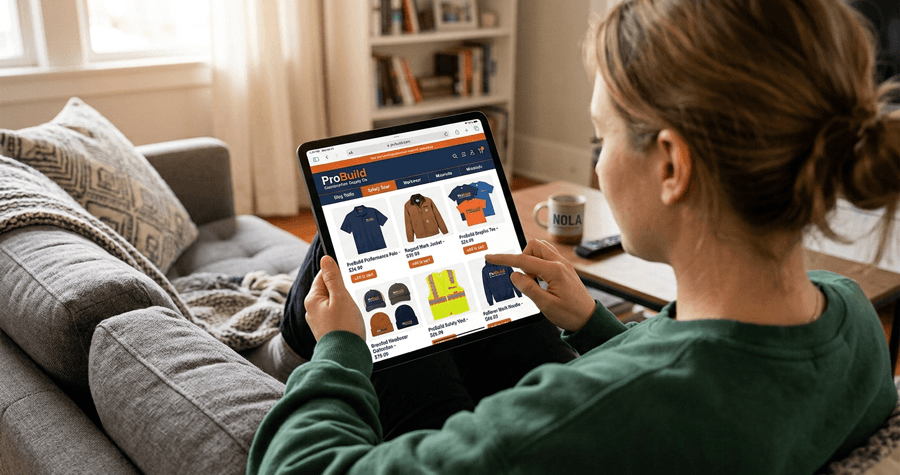
Why Construction Companies Need a Company Store

The Problem Usually Starts Small
A company with 10 employees can probably manage apparel with a spreadsheet and a few emails. Someone asks everyone for their shirt size, marketing orders 20 polos, and a box arrives at the office. It is not elegant, but it works.
Then the company grows. There are 50 employees instead of 10, some work remotely, others are assigned to projects hours away from headquarters, and maybe a second office opens. Field employees need different gear than office employees, leadership wants higher-end apparel for client-facing staff, and new hires arrive throughout the year.
Those are all good problems for a growing company to have, but now marketing has an Excel sheet containing everybody’s sizes, except three people never responded and somebody has lost 30 pounds since the last order, and a new hire starts next week. The process starts consuming time that nobody planned to spend on clothing.
A company store removes much of that friction because employees select their own items, choose their own sizes, provide the correct shipping information, and place their orders themselves from a catalog that marketing has already approved. It shifts marketers from processing individual orders to managing the overall system.
Employees Already Know How to Use an Online Store
One of the biggest advantages is also the simplest: nobody has to teach an employee how to order a jacket online.
Employees select the item, pick their size, choose any approved options, enter or confirm their shipping information, and complete the order. The experience is essentially the same as buying something from any other e-commerce site.
That eliminates one of the most annoying recurring jobs for marketing and administrative teams: collecting sizes. Instead of emailing 75 people asking for polo, jacket, vest, and T-shirt sizes and then trying to reconcile the responses, employees are responsible for selecting what actually fits them.
The same applies to delivery. Most companies I work with consolidate orders to their respective offices, while remote employees can have items shipped directly to them. Marketing no longer needs to receive six boxes at headquarters and spend an afternoon figuring out how to get one jacket to a superintendent working three states away.
More importantly, marketing’s purpose is to help the company grow. Moving repetitive, time-consuming, non-revenue-generating fulfillment tasks to a trusted outside partner gives marketers more time to focus on positioning, business development support, recruiting, content, campaigns, and the other work that actually drives the business forward.
Give Employees Freedom to Choose Without Giving Up Brand Control
A company store solves another common tension. Employees generally appreciate branded apparel more when they have some choice, while marketing and leadership still need to control how the company’s brand and image are represented in public.
A store gives you both.
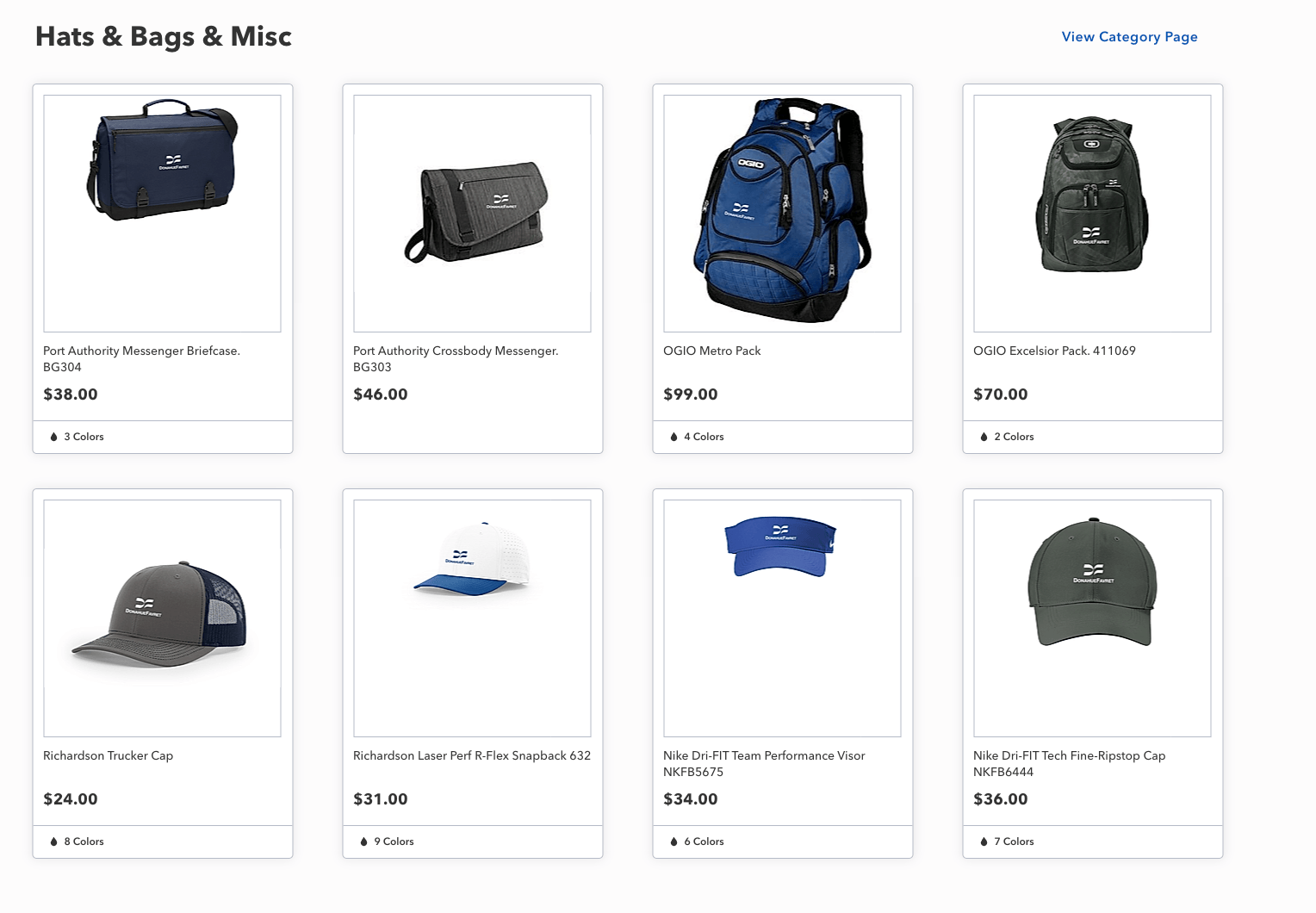
Many construction companies provide each employee with an annual apparel stipend or credit. Instead of giving everyone the exact same shirt, employees can choose from an approved collection of polos, button-downs, T-shirts, jackets, vests, hats, and other items.
 One employee may want a quarter-zip while another would rather have a jacket. Someone who always wears long sleeves can choose accordingly, while another employee may prefer polos. Let’s not forget female employees can pick out options that actually fit their bodies instead of being forced to wear the same polo shirt as everyone else. Employees can often purchase additional approved items for themselves or their families after using their company allowance.
This also works well for recognition and bonuses. Instead of giving everyone the same piece of swag, a company can award store credit and let the employee choose something they will actually use.
Marketing controls the catalog, products, and designs, while leadership determines the budget. That is a much better division of responsibility than asking the marketing coordinator to become everyone’s personal shopper.
A Store Protects Your Brand Identity
Construction companies accumulate old branded material surprisingly quickly. There is the current logo, the previous logo, the version somebody stretched horizontally, the old safety vest that uses the wrong shade of blue, the polo embroidered by a local vendor who recreated the mark instead of asking for the artwork, and the project sign using a logo that was retired four years ago.
It happens because physical brand assets are often decentralized. A superintendent needs something quickly and orders it locally. An office manager has a vendor they have used forever. A project manager finds an inexpensive website. Someone sends the wrong artwork because it is the first logo file they find.
A company store dramatically reduces that problem because employees are selecting from products and designs that have already been approved. Marketing can control the logo, colors, placement, product quality, decoration method, artwork, and available options before anything is ordered.
When the brand changes, marketing updates the store rather than chasing old artwork throughout the company. I have also seen contractors use apparel buy-back programs during a rebrand, where employees turn in old company apparel and receive credit toward new apparel. That helps remove obsolete logos from circulation much faster without making the transition feel punitive.
It Also Controls Your Vendors
Vendor sprawl is another hidden headache. One office uses a local embroiderer. Another orders promotional products online. Operations has a favorite sign company. HR orders new-hire items somewhere else, and somebody has an account with a national promotional-products website.
Individually, each decision may be reasonable. Collectively, they create inconsistent quality, inconsistent pricing, duplicate vendors, multiple invoices, and almost no control over the company’s physical brand.
A company store lets you consolidate much of that spending through a smaller number of trusted vendors. That does not mean one vendor has to manufacture everything, because a good store provider can manage the supplier relationships behind the scenes while employees experience one ordering system.
For a multi-office or multi-brand company, that single pane of glass becomes particularly valuable. Marketing can see what is available, employees know where to order, leadership knows where the money is going, accounting deals with fewer purchasing processes, and individual offices have less reason to create their own solutions.
A well-designed store can also collect variable information during checkout, such as office, department, project number, job cost code, or other accounting data. That makes cost allocation and invoicing considerably easier for accounts payable instead of requiring someone to decipher every order after the fact.
Apparel Is the Best Place to Start
I would not try to move every physical branded item into a store on day one. Start with the biggest pain point, which for many contractors is apparel because it creates the most sizing issues, employee requests, and administrative work.
Get that working first, then add other categories as the need becomes clear. Over the next year, that might include PPE, jobsite signage, promotional products, new-hire kits, awards, event materials, stationery, or temporary campaigns.
This approach is easier for employees too. They become accustomed to using the store for apparel before additional categories and workflows are introduced.
PPE Belongs in the System Too, but It May Need Its Own Rules
PPE is a natural extension, particularly for contractors with a large field workforce, but it operates differently from optional employee apparel. Required safety equipment is company-funded and may need different controls, approvals, and fulfillment rules.
Depending on the organization, PPE can live in a standalone store or in a protected section of the main store that employees access through an approved code or allowance. This keeps company-paid safety purchases separate from an employee’s apparel stipend while maintaining one familiar ordering experience.
The company can maintain approved branded hard hats, safety vests, gloves, field shirts, and other gear alongside non-branded safety items employees routinely need. This can be particularly helpful during onboarding because essential PPE and new-hire gear can be kept in inventory and ready when the employee starts.
A hybrid inventory model usually makes the most sense. Keep stock of the PPE and essential gear needed continually, place bulk apparel orders a few times per year for better pricing, and use print-on-demand where the added flexibility is worth a slightly higher unit cost.
The store remains the interface even though the purchasing rules and fulfillment methods behind different products may vary.
Jobsite Signage Is a Great Next Step
This is one of the applications construction companies often overlook. If every jobsite needs signage, why should every project team reinvent the ordering process?
A centralized signage store can standardize items such as:
 Fence mesh and banners
- Wayfinding
- Project identification
- Safety requirements
- Visitor check-in
- Surveillance notices
- Restricted-access areas
- Recruiting signage
- Project-team signs
- Community information
- Other frequently used site graphics
Using one trusted signage partner that can ship nationally means the sign installed in Texas can look like the one installed in Florida, Minnesota, or Louisiana. Marketing gets involved in developing and approving the design system once instead of recreating or correcting signs project by project.
The project team selects what it needs, enters the project-specific information, and has the signage delivered directly to the jobsite. The project pays for it, while marketing maintains control over the design and approved artwork.
When I CMO at REX Construction, REI Promos developed a store specifically around jobsite signage and it saved my marketing team 5-10 hours per project. It is a good reminder that a “company store” should not be thought of only as a place to buy polo shirts, it can solve a real construction operations problem.
Multi-Brand Companies Benefit Even More
The administrative case gets stronger when one organization owns multiple brands. I worked with a national ESOP with five different brands using a store structure to help manage apparel across the organization. Without a centralized system, imagine the potential complexity: five logos, different colors, multiple employee groups, separate budgets, numerous apparel choices, and employees spread around the country.
A company store gives marketing and leadership one place to manage the system while preserving the distinct identity of each brand. That becomes increasingly useful as construction companies grow through acquisitions.
Also, an acquirer does not necessarily want every acquired company to adopt the same name immediately. A store allows the parent organization to centralize purchasing and administration without forcing every business into the same visual identity.
One backend can support multiple brands without creating five separate administrative headaches.
Stores Are Useful for Temporary Campaigns Too
Not every store needs to live forever. A heavy civil contractor client developed a special USA 250 store around America’s 250th anniversary. A temporary collection gives employees access to campaign-specific apparel and merchandise without cluttering the permanent company catalog.
The same model could support company anniversaries, rebrands, ESOP celebrations, safety campaigns, major project milestones, recruiting campaigns, conferences, community initiatives, acquisitions, holiday programs, or employee recognition.
This gives marketing room to do something interesting without creating another manual ordering process. When the campaign ends, the collection can simply be removed.
The Same Model Works Beyond Contractors
Although contractors have particularly strong use cases, the concept works throughout A/E/C.
A friend who leads marketing for a large architecture firm uses the same type of system for stationery and other printed material. Approved business cards, letterhead, envelopes, presentation folders, notepads, and related items can all be standardized and ordered without marketing individually processing every request.
The underlying problem is the same whether someone is ordering a hard hat or a business card. You want the right item, with the right brand, going to the right person or location without creating unnecessary administrative work.
With the right store partner, much of that administrative burden moves away from marketing so marketers can spend more time marketing the business.
A Company Store Can Make Onboarding Easier
New hires expose how fragmented these systems can become.
HR tells marketing someone is starting. Marketing asks for their size. Someone checks whether there are enough shirts. Operations needs a hard hat. Business cards have to be ordered, and a jacket gets forgotten. The employee arrives, and half the materials are ready.
With a well-managed store and a small inventory of essential products, much of that can become standardized. New employees can receive their required company-paid PPE immediately and then use an apparel allowance to select approved items that fit their role, climate, and preferences.
For employees, the experience feels more professional. For marketing and HR, it removes another series of small manual tasks. Those tasks do not look expensive individually, but multiply them across every employee hired over several years and the administrative cost becomes substantial.
When Does a Company Store Make Sense?
You do not need to be a billion-dollar contractor.
I would start evaluating a company store when you have 25 or more employees, especially if you have multiple offices, remote employees, several brands, different needs for field and office employees, numerous vendors, frequent signage orders, or recurring new-hire fulfillment.
It is also worth considering when marketing is maintaining employee sizing spreadsheets, employees regularly request additional apparel, different offices are making independent branded purchases, or the company is preparing for a rebrand.
The trigger is not really employee count by itself. It is complexity. Once the system requires one person to remember who orders what, from whom, using which logo, delivered where, and charged to which budget, you have probably outgrown the spreadsheet.
Who Should Own the Store?
Marketing should own the brand side of the system. That means determining what products are appropriate, approving artwork and designs, establishing logo and decoration standards, and working with leadership to decide what should be offered.
Leadership should establish budgets and spending policies, while operations, safety, HR, and project teams provide input where their needs are involved. The key is that marketing governs the system without manually processing every transaction.
That is what makes the store valuable: marketing maintains control without becoming the fulfillment department.
A Vendor I Have Trusted for More Than 15 Years
 I have worked with REI Promos and Matt Lundy for more than 15 years, and they are the vendor I recommend when construction companies want to build this type of system.
I do not receive a referral fee or financial incentive for recommending them. I recommend them because I have seen them solve these problems repeatedly for companies in my client base and professional network.
Those solutions have included the REX Construction jobsite signage store, a special USA 250 store for a heavy civil contractor, apparel for a national ESOP managing five brands, PPE for a New Orleans general contractor, and stationery for a large architecture firm.
The applications are different, but the objective is consistent: make the purchase of branded materials, whatever they may be, easier without sacrificing control.
If your marketing team is still collecting shirt sizes in a spreadsheet, forwarding individual sign requests, tracking down logo files, and coordinating deliveries by email, I would talk with Matt Lundy at REI Promos about what a company store could look like for your organization.
The goal is not another online store to manage. It is a system that keeps marketing in control of the brand while allowing somebody else to handle much of the administrative burden.

Most Construction Buyers Aren’t Ready Yet
Most companies want marketing to generate more leads, more meetings, and more prospects responding to business development. There is one problem with that expectation: most of your potential buyers do not need what you sell right now.
LinkedIn’s B2B Institute calls this the 95–5 Rule. Its research suggests that in many B2B categories, roughly 5% of potential buyers are in-market at a given time while the other 95% are out-market and may not buy for months or even years. The exact percentage will vary by category and buying cycle, but the larger point matters: most of the people you want to reach are not actively shopping today.
That has major implications for construction marketing. It helps explain why cold outreach so often falls on deaf ears, why an obsession with immediate lead generation can create unrealistic expectations, and why consistent brand building and thought leadership matter even when they cannot be tied to a new project next Tuesday.
Marketing cannot control when someone needs you. It can influence whether they think of you when they do.
Cold Outreach Has a Timing Problem
Cold outreach is easy to measure. You send 1,000 emails, make 100 calls, book a certain number of meetings, and calculate the conversion rate. That makes it attractive to companies looking for quick marketing ROI.
The limitation is timing.
You might identify exactly the right company, find the right decision-maker, and send a thoughtful message about a problem you genuinely solve. If that company has no reason to address the problem today, your message still may go unanswered.
That does not necessarily mean the prospect is bad, your offer is bad, or the outreach was poorly executed. They may simply not be in-market yet.
Consider how construction companies themselves purchase professional services. A contractor with a capable marketing director is unlikely to wake up tomorrow and decide it needs a fractional CMO. A company satisfied with its current accounting system is unlikely to schedule software demos because a salesperson sent a clever email. An owner happy with its current general contractor is unlikely to replace that firm because another GC sent a capabilities brochure.
There needs to be a reason for something to change. That is the buying trigger.
Buyers Move Into the Market When Something Changes
LinkedIn’s research makes an important distinction: advertising generally does not push an out-market buyer into the market. Buyers enter when they have a need for a new product or service, while marketing works over the longer term by building and refreshing memories so the brand is easier to recall when that buying situation eventually occurs.
In construction, triggers are everywhere.
For a contractor considering outside marketing leadership, the trigger might be stalled growth, a push for more negotiated work, an acquisition, geographic expansion, a leadership transition, the departure of a marketing leader, aggressive growth goals, a stronger competitor, a recruiting constraint, or a company that has simply outgrown founder-led business development.
Before that trigger, the company might be a perfect fit for A/E/C CMOs and still have no reason to call us.
The same thing happens to your potential clients. An industrial owner may not need a contractor until a capital project is approved, a plant expansion is announced, new equipment is purchased, or an upcoming shutdown creates a deadline. A developer may not need a GC until financing closes, a site is acquired, or a tenant commits. A healthcare system may not need a renovation contractor until a department expands, regulations change, a new piece of medical equipment is purchased, or an existing facility can no longer support patient demand.
The trigger changes the buyer from someone who could theoretically purchase your service into someone who has a reason to act.
This Is Why Buying Triggers Matter More Than Personas Alone
Construction marketing has traditionally spent a lot of time defining audiences: owners, developers, facility managers, architects, municipalities, manufacturers, healthcare executives, and other decision-makers.
Those categories matter, but knowing who buys is only part of the strategy. You also need to understand what is happening when they become buyers.
A CEO may fit your ideal client profile for three years without having a reason to change anything. Then the company acquires a competitor and suddenly needs to combine two brands, two marketing teams, two websites, two cultures, and two go-to-market strategies.
Same person. Same company. Completely different level of urgency.
That is why I increasingly think about positioning through buying triggers rather than demographics alone. The useful marketing question is not simply, “Who is our buyer?” It is, “What happens inside their business that makes this problem important enough to address now?”
You Need to Be Known Before the Trigger Happens
The moment a buyer enters the market is not necessarily the moment they begin discovering every available option. In many cases, they begin with companies they already know.
LinkedIn’s B2B Institute describes this as mental availability, or the probability that a brand comes to mind in a future buying situation. Its research argues that brands should build associations with relevant buying situations before the customer enters the market because familiar brands are more likely to make the shortlist.
Construction has always worked this way.
An owner says, “We should talk to ABC. They do a lot of this type of work.” An executive says, “I keep seeing XYZ everywhere. Let’s include them.” A principal says, “Call Sarah. She helped another company through this.” A project manager says, “I heard their presentation at AGC last year. They know this market.”
Those moments can look spontaneous, but the awareness behind them was built over time. The buyer saw the brand, heard the name, read the article, met the executive, saw the project, watched the presentation, received the newsletter, or saw someone else share the research.
Then the trigger happened.
This is why the return on consistent marketing can be difficult to measure through last-touch attribution. The final website visit might happen on Monday, but the reason that company was on the shortlist could have been built over the previous two years.
Thought Leadership Gives Buyers Something Useful to Remember
Visibility by itself is not enough.
If buyers repeatedly see your logo but cannot associate your company with anything meaningful, you may have awareness without relevance. Thought leadership helps create that association.
A contractor that wants to become known for occupied healthcare renovations should consistently demonstrate expertise around operating in occupied environments, infection control, phasing, communication, shutdown planning, patient experience, and other problems healthcare owners encounter.
An industrial contractor pursuing shutdown work should demonstrate expertise around planning, schedule risk, labor, safety, logistics, and minimizing lost production. A specialty contractor trying to move upstream should educate buyers about the decisions that create problems before the specialty contractor normally gets involved.
Over time, buyers begin associating the company with the buying situations where that expertise matters. This is much more useful than publishing random content simply to remain active on LinkedIn.
Consistent Messaging Matters for the Same Reason
Construction companies sometimes become bored with their own messaging long before the market has absorbed it.
Marketing launches a new positioning statement in January. By March, leadership is asking what comes next.
Usually, the answer should be more of the same idea.
Your prospects are not studying your marketing plan. They do not attend your internal meetings, review every social post, read every email, or memorize your website. Most barely notice any individual piece of marketing.
Consistency is how individual impressions eventually become memory.
If you want to be known as the contractor for complicated occupied renovations, you should expect to talk about complicated occupied renovations repeatedly. If you want to own a niche in mission-critical construction, your expertise in that space should appear throughout your projects, thought leadership, presentations, social media, website, business development materials, and subject matter experts.
The message should evolve, but the position should compound. Random marketing makes the audience start over every time, while consistent marketing gives each new touchpoint something to build on.
Marketing to the 95% Is Not About Asking Them to Buy
This is where many companies get uncomfortable with long-term brand marketing. If someone is not buying, why spend time marketing to them?
Because they will not always be out-market.
The purpose of reaching future buyers is not to repeatedly ask for a meeting they do not need. It is to become familiar and useful before they need one.
That changes what good marketing looks like.
Instead of every piece ending with “Schedule a consultation,” some content should simply help. Explain a problem. Share a perspective. Teach the market something. Publish research. Show how your team thinks. Explain a project lesson. Challenge a common assumption.
LinkedIn’s 95–5 research argues that brand marketing primarily works on future buyers by creating memories that can be activated when they enter the market later. That is fundamentally different from lead generation, which is designed to capture demand that already exists.
Construction companies need both.
The 5% Still Matters
None of this means abandoning lead generation.
If someone is actively looking for a contractor, architect, engineer, software platform, or marketing partner today, you absolutely want to capture that demand. Search, strong service pages, calls to action, retargeting, business development, CRM follow-up, and good proposals all matter.
The point is that the 5% cannot be your entire growth strategy.
If every competitor is fighting over the small group of buyers who are already actively searching, the competition gets intense quickly. Costs rise, inboxes fill up, and the buyer has multiple companies asking for attention at the same moment.
Building awareness with the future market gives you an opportunity to arrive earlier.
Stop Treating Every Prospect Like a Lead
One of the side effects of modern marketing technology is that we can track almost everything, so we start treating everyone as though they should convert.
They downloaded something. They visited a page. They watched a video. They clicked an email. Sales gets the notification and starts pursuing them.
Sometimes that makes sense. Sometimes the person was simply interested.
A construction CEO can read an article about succession planning without planning to retire this year. A developer can research construction costs without having an approved project. A marketing director can read about fractional CMOs without intending to hire one.
Those interactions still have value because the individual learned something, encountered the brand, and perhaps associated that brand with useful expertise. The mistake is assuming the only valuable next step is an immediate sales conversation.
Measure the Long Game Differently
If you judge every marketing activity by how many meetings it creates this month, marketing will naturally drift toward chasing the 5%. The problem is that short-term metrics can understate the value being created with future buyers.
That does not mean brand marketing should escape measurement. It means we need the right measures.
Track branded search, direct traffic, newsletter growth, returning visitors, share of voice, engagement from ideal accounts, speaking invitations, referral sources, inbound opportunity quality, assisted conversions, and whether prospects arrive already understanding what makes the company different.
Ask new clients how long they had known about the company before reaching out. Ask what they had seen and what made them include you.
You may discover the first meaningful touch happened much earlier than the lead-generation dashboard suggests.
The Goal Is to Be Easy to Remember When the Market Moves
Construction leaders often want marketing to create urgency. Sometimes it can, but marketing cannot manufacture a plant expansion that has not been funded, create a leadership transition that is not happening, force a contractor into a new geography, or make an owner suddenly need a new building.
Those triggers belong to the buyer.
What marketing can do is make sure your company has earned a place in the buyer’s memory before the situation changes.
Know the buyers you want. Understand the situations that move them into the market. Build messaging around those situations. Share useful expertise consistently. Develop a distinctive brand people can recognize, and stay visible without constantly asking for something.
Then, when the trigger occurs, you are not another stranger sending a cold email at exactly the same time as everyone else. You are already one of the companies they know.
That is the long game.

Your Employees Are Brand Ambassadors, for Better or Worse
A friend recently texted me after reading one of the stories in my book, Choose Your Own Construction Marketing Journey. She wanted to know if it was really true. Unfortunately, it was.
A business developer I knew had spent more than three years pursuing what would have been the largest project in his company’s history, worth more than $100 million. His company was qualified, competitive, and, from what he later learned, the team managing the selection process was prepared to recommend them.
Then, on the day the client was making its final decision, one of the contractor’s employees got into a traffic altercation. The employee was driving a branded company truck, wearing company apparel, and gave another driver the “one-finger salute”.
That other driver happened to be the CEO of the prospective client.
The CEO walked into the selection meeting and said he would never hire that contractor. The client’s team, which had planned to recommend them, reportedly hid the contractor’s bid rather than even put it forward for consideration.
More than three years of business development disappeared because of a few seconds in traffic. The employee was disciplined, and the incident prompted company-wide education about how employee behavior affects the organization, but the $100 million-plus opportunity was gone.
Marketing did not lose that project. Business development did not lose it. Estimating did not lose it. An employee representing the company in public did.
That is why every employee is a brand ambassador, whether they volunteered for the role or not.
Your Brand Does Not Belong Only to Marketing
Construction companies tend to think about brand through things marketing can control: the logo, website, proposals, presentations, signage, social media, project photography, and advertising.
Those things matter, but the market experiences your company through people too. A superintendent talks with an owner. A project manager attends an OAC meeting. A driver pulls into a gas station wearing a company shirt. An estimator attends an association event. An executive comments on LinkedIn. A laborer answers a neighbor’s question outside a jobsite.
Every one of those interactions creates an impression.
The individual involved may think they are simply being themselves, while the person watching may see the company logo on their chest or truck and make a much broader judgment. That is especially true in construction because our brands are unusually visible in the physical world.
Employees wear branded PPE and apparel, drive branded vehicles, work on highly visible jobsites, and regularly interact with clients, trade partners, neighbors, and the public. You do not get to turn the brand off when someone leaves the marketing department.
Branded Vehicles Turn Driving Into a Public Brand Experience
Company vehicles may be one of the clearest examples. When someone drives a truck with your logo across the door, they are driving a billboard through the community.
If they are courteous, professional, and responsible, nobody may consciously think, “What excellent brand behavior,” and that is fine. Good behavior simply reinforces the expectation that a professional company employs professional people.
Bad behavior is much more noticeable. Aggressive driving, cutting people off, excessive speeding, blocking entrances, road rage, littering, or parking like nobody else matters creates a very different impression. The $100 million-plus story is an extreme example, but the mechanism is not unusual because you rarely know who is in the car beside you.
It could be a prospective client, the architect on an upcoming project, a job candidate considering your company, a supplier, or your client’s board member. It could also simply be someone who now has a reason to tell several other people that your employees are jerks.
The employee may experience the incident as a private moment of frustration. The branded truck makes it public.
The Logo on Your Shirt Changes the Context
Apparel works the same way. Construction companies invest heavily in branded shirts, jackets, hats, safety vests, and other gear because they want employees to look like a team and represent the company well. That visibility comes with a tradeoff.
If you are wearing the logo, people can associate your behavior with the organization. How you treat the server at lunch matters. How you talk to someone at a convenience store matters. How you behave at an association event matters. How loudly a group of employees acts at a restaurant after work can matter.
Nobody expects employees to behave like corporate spokespeople every hour of the day. They are people, and companies cannot control every moment of an employee’s life. But wearing the brand creates an obvious association.
Even without the logo, that association can still exist. In close-knit construction markets, people often know where other people work, and your reputation follows you beyond your uniform because clients, competitors, architects, engineers, and trade partners often move within the same relatively small professional network.
Your behavior becomes part of how they experience your employer.
The Positive Side Is Much More Powerful
This should not become a paranoid discussion about all the ways employees can embarrass the company. The upside is much bigger.
Good employees strengthen a construction brand every day without ever thinking of themselves as marketers. They volunteer in the community, participate in industry associations, answer questions patiently, treat trade partners with respect, help a young person understand what a career in construction could look like, stay positive when a project becomes difficult, and make clients feel heard.
Those interactions are often more credible than formal marketing because people are experiencing the company rather than hearing the company describe itself.
Marketing can claim that your company has great people. A client interacting with a great project manager proves it.
A careers page can say the company cares about the community. Twenty employees showing up to volunteer proves it.
A proposal can describe a collaborative culture. The way your superintendent treats a trade partner when something goes wrong proves it.
Brand is strongest when what marketing says and what people experience are the same thing.
Your Jobsite Is Full of Brand Ambassadors
This connects directly to the way companies manage their jobsites.
The jobsite is probably the most visible expression of a construction brand, and employees are a major part of that experience. Owners visit for OAC meetings and progress walks. Architects and engineers come through. Neighbors see the crews every day. Employees from other contractors see how your people operate, and clients bring executives and customers through to show off the project.
Those visitors notice behavior.
They notice whether people appear organized, whether someone offers to help when they look lost, whether the team seems proud of the project, and whether employees communicate professionally. They also notice bad parking, trash, disrespect toward neighboring businesses, inappropriate language, and people acting as though the public around the site is an inconvenience.
Marketing may never hear about most of those moments, but they still affect the brand.
Your Employees Are Also Recruiting
The same principle applies to your employer brand. Candidates do not only evaluate what recruiters tell them. They watch your employees.
Someone considering a move may know one of your project managers, work alongside your superintendent on a joint venture, see your people at an industry event, or have friends who interact with your teams. They pay attention to whether those employees seem engaged, professional, burned out, proud, miserable, ambitious, helpful, or cynical.
That information carries enormous weight because it feels less filtered than the Careers page. A recruiter can say the company has a great culture. A candidate who repeatedly meets employees with positive attitudes has evidence.
The reverse is true too. A construction company can spend heavily on an employer-brand campaign and still struggle if its employees consistently tell people not to work there.
This is one reason culture and brand cannot be separated neatly. What employees experience internally eventually becomes visible externally.
Brand Expectations Should Start Before Someone Is Hired
I would not turn this into a long list of etiquette rules. Most adults know they should not give someone the finger while driving a company truck. The larger issue is whether employees understand that their actions can affect the business in ways they may never see. That conversation can begin during the interview process.
If professionalism, respect, community involvement, teamwork, or accountability are truly part of the company culture, talk about those expectations with candidates. Ask questions that help you understand how they respond to difficult people, stressful situations, mistakes, or conflict.
Then reinforce those expectations during onboarding. Do not simply hand a new employee a branded shirt and explain the dress code. Help them understand what the company stands for and what it means to represent it.
The goal is not to make employees afraid to be themselves. It is to create awareness that the reputation everyone depends on is built collectively.
Core Values Matter Most When the SOP Does Not Exist
This is one reason I care about meaningful core values. Policies and procedures can address many recurring situations, but no company can write an SOP for every decision an employee will ever face. There will always be ambiguous moments.
A neighbor is angry about construction noise. A client makes an unreasonable request. Someone cuts you off in traffic. A subcontractor makes a mistake. A visitor shows up at the jobsite confused. An employee sees something that technically belongs to another person’s responsibility.
What guides behavior when there is no policy telling someone exactly what to do? That is where real core values should matter.
If values are only words painted on an office wall, they are not very useful. When they are genuinely understood, they give employees principles for making decisions when the correct response is not obvious.
Respect. Accountability. Service. Safety. Humility. Teamwork.
Whatever values a company chooses, employees need to understand what they mean behaviorally. If “respect” is a core value, it should apply to the client, the apprentice, the neighboring business owner, and the stranger in traffic.
Leaders Carry Even More Brand Weight
This conversation cannot focus only on field employees. Leaders are even more visible.
A CEO’s behavior at an industry event carries more weight than most employees’ behavior because people know who the CEO is. The same applies to presidents, executives, business developers, and other highly visible representatives.
Their LinkedIn comments matter. How they treat association staff matters. How they interact with people they do not perceive as important matters. How they handle conflict matters.
Their reputation can become inseparable from the company’s reputation, particularly in founder-led businesses.
Leadership therefore has to model the behavior it expects from everyone else. It is difficult to tell employees they are brand ambassadors if executives behave as though the rules do not apply to them.
Social Media Has Made the Line Even Blurrier
Employees also represent companies in digital spaces, although the connection can be less obvious than a wrapped truck. LinkedIn profiles usually identify employers directly. Other social platforms may not, but people who know the employee know where they work.
That does not mean employers should police every personal opinion or try to control employees’ private lives. It does mean employees should understand that the wall between personal and professional reputation is thinner than it used to be.
Screenshots travel. Comments are searchable. Videos can spread far outside the original audience.
The safest principle is not “never say anything.” It is simply to understand that public behavior can have professional consequences, particularly when the connection to an employer is obvious.
Give Employees Opportunities to Strengthen the Brand
If employees are already brand ambassadors, companies should make it easier for them to be good ones.
Encourage community involvement. Support participation in industry associations. Give subject matter experts opportunities to speak and share what they know. Recognize employees who represent the organization well. Provide good apparel employees are proud to wear, and create jobsites they are proud to show people.
Help younger leaders build visibility in the industry, and explain the company’s values in practical terms rather than assuming everyone interprets them the same way.
None of this requires turning employees into influencers or asking them to repost every company announcement. In fact, forced employee advocacy often feels exactly like what it is: forced.
The strongest advocacy happens when employees genuinely like the company, understand what it stands for, and are proud to be associated with it.
One Employee Can Reinforce Years of Brand Building or Undermine It
The employee who gave the prospective client’s CEO the finger probably had no idea what was at stake.
They almost certainly did not know the other driver was about to participate in a decision involving a project worth more than $100 million. They did not know their business development team had spent three years building that opportunity. That is exactly the point.
Employees rarely know who is watching, and the consequences are usually far less dramatic than losing the largest project in company history. But smaller interactions accumulate too.
Every positive interaction strengthens trust. Every professional jobsite visit reinforces the company’s reputation. Every employee who participates constructively in the industry expands the company’s relationships, and every person who treats the community well adds another small piece of goodwill.
The opposite accumulates too. Your employees are already brand ambassadors, along with your executives, project managers, superintendents, drivers, estimators, and business developers. For better or worse, the market experiences your brand through all of them.
The goal is not to control every interaction. It is to hire people who fit your values, make those values meaningful, help employees understand the impact they have, and create a culture they are proud to represent.
Because sometimes the most important impression your company makes has nothing to do with marketing. It may happen at a jobsite, at an association event, in a restaurant, or in the lane next to your future client’s CEO.
Build a Content Ecosystem, Not a Content Calendar
Most construction companies do not have a shortage of things to talk about. They have a system problem.
Marketing publishes a project announcement on Monday, a safety photo on Wednesday, and realizes on Friday that nobody has posted to LinkedIn recently. Someone writes a blog article because SEO is on the annual plan. An executive speaks at a conference, the presentation is uploaded to a folder, and almost nobody outside the room ever sees it again.
A month later, marketing starts over and asks the same question: What should we post next?
That approach creates activity, but it rarely builds authority.
A better approach is to build a content ecosystem, where the company’s strongest ideas, expertise, projects, and perspectives move through multiple channels and formats while reinforcing the same positioning.
The goal is not to publish more content. It is to make your best content work harder.
Most Contractors Are Sitting on More Content Than They Realize
Construction companies are full of subject matter expertise.
Project executives know why certain jobs go sideways. Superintendents solve problems every day that clients never see. Estimators recognize the decisions that create budget problems before construction begins. Safety professionals understand risks that rarely appear in a marketing brief, while recruiters know why good people accept one offer and reject another.
Executives have decades of perspective on clients, markets, labor, risk, growth, and leadership.
The problem is that most of this knowledge stays inside people’s heads, email inboxes, meetings, jobsite conversations, and project folders.
Marketing’s job should not be to manufacture expertise for these people. It should capture what they know, find the ideas that matter to clients and employees, and make those ideas easier to understand and share.
That distinction matters even more as generative AI makes generic content nearly free to produce. Anyone can create another article called “Five Tips for a Successful Construction Project.” Very few companies can publish a project executive’s firsthand explanation of the three preconstruction decisions that repeatedly cause occupied renovation schedules to fail.
One is information. The other is expertise.
Start With an Idea, Not a Platform
A content calendar often starts with empty boxes.
We need two LinkedIn posts this week. We need a blog on Thursday. We need something for Facebook. We have not sent an email this month.
That approach forces the team to constantly generate new material to satisfy the schedule.
A content ecosystem begins somewhere else.
What do we want to be known for? What problems do our clients care about? What buying situations are important to our growth strategy? What does our team know about those problems that would genuinely help someone?
Those questions produce the core idea. Only then should marketing decide how that idea should appear on different channels.
For example, imagine a project executive spends 30 minutes with marketing discussing this question:
What causes the most avoidable problems during occupied renovations?
That conversation can produce far more than one article. The important thing is not producing ten pieces of content from one interview for the sake of volume. It is identifying the useful ideas inside that conversation and presenting each one in the format where it works best.
One Strong Idea Can Become an Entire Content Series
The full conversation with that project executive might become a long-form website article explaining the major risks in occupied renovations.
A particularly strong opinion could become a LinkedIn post under the executive’s name. Three recurring mistakes could become a carousel. A real project example could become a case study. A short explanation could become a video, while common owner questions could become FAQs on the website.
A deeper version could become a webinar, association presentation, or client lunch-and-learn. The primary lessons could become a section in an email newsletter, while a business developer could send the article directly to a prospect planning an occupied renovation.
Months later, the company might combine this material with several related pieces and create a larger guide to planning construction in occupied facilities.
The company did not need ten unrelated ideas. It needed one valuable subject and a system for extending it.
That is the foundation of a content ecosystem.
Repurposing Does Not Mean Copying and Pasting
Repurposing gets a bad reputation because many companies do it poorly.
They publish an article on the website, copy the opening paragraph into LinkedIn, paste the same copy into Facebook, send the article in an email, and call it a multichannel campaign.
That is distribution.
Good repurposing recognizes that people behave differently on different platforms. The core expertise can remain consistent while the format, depth, opening, visuals, and call to action change.
Your Website Is the Permanent Library
The website should usually hold the deepest version of an important idea.
This is where the company can explain the issue thoroughly, answer related questions, incorporate project examples, show proof, introduce subject matter experts, and connect the topic to relevant services.
Long-form articles also create something permanent. A good social post might disappear from most people’s feeds within days, while a strong website resource can continue to be found through search, shared by business development, referenced in proposals, linked from future content, and discovered by AI search tools long after it was published.
Your website should gradually become a useful library of what your company knows.
LinkedIn Needs a Point of View
LinkedIn is not your blog.
Instead of copying the article introduction, identify an observation that can stand on its own.
The project executive might say, “The worst time to discover your renovation phasing plan does not work is after your client’s employees have already moved into temporary space.”
That idea can become a useful post without requiring the reader to leave LinkedIn. Another post might share a project lesson, a third might challenge a common assumption, and a fourth might use a photograph to demonstrate the logistical issue.
Each one reinforces the same expertise without simply repeating the article.
Instagram and Facebook Need More Visual Translation
Some ideas that work as detailed articles need to become simpler and more visual for Instagram or Facebook.
Three renovation mistakes might become a carousel. A project lesson could become before-and-after photography with a concise explanation. A superintendent might record a 45-second video explaining something customers frequently misunderstand.
A complex process could become a simple diagram. The message remains connected to the larger content theme, but the execution fits how people consume information on that platform.
Email Creates Continuity
A newsletter should not simply list everything the company published that month.
It should help the reader make sense of the best material. Explain why a topic matters now, share the most useful insight, connect it to another resource, and give the reader a reason to continue exploring if the issue applies to them.
Email is especially useful because it creates continuity between individual pieces of content. Someone may not need the information today, but six months later, when the relevant buying trigger occurs, they may remember the company that has been consistently helping them understand the issue.
Video Lets Buyers Experience the Expert
Some expertise becomes more credible when buyers can hear the person explaining it.
That does not require a studio or highly produced corporate video. A project executive who can clearly answer a real owner question on camera demonstrates expertise differently than a polished article does.
Video gives prospective clients a sense of how someone communicates, thinks, and approaches problems. Longer conversations can also create multiple shorter clips, but the clips should be selected because each contains a useful idea rather than because marketing needs six reels this month.
Presentations and Webinars Should Keep Working After the Event
Construction companies put significant effort into presentations.
An executive develops an AGC session. A technical leader prepares a webinar. A project team presents lessons learned. A CEO spends weeks developing a keynote.
Then the event ends and the content largely disappears.
That is wasted intellectual capital.
A strong presentation can become articles, videos, social posts, graphics, newsletter content, follow-up resources, FAQs, and future presentations. Questions from the audience can reveal additional topics buyers care about.
The event should be one expression of the idea, not the end of it.
Build the Ecosystem Around Content Pillars
An ecosystem still needs boundaries.
Without them, repurposing can simply create more random content.
Start with a small number of subjects your company needs to be known for. These content pillars should come from the business strategy, positioning, expertise, and growth priorities rather than whatever topics happen to be popular online.
A commercial contractor might use pillars such as:
- Client challenges and buying triggers
- Technical expertise and project execution
- People, culture, and career development
- Market perspective and company point of view
A specialty contractor might organize content around specific applications, common project risks, preconstruction decisions, field expertise, and workforce development.
The exact pillars matter less than the discipline behind them. If a topic does not help the company reinforce a useful area of expertise, position, relationship, or business objective, it probably does not deserve much marketing energy.
Marketing Teams Are Evolving Around the Content Ecosystem
Building this kind of system is also changing the people construction companies need inside their marketing departments.
Over the past few years, one of the roles I have recommended most often is some version of a content curator or content coordinator.
That title can mean different things depending on the size of the company, but the function is increasingly important. This person is not expected to be the technical expert on preconstruction, safety, roofing, healthcare construction, industrial shutdowns, or whatever markets the company serves.
Their job is to find the expertise that already exists.
They identify the people worth interviewing, listen for useful ideas in meetings, watch for strong project stories, capture frequently asked questions, coordinate with subject matter experts, organize photos and video, maintain the content pipeline, and make sure valuable knowledge does not disappear after a presentation or project meeting.
They also help connect the dots.
A content curator should be able to recognize that something a project executive said during an interview could become an article, three social posts, a short video, a newsletter section, and a discussion point for an upcoming webinar. They should know that a great project photograph becomes more valuable when it is accompanied by the lesson behind the work, not simply the square footage and completion date.
This is fundamentally different from hiring someone whose primary responsibility is to “post on social media.” The content curator coordinates expertise.
The Curator Is Not the SME
This distinction deserves to be explicit because it is where many content programs go wrong.
A 25-year-old content coordinator should not be expected to invent a veteran superintendent’s perspective on jobsite logistics. They should know how to get that perspective out of the superintendent.
The curator needs curiosity, interviewing ability, organization, enough understanding of the business to recognize a useful idea, and the communication skills to translate technical expertise without flattening it into generic marketing language.
The subject matter expert still owns the substance. That might be a project executive, estimator, engineer, superintendent, safety leader, recruiter, CEO, or client-facing specialist.
The curator creates the system around them.
This model is particularly effective in construction because the people with the deepest expertise are usually the people with the least time to create content themselves. Asking them to write a 1,500-word blog post is often unrealistic, while asking them thoughtful questions for 30 minutes can be much more productive.
Marketing can take it from there.
AI Makes the Curator More Powerful, Not Less Necessary
AI is accelerating this shift.
A good content coordinator can now take a recorded SME conversation, generate a transcript, identify themes, create an initial outline, organize supporting material, draft variations, and reformat approved content far faster than was possible a few years ago.
That does not eliminate the curator. It increases their leverage.
Someone still needs to recognize which SME is worth interviewing, ask the questions that uncover useful experience, distinguish a generic answer from an interesting one, challenge unclear statements, verify claims, protect the company’s voice, understand the audience, and decide what deserves to be published.
AI can help transform expertise. It cannot be allowed to manufacture expertise the company does not actually have.
That is why I expect content curation and coordination to become an increasingly important marketing capability. The companies that win will not necessarily employ the most writers; they will be better at capturing and distributing what their people genuinely know.
Connect the Ecosystem to Buying Triggers
Content becomes much more valuable when it reflects the reasons buyers enter the market.
Imagine a contractor wants to grow its manufacturing practice.
The marketing team could publish generic posts about manufacturing construction, or it could study what happens before a manufacturer begins looking for construction help.
A production line needs to be added. Capacity is constrained. A plant is being expanded. Equipment has been purchased. A company is reshoring production. An acquisition creates a facility need. A shutdown is scheduled. A capital plan receives approval.
Those situations should shape the content.
Instead of another “Why Choose Us for Manufacturing Construction” article, the contractor could publish guidance on planning a production-line expansion without disrupting operations. An executive could discuss the five questions manufacturers should answer before purchasing equipment that requires facility modifications, while a project team could explain how early contractor involvement affected the schedule of a recent plant expansion.
A webinar could address shutdown planning, and business development could share those materials with manufacturers before they have active projects.
Now the content ecosystem is building an association between the contractor and the situations that eventually create work.
Repetition Is Part of the Strategy
One reason companies publish random content is that marketers and executives become bored with their own themes.
They assume the audience must be bored too.
Usually, the audience barely saw the first post.
People are busy. Algorithms control what appears in their feeds. Emails go unread. Prospects are not studying your content strategy or noticing that the project executive discussed phasing six weeks ago.
Strong brands repeat important ideas.
If your company wants to become known for prefabrication, occupied healthcare construction, complex industrial work, higher education, preconstruction, safety innovation, or developing exceptional field leaders, those subjects should appear repeatedly.
The stories and formats should change, while the association should strengthen.
There is a difference between saying exactly the same thing every week and consistently reinforcing what you want to be known for. Random content avoids repetition; effective positioning requires it.
A Content Ecosystem Makes Thought Leadership More Sustainable
One of the biggest barriers to thought leadership in construction is subject matter expert time.
Your project executives have projects to run. Your superintendent is not waiting for marketing to schedule a content interview. Your estimator has bids due, and your CEO has a company to lead.
A good content system respects that reality.
Marketing should capture expertise efficiently, then do the work of multiplying its value. A focused 45-minute SME interview might support several weeks of content. One quarterly webinar could support an entire campaign, while a podcast conversation might create an article, several clips, executive social content, a newsletter feature, and new ideas for future interviews.
A piece of original research can fuel content for months.
The SME should provide the experience, expertise, examples, opinions, and judgment. Marketing should shape the material, organize it, challenge it when necessary, and determine how to make it useful for the audience.
The content curator or coordinator is often the person who keeps that entire process moving.
Not Every Piece Needs to Be Completely New
Marketers sometimes feel guilty repurposing material because they think every post should deliver a new idea.
That standard is unnecessary and inefficient.
A strong article might contain six ideas worth exploring separately. Research can produce dozens of useful observations, while a project can reveal several different lessons depending on whether the audience is an owner, architect, candidate, estimator, or operations professional.
An executive’s perspective can evolve over time.
Repurposing also allows the company to meet different people where they are. Someone who will never read a 2,000-word article might watch a one-minute video. Someone who ignores the video might save a carousel, while another person may encounter the idea during a webinar six months later.
The value is not how many unique thoughts marketing produces each week. The value is how effectively the company’s best expertise reaches and stays with the right people.
Build Paths Between Content
An ecosystem also means content connects.
A LinkedIn post can introduce an issue and point to a deeper article. The article can link to a related project, while the project can feature the people who solved the problem. Those subject matter experts can have other articles or videos.
A newsletter can bring the reader back to another part of the topic later. A webinar can take the discussion deeper. Business development can use the best resources during a pursuit.
Over time, someone interested in one subject can move naturally through a body of expertise instead of encountering an isolated blog post and leaving.
The website stops functioning like a brochure with a blog attached. It becomes a knowledge base for the problems your company is best equipped to solve.
The Return Compounds
This is where an ecosystem becomes more valuable than a content calendar.
Random content is consumed and replaced. An ecosystem accumulates.
After a year, the company does not simply have 50 articles and 150 social posts. It has a searchable body of expertise, answers to buyer questions, firsthand perspectives from employees, project proof, resources business development can use, content that supports recruiting, material executives can present, and stronger associations between the company and the problems it wants to own.
That body of work also improves the economics of future content creation.
Marketing does not start with a blank page each Monday. New ideas connect to existing ones. Old material can be updated. Research can be revisited, and an SME interview can expand an established pillar rather than creating a completely new direction.
The ecosystem gets deeper as it grows.
Stop Asking What You Should Post This Week
A content calendar is still useful.
Someone needs to know what is publishing, where it is going, who owns it, and when it needs to be completed. The problem is confusing the calendar with the strategy.
Instead of beginning with empty publishing slots, begin with better questions.
What do we want this company to be known for? What problems do our best clients face? What events cause those problems to become urgent? What expertise does our team have that the market would find useful?
What evidence can we provide? Which subject matter experts have earned a point of view? What major ideas are worth reinforcing for the next year, not merely the next week?
Then make sure somebody owns the system that captures those answers.
For a growing construction marketing department, that person may increasingly be a content curator or coordinator rather than another traditional marketing generalist.
Capture the ideas. Build substantial anchor content when the subject deserves it. Break the strongest ideas into useful pieces. Adapt them for each platform instead of copying and pasting, connect those pieces to one another, and keep reinforcing the areas of expertise your company wants the market to remember.
That is how you stop feeding a content calendar and start building an authority engine.